Was Christopher Columbus really the first European to discover America? Since the discovery of a Viking settlement at L’Anse aux Meadows in eastern Canada in the 1960s, historians have begun to reevaluate the primacy of Columbus. Perhaps others arrived in America even earlier.
One candidate is Saint Brendan, a 6th-century Irish monk who exiled himself to the edge of the known world in order to follow a divine path. Irish oral tradition celebrates Brendan of Clonfert (also known as Brendan the Navigator) as a hero. It suggests he journeyed thousands of kilometers across the Atlantic to the New World, 500 years before even the Vikings.
Who was Brendan of Clonfert?
Brendan of Clonfert was one of Ireland’s twelve apostles, a group of early saints responsible for spreading Christianity through the country. These scholars of theology, art, science, and geography built schools and churches and trained missionaries.
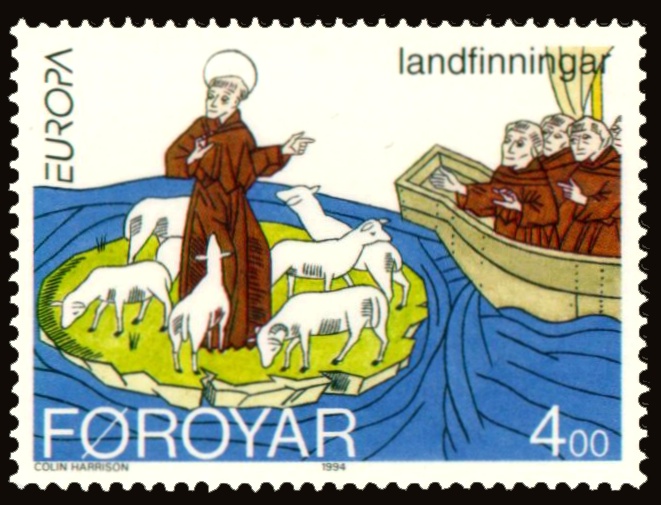
A stamp from the Faroe Islands depicts the myth of St. Brendan. Photo: Colin Harrison
Brendan loved sailing and went on several voyages to islands off the coasts of Ireland and Scotland. He also traveled to mainland France and Wales to establish monasteries. He managed 3,000 monks.
Allegedly, Brendan told St. Barinthus that he had heard rumors of lands across the Atlantic. He felt compelled to find these lands and establish monasteries.
Brendan’s saga
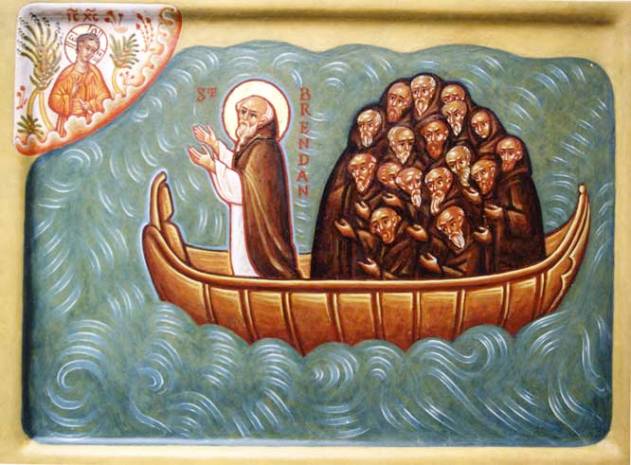
Brendan recruited 14 monks and got to work on a vessel strong enough to carry them over the Atlantic. They built a traditional Irish vessel called a currach, which consisted of a light wooden frame covered in animal hides, as well as an extra protective layer of tar or pitch for waterproofing. With simple benches, a small mast, and a linen sail, it was able to carry 15 men and supplies.
The voyage was recorded in a saga-like fashion, titled Navigatio Sancti Brendani Abbatis (The Voyage of St. Brendan the Abbot). The account places the journey between 512 and 530 CE. After sailing up Britain, where they supposedly encountered a sea monster and almost recited Mass on a whale (which they mistook for an island), Brendan visited several mysterious lands.
The islands
He mentions visiting the Paradise of Birds and the Island of Sheep, where “the sheep were so very large…larger even than oxen…because they were never milked, and felt not the stress of winter, having at all seasons abundant pasture.”
He mentions another island where “great demons threw down lumps of fiery slag from an island with rivers of gold fire.” After that terrifying encounter with what sounds like a volcano, he described another island with an abundance of grapes:
They saw an island covered all over with trees, closely set, and laden with such grapes…all the branches weighed down to the ground. Taking up one of them, and seeing its great size, and how full of juice it was, he said, in wonder: ‘Never have I seen or read of grapes so large.’
Further on, he mentions traversing a strange sea full of columns that looked like glass or crystal. Eventually, the party came to a heaven-like paradise they called the Promised Land of the Saints:
When they had disembarked, they saw a land, extensive and thickly set with trees, laden with fruits, as in autumn. All the time they were traversing that land, during their stay in it, no night was there, but a light always shone, like the light of the sun in the meridian.
They came to a large river flowing towards the middle of the land, which they could not cross.
Where did they go?
Some details of the story seem to support the theory that they arrived on the North American continent. Some believe that St. Brendan was taking a similar route to the Vikings, who sailed from the British Isles to Iceland (where they might have seen a volcano erupt), then Greenland, and onto North America.
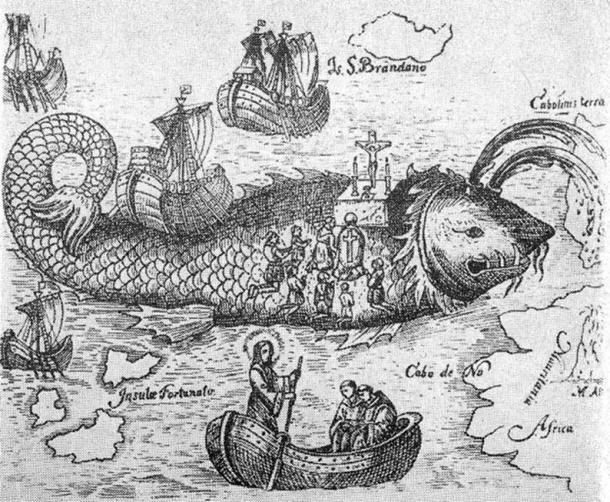
A scene from the ‘Navigatio.’ Photo: Unknown
The Island of Sheep and Paradise of Birds could refer to the Shetland and Faroe Islands, respectively. Sheep have dwelled in the Shetland Islands since the Iron Age, and over 300 bird species live on the Faroe Islands.
In 2021, scientists found ancient sheep DNA in the Faroe Islands dating to the 400s or 500s. This suggests humans (most likely Celtic shepherds) visited the island before the Vikings settled there in the 9th century. It is possible that sheep were wandering the islands by the time St. Brendan passed through.
The Island of Grapes will sound familiar if you have read the Norse sagas. Leif Eriksson named a section of North America Vinland because he found wild grapes and fertile land.
Next, St. Brendan traversed a sea of columns, which could be Greenland icebergs. Finally, they arrived in a fertile and abundant land where “the sun did not set,” and a river prevented them from continuing. Historians think that St. Brendan may have encountered the St Lawrence River.
Tim Severin’s recreation
In 1976, British explorer Tim Severin attempted to recreate St. Brendan’s voyage. He constructed an 11-meter boat following the details mentioned in the Navigatio, using wood and animal hides in the construction.
Severin left Count Kerry and sailed for 13 months to Peckford Island, Newfoundland. He traced St. Brendan’s possible route, going from Ireland to the Scottish Islands, then the Faroe Islands, Iceland, Greenland, and finally to Canada.
The journey was difficult. He almost capsized and faced extremely rough waters, but he showed that St. Brendan’s voyage was at least possible.