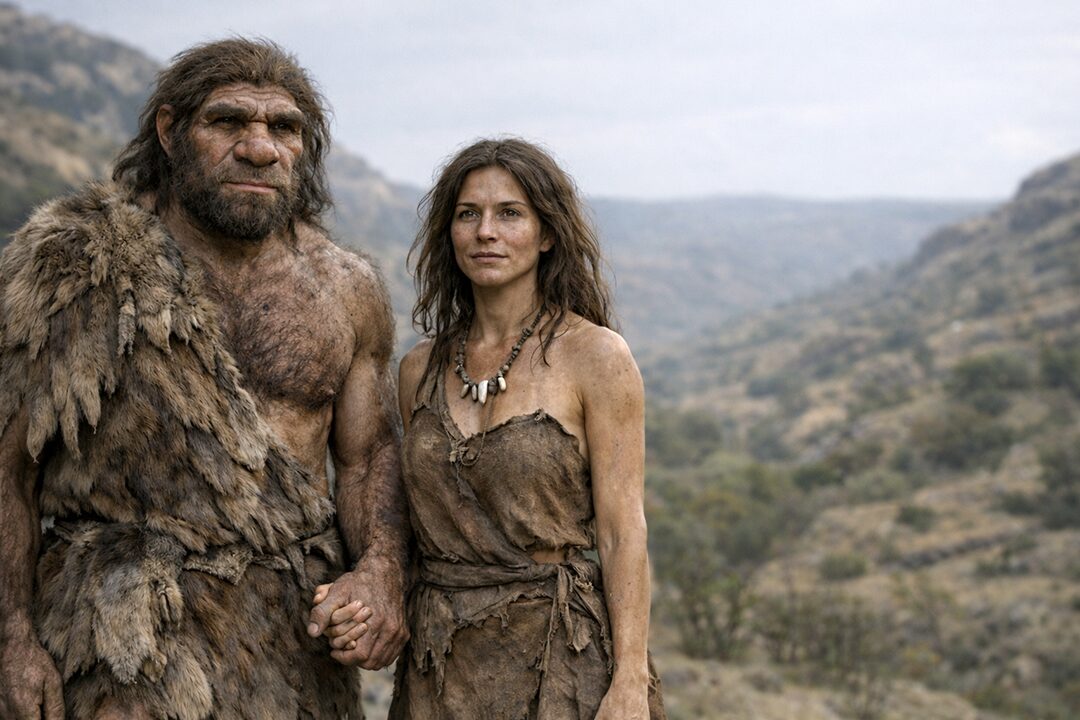
We’ve known for decades that Homo sapiens and Neanderthals were neighbors at times and even had children together. But new genetic research is revealing fresh details about who was involved in those prehistoric liaisons. It turns out that Neanderthal men and human women interbred much more frequently than Neanderthal women did with human men.
Tens of thousands of years ago, modern humans left Africa and spread into Europe and Asia, then occupied by the Neanderthals. The two species were genetically close enough to produce fertile offspring. Evidence of these ancient unions survives in the DNA of nearly everyone whose ancestors lived outside sub-Saharan Africa.
Neanderthal deserts
About 1–4% of our genome today traces back to Neanderthals. For years, scientists have puzzled over the pattern of Neanderthal DNA in our genomes. Neanderthal genes seem to be sprinkled across most of our chromosomes, but not the X chromosome. In the X chromosome, which plays a key role in sex determination, Neanderthal DNA is curiously scarce. The stretches of missing genetic material were dubbed “Neanderthal deserts.”
“For years, we just assumed these deserts existed because certain Neanderthal genes were biologically ‘toxic’ to humans –- as tends to be the case when species diverge –- so we thought the genes may have caused health problems and were likely purged by natural selection,” explained study co-author Alexander Platt.
The new study offers a different explanation. By comparing three female ancient Neanderthal genomes with 73 from present-day people from African populations that never interbred with Neanderthals, scientists discovered a bizarre pattern. Neanderthal X chromosomes contained 62% more human DNA than non-sex chromosomes. This suggests the vast majority of interbreeding took place between Neanderthal men and human women.
Men have one X and one Y chromosome, while women carry two X chromosomes. If male Neanderthals and female humans were the primary partners in these ancient encounters, fewer Neanderthal X chromosomes would ever make it into the human gene pool. This suggests that human women contributed more to Neanderthal genomes than Neanderthal women contributed to modern human genomes.
It is highly unlikely that this is due to chance. “Mating preferences provided the simplest explanation,” Platt explained.
It is possible that Neanderthal men preferred human women, or vice versa. Whatever the reason for this preference, it left a lasting genetic echo.