Despite its unmemorable name, J2322-2650 is a strange system. A Jupiter-sized exoplanet orbits an energetic neutron star, which constantly bombards it with gamma rays. Now, a team of astronomers has published its observations of the planet. They discovered strong westerly winds and an atmosphere unlike anything else.
So is it really a planet at all?
Pulsars and their companions
When massive stars die, they jettison their outer layers in a supernova. No longer able to support itself through nuclear fusion, the core collapses in on itself. If it’s big enough, it forms a black hole. If it’s not, it leaves behind a neutron star.
In many ways, these zombie stars are more dramatic objects than black holes. Many emit violent bursts of gamma rays and X-rays, the sort of light that would tear apart human cells. Periodic radio emission is also common, flung out from near the surface of the neutron star as a result of off-kilter magnetic fields. (Exactly how close to the surface this emission begins, and through what mechanism, remains a mystery.)
Neutron stars that emit in the radio band are known as pulsars, or zombie stars, because they are remnants of massive dead stars. These radio pulses are so regular, so seemingly artificial, that their discoverer, Jocelyn Bell, jokingly referred to them as “little green men.”
Astronomers observe the radio waves of pulsars to study all sorts of phenomena. They can detect companion stars orbiting the pulsar — everything from rocky planets to other neutron stars — using slight delays in the pulse arrival times at the telescope.
That’s how the team behind a new study on J2322-2650 knew to point the James Webb Space Telescope at this source, when no traditional exoplanet survey would have noticed the faint Jupiter-like companion. (In all but a few exciting cases, pulsars do not emit visible light.)
Carbon winds on a lemon-shaped planet
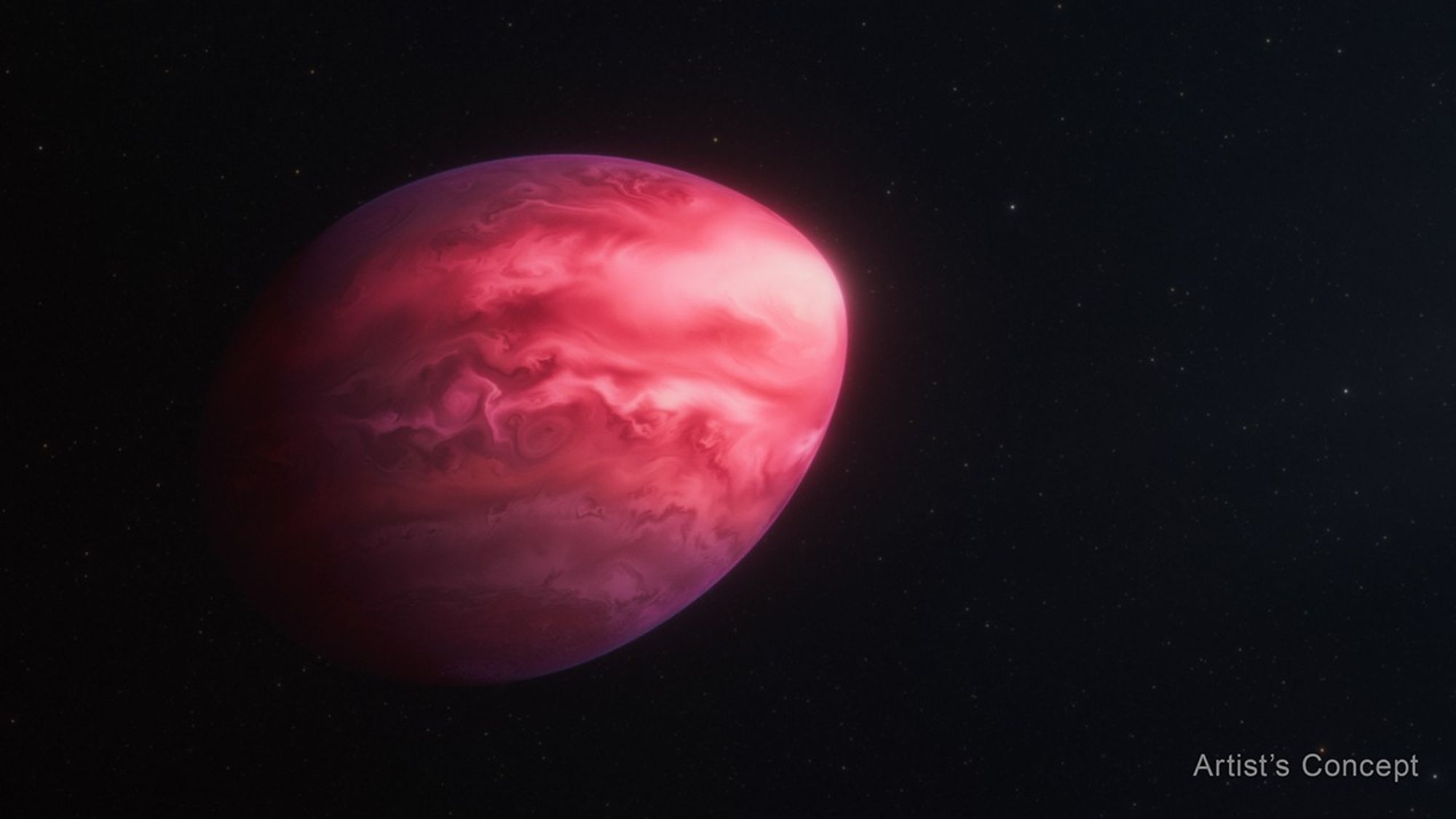
An artist’s conception of the pulsar’s companion. Photo: NASA/JWST/ESA/CSA/Ralf Crawford (STScI)
Jupiter-like planets tend to have atmospheres composed mostly of hydrogen and helium, similar to the Sun. Heavier atoms like nitrogen, carbon, and oxygen allow molecules such as ammonia and methane to form. While no two gas giant exoplanets are the same, astronomers have never found anything like the companion of J2322-2650 before.
Instead of a hydrogen-based atmosphere, they found mostly helium and an absurd amount of carbon. Not hydrocarbon chains, which commonly occur in outer space, but pure molecular carbon. In solid form, pure carbon forms minerals like graphite and diamonds. There is no earthly analog for gaseous clouds of carbon — even the darkest soot also includes lots of oxygen and hydrogen.
Team co-author Peter Gao said that the observations stunned him. “I remember after we got the data down, our collective reaction was ‘What the heck is this?’ It’s extremely different from what we expected.”
The weird planet’s nearness to a pulsar enables its gaseous, carbon-rich atmosphere. The two are so close together that the pulsar’s gravity keeps the companion pinned with one side always facing it, a process known as tidal locking. (The Moon, for instance, is tidally locked to the Earth). Because the near side of the companion is slightly closer to the pulsar than the far side, the difference in gravitational attraction stretches it out like a football.
So that’s the companion of this zombie star: an elongated, tidally locked object covered in carbon winds, whose nearside is pummeled by gamma rays all the time and whose far side never sees light.
What is it?
Black widow pulsars
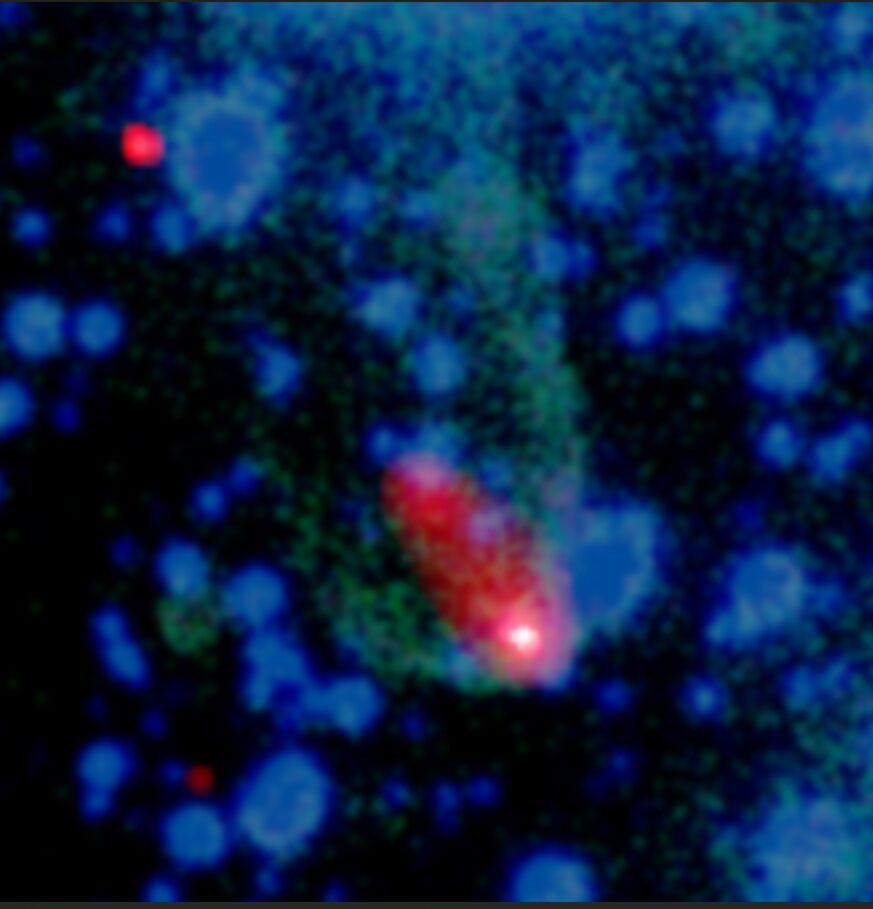
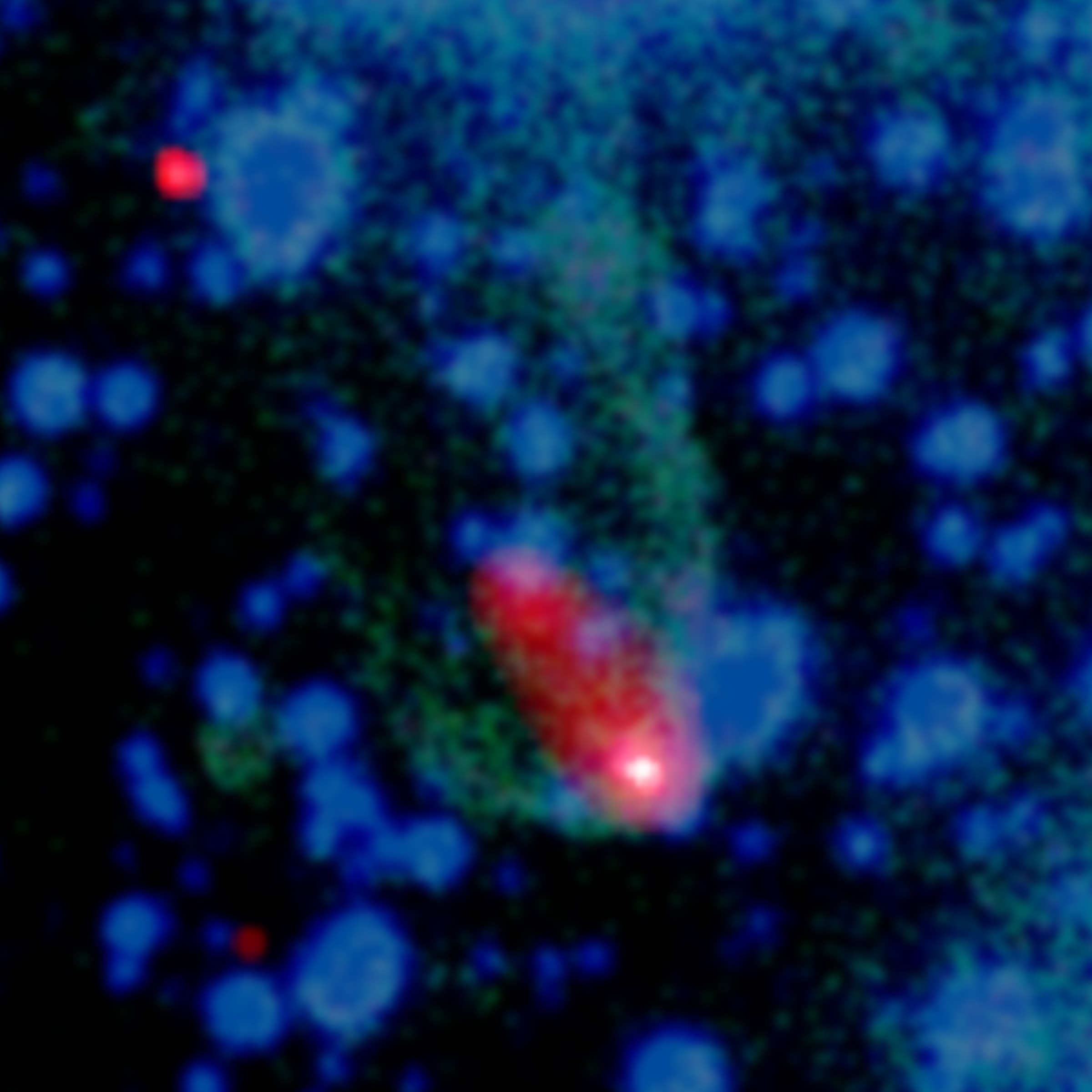
A composite optical and X-ray image of the original black widow pulsar. The extended pink blob shows the shocked gas around the pulsar. Photo: By X-ray: NASA/CXC/ASTRON/B.Stappers et al.; Optical: AAO/J.Bland-Hawthorn & H.Jones
Black widow is one of those wretched, jargon-y pulsar terms that baffle most other astronomers, let alone the general public. But unlike many offbeat pulsar terms (just what is a birdie, anyway, and what does it mean to zap one?), black widow is descriptive. A black widow pulsar is one that, like a female black widow spider, is “eating” the light, fluffy atmosphere of its companion. Many of these companions are brown dwarfs, failed stars more similar to Jupiter than to our Sun.
Most astronomers consider brown dwarfs to be planets. Like Jupiter, they have hydrogen atmospheres rich with common molecules like methane, and more exotic iron and silicate compounds. They are not dominated by helium and pure molecular carbon.
Even if we assume this system represents the end-stage of classical black widow formation, where the pulsar has already stripped most of the atmosphere off its companion, the carbon remains an anomaly. Carbon and oxygen form at the same stage of stellar evolution, so there should be a lot more oxygen floating around its atmosphere.
The authors of the study discuss more exotic scenarios, like a merger between one helium and one carbon-oxygen white dwarf. But these still can’t explain the carbon concentration they observed. We may know what this companion looks like now, but what it used to be remains a mystery.
Above, an artist’s conception of the system, as the lemon-shaped planet orbits the pulsar. Imagery: NASA/JWST/ESA/CSA/Ralf Crawford (STScI)