The meadows of Alexandra Fiord were my introduction to Ellesmere Island. Irrigated by three vigorous little streams and drenched in warmth and sunshine unusual at 79º N, these meadows are among the richest in the High Arctic. A pair of glaciers that almost meet at their snouts dominate the valley and supply the summer water that gives life to everything.
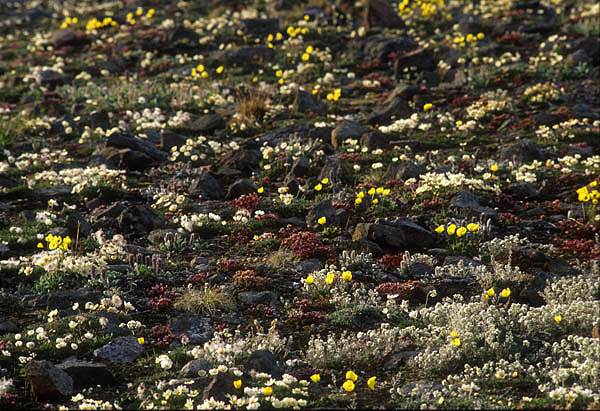
Alexandra Fiord meadow. Photo: Jerry Kobalenko
I had spent my first night wandering around in a state of rapture, astonished that the far north could be so hospitable. Even for beginners, it would take real talent to bungle a hike in this gentle polar oasis.
In August 1875, the British Arctic Expedition under George Nares visited this little enclave on their way further north. Some of the sailors went ashore to hunt Arctic hares. One of them, presumably dressed in all his naval-issue layers on a warm afternoon, collapsed and had to be carried back to the ship on a stretcher. His ailment –- heatstroke, not hypothermia.
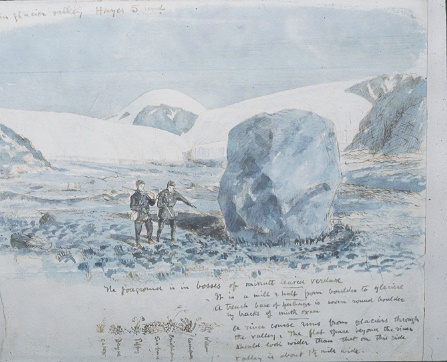
The Nares Expedition’s surgeon and artist, Edward Moss, painted two sailors hiking past a boulder in the meadows of Alexandra Fiord.
Historic irony
If nothing else, this incident proves that Arctic history has a sense of humor, because Canada owes its High Arctic sovereignty to the Nares expedition. It was the first in this region to base itself on Ellesmere rather than Greenland.
Today, most polar explorers have their advocates or apologists: A few still cling to the notion that Peary or Cook reached the North Pole, John Franklin’s disappearance is part of the Arctic mythos, but no one identifies with Nares or his crew. Despite the expedition’s importance, no one talks much about it.
After the Franklin disaster, in which all 129 men were lost, Arctic exploration fell out of political favor. But it remained popular in naval circles because it was the best way for officers to distinguish themselves in peacetime.
The Nares expedition was thrown together in a few short months after a change of government gave it unexpected approval. George Nares had apprenticed on an earlier Franklin search but was dragooned from a scientific vessel in the tropics to lead this new venture.
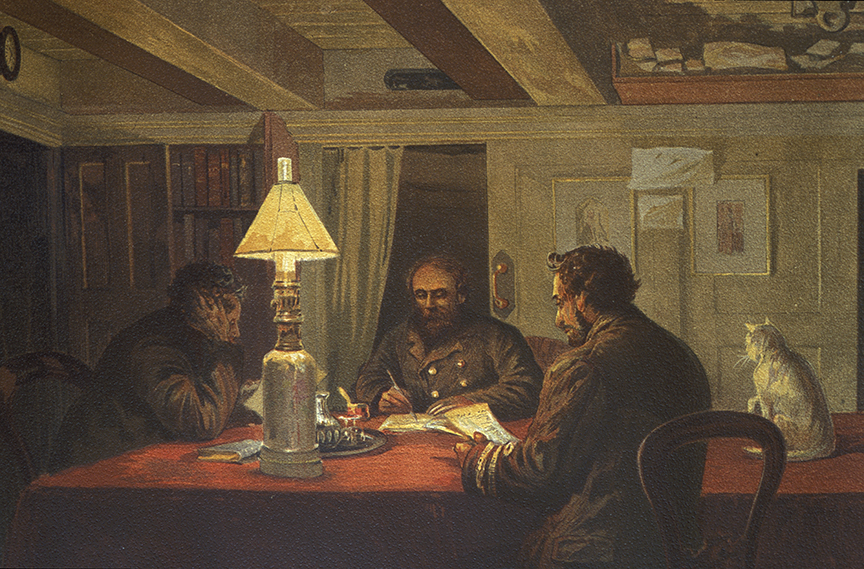
George Nares, center, in his stateroom. The expedition’s cat, which did not like walking on the outside decks in -58˚C, watches the proceedings. Image: Edward Moss
‘Our goal, the Pole’
He had a scientific mind but was a product of the Royal Navy tradition and was hardly an inspired leader. He took the assignment not for romantic notions of exploration but because he felt it would further his career.
Attempting to reach the North Pole wasn’t the expedition’s original plan. But by the time the two ships, the Alert and the Discovery, left Portsmouth in May 1875, the thousands of cheering spectators expected no less than “our goal, the Pole.”
Nares’s seamanship, at least, was exemplary, and after their detour into Alexandra Fiord, they forced their way north through the dangerous pack ice. The two ships eventually split up, the Discovery settling in what they called Discovery Harbour –- and what later became famous as Fort Conger, the base for many polar expeditions -– while the Alert under Nares himself steamed another 100km north, almost to the top of Ellesmere Island. Here, they prepared for the winter at a place they christened Floeberg Beach, after the many giant ice floes that guarded the shore.
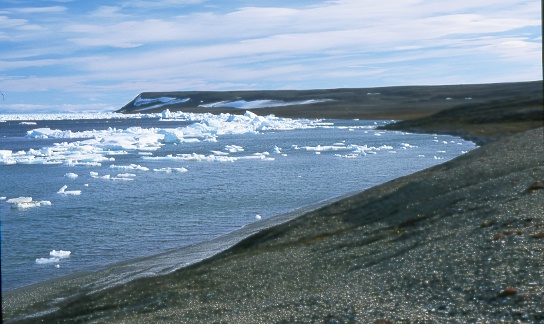
Floeberg Beach has fewer floes today. Photo: Jerry Kobalenko
Signs of the past
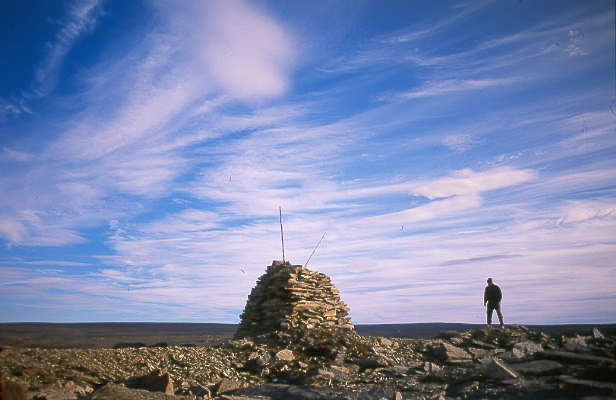
Things rot with glacial slowness in the High Arctic, and today at Floeberg Beach, signs of the Nares expedition are everywhere. Their giant cairn, one of several along the Ellesmere coastline, looks down intact from a nearby ridge, two broken pieces of flagpole protruding out the top. In the vicinity of a storage tent, they had to correct the broadside orientation of their nearby ship with “much labor and no trifling expense in broken hawsers.” Both the outline of the tent and the broken hawsers remain as if their struggle happened last week rather than in 1875.
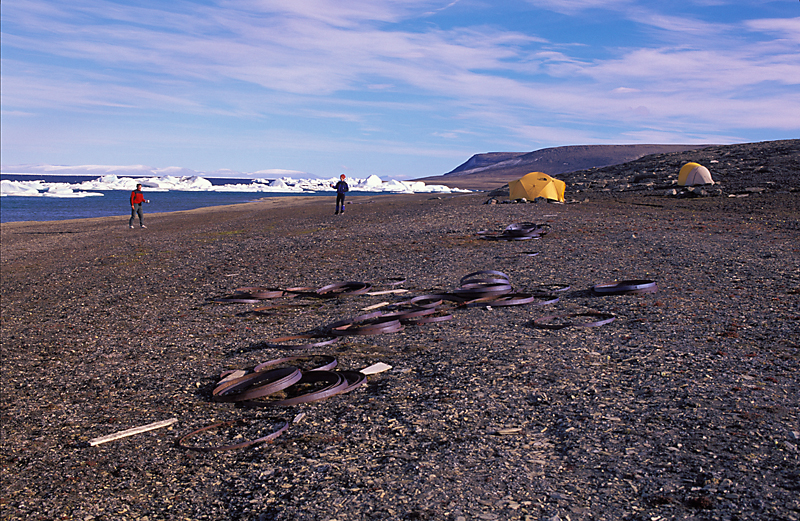
Barrel hoops from the Nares expedition still lie on Floeberg Beach. Photo: Jerry Kobalenko
In this era, Britannia still ruled the waves, and its global status created a cultural arrogance that seems to have reached its fullest flower with polar expeditions. Explorers from other nations had already begun to adopt Inuit ways, eating local food, living in snow houses, and traveling by dog team. Even British non-establishment explorers, such as John Rae, successfully used native methods.
But in the Admiralty staterooms and the stodgy clubs of Pall Mall, where so many official expeditions were planned, a British gentleman’s theory trumped everyone else’s practice. As a result, Nares chose manhauling over dogs, preserved foods over fresh fare, and chilly tents over cozy snow houses. Because snowshoes had been rarely needed on the windpacked snows of the Central Arctic, where the British had mostly traveled, only two of Nares’s men had them –- and they had to endure “shouts of derision” when they brought them aboard ship. Skis were not even considered: Fridtjof Nansen would not ski across Greenland for another 13 years, kick-starting the skiing renaissance.
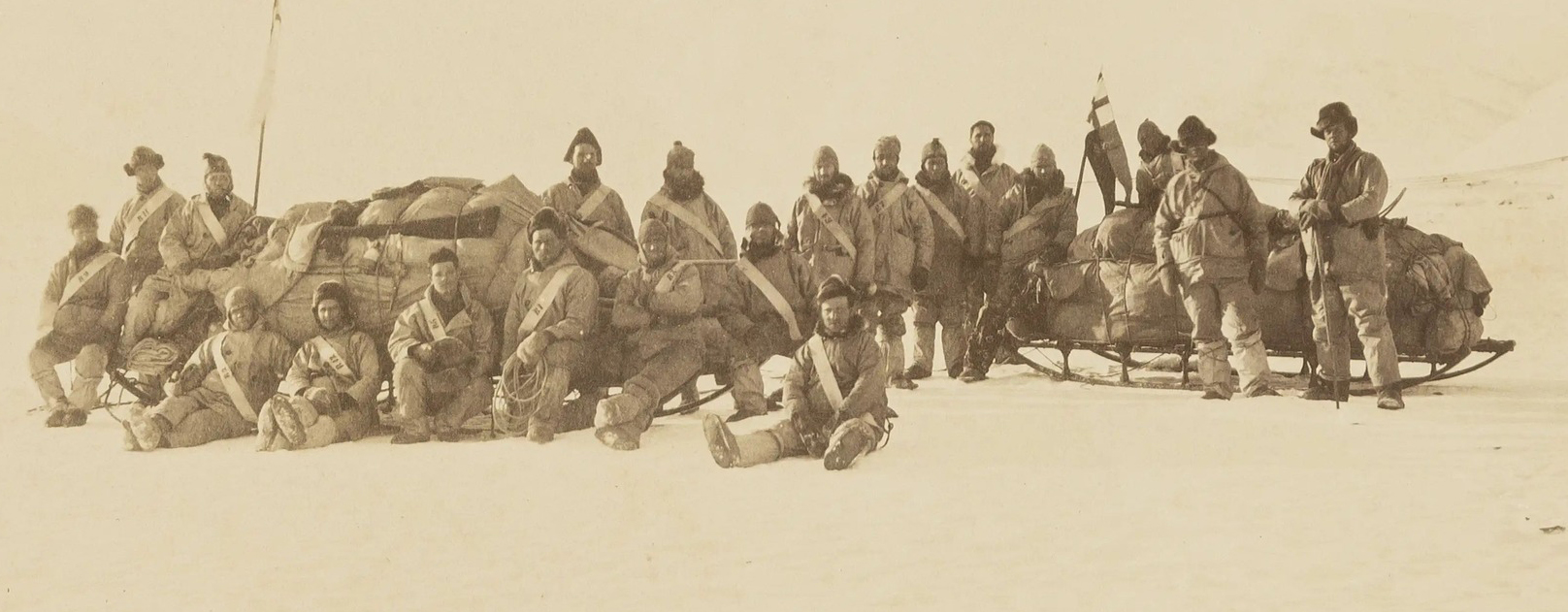
Nares expedition sledders.
Manhauling
That autumn on Ellesmere Island, their introduction to manhauling was not encouraging. Nares himself did not join the sled parties, but directed from the ship through a series of rigid memos. Parties were instructed to complete their tasks or distances by a precise date. These commands were difficult to meet because the huge sleds weighed 65kg when empty and almost a ton when loaded.
Seven men in harnesses jerked them forward, while one officer on each team walked ahead, picking a route and making notes. Sometimes they made barely two kilometers a day. “The sledges pull like a plow with a cart-load on it,” said one man.
When they cooked in the tent, billows of steam condensed on everything. Soon, their 15kg tent weighed 25kg, sleeping bags went from 3.5kg to 8kg, and even backpacks somehow went from 3 to 4.5kg. By the time they returned to the ship, 24 men had 43 cases of frostbite; three of them lost big toes. It was a sad inventory, but nothing about the experience prompted Nares to rethink the British approach to Arctic travel.
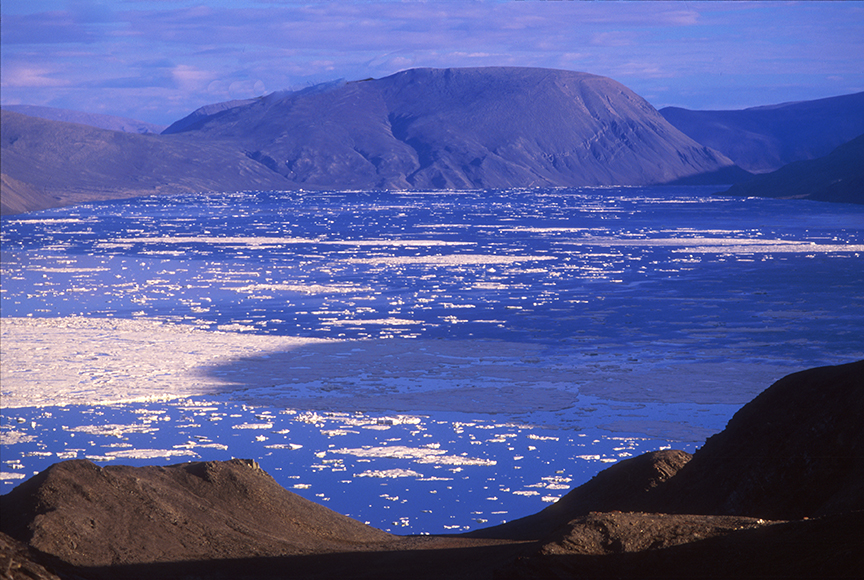
Discovery Harbour. Photo: Jerry Kobalenko
Discovery Harbour
In Discovery Harbour, meanwhile, the second ship had life a little easier. Discovery Harbour was no oasis, but it was much more genial than dank, exposed Floeberg Beach. Muskoxen and Arctic hares roamed grassy valleys, and the men even found a coal seam nearby, a natural source of fuel. That coal seam convinced the following expeditions to make Discovery Harbour a base
Both crews spent the long winter on board the ship. Frost formed on ceilings, then melted, then refroze. Eventually, it became a thick armor plate. They had to rig blankets over their beds to divert the dripping.
“It is decidedly unpleasant, whilst writing, to have a continual stream of water pouring down upon your paper,” wrote an officer with annoyance.
One man rigged an umbrella over his chair so he could read without a trickle down the back of his neck. Another tried to lessen the problem by keeping 52 candles burning all day in his quarters. Apparently, there was no shortage of candles.
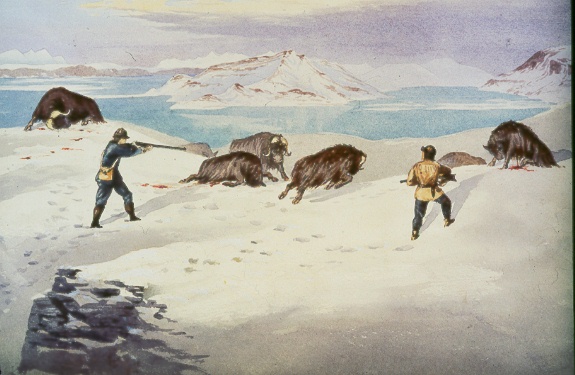
Edward Moss’s watercolor of a muskox hunt at Discovery Harbour.
Scurvy
There was a shortage of fresh food, however, despite the muskoxen killed at Discovery Harbour. For over a century, British sailors had taken daily lime juice rations in a bid to prevent scurvy –- a disease we now know comes from a lack of Vitamin C. Ordinarily, we get our required 15 milligrams a day from fresh fruits or vegetables. The Inuit got theirs from their diet of raw meat. At that time, no one understood the cause of scurvy. From experience, it just seemed that lime juice prevented it.
Unfortunately, at this time, British lime juice didn’t carry much Vitamin C. The men also didn’t enjoy the taste very much and had to be forced on deck every day to down their hated two tablespoons under the watchful eye of an officer, who then ticked their name off a roster. Some, like mischievous kids, managed to avoid downing their portion. As the sledgers prepared to leave after a winter of preserved food, they had very little Vitamin C in their bodies.
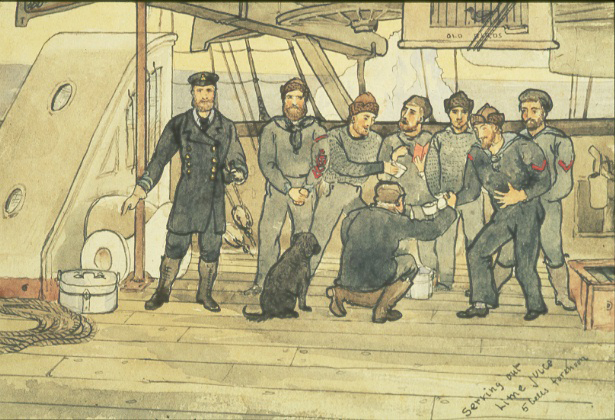
The daily lime juice ration. Image: Edward Moss
The spring expeditions
Three exploratory parties set out. One trekked across the frozen strait to Greenland. Another headed west along the north coast of Ellesmere. And the third struck out across the Arctic Ocean toward the North Pole. Since geographers of that time believed in an Open Polar Sea – a kind of permanent polynya just north of Ellesmere that would provide clear sailing – they also carried two boats weighing 335 and 180kg.
The unwieldy sleds, the deep snow, and their lack of snowshoes made progress grim. Sailors were not fit like voyageurs, especially after a sedentary winter. The Ellesmere party, under Lieutenant Aldrich, struggled west and managed to cover most of the north coast. It was the Nares expedition’s main achievement.
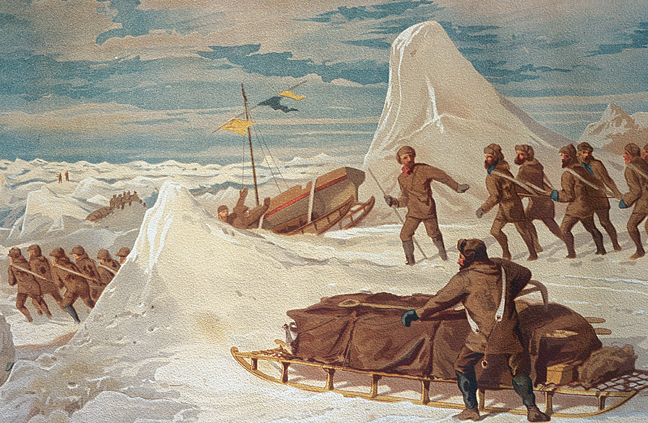
Image of sledging party: Edward Moss
The North Pole party under Lieutenant Markham had a harder time. Instead of an Open Polar Sea, they found pressure ice that formed an almost impenetrable barrier to progress. (Markham would later write a book about the expedition called The Great Frozen Sea –- a knock at the armchair experts.) Gamely, they struggled until 83º 20’. It was a new Farthest North, but the Pole itself was still 700km away.
But Nares’s men had a bigger problem than discovering that the North Pole was out of reach. Scurvy struck down all three sled parties. Gums and limbs swelled, telltale bruises appeared, sledgers collapsed in their harnesses. Of 120 men on the two ships, 60 were stricken. Four died. “God help us,” wrote one of the officers in his sledging journal.
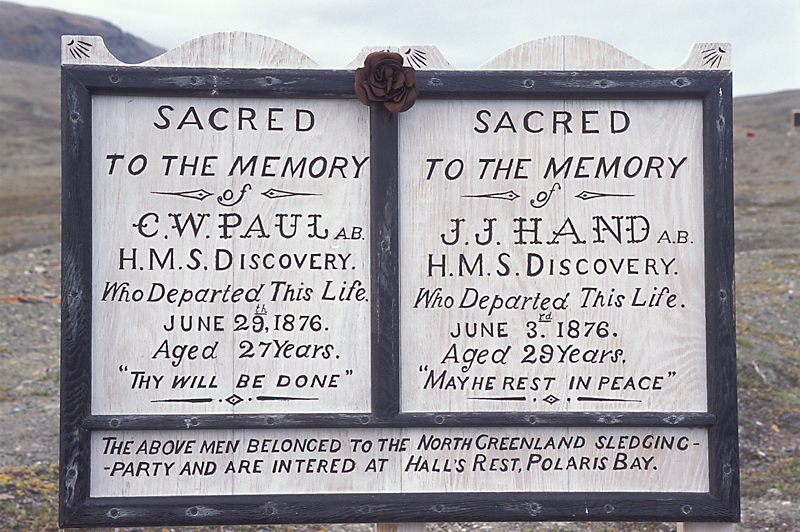
A replica memorial at Discovery Harbour for two of Nares’s men who died of scurvy. Photo: Jerry Kobalenko
Disaster strikes
Desperately, they limped back to their ships. The Aldrich party was saved by a gallant 60km trek to the Alert for help by one officer, Lieutenant Parr. Today, chilling memorials stand at Floeberg Beach and Discovery Harbour to the fallen sledgers. Three of them died on the sledge journeys and were buried on the ice, but one man, Niels Petersen, was interred at Floeberg, and his grave overlooks the lonely beach where shorebirds cry all summer.
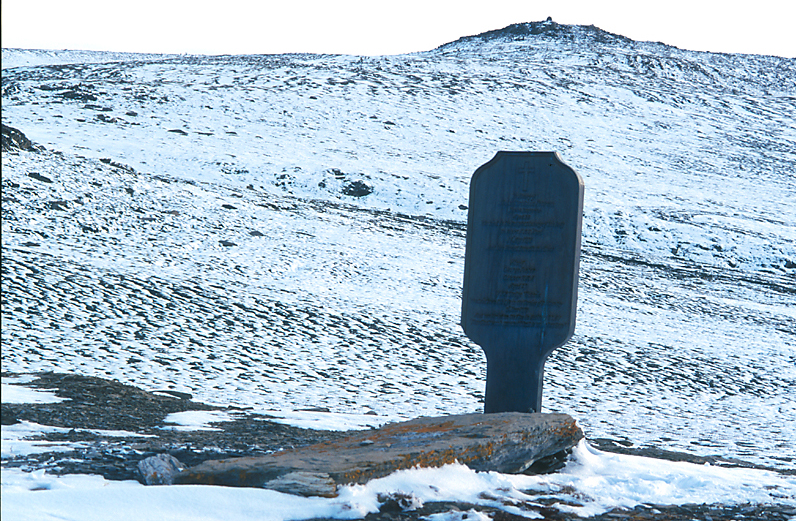
The grave of one of Nares’s men, Niels Petersen, another scurvy victim. Photo: Jerry Kobalenko
Puzzled by the outbreak of scurvy and discouraged by the sledging conditions, Nares sailed for home in 1876, a year earlier than planned. His premature arrival opened him to withering sarcasm. The entire country had backed the venture, and now the entire country chafed from the puny results. Nares was no intrepid adventurer, but he was a shrewd politician and weathered the criticism. In a kind of golden handshake, every man, including Nares, was promoted for his work, but then the expedition was quietly forgotten.
The Nares expedition was “like a caricature of British exploits of the Franklin era,” writes one modern historian.
In 1880, Britain relinquished its claim to the Arctic islands to its former colony, Canada. For the next 50 years, the United States, Norway, and Denmark contested Canada’s sovereignty in the High Arctic, based on their own later explorations. Finally, in 1930, Canada’s claim won out, thanks largely to those disastrous first footsteps on Ellesmere.