A thousand years before the first pharaohs ruled Egypt, Eastern Europe boasted a network of settlements larger than any other in the world. They were the Tripillyan megasites, centers of salt and copper production. Some had populations of up to 40,000 people. And every single one of them burned down.
The Tripillya culture occupied what is now Ukraine from about 4600 – 3500 BCE. Remembered for their elegant ceramics, they left behind the earliest known example of a pottery wheel. They practiced agriculture, in particular, cereal and dairy farming. This helped support small, dense settlements of wattle-and-daub houses.
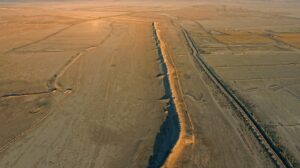
By the 4th millennium BCE, these settlements had developed a characteristic style, featuring several hundred to over a thousand buildings arranged in concentric rings. In some, streets radiated toward the center of the oval like the spokes of a wheel. The largest covers several square kilometers and may have supported as many as 40,000 people.
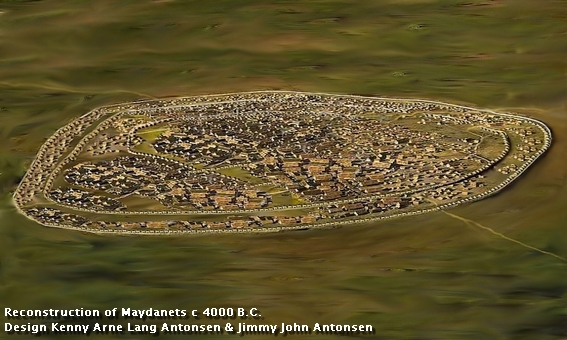
A reconstruction of the Tripillyan city of Maydanets. Many Tripillyan megasites featured ditches around the settlement. Photo: Kenny Antonsen/Jimmy Antonsen/Wikimedia Commons
The burned house horizon
Burnt clay rubble, the product of intense fire, also characterizes Tripillyan ruins. Its presence is so ubiquitous that for decades, archaeologists argued that the Tripillyans used fire in the house-construction process. But it’s not just the house walls that show signs of fire damage, as we would expect from fire use during construction. Many of the houses are filled with piles of burned trash, burned grains, and burned furniture.
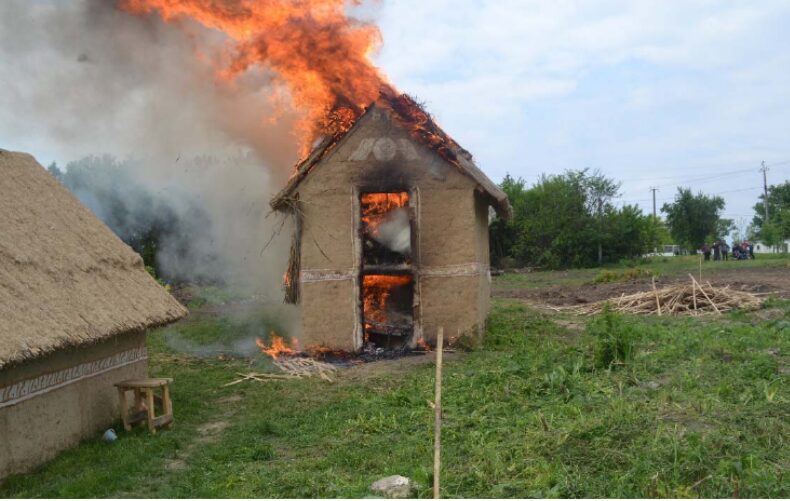
The fires also don’t appear to have been accidental. When faced with a fire-based mystery, researchers became excited about the opportunity to conduct classic experimental archaeology. Several teams purchased or built wattle-and-daub houses in Eastern Europe and set them on fire.

A 1977 house-burning experiment. The team purchased a wattle-and-daub house in Serbia and lit it on fire to determine whether the Tripillyan house burnings were accidental. Photo: Bankoff and Winter 1979
Each team found that natural fire allowed to run its course could not account for the damage to Tripillyan dwellings. Only when they added fuel did the heat match the temperatures from the Tripillyan ruins. Additionally, very few human or animal remains have been found inside the houses, suggesting that the fires were intentionally set.
The map below shows part of Eastern Europe from the late Stone Age. In the red section of the map, people burned down most of their own houses after years of living there. Outside the line, they didn’t. The line is called the burned house horizon, and archaeologists still don’t know why it exists.
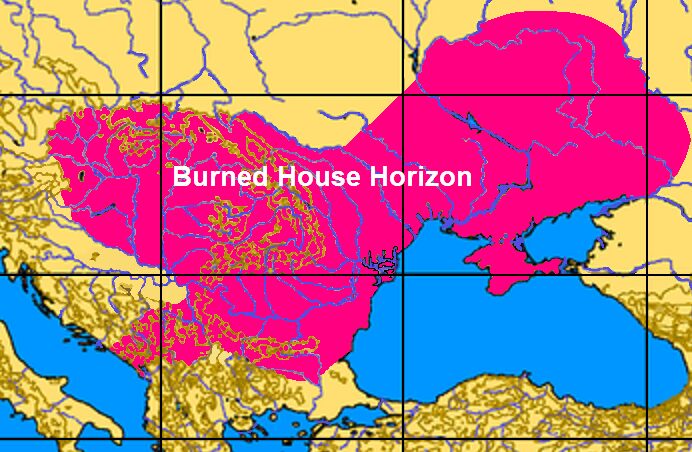
The burned house horizon included cultures other than the Tripillya, but the burned Tripillyan sites are the most common. Photo: Saukkomies/Wikimedia Commons
The scene of the crime
The modus operandi for Tripillyan house burning evolved over time. There are exceptions to how it occurred, but the following rules hold in most cases:
Houses were burned individually or in small groups, not as a whole settlement.
Houses were burned without humans or animals inside.
Houses were burned with furniture and refuse inside, or next to a house containing these things.
Houses were burnt with food inside.
Houses were burned at such a high temperature that a single fire would require 100-250 trees as fuel.
New houses were rebuilt on top of the remnants of old houses.
Taken together, a picture starts to emerge. The Tripillyans burnt down homes that were still functionally useful, and they did not do so merely to clear space, or newcomers could have moved into the preexisting homes. They did not use homes as crematoriums for the dead or simply as garbage disposal, but did use them to burn items. And they were very, very good with fire.
The murder of a house
We can immediately rule out one possible explanation for this arson. If invaders regularly burned down these settlements, then we would find other signs of warfare in the ruins. Bodies, some burned to death, and others killed violently. Weapons. More elaborate defensive structures than a ditch two meters in diameter.
As the purposeful, non-aggressive nature of house burning became clear, archaeologists began to discuss the concept of domicide, or the murder of a house. The sociologists who coined the term intended it to describe an act of violence against the humans who lived in the house. They brought up the treatment of Native Americans under the Indian Removal Act. Recently, a United Nations Special Rapporteur has applied the term to the bombing of the Gaza Strip.
Domicide within the burned house horizon is a different beast. It is personal, or valuable ceramics would not have been left within the burning house. One theory is that the Tripillyans viewed houses as having souls of their own and helped them die at the end of their lives. Another is that they burned a house after an important inhabitant passed away.
But domicide remains more of a marker of our ignorance than an answer to the house-burning question. Without a written record or objects of clear spiritual importance, the role of houses in Tripillyan society remains elusive.