Last summer, three accomplished alpinists — Ethan Berman, Sebastian Pelletti, and Maarten van Haeren — became the first to climb the long-coveted southeast pillar of Ultar Sar.
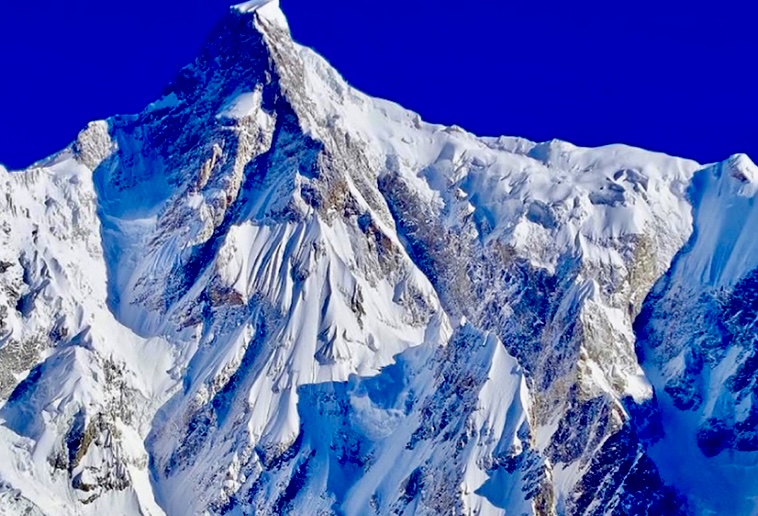
Also known as Bojohagur Duan Asir II, 7,388m Ultar Sar dominates Pakistan’s Batura Muztagh subrange, rising 5,300m above the Karakoram’s Hunza Valley. The southeast pillar, a sweeping 3,100m wall of snow, ice, rock, and mixed terrain, had long been nicknamed the Hidden Pillar or the Walker Spur of the Karakoram. It had repelled numerous strong teams for three decades and earned a reputation as one of the range’s final great challenges, longer and more sustained than even the infamous north ridge of Latok I.
Past attempts
The pillar’s history is marked by persistence and setback. Early attempts included Toshio Narita’s Japanese team in 1992, which retreated from around 5,400m due to overwhelming technical difficulties. In 2000, a French group led by Jerome Blanc Gras reached the base before poor weather stopped them from properly engaging the wall. Yannick Graziani and Christian Trommsdorff pushed farther in 2005, climbing to about 5,800m — roughly halfway — before conditions forced them down.
A notable alpine-style effort came in 2011 from Fumitaka Ichimura and Yusuke Sato, who started from a 4,300m base camp and reached 6,500m after a week of effort, only to retreat amid deteriorating snow.
Tragedy struck in 2018 when bad weather caught Tim Miller, Bruce Normand, and Christian Huber. A small avalanche buried their tent at 5,900m, claiming Huber’s life. A helicopter rescued the survivors.
The peak itself had remained unclimbed until July 1996, when two separate Japanese expeditions succeeded on the southwest and south ridges. But the southeast pillar remained untouched. Its combination of high altitude, objective dangers, and relentless technical climbing deterred even the boldest.
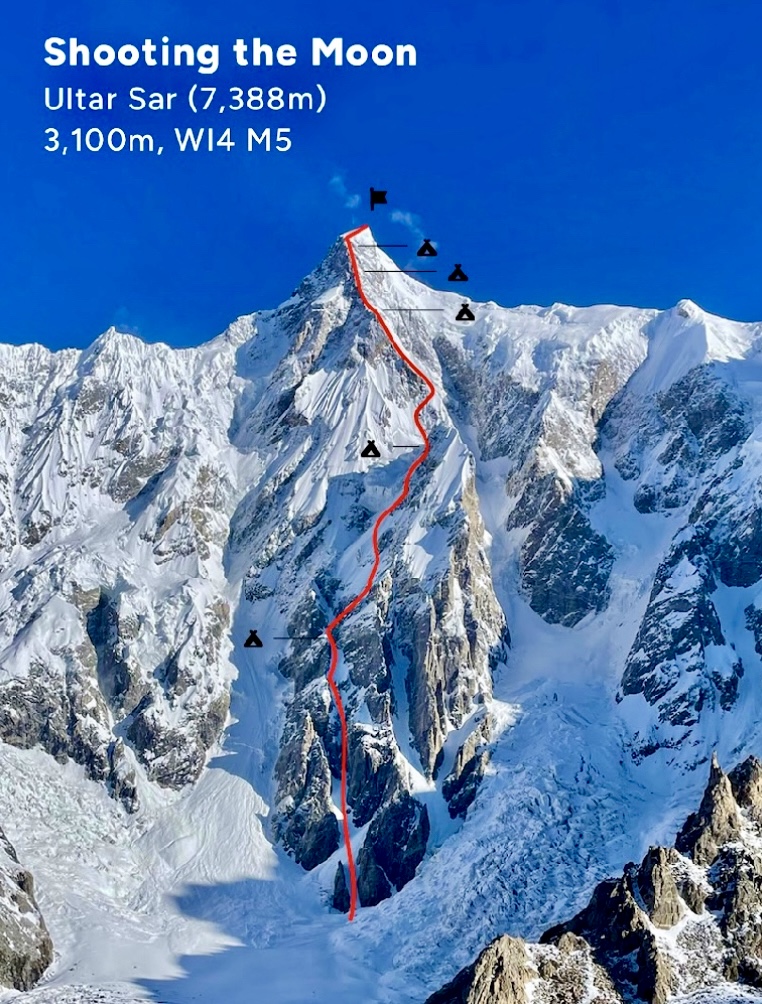
The route up the southeast pillar of Ultar Sar. Photo: Sebastian Pelletti/Ethan Berman/Maarten van Haeren
Lessons learned
Berman, Pelletti, and van Haeren had previously attempted the line in 2024. They reached around 6,000m before unstable snow shut them down. That near-miss provided crucial insights into the route’s behavior, timing, and hazards, particularly the value of climbing at night and early morning for better ice conditions.
Returning in 2025, they were better equipped and supported by a Cutting Edge Grant from the American Alpine Club, the John Lauchlan Memorial Award from the Alpine Club of Canada, and the Mazamas Bob Wilson Grant. Abdul Ghafoor of Pakistan Higher Ground Expeditions provided logistical backing.
Their journey to the mountain was far from smooth. Regional tensions between Pakistan and India led to widespread flight cancellations, stranding them for a chaotic week with unplanned stops in several cities. They finally reached the Hunza Valley about a month before the climb, allowing time for acclimatization and weather monitoring.
The climb
When a promising window appeared in early June, they committed fully, climbing in pure alpine style: no fixed ropes, no porters on the route, just the three of them roped together, carrying all gear, food, and fuel. They started from a base camp at about 4,300m on June 6.
The first three days focused on rapid elevation gain, prioritizing safe spots for rest amid the steep terrain. Much of the lower and middle pillar consisted of relentless 70˚ ice, demanding constant front-pointing and precise tool placements. Drawing from their 2024 experience, they shifted much of their movement to nighttime and early morning to optimize temperatures and conditions. This way, they evaded the fierce afternoon winds and thick clouds that often obliterated visibility.
Apart from the lower entrance fan and the final 200m to the summit, the entire route featured steep ice and rock, with few easier sections. By the end of day three, after a particularly long push, they had advanced from 5,800m to 6,650m, on mostly 70˚ ice. Here, they arrived at the base of the prominent rock pillar that defines the upper mountain.

Berman and van Haeren set up their hammock at 7,000m. Photo: Sebastian Pelletti/Ethan Berman/Maarten van Haeren
Crux and summit
Day four brought the route’s crux: a demanding stretch of mixed climbing from around 6,800m to 7,200m, featuring sections up to M5, including thin ice smears and the first major M5 section at the start of the rock pillar. This proved taller and steeper than anticipated, with no snow slopes to ease the difficulty. Delicate rock moves and sustained tool work kept the tension high. High winds and clouds interrupted progress at times, forcing early stops. Yet they persevered, eventually breaking through to the final, more moderate snow slopes to the summit.
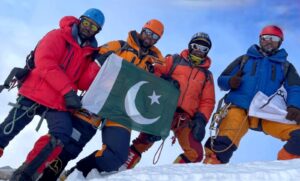
On June 11, after six days of climbing from base camp, the three reached the top together. They had climbed the entire 3,100m line from base to summit. They named the route Shooting the Moon, assigning it an overall grade of M5 WI4, an honest assessment of the continuous steep ice, precarious mixed ground, and sparse protection opportunities.
The descent tested them as much as the ascent. It took them two full days, June 12-13. Retracing their line, they executed more than 70 rappels, losing exact count amid fatigue. An afternoon storm caught them at their 6,650m bivouac, pinning them for a full 24 hours of relentless blowing snow.
When a narrow window opened, they seized it, descending in major stages: first from the summit to 6,650m, then — after the delay — to 4,300m, and finally a marathon 31-hour push to base camp.
Conditions eased significantly below 6,000m, and they reached safety just before an even larger storm engulfed the range for days. Their timing proved exquisite, narrowly avoiding being trapped longer.
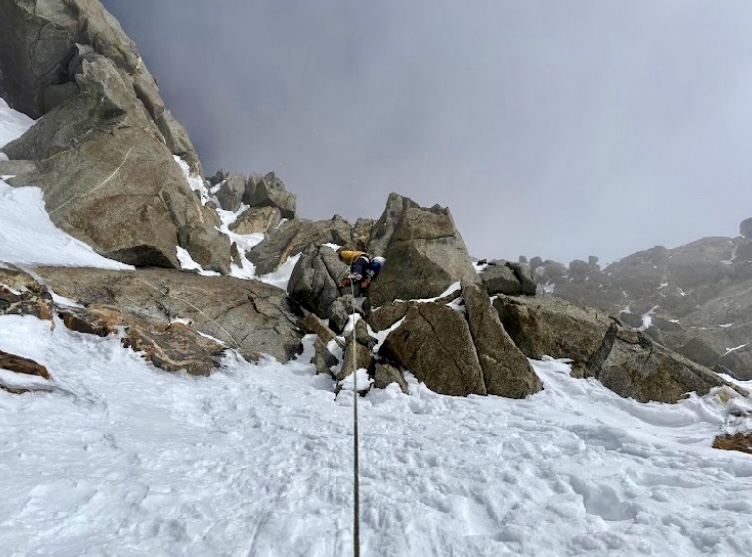
Maarten van Haeren leads the start of the rock pillar at 6,800m (first M5 crux). Photo: Sebastian Pelletti/Ethan Berman/Maarten van Haeren
Bivouacs on the pillar
All their bivouacs were minimalist. Few natural ledges exist on the pillar, so they spent hours chopping platforms into the ice, large enough for all three to share a hammock-style shelter. Key sites were at 6,650m (reached after grueling ice climbing on day three) and 7,000m, where the hammock provided precarious but essential rest. Excavating these spots after long days added to the physical toll, but it allowed them to stay light and mobile.
Pelletti shared his thoughts on the experience:
This feels like the biggest climb any of us has individually done, and we are still processing the experience. We’ve all completed multi-day alpine climbs, but this was our first time applying this experience to an objective above 7,000m.
We are just super-satisfied in the way we worked together on an objective that seemed too big to contemplate as a whole.
With its blend of historical significance, extreme technical demands at altitude, significant objective risks, and excellent execution in lightweight style, the first ascent of Ultar Sar’s southeast pillar stands as a defining achievement in contemporary alpinism. In a year filled with notable climbs across the Greater Ranges, this one rises above the rest. For us, it’s undeniably the most outstanding expedition of 2025.
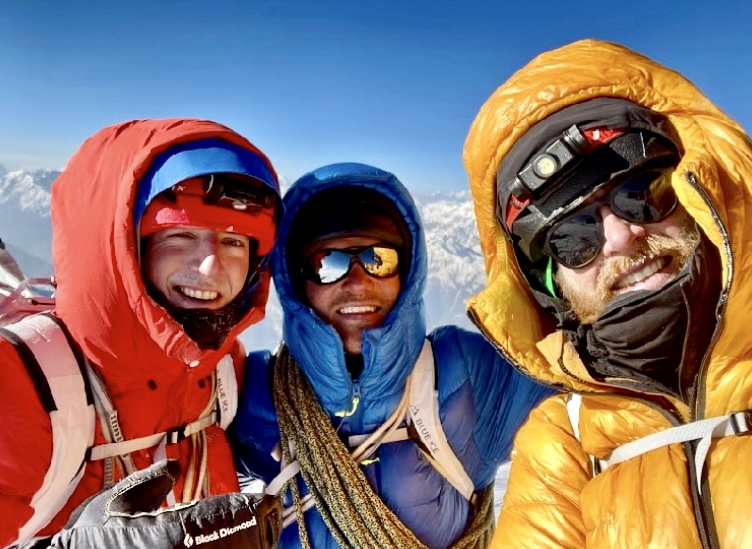
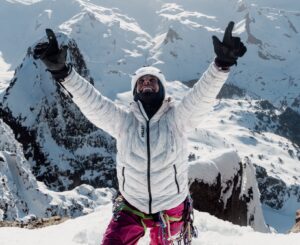
Left to right, Ethan Berman, Sebastian Pelletti, and Maarten van Haeren on the summit of Ultar Sar. Photo: Sebastian Pelletti/Ethan Berman/Maarten van Haeren