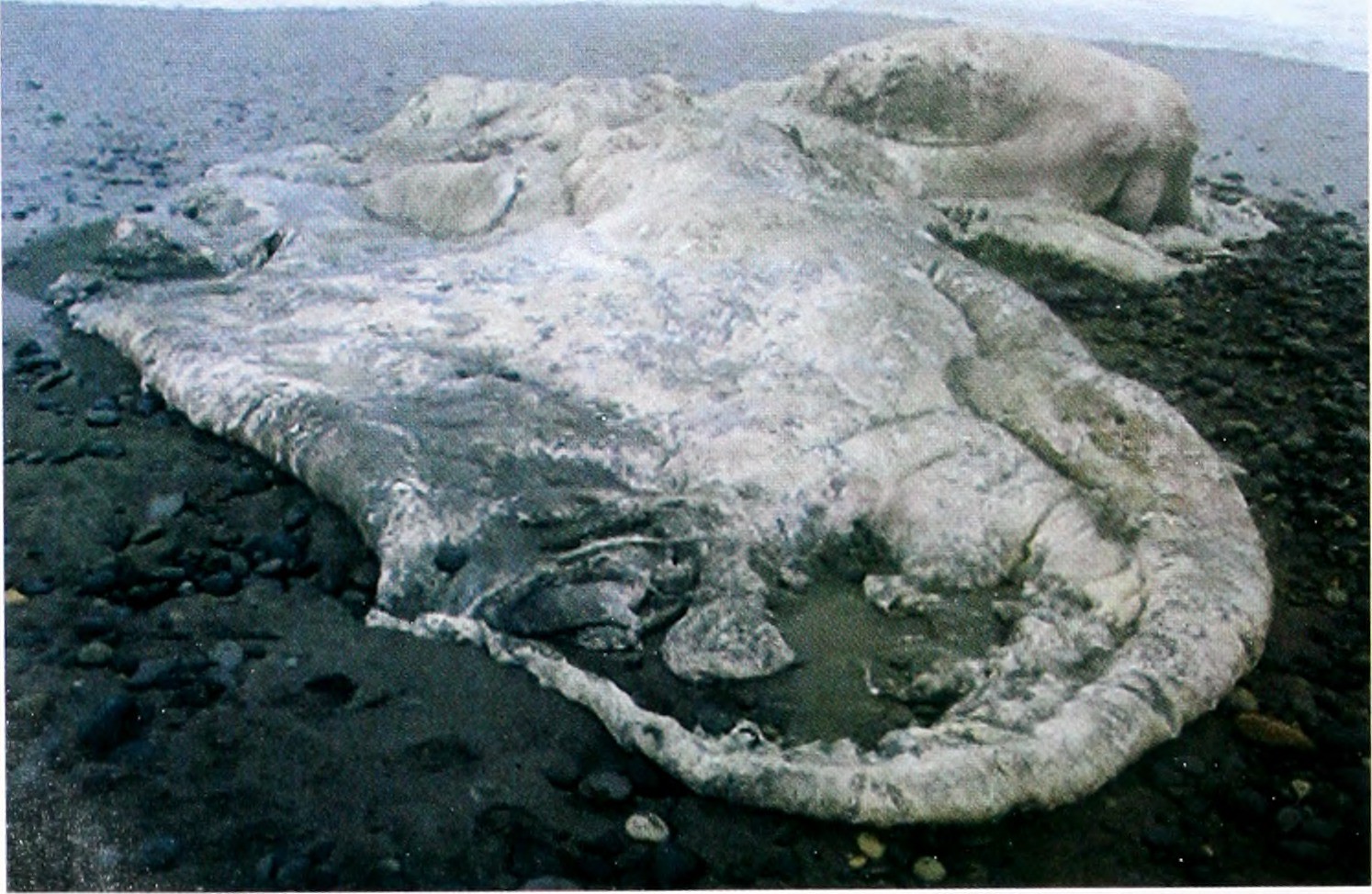
One day, you’re walking on the beach. Just when you’re about to go in the water or look for seashells, you come across a horrific sight — a blob of decomposing matter unlike anything you have seen before. Coming in all shapes, sizes, and colors, these massive unidentified blobs have struck fear and awe in those who found them. But what are they? And where do they come from?
Official name
These large piles of organic matter have an official name –- globsters. The word simply combines “glob” and “monster.” That is precisely what they are — large, grotesque, and often putrid-smelling masses of tissue, hair, fur, and other features. Sometimes, they have incredibly long limbs, tentacles, sharp teeth, and odd growths or protrusions. They are also gelatinous and blubbery.
Whatever they are, they wash ashore in an advanced state of decomposition. According to British biologist Ivan T. Sanderson, who coined the term in the 1960s, globsters typically lack distinct features such as eyes, a head, or bones, making them difficult to identify.
Well-known globsters
Scientists began noticing globsters in the early 1800s. Their bizarre history began in the Orkney Islands of Scotland. After a storm battered the island of Stronsay on September 25, 1808, locals found a blob-like creature that resembled a dinosaur. It measured 17 meters long and appeared to have wings and a mane along the back. No one knew how long the creature had been in this state.
The community buzzed with the possibility that it was an undiscovered species of sea serpent or even a dinosaur. Though experts at the University of Edinburgh bestowed on it a new species name, Halsydrus pontoppidani, further examination found it belonged to a regular resident of Scotland’s waters: the basking shark.
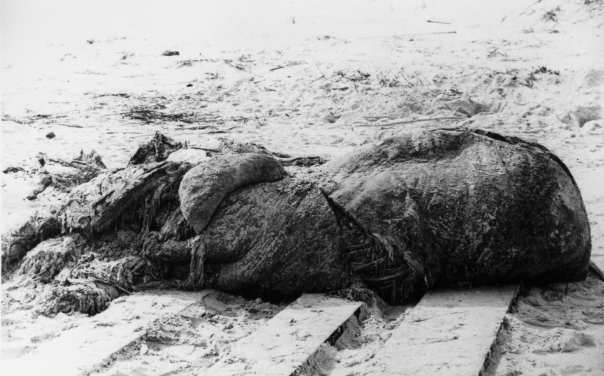
The St. Augustine Monster. Photo: Public domain
Decades later, in 1896, a globster washed up on Anastasia Island off St. Augustine, Florida. Two young boys were riding their bikes one November evening when they stumbled upon a hunk of pink slime and blubber. It measured 5.5 meters long and 2 meters wide. It looked like it once had large tentacles or arms that had been eaten off.
The boys alerted a local professor named Dewitt Webb, who consulted with other scientists. Addison Emery Verill from Yale University initially identified it as a new species of octopus. However, examining it further, he realized:
“The ridges at the mutilated end, then supposed to be the stumps of mutilated arms, seemed to confirm the view that the mass was the mutilated body of an octopus…As soon as specimens of the tissues were sent to me, even a hasty examination was sufficient to show that this view was not correct…The thick masses of tissue consisted almost wholly of a hard, elastic complex of connective tissue fibers of large size.”
Correcting himself, he stated that it was the remains of a whale. Nevertheless, the globster went down in local lore as the St. Augustine Monster.
‘Trunko’ the globster
In October 1924, another globster from Margate, South Africa, made the news. An article cited eyewitness testimony:
H.C. Ballance of the Margate estate here was walking along the seacoast when he saw two killer whales battling for life against a strange sea monster whose head reared up 20 feet above the surface of the sea. Ballance watched while the monster killed both whales and, exhausted, floated ashore on its back…
It was 47 feet long with a tail 10 feet long and two feet wide and, instead of a head, a trunk like an elephant’s, five feet long and 14 inches in diameter, but resembling a pig’s snout at the end. The monster was entirely covered with snow-white hair, 10 inches long.
The globster was nicknamed Trunko — after its supposed trunk, I guess. At first, witnesses mistook this globster for a giant polar bear because of its white fur. However, experts later suggested that the mass belonged to a sperm whale that might have had a large nose due to disease or old age.
As for it “battling” two killer whales, most likely the killer whales were playing with a dead whale carcass. It is very common for killer whales to fling their prey high in the air while feeding.
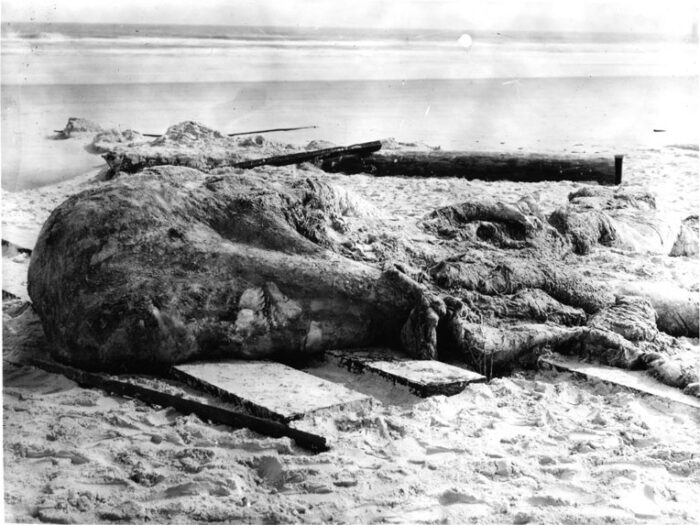
Another view of the St. Augustine Monster. Photo: Public domain
In 1977, a globster found off New Zealand differed from the others. A trawling vessel called the Zuiyo-maru discovered a brownish-red carcass with an exceptionally long neck and apparent flippers. Theorists pointed to its resemblance to the plesiosaur, a type of dinosaur.
Unfortunately for this exciting theory, a test of the creature’s amino acids determined it was a dead basking shark whose loose jaw gave it the appearance of a long neck. But that didn’t stop its cameo appearances in the Godzilla and Jurassic Park movies!
Not so extraordinary
Are we sensing a trend here? As exciting as the possibility is, globsters are not new, undiscovered species. On close examination, they turn out to be dead sharks or whales. Their startling appearance is what confuses people.
Just beneath a whale or shark’s blubbery skin lie several layers of collagenous connective tissue. As the animal decomposes — after prolonged exposure to the elements and to scavengers — these layers are eaten or rot away. What remains are minuscule tissue fibers as the collagen breaks down. Wave action turns the collagen into tiny strips that closely resemble hair or fur.
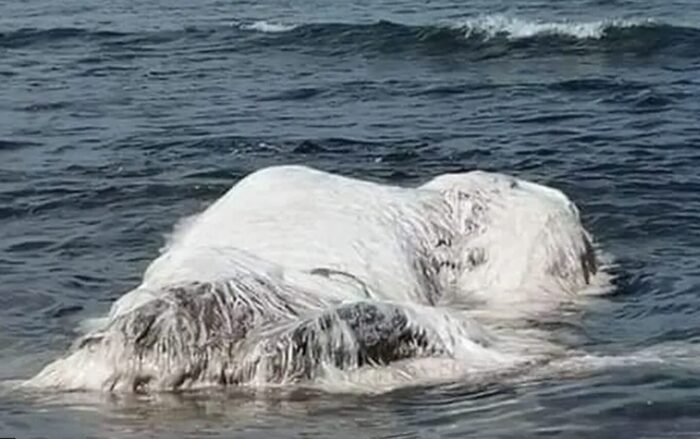
‘Hair’ globster in the Philippines. Photo: BBC
The same goes for other globsters such as the Tasmanian Globster of 1960 and the Chilean Blob of 2003. Both turned out to be highly decomposed whale carcasses. Back in the day, many globsters were at the mercy of imaginative scientific analyses predating DNA tests. Now they are no longer a mystery.
In 1962, Australian mammologist John Henry Calaby remarked, “I hate to raise the subject of the Tasmanian monster again, but some Tasmanians…apparently consider that the deflation of the monster was a blow to their national pride and are making sterling endeavors to keep it alive.”
Despite the evidence, it hasn’t stopped dreamers from concocting an extraordinary explanation of these blobs. Alas, globsters are just the unsavory byproducts of decomposition at work.