Apart from the rash of opinions, the tragedy that took 10 lives on Broad Peak on July 30 is better understood now. Some have offered analysis based on trackers, the mountain layout, and timelines. Climbers who were in Broad Peak Base Camp and on neighboring K2 have also begun to speak out.
From what we know, the avalanche was both lethal and so big that the 10 climbers in its path could not avoid it. If anything could have been avoided here, it was the 10-hour delay between when the avalanche occurred and when Base Camp realized something was wrong and radioed for assistance.
One of the rescuers, Abid Baid of Pakistan, has also given ExplorersWeb new details about the recovery operation. The Hunza climber is back in Skardu after a long trek from Broad Peak Base Camp. He plans to return to the mountain to recover the remains of his close friend, Sohail Sakhi, one of three victims who remain unaccounted for.
The avalanche
A huge avalanche struck 10 climbers in four teams at around 9:30 am Pakistan time on July 30, as they climbed between Camp 2 and Camp 3 on the normal route of Broad Peak. The snow swept away the climbers at around 6,600m. Their trackers revealed that they fell hundreds of meters and landed in an off-route area that was difficult to access. Two came to rest near the base of the mountain.
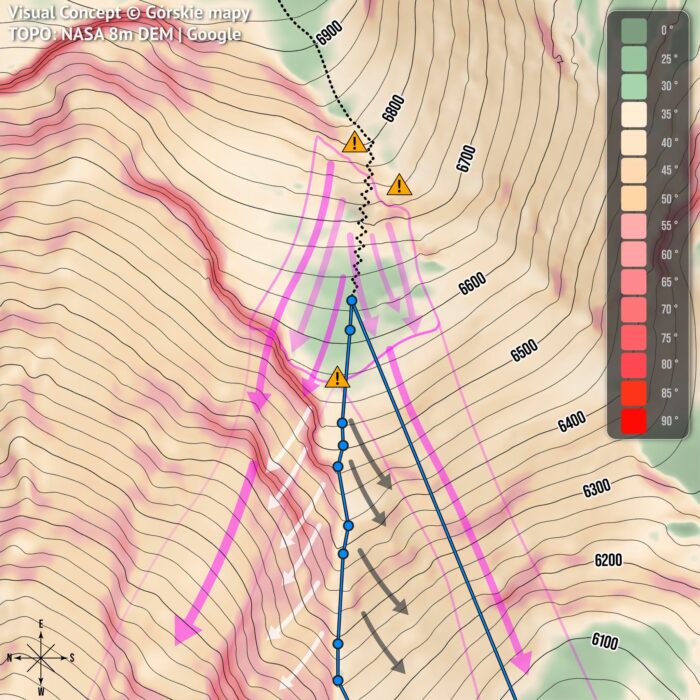
Flow of the avalanche, altitudes, and the tracker of Nirmal Purja, showing his upward climb. Graphic compiled by Gorskie Mapy
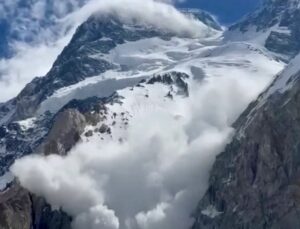
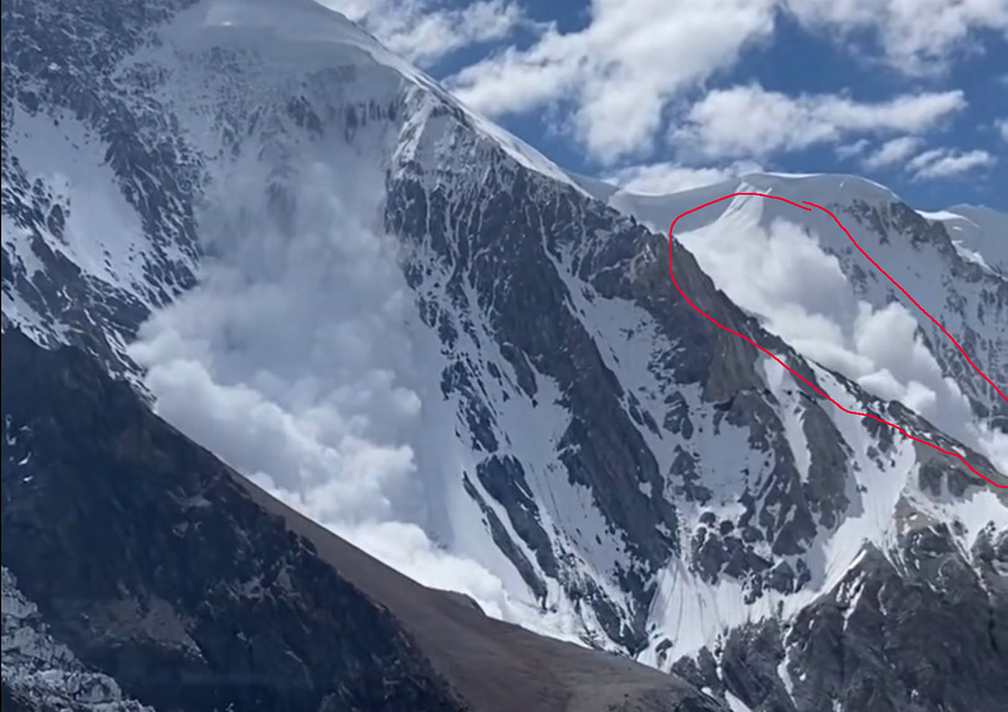
Looking at some videos of the avalanche shared by Jenjen Sherpa from neighboring K2, it seems the avalanche came from a snowy rib located up and to the right of Camp 3. Rather than a slab avalanche like the one on Shisha Pangma in 2023, killing two American women and their guides, the Broad Peak slide might have been triggered by a cornice or serac falling from that rib. It was massive and violent enough to sweep the climbers off the normal route, which follows a kind of ridge, toward one of the adjacent gullies:
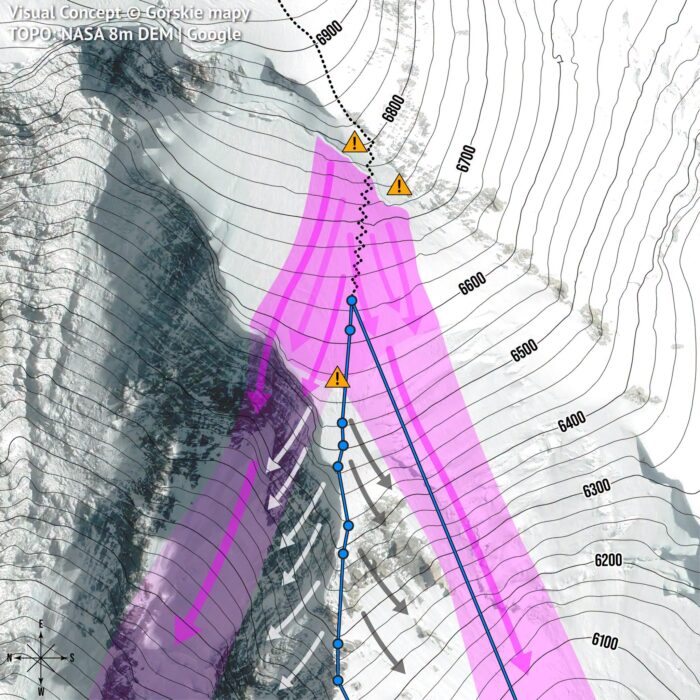
The avalanche flowed on both sides of the ridge around the normal route and into two surrounding gullies. (See Nirmal Purja’s line of ascent in blue.) Graphic compiled by Gorskie Mapy
The silence
The disaster came as a surprise to everyone, including the rescue services of the Pakistani Air Force, who didn’t learn of a potential incident until 10 hours after it occurred. Everyone wondered: How can such a calamity go unnoticed for an entire day?
Jenjen Lama, in charge of the Seven Summit Treks (7ST) expedition on neighboring K2, told Everest Live that the delay occurred because no one thought anything was wrong. Jenjen Lama saw the avalanche and even filmed it from K2. He called the 7ST team at Broad Peak Base Camp and suggested they check with their climbers to see if anyone had been affected.
He explained that although none of the Broad Peak climbers answered radio calls from their Base Camp, no one was worried at first. According to Jenjen, everyone figured the guides had turned their radios off to save power. There is no cell phone or internet connection at the Baltoro 8,000’ers, and Starlink is not permitted.
It was only in the evening that they started to wonder why no one had called in. They asked someone from 7ST in Kathmandu (!) to check the climbers’ trackers. Then they saw the sudden loss of altitude on some of them and raised the alarm.
Jenjen posted a high-quality video of the Broad Peak avalanche on TikTok, which looks to have been filmed from the glacier:
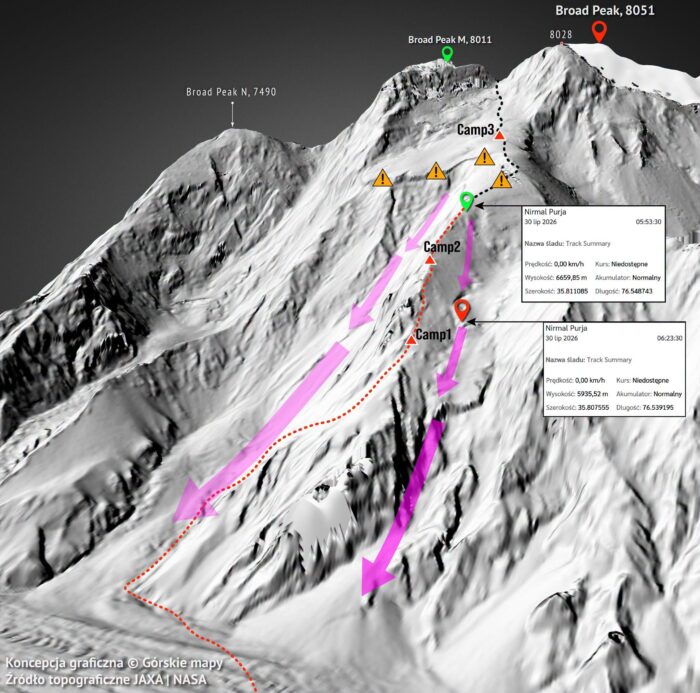
The avalanche flow on Broad Peak and the route to Base Camp in red. Photo: Gorskie Mapy
Catastrophe unnoticed
Abid Baig of Hunza had climbed Gasherbrum II on July 21 and then went to climb K2. “We were on the summit push of K2, and I was at Camp 2 personally on July 30,” he told ExplorersWeb from Skardu.
Baig said he didn’t see the avalanche himself and only heard of the accident on the radio that evening. He was not sure whether Jenjen Lama had filmed the right avalanche.
“I think he had filmed another avalanche because the route of the avalanche is [through] a deep, low valley/gully. Either that, or he might have observed the moment when it was breaking between C2 and C3,” Baig noted. Baig knows the area well because he was one of the rescuers who risked their lives to find and retrieve the bodies.
Baig also confirmed to us that the normal route, and therefore the avalanche, may not be visible from Broad Peak Base Camp, which is usually further up the glacier.
“Actually, there were no climbers at BC on the 30th because all of them were either on K2 or BP,” he said. “Some staff members apparently saw the slide, but they thought it was a normal thing, as seeing avalanches on the mountains from Base Camp is pretty normal.”
On July 31, helicopters flew to Broad Peak, but the main rescue effort came from K2. There, the guides — all related to those on Broad Peak — aborted their summit pushes and hurried to help. Mingma G of Imagine Nepal took the lead, but others went with him.
From rescue to recovery
“I decided to call off my expedition on K2,” Baig said. “Sohail [Sakhi, also from Hunza] was my friend, and I hoped I might find him injured and in need of help, so I went down immediately. But when we arrived at the scene the next day [July 31], we realized that there’s nothing left to be hopeful about.”
Instead, the rescuers became a recovery team, determined to retrieve the bodies from the avalanche site.
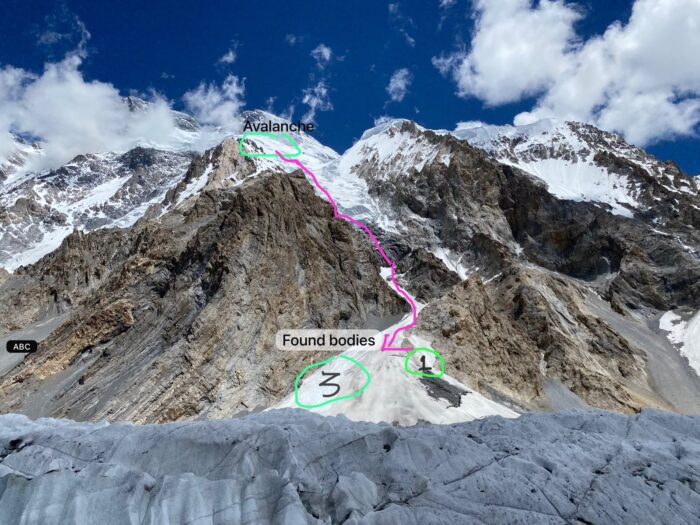
Location of Purja, Wang, Nima Sherpa, and Kilu’s bodies after the avalanche. Topo provided to ExplorersWeb by Abid Baig
Close call
As Mingma G reported last week, the recovery team had to deal with difficult terrain and fresh avalanches. One avalanche occurred while they were trying to recover the body of Nawang Thindu, which was located above the rest.
“Sirbaz Khan and I narrowly escaped,” Baig confirmed. Here is his description of the events:
On the third day after the incident, we were probing the debris at noon [looking for buried bodies] when we suddenly heard a huge sound coming from the direction of the [original] avalanche. We immediately ran toward the side of the corrie and took shelter in the rocks.
The avalanche then came down right in front of us, completely covering the previous debris with another layer of ice and snow. At that point, our chances of finding Sohail became slimmer, as the new avalanche had buried him even deeper.
The avalanche also buried Baig’s backpack with his phone, Garmin, and drone, which are valuable assets for a Pakistani guide. However, he simply had no time to grab anything; he just ran for his life.
Back for Sohail
The search to find and recover the three bodies of guide Sohail Sakhi of Pakistan, his client Sarah Mallory Geis of the U.S. — both still missing — and Nawang Thindu Sherpa — whose remains were unreachable by the recovery party — has been temporarily suspended after more than a week. The Alpine Club of Pakistan said the efforts will resume once conditions improve and the terrain is safer.
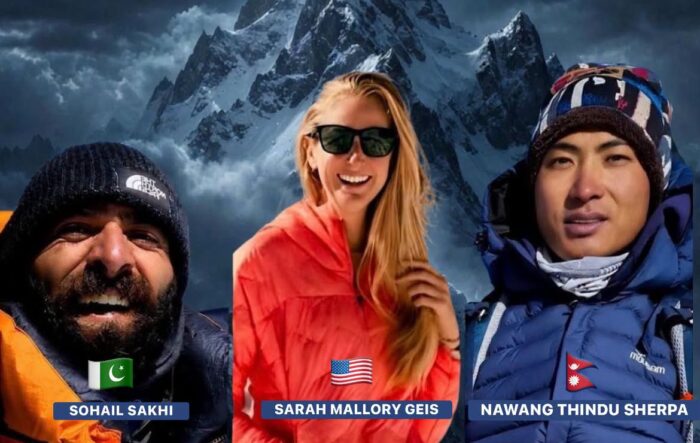
File images of the climbers remaining on Broad Peak, compiled by Agus S. Maruf.
Abid Baig insists that he and 14×8,000m summiter Sirbaz Khan will return to the mountain by the end of September. By then, they hope, the avalanche debris will have melted enough to expose the bodies of Sakhi and Geis.
Purja’s body was repatriated to the UK, since he was a British citizen. The Nepal Mountaineering Association had hoped to bring the body to Nepal for a tribute before it was then flown back to England. The remains of Kili Pemba “Kilu” Sherpa, Nima Sherpa, and Gyalu Sherpa will be sent to Kathmandu tomorrow, Tuesday.
Cooperation is key
It is surprising that there is no protocol for climbers to check with Base Camp over the radio to confirm they are okay after a big avalanche in their area.
In addition, climbers on Pakistan’s 8,000m peaks have reported this year a lack of communication and resistance to sharing information among commercial teams. With teams only aware of their own climbers, they couldn’t know that no one in any of the four teams had checked in for 10 hours. Likewise, someone could have seen the alarming movement in the climbers’ trackers.
In this case, a swift search would not have saved anyone, but it might do so in future disasters.
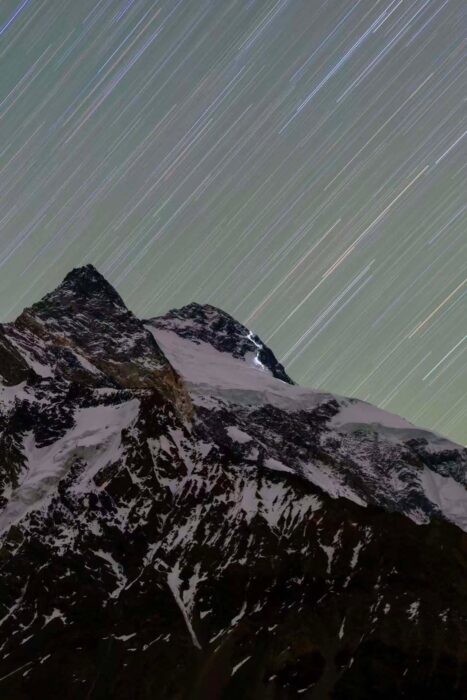
Broad Peak under the stars. Photo: Karakorum Expeditions