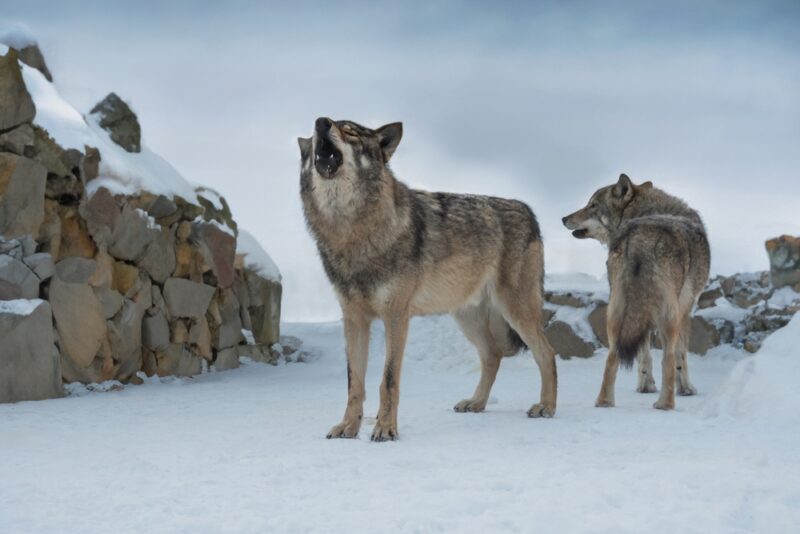
Remains on a small island in the Baltic Sea suggest that humans kept and cared for wolves for thousands of years before they domesticated dogs.
Archaeologists unearthed two 3,000 to 5,000-year-old canid bones from prehistoric grey wolves inside a cave on the Swedish island of Stora Karlsö. This might sound fairly innocuous, but the island has no native land mammals and is surrounded by a huge expanse of water. Wolves couldn’t have swum to the island on their own. Researchers believe that people brought them there by boat.
Finding wolf bones in prehistoric human settlements is very rare. Wolves were sometimes used in rituals or killed for their fur, but the bones found were large body bones, which would not usually be left behind in either of these scenarios.
The team behind the new study analyzed the ancient DNA and confirmed the remains did not belong to early dogs but to true wolves with no detectable dog ancestry. The analysis also revealed little genetic diversity, a trait commonly observed in controlled populations.
“While we can’t rule out that these wolves had low genetic diversity for natural reasons, it suggests that humans were interacting with and managing wolves in ways we hadn’t previously considered,” said co-author Anders Bergström.
Photo: Shutterstock
Shared people’s diets
Chemical tests on the bones revealed that the wolves’ diet was rich in seal and fish. This perfectly mirrors the diet of the human seal hunters and fishers who used the cave during the Stone and Bronze Ages. This again suggests a relationship in which humans provided the wolves with food.
“Not only did they have ancestry indistinguishable from other Eurasian wolves, but they seemed to be living alongside humans, eating human food, and in a place reachable only by boat,” explained lead author Linus Girdland-Flink.
On top of this, one specimen shows clear evidence of a severe limb injury that would have hindered movement and made hunting difficult. Despite this, the grey wolf survived despite its injury, which raises the possibility that humans cared for it.
Though it is clear there was some kind of relationship between the wolves and humans, it is unclear whether they were working animals or companions, and how tame the wolves really were. The story of dog domestication is a complicated one. Some believe that wolves were gradually drawn into human camps, scavenging near settlements, and adapted to our presence over time. Others think humans actively reared wolf pups in an attempt to domesticate them.
We do know their domestication likely involved several regions and started over 15,000 years ago. This research only adds to the narrative, showing that humans and wolves seem to have lived side-by-side, and that it was not mere coexistence.