This week, SpaceX launched its 10,000th satellite into low-earth orbit. Many of us have seen chains of these satellites in the pre-dawn hours, moving in formation across the night sky before settling into position. It’s been a boon for good internet connection in remote regions. Norwegian polar traveler Borge Ousland used a SpaceX Mini for the first time on his journey across Ellesmere Island with Vince Colliard last year. Ousland was surprised by how well it worked; almost too well.
“I felt I had to do two hours of office work in the tent every night,” he told ExplorersWeb.
Satellite internet at a cost
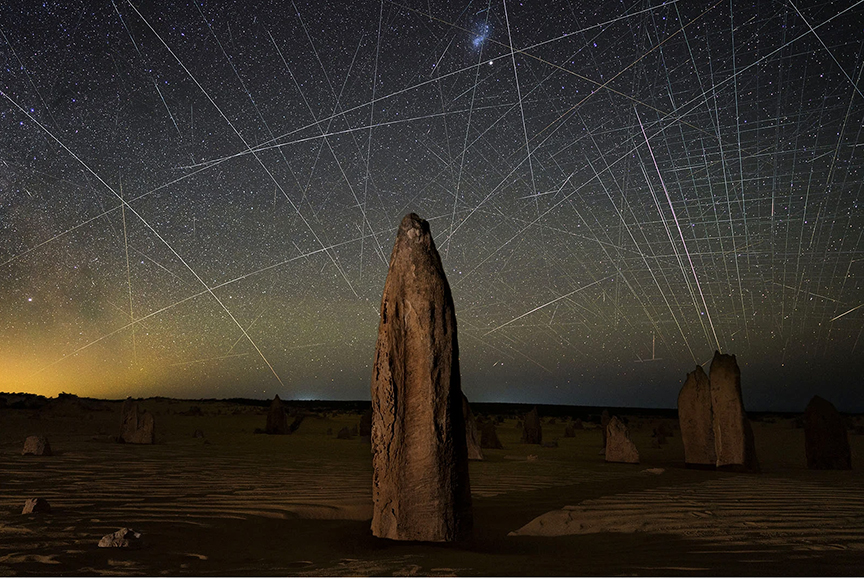
But the convenience of an internet connection comes at a cost beyond our inability to get away from the office. For years, astronomers have complained that satellite light pollution is getting in the way of their space telescopes. Back in 2022, astrophotographer Joshua Rozells went to Western Australia to shoot star trails against the hulking limestone pinnacles. He set up his tripod and an intervalometer that triggered his camera every few seconds. After 85 minutes, he had 343 images. Every one of them contained at least one satellite streak.
He’d seen satellite streaks in his images before, but their ubiquity here surprised him. In Photoshop, he digitally sandwiched the images together, showing just how crowded the night sky was with satellites. The satellite trails are not cloned; this is what the night sky looked like, even in that remote corner of Western Australia, if you left the shutter open long enough.
The image won Rozells a category prize in a photo contest put on by Australian Geographic. “The issue has gotten progressively worse,” he told the magazine at the time.
Four years later, there are thousands more satellites than when he created this image. “[It] is getting exponentially worse, and it will continue to do so if we do not take major steps to mitigate the problem,” he told the photo site PetaPixel this week. “In most countries, there are very few restrictions for launching satellites.”