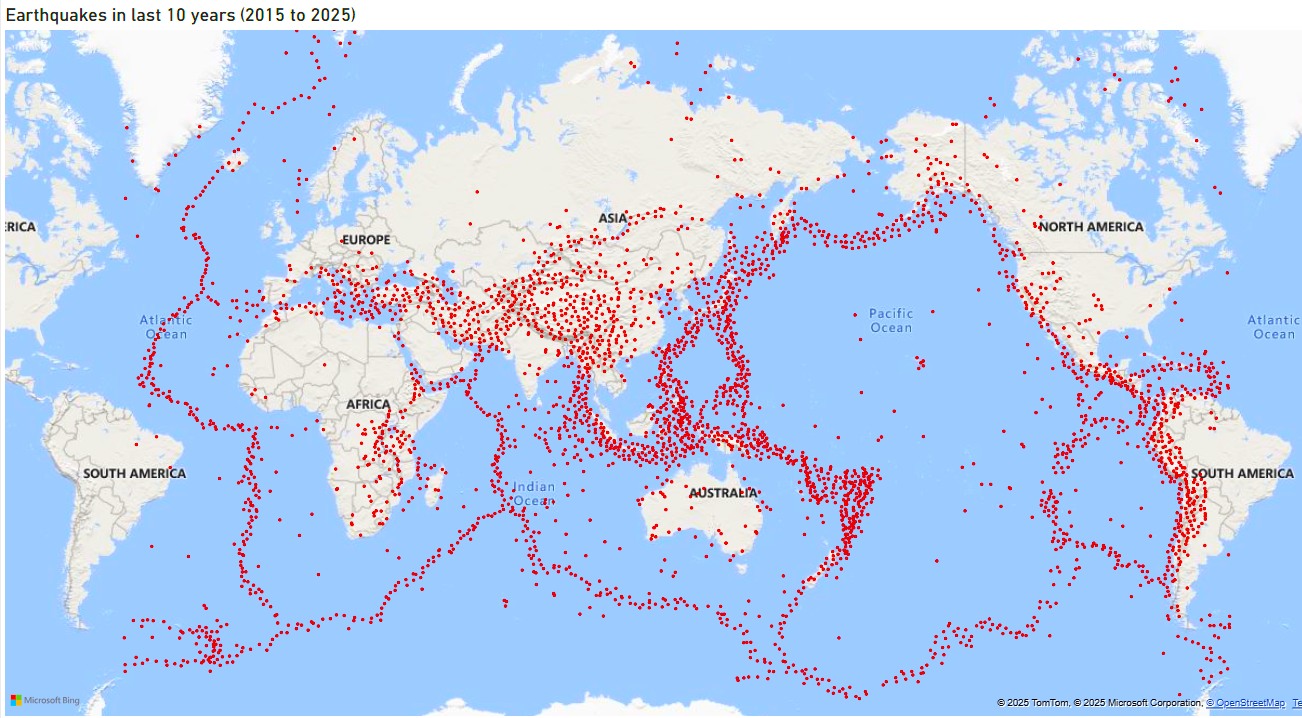
A map of earthquakes between 2015 to 2025 shows a near-continuous flicker of convulsions around the world. The pattern reveals the locations clearly: The dense clusters of dots coincide with the planet’s tectonic plates.
What is perhaps most surprising is the sheer number of earthquakes that occur. Over the last 24 hours, 1,518 earthquakes have been recorded, according to data from Volcano Discovery. In the last 10 years, there have been a staggering 4,884,014. Despite this, most of us would say that we have never felt one, and only the occasional large earthquake makes global headlines.
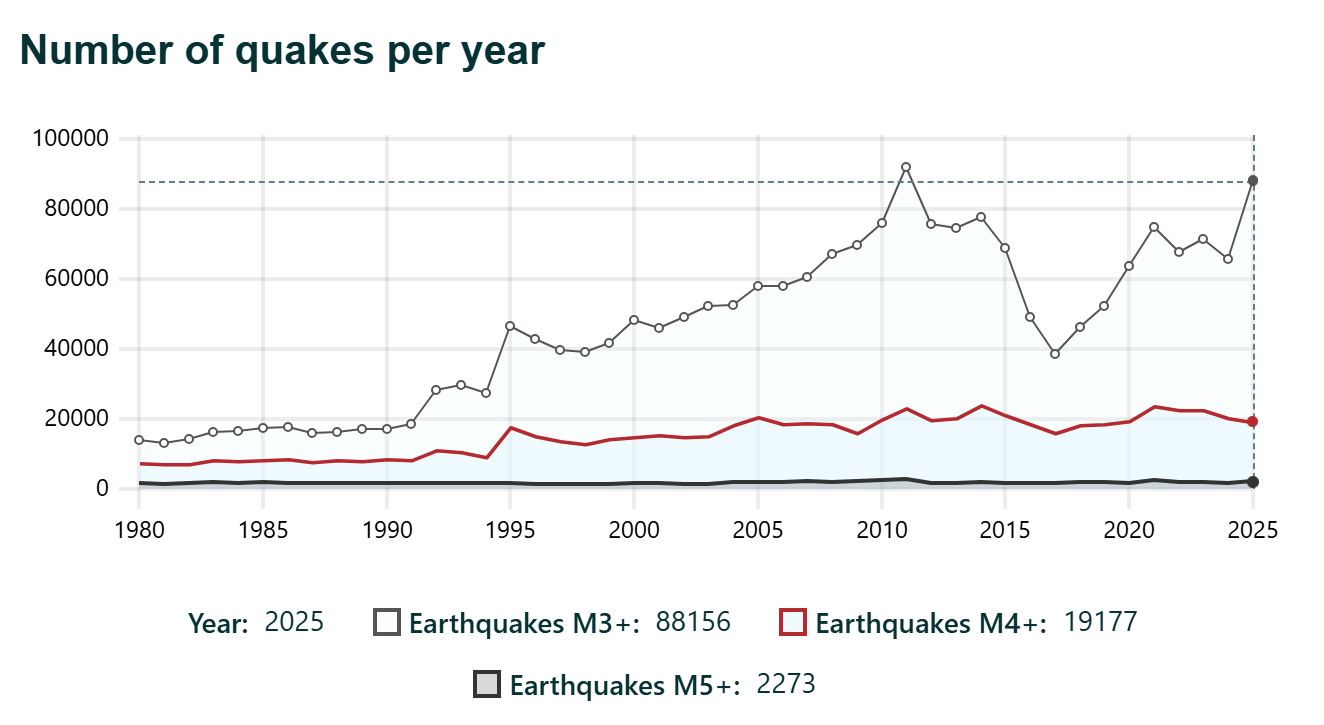
Graph showing the number of M3, M4, and M5 earthquakes annually since 1980. Image: Volcano Data
The reason is that almost 64 percent of these earthquakes have magnitudes below 2.0. These are too weak for us to notice, but seismometers easily register them. A further 22 percent fall between magnitude 2.0 and 2.9. Again, these are often imperceptible — no worse than the vibrations of a passing truck. These small tremors account for most of the recorded earthquakes.
It may seem as if the number of earthquakes has risen in recent decades. Instead, what has changed is our ability to detect them. Seismic networks have expanded, and modern instruments are far more sensitive and can register even microquakes that would previously have gone unrecorded. In fact, seismic activity has remained relatively stable.

However, this activity is unevenly distributed across the globe. For nine of the last 10 years, the United States has recorded more earthquakes than any other country. This is likely due to its extensive seismic monitoring network and the active plate boundaries in Alaska and the western states.
This year, Japan topped the list with 160,079 recorded earthquakes. The vast majority of these were harmless. Only 5,954 exceeded magnitude 3, and just 149 reached magnitude 5, the level at which light structural damage starts to occur.
Despite the sheer number of tremors worldwide, devastating earthquakes remain rare. On average, there are around 15 earthquakes of magnitude 7 or higher per year. Of the 50 largest earthquakes since 1900, only one has occurred in the past decade.
On July 30, 2025, a magnitude 8.8 earthquake struck about 71 kilometers offshore from Russia’s Kamchatka Peninsula, in the North Pacific Ocean’s Kuril-Kamchatka subduction zone.
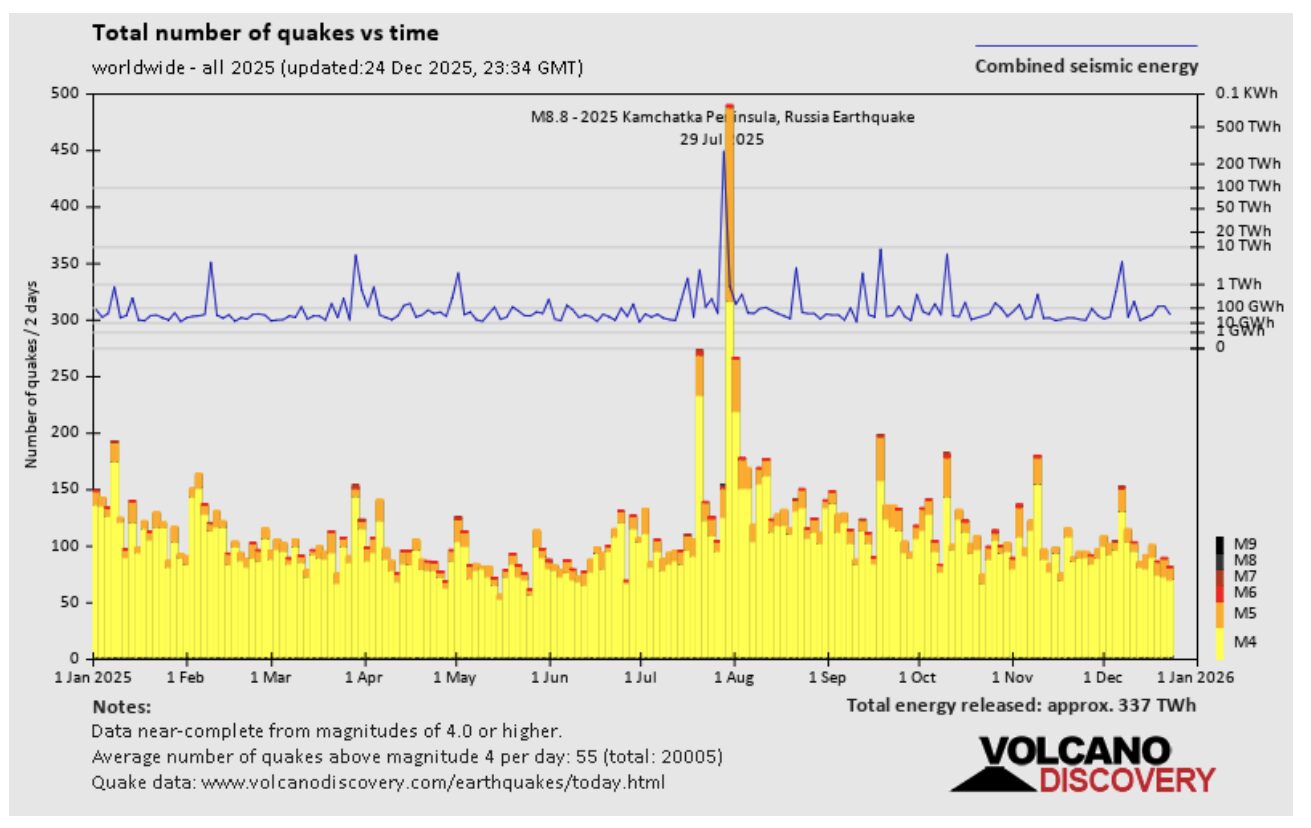
Graphical representation of the earthquakes in 2025. Image: Volcano Data
The quake generated a tsunami and triggered the eruption of seven volcanoes in the geologically unstable region. According to the U.S. Geological Survey, at least four people were injured, and 55 homes and several buildings were damaged near Petropavlovsk-Kamchatsky, the regional capital of Kamchatka.
Additionally, at least 106 buildings were damaged in nearby Sakhalin, and the tsunami destroyed several port structures. The tsunami also damaged the harbor at Crescent City, California.
It is the largest earthquake recorded globally since Japan’s 2011 Tōhoku event and ranks among the top 10 largest ever observed.
A decade’s worth of global data shows that earthquakes are not the rare events we believe them to be. The majority just pass silently beneath our feet.