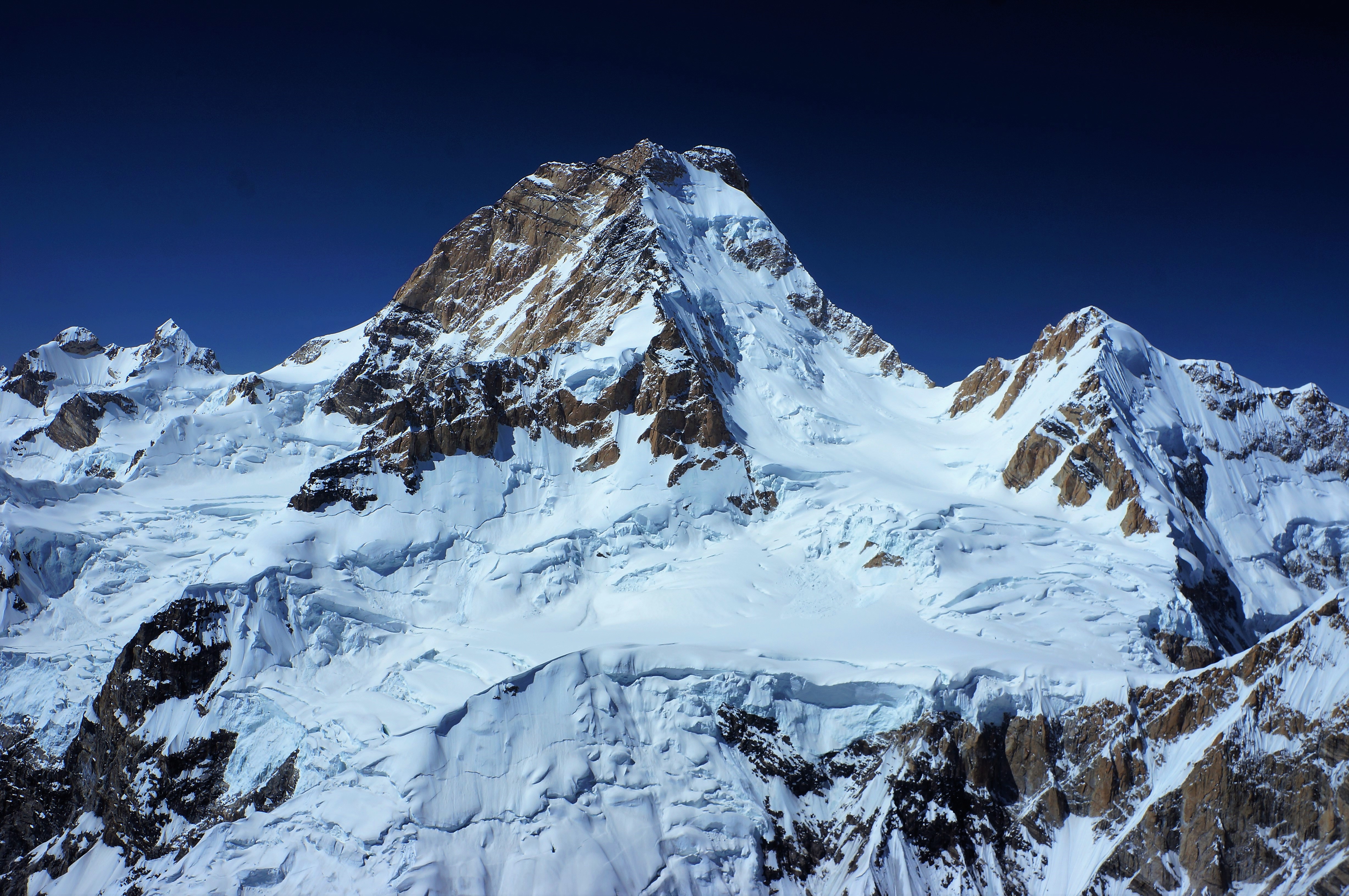
Masherbrum, also known as K1, lies in Pakistan’s Karakoram range. At 7,821m, this elegant but difficult pyramid is the 22nd-highest mountain in the world. Just four expeditions, totaling about 15 climbers, have summited it. Its last ascent was 41 years ago.
In the following weeks, Czech and Colombian teams are preparing to add their names to the short list of summiters. It’s a good time to look back at some of the most interesting moments of Masherbrum’s climbing history.
The peak’s graceful appearance from many angles has earned it the local Balti name of Masherbrum, often translated as Queen of Peaks. Some older interpretations link the name to darker connotations, including “Doomsday Mountain,” though the precise etymology remains debated.
In 1856, during the Great Trigonometrical Survey of India, British Lieutenant Thomas Montgomerie observed several prominent peaks in the Karakoram from a distant station in Kashmir. Unable to approach closer at the time, he assigned them temporary alphanumeric labels: K1, K2, and so on, with “K” standing for Karakoram.
K1 referred to what is now called Masherbrum. Surveyors later confirmed the local Balti name for this peak, while the second-highest mountain in the world, K2, retained its alphanumeric designation because no widely recognized local name emerged during the early mapping efforts. The system was never intended to be permanent, yet it stuck for the more remote K2, while K1 quietly reverted to Masherbrum.
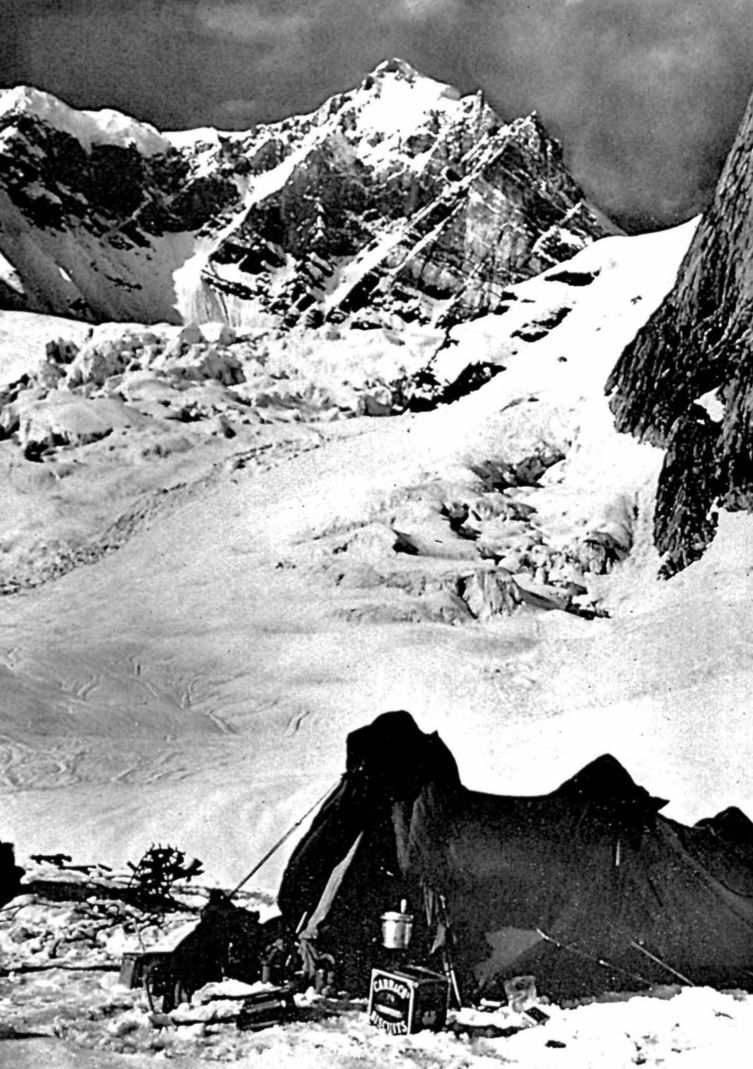
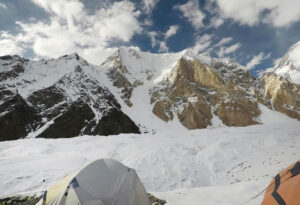
Camp 1 with the third icefall and Serac Peak behind, in 1957. Photo: Joseph Walmsley/Alpine Journal
A demanding peak
The mountain’s sparse climbing history reflects its demanding character. Objective hazards such as avalanches, seracs, cornices, and sudden storms, combined with remoteness and short weather windows, have kept successful ascents rare.
There have been approximately 10 to 12 unsuccessful attempts, most recently in 2022, when Czech climbers Marek Holecek, Radoslav Groh, and Tomas Petrecek attempted the unclimbed West Face, reaching 7,300m.
Masherbrum’s slightly lower southwest summit (7,806m) has had just one reported ascent.
Early reconnaissance and the 1957 tragedy
Serious climbing attempts began in the 1930s. A 1938 British expedition led by Major James Waller explored the Southeast Face but retreated well below the summit amid storms and frostbite. A 1955 New Zealand party pushed high on the same face, reaching about 7,100m, before early-season snow and exhaustion forced them to abandon their effort.
The 1957 Manchester Himalayan Expedition, led by Joseph Walmsley with Bob Downes as deputy leader and Don Whillans as a key member, made a determined attempt on Masherbrum via the Southeast Face. The team established a series of camps up the Serac Glacier and on the steep slopes of the Dome, often through deep, soft snow.
They placed Camp 6 at approximately 7,315m. From here, Whillans and Geoffrey Smith made the first summit bid but encountered poor snow conditions in the final couloir between the North and South summits. They bivouacked at 7,560m before retreating in worsening weather.
On the night of July 18–19, Downes (who had moved up with Walmsley as the next assault team) developed a severe racking cough and breathing difficulties at Camp 6. He died the following morning, almost certainly from high-altitude pulmonary edema. Storms pinned the survivors at the high camp for several days.
After bringing the body down, Whillans and Walmsley made a further attempt. They reached a highest point of 7,711m, within about 100m of the main (North) summit. Soft, unstable snow in the final couloir and slow progress on the left-hand rocks forced them back. They left a fixed 90m rappel rope on the rocks at that point.
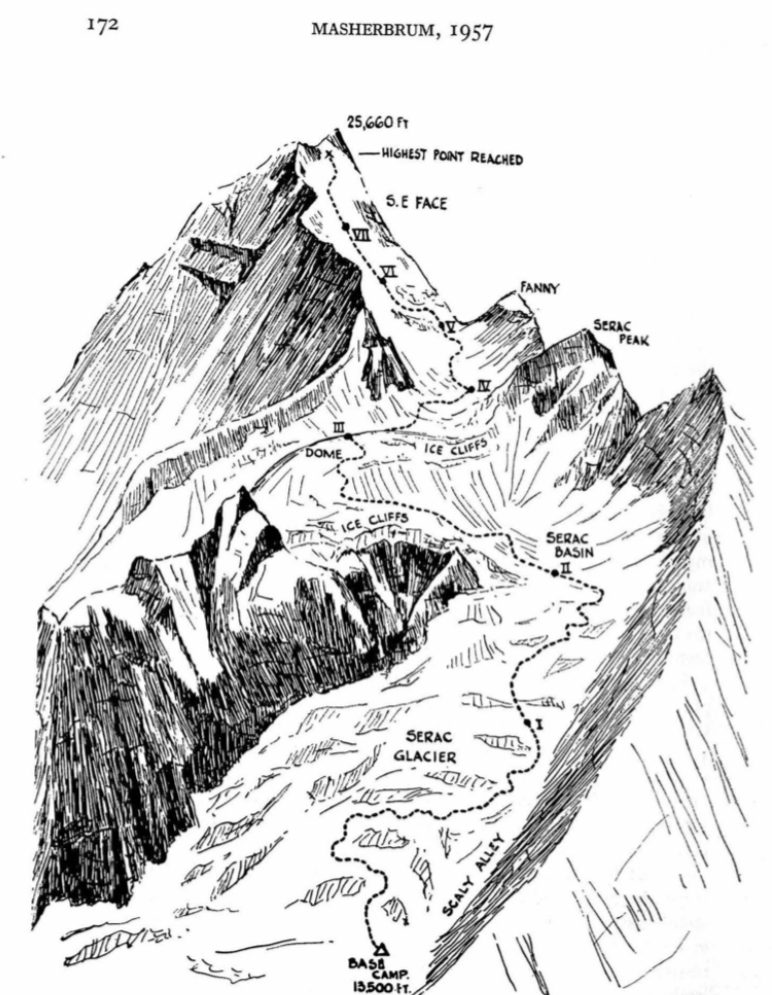
Masherbrum Southeast Face and Serac Glacier, showing the 1957 route. Sketch by R.O. Downes/ Alpine Journal
The first ascent
Success finally came in 1960 with the American-Pakistani Karakoram Expedition, directed by Nick Clinch and with George Bell as climbing leader. The team included Willi Unsoeld, Tom Hornbein, Dick Emerson, and some Pakistani officers, notably Captain Jawed Akhter Khan.
The party followed the Southeast Face using traditional siege tactics: fixed ropes, a series of camps reaching 7,315m, and coordinated movement through serac fields, icefalls, a dome feature, an upper basin, and the final couloir with rock steps and a knife-edge ridge.
On July 6, Unsoeld and Bell successfully reached the main summit, followed two days later by Clinch and Jawed Akhter. Khan’s achievement marked a historic milestone as the first Pakistani to summit a major Karakoram peak. The expedition also managed to climb the subsidiary Serac Peak. Despite frequent avalanches and storms, careful preparation combined with favorable weather windows ultimately secured their success.
The first alpine-style attempt
By the late 1970s and early 1980s, some climbers began favoring lighter, more independent approaches. French alpinist Christine de Colombel and her partner, American David Belden (an experienced guide, photographer, and writer on mountain philosophy), were among the first mountaineers who opted for alpine-style on a major Karakoram peak.
In the spring-summer of 1980, they attempted a two-person alpine-style ascent of Masherbrum. They carried all their own equipment, used no high-altitude porters, fixed no ropes, and took no supplemental oxygen.
De Colombel and Belden arrived at base camp on June 16 and examined the unclimbed West Ridge, but judged the hazards too great, due to seracs and avalanches. Turning to the Southeast Face, they made steady progress despite the worsening weather in what Belden later described as one of the worst seasons in 25 years.
In mid-July, the duo reached 6,200m in repeated bad weather. During an early August push, they bivouacked at 7,000m, then struggled up to 7,200m on the Southeast Face. The weather and terrain were worsening.
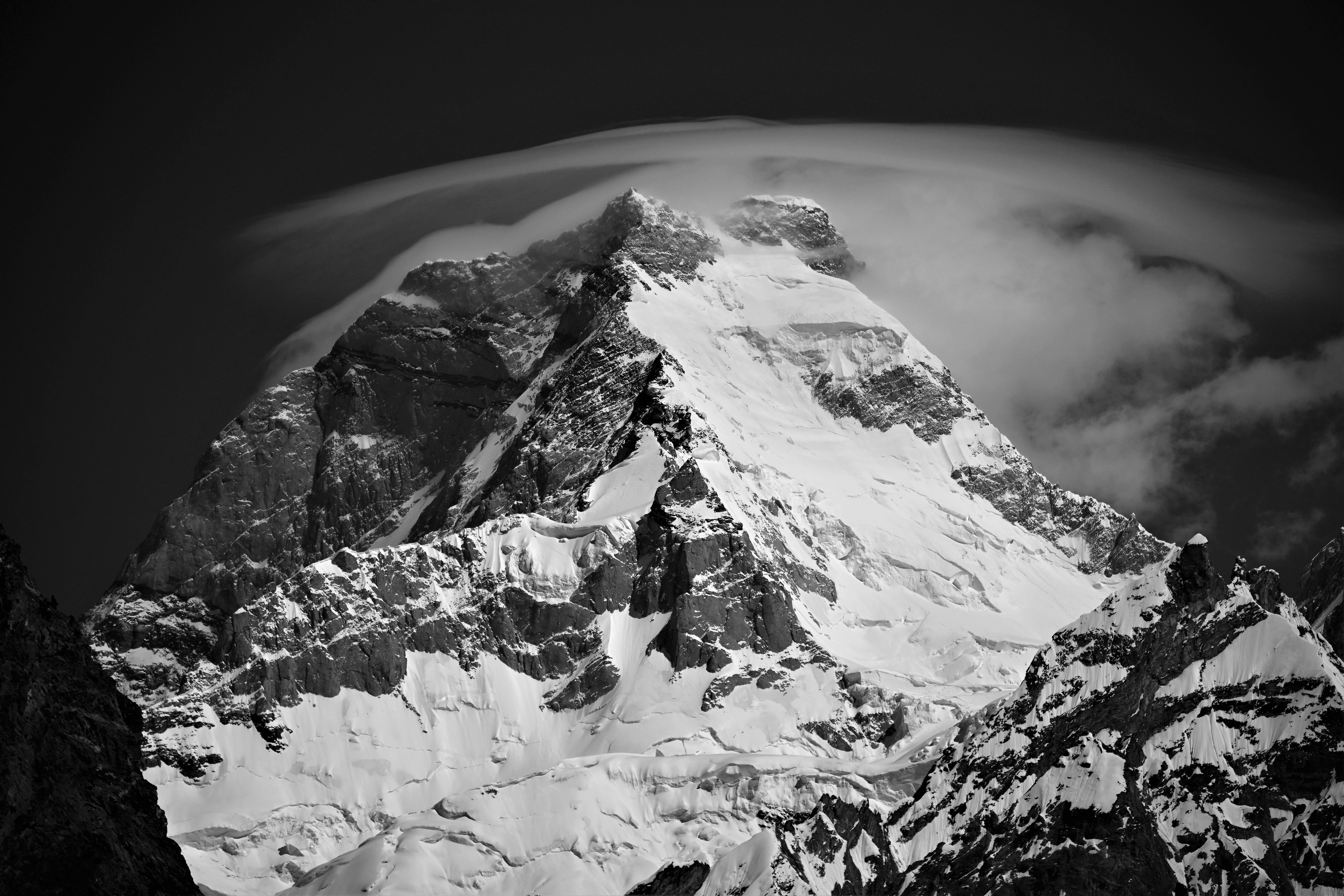
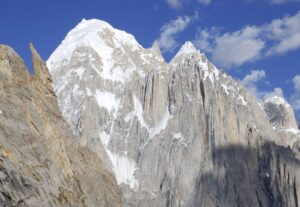
Masherbrum. Photo courtesy of Sebastain Alvato for ExplorersWeb
Avalanches
Reaching 7,200m on August 8, the duo were caught by heavy snowfall and repeated avalanches. One slide swept away their tent, leaving De Colombel with bruised and fractured ribs. They sheltered under an ice cliff while slides thundered past, enduring days of intense psychological strain.
De Colombel later wrote in her 1981 book Voyage au bout du vide: Une cordée alpine au Masherbrum (”Journey to the end of the void: An alpine rope team at Masherbrum”) about the dramatic tension of the avalanche ordeal:
Two days already. Two days that the mountain relentlessly collapses with a dull roar. We who had the immense insolence to believe that the summit was for the next day, at this hour we are cowering under an ice cliff. In the hollow of these breaking waves from the summit slopes, we are trapped like rats. Impossible to go up, impossible to go down…We are at 7,200m in the storm, and nothing can distract us from this anguished wait: Which avalanche will smother us in its shroud?
With de Colombel injured and visibility near zero, they began a difficult three-day descent to base camp. Navigating steep, avalanche-prone slopes in a storm with limited gear and one partner compromised, tested their limits. Finally, they reached safety.
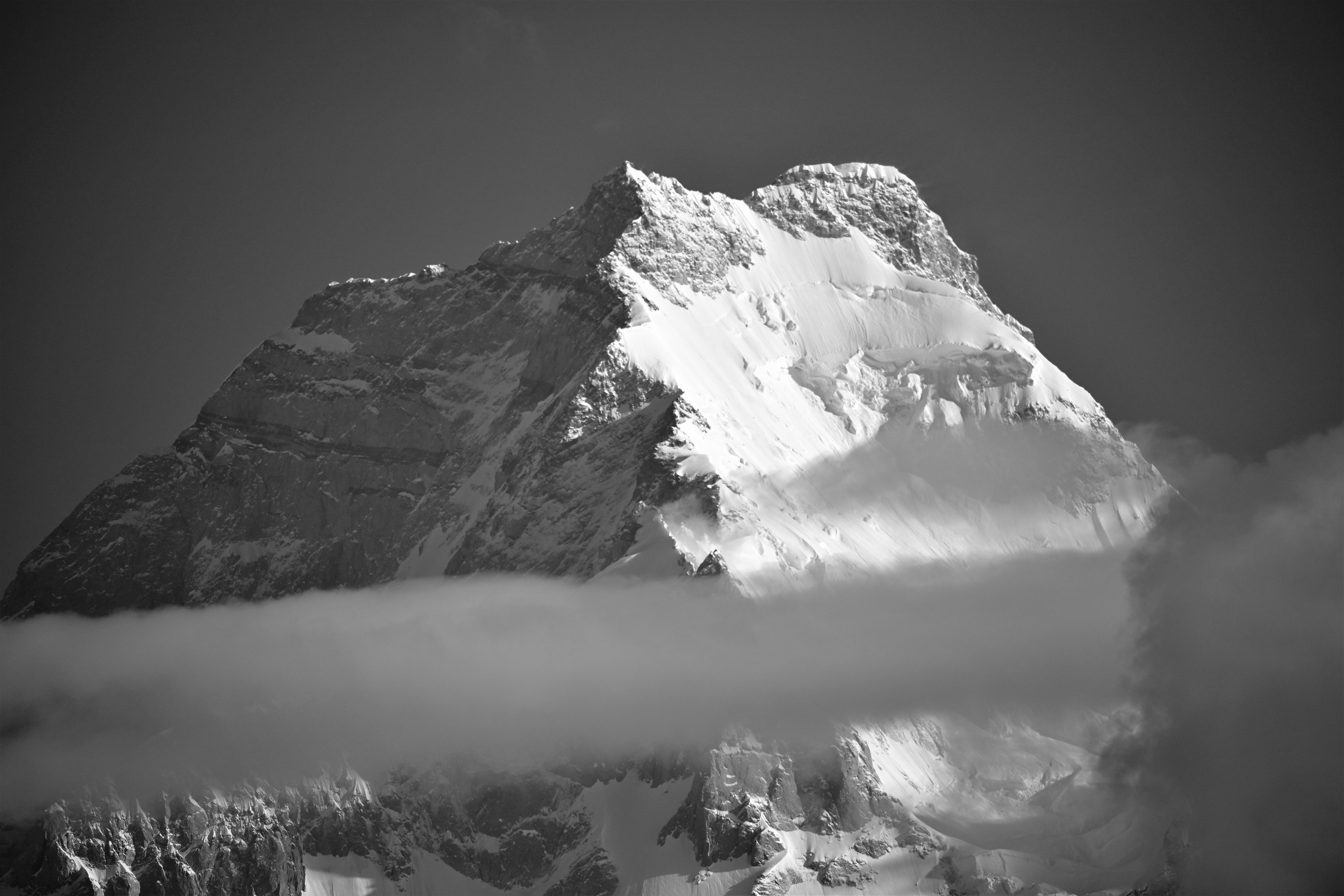
Masherbrum. Photo: Sebastian Alvaro
The Southwest summit and tragedy
In 1981, a Polish expedition led by Piotr Mlotecki targeted the unclimbed Southwest summit (7,806m) of Masherbrum, then regarded as the highest virgin summit in the Karakoram. On September 17, Zygmunt Andrzej Heinrich, Marek Malatynski, and Przemyslaw Nowacki overcame the steep Southeast Face (ice sections, a serac barrier, a col, and a final ridge with cornices and gendarmes) to reach the top.
The descent turned catastrophic. An unplanned high bivouac on an exposed ridge in deteriorating weather claimed the lives of Malatynski and Nowacki from extreme cold and exposure. Heinrich, who had found slightly better shelter on the lee side, discovered them the next morning. He continued alone, surviving a long fall down ice cliffs before reaching the lower camps. The bodies remained on the mountain. A concurrent British RAF expedition reached about 7,130m on the main peak without summiting.
Later ascents of the main summit
Two further ascents of the main summit occurred in the mid-1980s. In August 1983, a Japanese team repeated the 1960 American route, with two members – Masahiro Nomura and Takeyasu Minamiura – reaching the top.
In 1985, on consecutive days in July, both Japanese team (via the North Ridge – Northwest Ridge- Northwest Face), and an Austrian team (via a technical Northwest Face route involving rock and ice climbing) reached the summit.
Regarding the 1985 Japanese route, it involved traversing across the Northwest Face to the col between the Main and Southwest peaks, after navigating from the North Ridge through the Northwest Ridge. The ascent involved transitioning from the lower North Ridge, moving right to the Northwest Ridge, and finally traversing the face due to poor rock conditions. According to the expedition report in the American Alpine Journal, “as they climbed toward the summit ridge, the team found the body of one of the Polish climbers, Malatynski or Nowacki, who in 1981 tragically died after making the first ascent of Masherbrum Southwest.”
These remain the last confirmed ascents of the main summit on record.
In 1988, an Italian team made the first ascent of the subsidiary Masherbrum Far West (7,200m) via its West Face.
Further attempts
Subsequent expeditions have generally ended in retreat. A 1995 American South Face attempt reached 6,888m before an unexpected storm with deep snow and high avalanche risk forced their descent. Further attempts on the mountain via various routes—including expeditions on the North Ridge, East Ridge, and Northeast Face between 1985 and 2006 — were halted by severe weather, serac falls, or highly avalanche-prone slopes.
A 1991 British commercial expedition succeeded in putting 14 clients on a disputed subsidiary peak they called Masherbrum II. They claimed its altitude was 7,200m, but later assessments, based on altimeter comparisons and photographs, suggest the true height was closer to 6,600m.
At the same time, another British team, led by David Hamilton, attempted the main summit from the Hushe Valley side. They reached approx. 6,250–6,500m before retreating in bad storm conditions. This second group took photographs from high on the main peak that directly disputed the commercial team’s claimed height and topography of the subsidiary peak, adding further discussion around the mountain’s complex massif. Neither effort produced success on the main summit.
A notable modern effort came in 2013–2014 when David Lama, Hansjorg Auer, and Peter Ortner attempted the unclimbed Northeast Face in alpine style, advancing only about 400m up the base of the wall before turning back due to extreme avalanche danger.
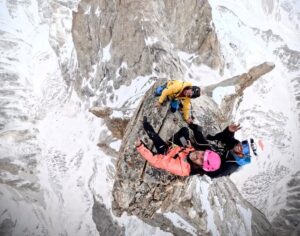
In 2022, a powerful Czech trio attempted the unclimbed West Face of Masherbrum in alpine style. Here, Radoslav Groh and Marek Holecek reached 7,300m. Groh is a member of the Czech team that aims to climb Masherbrum this summer.
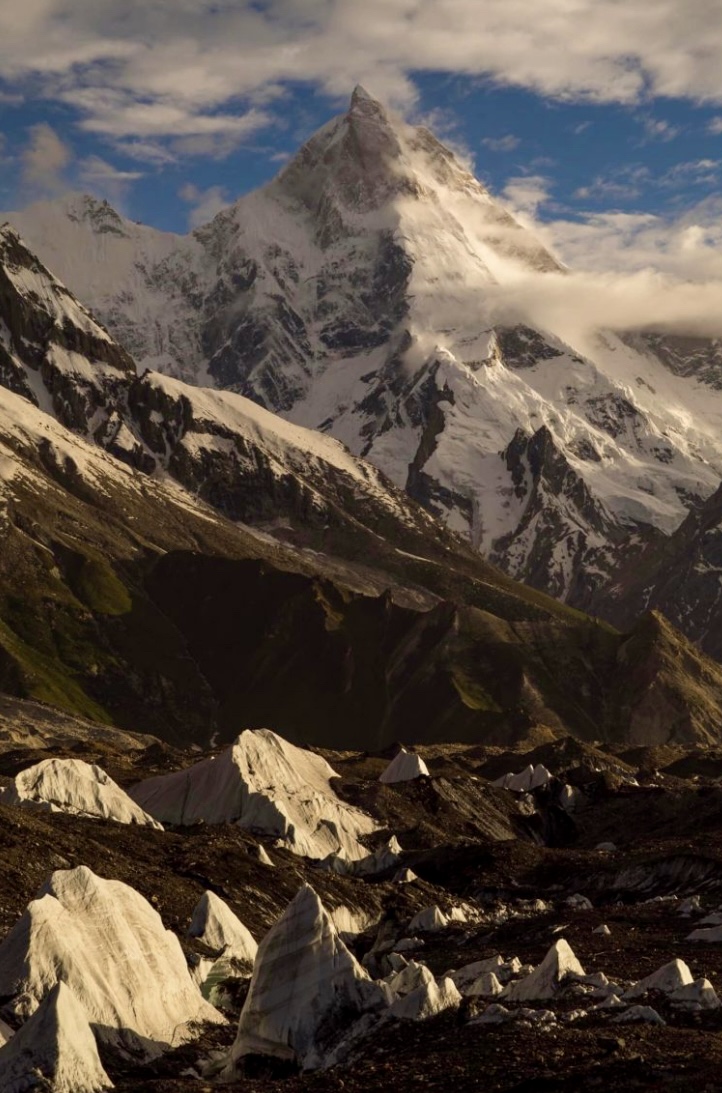
Masherbrum in 2022. Photo: Marek Holecek
Unclimbed challenges
Large sections of the Northeast Face and the West Face remain unclimbed. Their scale, combined with constant objective hazards, continues to attract small teams of highly experienced alpinists while resisting success.
Masherbrum’s overall record (fewer than 20 people on its two highest summits combined, with no confirmed main summit ascents after 1985) reflects a consistent pattern. The combination of technical demands, avalanche and serac risk, logistical isolation, and brief weather windows has preserved a seriousness that many more accessible high peaks have lost.
From Montgomerie’s distant sketch in 1856 to the reflective accounts of later climbers, Masherbrum has tested not only physical and technical limits but also judgment and humility. The Queen of Peaks remains selective, offering her summit only rarely and on her own terms.
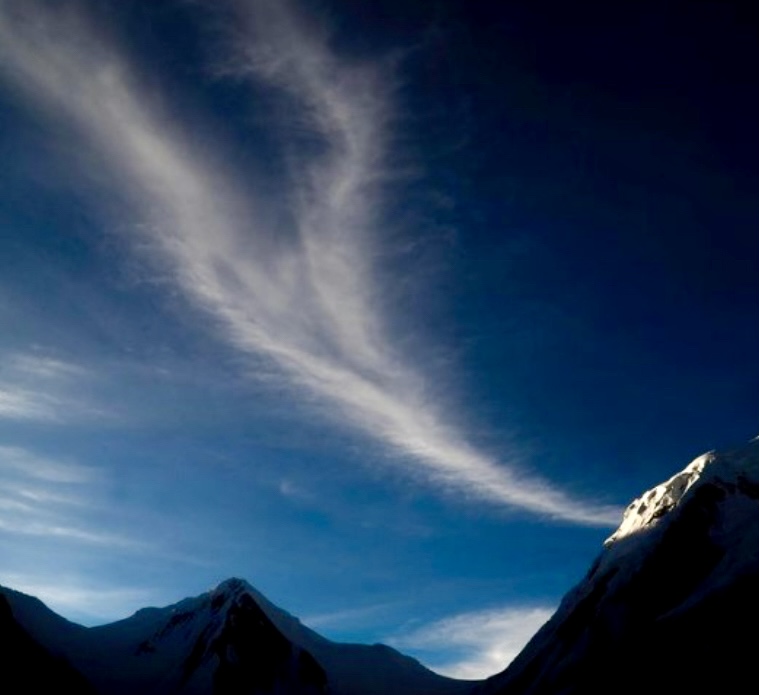
The view from Masherbrum’s West Face. Photo: Marek Holecek