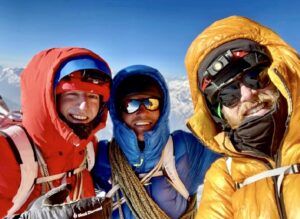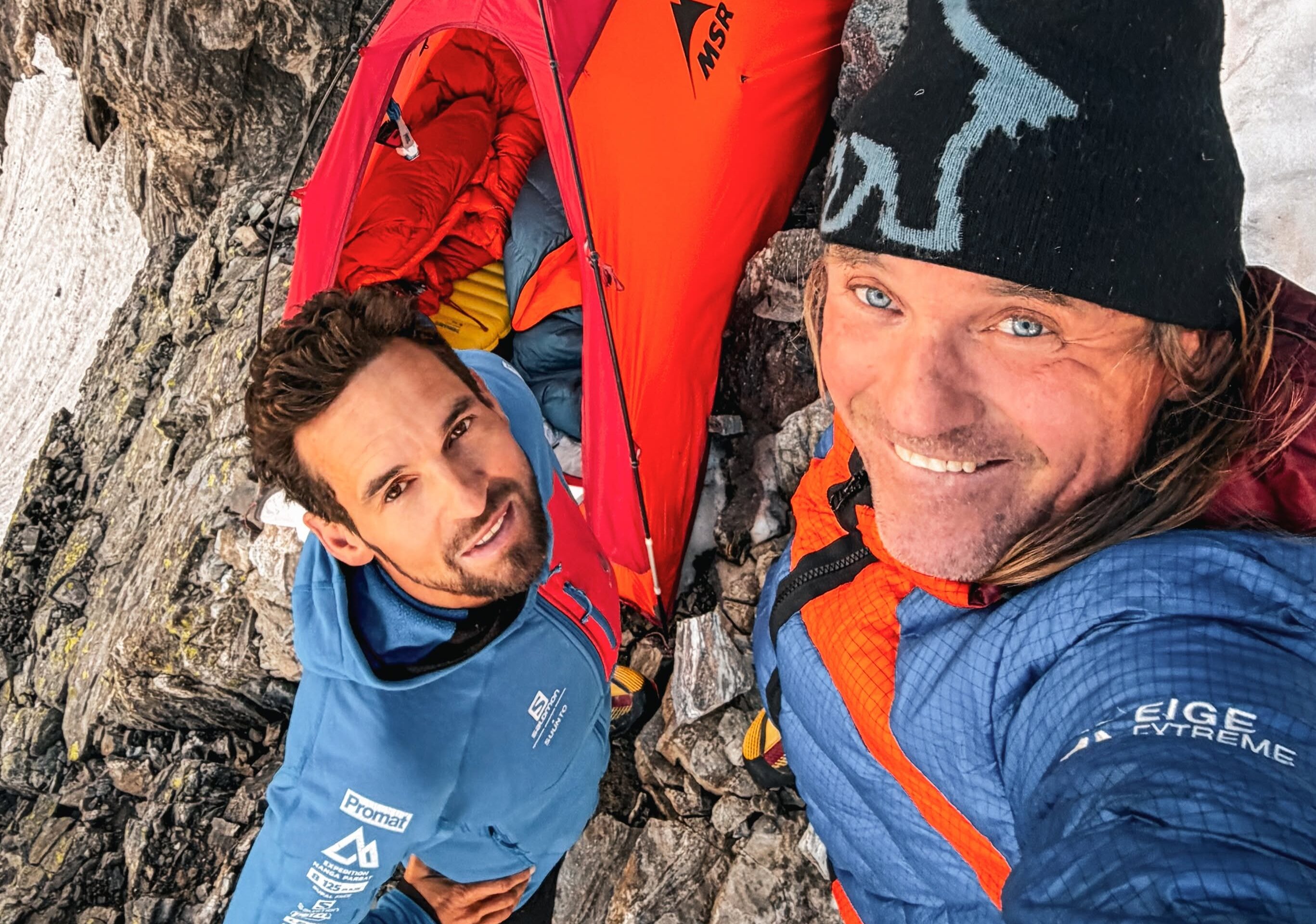
Unaware of last week’s drama on Broad Peak, Marek Holecek and Tomas Petrecek of the Czech Republic have been fighting their own battle against the 4,600m-high Rupal Face of Nanga Parbat. After their planned new route proved undoable, they are looking for alternatives.
After a thorough acclimatization on neighboring Rakhiot Peak, last weekend they launched a single-push, alpine-style attempt up a completely new route on the 8,125m giant.
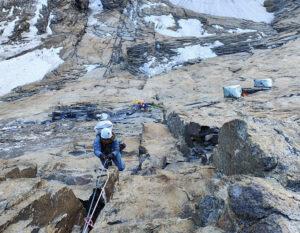
The climbers started up a snow gully and then crossed several rocky sections to their first bivy at 4,600m. The following day, they continued on the first snow ramps and then headed for a couloir they hoped would lead them to the upper section. However, conditions proved too dangerous as the day went on.
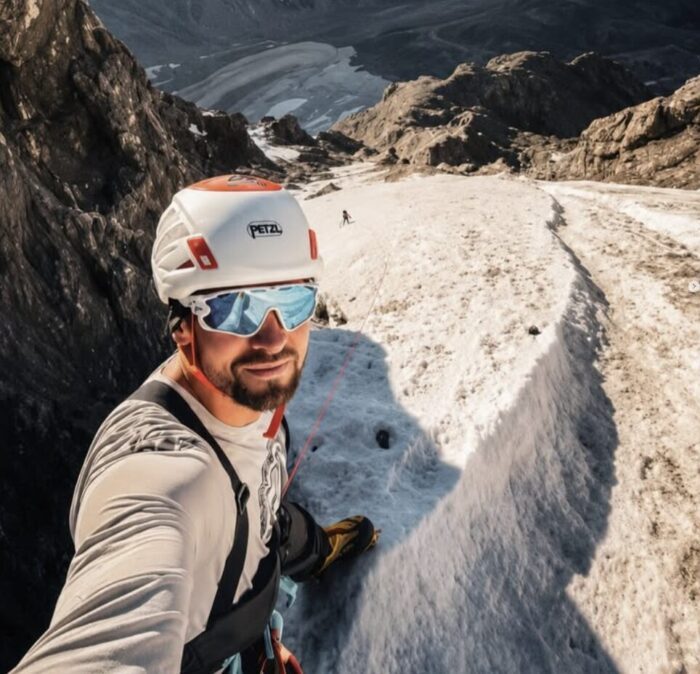
Petrecek on the second day of the climb, before entering the avalanche-swept couloir. Photo: Tomas Petrecek
“Avalanches were constantly rushing down with only minimal intervals between them,” Petrecek reported. “Under these conditions, we simply couldn’t continue.”
The pair downclimbed until they found a slightly more comfortable spot for their bivy tent, on a rocky ridge, as shown in Petrecek’s video:
No exit
Their plan was to check the couloir again earlier in the day, hoping for better conditions. But then the weather suddenly turned for the worse. A three-hour rainstorm soaked the tent. “It was almost not freezing at night, even at high altitudes,” Holecek noted. “This is an anomaly, but it happens and, unfortunately, we accidentally ran into it.”
Petrecek agreed. “All around us, [meltwater] rivers of various volumes started flowing, and to make matters worse, stones also started moving.”
The following day, avalanches were still constant, so the climbers couldn’t move and realized there was no sense in trying any longer.
A terrifying descent
They packed and retreated at 2 am that night, before the avalanches started again. Holecek described the rappels in the dark as terrifying, since the climbers descended down a different line from the one they had climbed. The night was pitch dark, and the rock was polished smooth.
At sunrise, the danger of falling rocks and avalanches increased dramatically, so the pair had to literally run down the wall and then across the glacier until they reached safe terrain, luckily unharmed. A day of rest, a wash, and some food restored their optimism.
“We are not completely destroyed, and the memory of the previous horrors is gone,” Holecek wrote. “The forecast is not bad. We can’t go for the same route under these conditions, if we love our lives, but what if in a few days, we try the route that [Tomas] and I started eight years ago?”
The 2018 line
Holecek is referring to the line they attempted in 2018. It started close to the 1970 Messner Route and then drifted toward a series of rocky buttresses. They spent six days on the face and reached about 7,800m, but high winds forced them to turn around 300m below the summit.
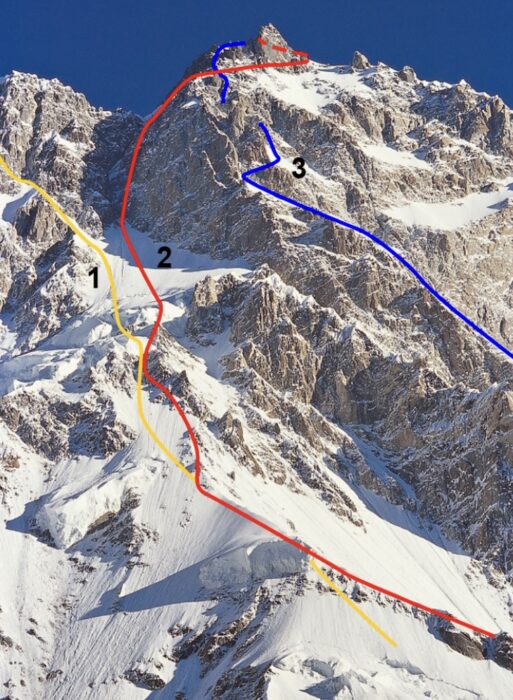
The upper section of the Rupal Face. (1) Holecek-Petrecek attempt in 2018; (2) South-Southeast Spur, aka Messner Route, 1970; (3) Central Pillar, Anderson-House Route of 2005. The far right skyline is the top section of the 1985 Mexican-Polish Route. Photo: Lee Young-Jun Collection via the American Alpine Journal