The Piolets d’Or jury had a tough time picking the best activities among 50 outstanding climbs that represent the best of exploratory alpinism. Its final selection is just out.
The Jury, formed by Lise Billon (France), Jordi Corominas (Spain), Luka Lindic (Slovenia), Young Hoon Oh (South Korea), Paul Ramsden (UK), and Enrico Rosso (Italy), chose the four best climbs of 2025 from a “big list” of 50. A fifth award promotes women’s alpinism. In no particular order, the awarded climbs were:
Ultar Sar
The first ascent of the southeast pillar of Ultar Sar (7,388m) in Pakistan’s Batura Muztagh, by Ethan Berman (U.S.-Canada), Maarten van Haeren (Canada) and Sebastian Pelletti (Australia).
The team climbed a monster 3,100m route on highly difficult terrain, with sections up to M5 and WI4 from June 6 to 11, 2025. They climbed in pure alpine style, with five bivouacs on the wall and a high level of commitment.
The trio needed two more days to descend via the same line, which they named Shooting the Moon. The expedition was rated number 1 on ExplorersWeb’s list of the best expeditions of 2025.
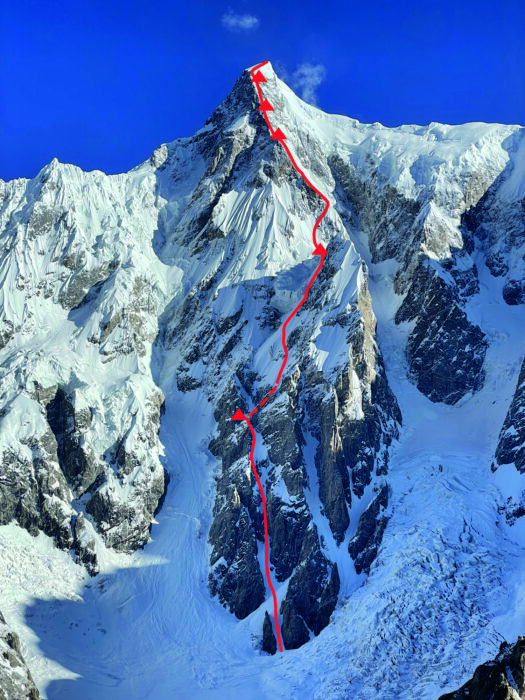
Topo of Shooting the Moon on Ultar Sar. Photo: Ethan Berman
Aikache Chokk
When we heard of the formidable new route and traverse opened in Pakistan’s Aikache Chokk (6,673m) by James Price of the UK and George Ponsonby of Ireland, we wrote: “Two Young Alpinists Surprise With One of the Best Climbs of the Year.” The Piolet d’Or jury agreed.
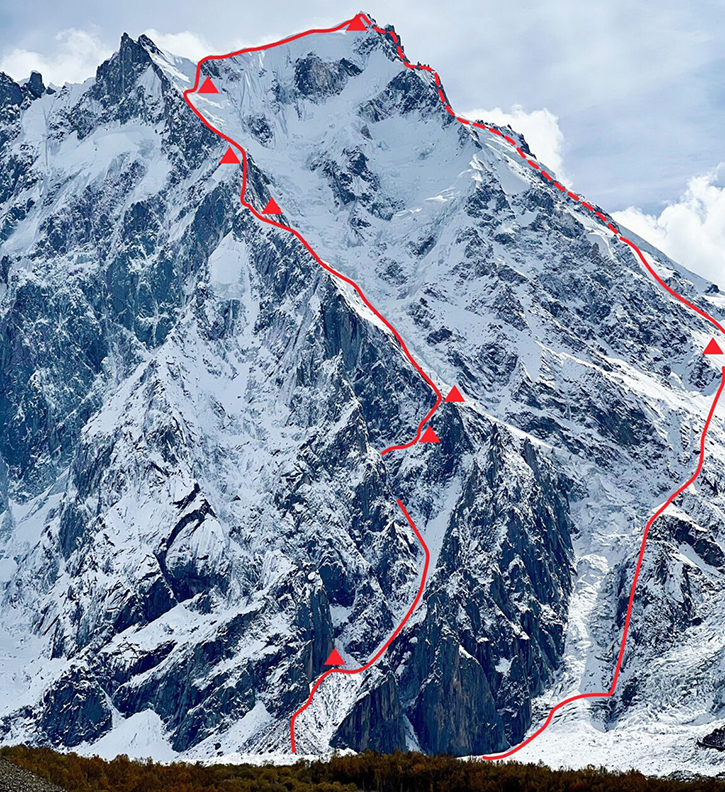
The route on Aikache Chokk. Photo: James Price
Price and Ponsonby, both members of the British Young Alpinist Group, made the first ascent of the northwest face of Aikache Chokk in the Baltar Valley. It was just the second overall ascent of the mountain.
It took them nine days to reach the summit. Once, they had to retreat at an impassable section and find a different line of ascent. The upper part featured difficult weather and snow conditions. Finally, they risked a descent via a different route with no information, on unknown terrain, and in poor visibility.
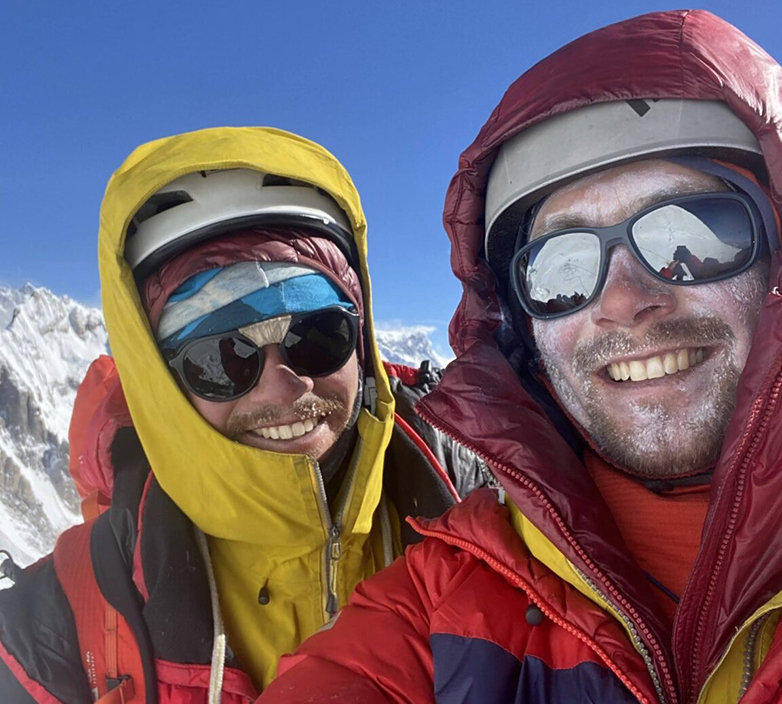
On the summit of Aikache Chokk. Photo: Ponsonby/Price
Yerupajá Grande
The third Piolet d’Or climb took place in the Huayhuash range of the Peruvian Andes. Bru Busom, Ruben Sanmartin, and Marc Toralles of Spain did the first complete ascent of the east spur of Yerupajá Grande (6,634m), the second-highest peak in Peru. They followed with a nearly 600m traverse south along the narrow, corniced ridge to Yerupajá Sur. Here, they reached one of the secondary summits, then descended the southeast face (1,000m at an average angle of 65°).
The team named their route Essence of Commitment because the ridge between the two peaks offered no retreat, and the options for rescue if anything went wrong were next to nil. Incidentally, this is the first Piolet d’Or-winning climb done by Spaniards.
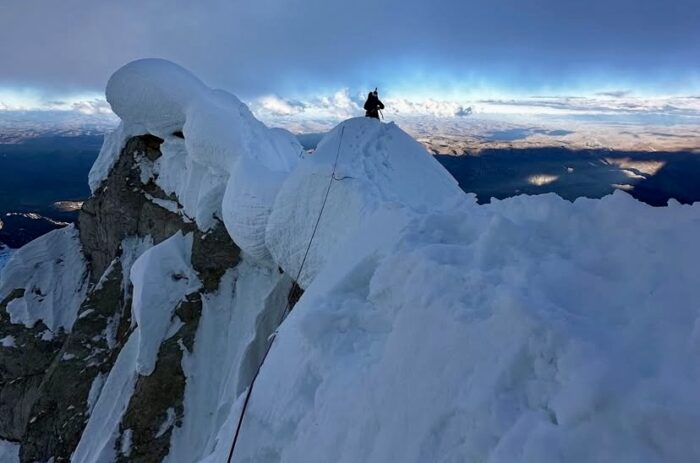
A Spanish climber on the pillowy snow of the summit ridge. Photo: Marc Toralles
Jannu East
Benjamin Vedrines and Nicolas Jean of France received a Piolet d’Or for their first ascent of Jannu East (7,710m), the eastern point of Mount Jannu in the Kangchenjunga region. It was an excellent, pure alpine-style route that mainly goes along the two-kilometer-long eastern ridge.
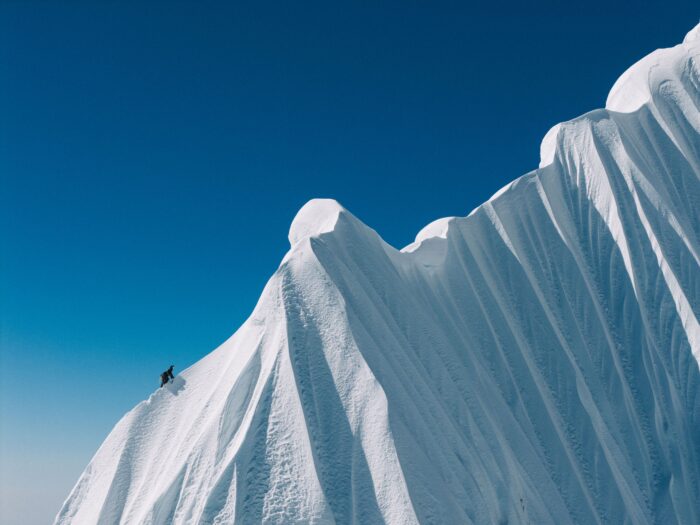
The corniced snow ridge. Photo: Thibaut Marot
The Piolets d’Or jury report reads:
The pair planned a route on Jannu that would play to their proven ability to climb light and fast. On October 12, they camped at 5,100m on the glacier below the face and fixed the first pitch. Next day, they climbed 1,100m through hanging snowfields, steep snow, WI5 and a tenuous mixed pitch of M6. Much of the terrain was poorly protected.
From a bivouac at 6,200m, they slanted left to reach the east ridge at 6,900m, where they spent the night. Next day, precarious climbing along the narrow and heavily corniced ridge above led to the summit. Descending their line over the next one and a half days required around 50 rappels and downclimbing.
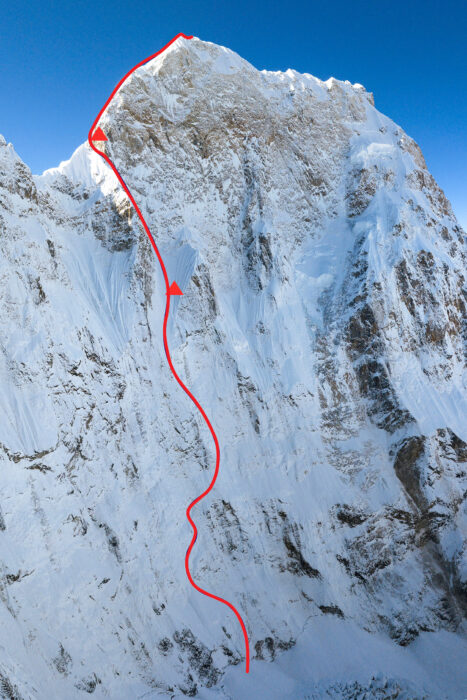
Topo of Vedrines and Jean’s line on Jannu East. Photo: T. Marot
Interestingly, the pair had two activities included in this year’s big list: the Jannu East ascent and their earlier acclimatization climb of Anidesh Chuli, which was also a first ascent.
Last year, Vedrines received a special mention for his general excellence on mountains from the Alps to the Himalaya.
Female award to Nanga Parbat skier
The Piolets d’Or also aim to promote female alpinism by granting a Special Mention either to an all-women’s expedition, to a woman or women taking a lead role in a mixed-group ascent, or to a single woman for major mountaineering ascents through the years.
In 2026, the award goes to Tiphaine Duperier from France. Duperier took part in the ascent and ski descent of the Schell route on the huge Rupal Face of Nanga Parbat with Boris Langenstein. David Goettler of Germany, who climbed with them, paraglided back to Base Camp.
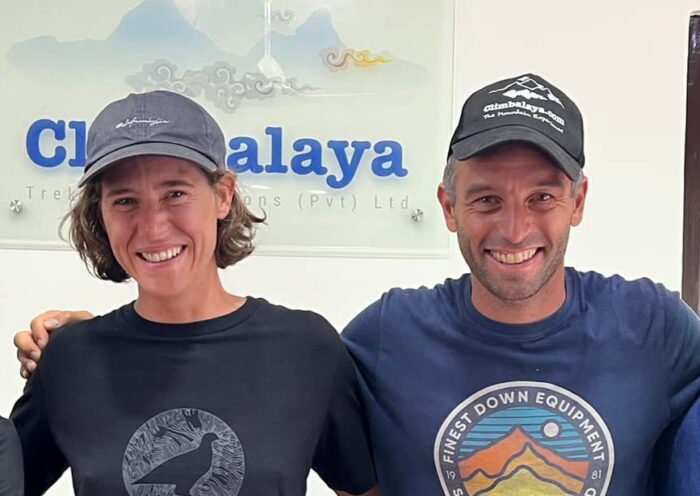
File image of Tiphaine Duperier and Boris Langenstein in 2022. Photo: Climbalaya
Duperier is well known as an extreme skier, but she is also an excellent climber. The ascent of Nanga Parbat was the first complete alpine-style climb of the Schell route, and the ski descent was the first from the 8,125m summit to where the snow ended. While Goettler needed less than one hour to fly back to Base Camp, the skiers needed three more days and faced several difficulties, including some ups and downs, on the highly technical route.
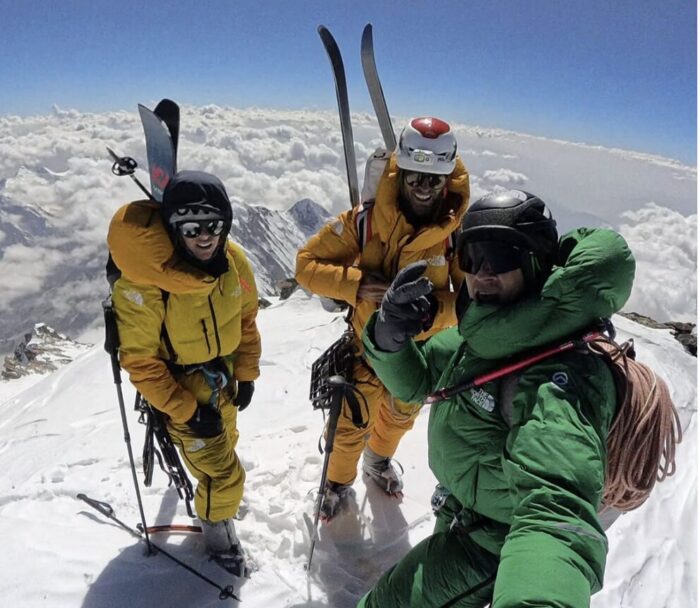
Left to right, Tiphaine Duperier, Boris Langenstein, and David Goettler on the summit of Nanga Parbat. Photo: David Goettler
For context, the first continuous descent of Nanga Parbat was done this year (2026) by Andrzej Bargiel of Poland, via the normal Kinshofer route. Bargiel used no oxygen, but did his ascent with fixed ropes rather than alpine-style.
No competition
As usual, the organizers revealed the awardees in advance to give the climbers time to attend the ceremony and, as they told ExplorersWeb, to erase all feelings of competition. “This is a celebration of exploratory alpinism, not a contest,” they insisted.
Overall, the Piolets d’Or reward alpine-style ascents. All this year’s climbs (except Duperier’s ski descent) are new routes opened in alpine style.
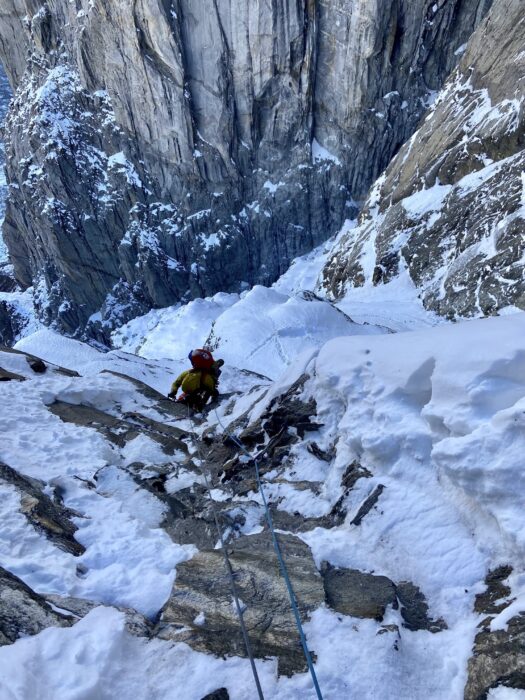
Difficult mixed terrain on Aikache Chhok. Photo: Ponsonby/Price
It’s interesting to note that among those shortlisted for a special mention in the Greater Ranges were the two Everest skiers — remarkable performances but heavily supported. In the end, they did not receive awards. The same is true for the two nominated 8,000m climbs: Sergey Vasiliev’s team on the Southwest Face of Manaslu, and Urubko-Cardell’s line on Nanga Parbat.
Most of this year’s awarded climbers are quite young, in their 20s and 30s. Clearly, a new generation of climbers continues to push the boundaries of excellence in alpinism.
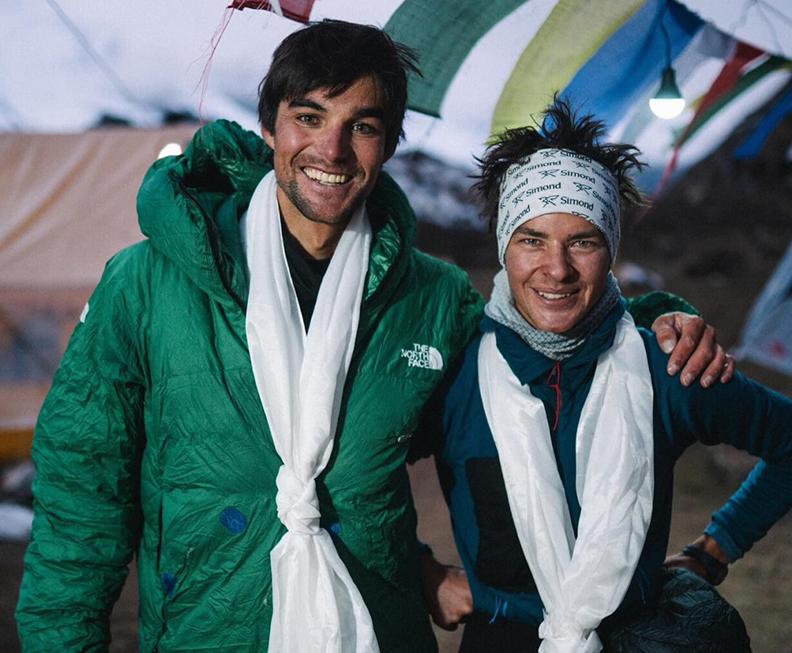
The Jannu East summiters in Base Camp. Benjamin Vedrines, left, and Nicolas Jean. Photo: @quentin_degrenelle
The trophies will be presented at an outdoor venue in France, with the Ecrins Massif as background, on October 23. At the event, Peter Habeler of Austria will receive a special award for his many climbing accomplishments over a lifetime.