Some great long-distance bicycle tours of the world include Europe’s EuroVelos — 17 dedicated routes that criss-cross the continent; the rugged Great Divide Mountain Bike Route in North America; and the Munda Biddi trail through Western Australia’s bushland. But for a mammoth, country-hopping epic that can take years, riding the length of the Americas is the ultimate challenge.
30,000km or more
Starting in Anchorage, Alaska, and finishing at the tip of South America in Ushuaia, Argentina, a cyclist covers between 30,000 and 50,000km.
Those looking to cycle quickly and directly to the finish stick to the Pan-American Highway. After cutting south through Alaska, they hug the western seaboard of the Americas for most of the journey. It’s an almost straight shot on mostly paved roads, and the fastest riders can knock it over in less than a year.
However, many cyclists head inland at various points, adding distance but also customizing their journeys based on scenery or culture. In Mexico, many choose a more central route through Mexico City and Oaxaca to avoid troubled provinces like Jalisco and Guerrero. In South America, it’s common to trade the Peruvian coastline for the Peru Divide, a 1,600km high-altitude route through the Andes. Finally, in the far south, cyclists can choose between the Carretera Austral in Chilean Patagonia and routes through eastern Patagonia in Argentina.
For an example of one end of the distance spectrum, consider Mark Beaumont. He rode the Americas for a BBC documentary series between 2009 and 2010. He took a direct route down both continents, skipping the infamous Darién Gap, as all cyclists do. This 100 to 160km roadless section of jungle between Panama and Colombia is a dangerous drug and people-trafficking route. Beaumont covered just over 21,000km and finished in 268 days.
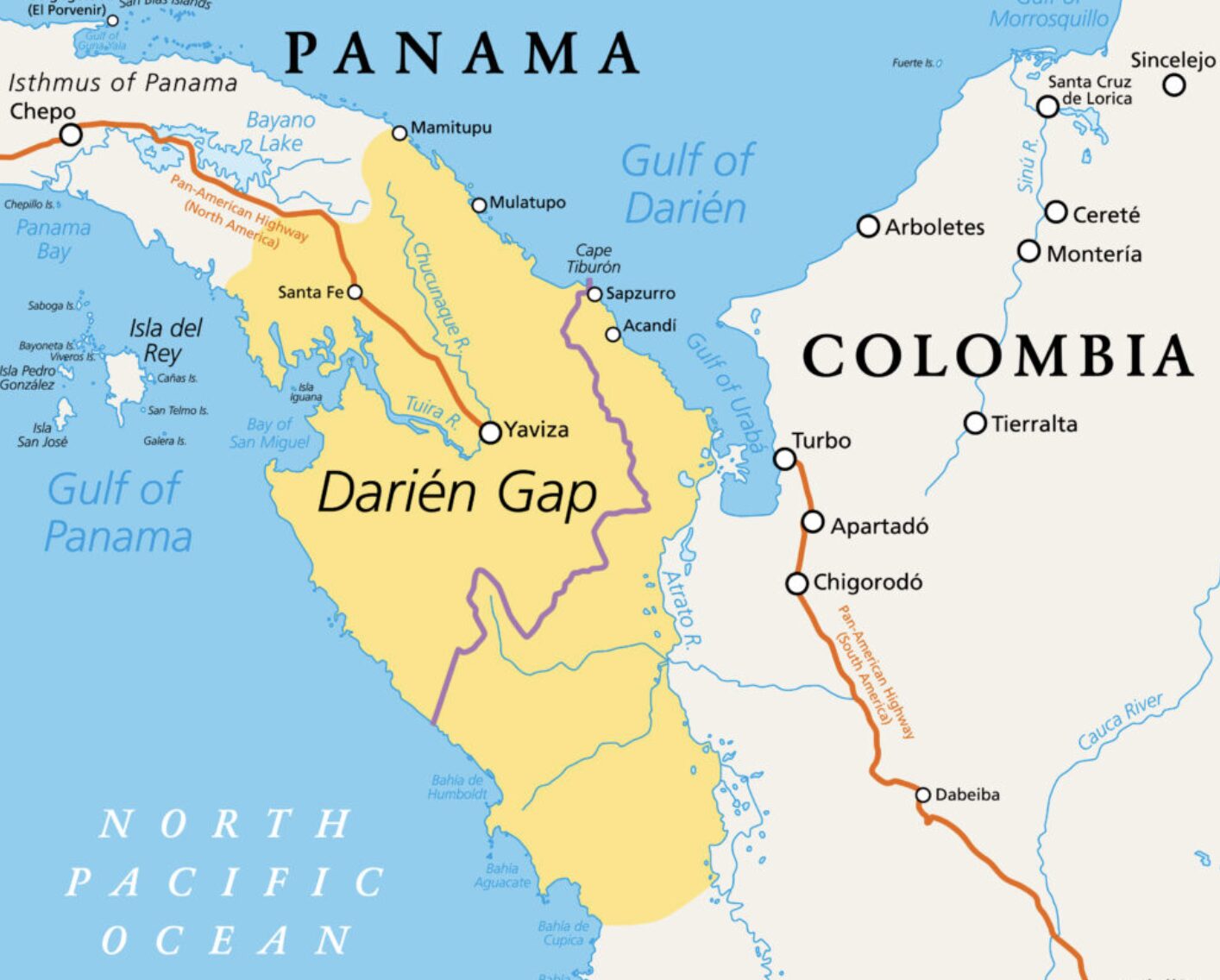
The Darién Gap. Photo: UUSC
By contrast, Mark Watson and Hana Black clocked a whopping 51,000km over seven years between 2016 and 2023. They took an inland route through the U.S., explored the mountains in Peru, and even detoured to cycle in Cuba. They also skipped the Darién Gap.
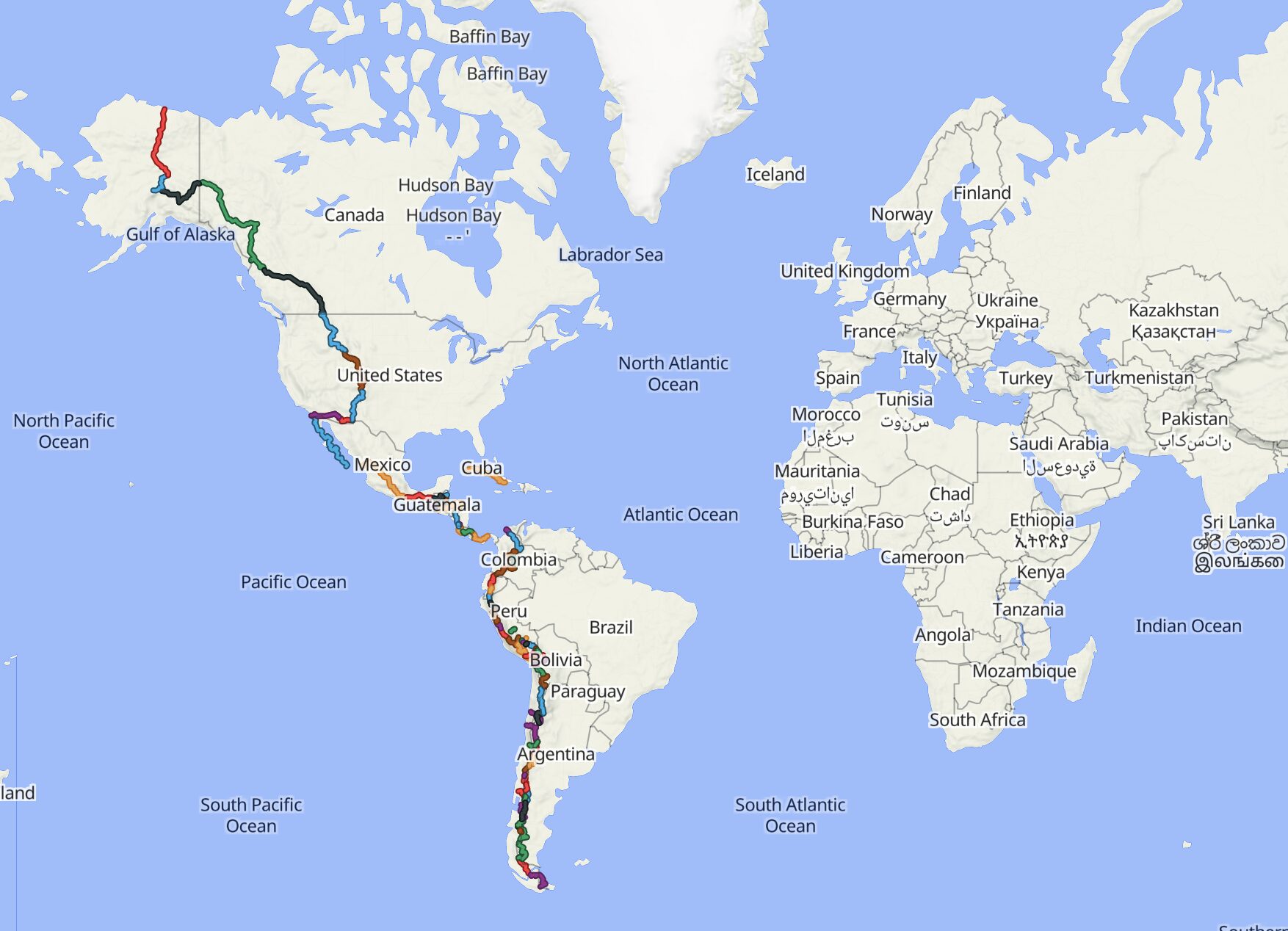
Mark Watson and Hana Black’s route. Photo: Mark Watson and Hana Black
When to go
Most riders start in Alaska in the summer. Exactly when in the summer depends on the year, but it’s best to start no earlier than mid-June to avoid spring snow. Starting early gives you a few months to get south before more snow arrives in October or November, but it does mean you may have to contend with forest fires and some extremely smoky days.
Further south, riding months are pretty flexible, though many people try to avoid the southern U.S. and Mexico in midsummer. Rainy seasons in South America vary slightly by country, but are rideable as long as you stick to paved roads. In the far south, Patagonia has a short riding season during the southern hemisphere summer (roughly December to March).
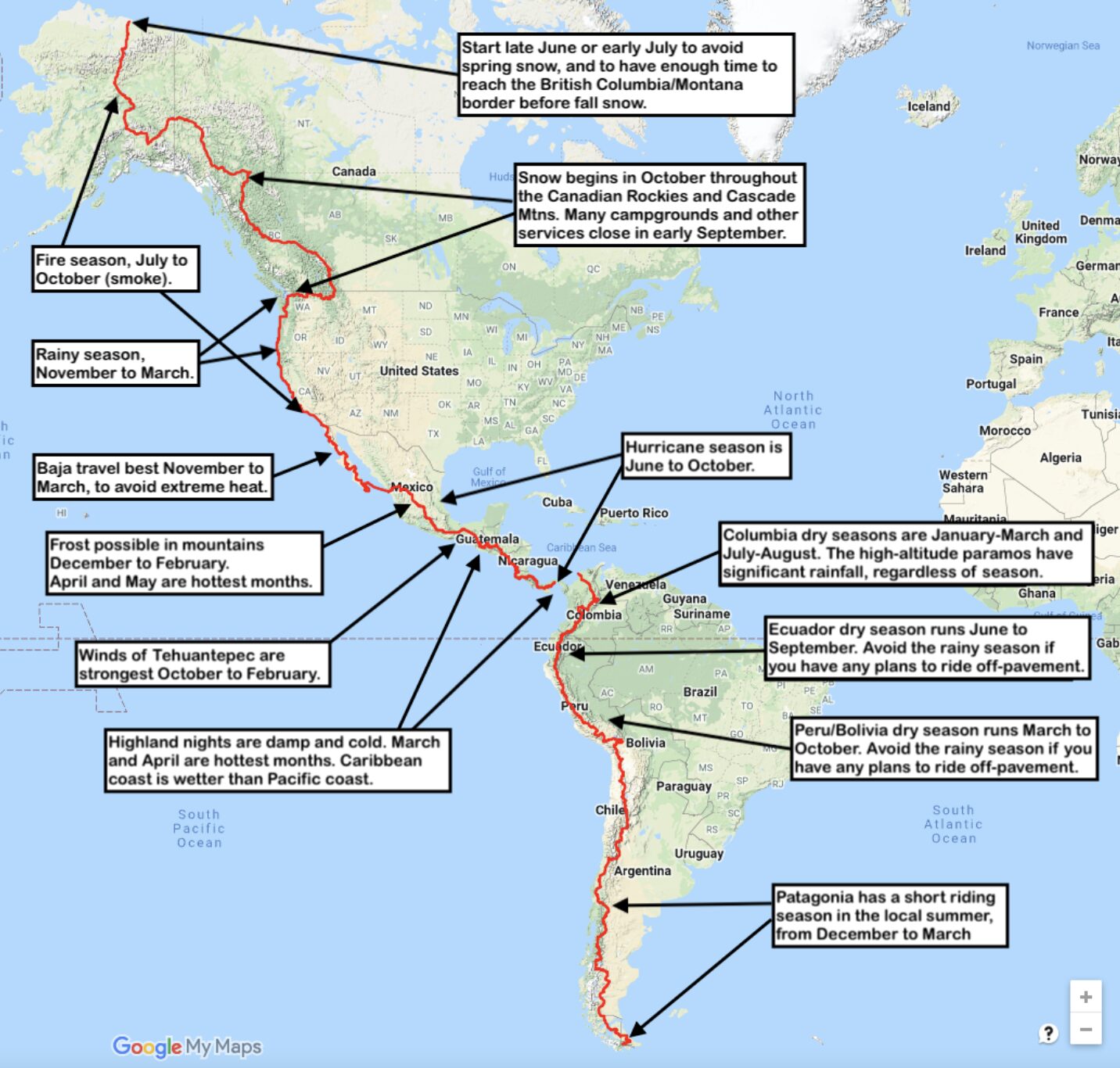
An extremely useful map by bicycle tourers ‘Pedals and Puffins,’ showing different weather and season considerations for cycling the Americas. Photo: Pedals and Puffins
Early pioneers
Dan and Lys Burden and Greg and June Siple hatched the idea of a huge cycle expedition covering the length of the Americas while at the University of Montana in the 1970s. Planning their trip from Alaska to the southern tip of Argentina over a couple of years, they eventually left Anchorage in June 1972. Over roughly 12 months, they cycled to southern Mexico. There, Dan Burden contracted hepatitis. The Burdens were then forced to end their tour. The Siples continued south and completed their journey in Tierra del Fuego in February 1975. They might have been the first to do the entire route, although this is uncertain.
After their trip (covered in a National Geographic article), the route remained the domain of a few hardcore long-distance cyclists until the 2000s, when the internet led to an explosion of interest in adventure cycle touring.
Current riders
Despite its length and commitment, there are usually at least a couple of cyclists plying it at any time.
American Daniel Bijan Connell is less than 20 days into his ride, but has already blitzed through Alaska and Canada while consistently logging astonishing distances. He recently clocked 400km in a day, twice what Tour de France cyclists cover!
Perhaps his speed shouldn’t come as a surprise: Earlier this year, Connell rode from Canada to Mexico in 6 days, 15 hours, and 53 minutes, setting a new Pacific Coast FKT (fastest known time).
Meanwhile, Leanna Carriere and Timm Dobert have put a unique spin on the journey: the couple is “racing” three GPS-tracked whimbrels (a medium-sized wading bird) on their southward migration. Carriere and Dobert are just over 600km into their ride.
In 2023, we covered the youngest person to complete the route. Liam Garner was 17 when he stood at Prudhoe Bay, Alaska, pointed his bicycle south, and started pedaling. On Jan. 10, 2023, 527 days later, he arrived in Ushuaia. He’d cycled 32,000km through 14 countries.