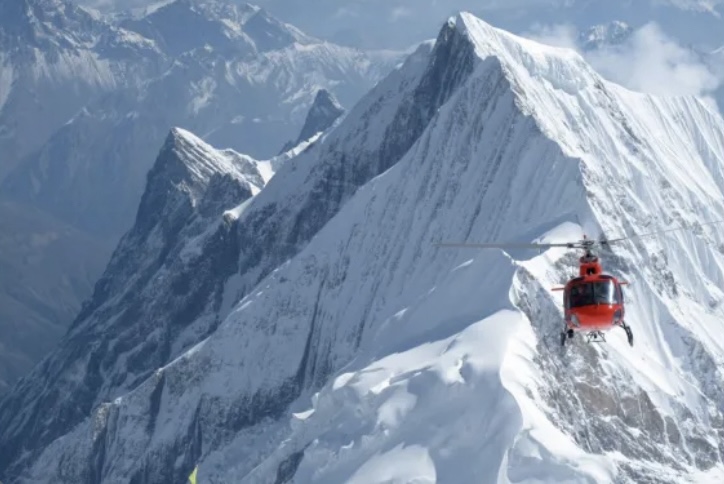
In the spring of 2010, two Swiss experts were in Nepal to teach local helicopter crews high-altitude rescue skills. Then, a distress call from Annapurna I turned the training into the highest longline extraction then recorded.
On the morning of April 29, an AS350 B3 from Fishtail Air lifted off from Annapurna Base Camp and headed for Camp 4. Daniel Aufdenblatten, a 35-year-old Air Zermatt pilot, and Richard Lehner, 38, a mountain guide from the same Swiss valley, had come to Nepal to train local Nepalese crews. The radio call from high on the world’s 10th-highest mountain ended the training.
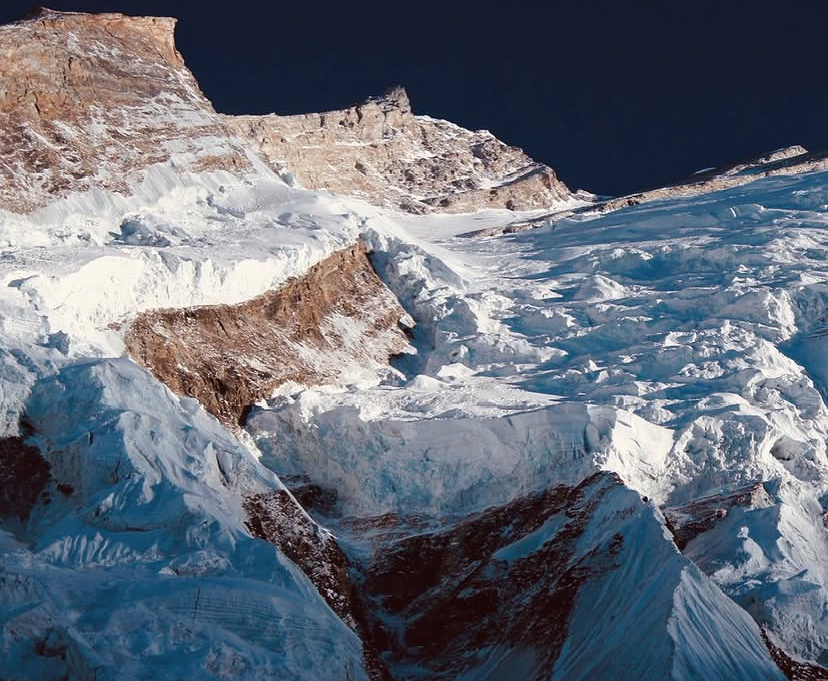
The Dutch Rib route is the knife-blade ridge on the right. Photo: Don Bowie/Instagram
That season, 11 teams targeted 8,091m Annapurna I. The Spanish Annapurna I Expedition led by Carlos Pauner chose to climb the North Face, just east of the Dutch Rib, without bottled oxygen. They used the fixed lines already established by another Spanish expedition led by Edurne Pasaban, according to The Himalayan Database. Pauner’s team included Francesc Xavier Arias, Bartolome Calafat, Juanito Oiarzabal, Francisco Javier Perez, Lluis Rafols, and Sherpas Dawa and Lhakpa Sonam Sherpa.
Throughout the early weeks of April, they methodically established their lower camps before pushing higher to complete their acclimatization.
Cannonballs of ice
On April 16, a sudden rock or ice fall broke off the face and struck Camp 3.
As Arias and Rafols rested in their tent, the others were outside putting up a second shelter. The falling ice smashed directly into the occupied tent, leaving Arias with a severe blow to his back and Rafols with a neck injury. Although neither man suffered any broken bones, both were in immense pain, prompting the entire group to descend the following day.
Recognizing that their expedition was over, Arias and Rafols left Base Camp by helicopter on April 24 and caught a flight home from Kathmandu the next day.
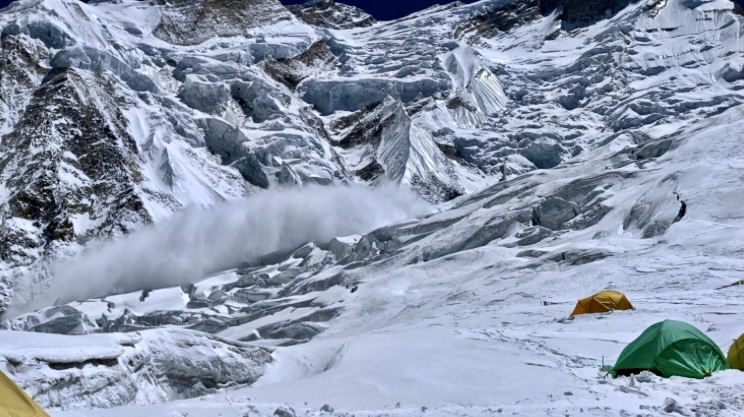
Avalanches between Camp 2 and Camp 3 on Annapurna I in 2025. Photo: Piotr Krzyzowski
The others continued. On April 24, Calafat, Oiarzabal, Pauner, and Perez started up, alongside Dawa Sherpa and Lhakpa Sonam Sherpa. The next day, five of them established Camp 4 at 6,950m. The sixth man, Perez, turned back when a crampon broke and was in Base Camp on April 26, becoming the voice on the radio.
The summit team left Camp 4 at 2 am on April 27, fixing some 150m of rope above the camp. They topped out at 4 pm, about an hour behind a Korean party led by Oh Eun-sun. Then they started down in failing light.
Horia Colibasanu, a member of a separate Romanian expedition, had summited earlier that same day, at 11:40 am, without bottled oxygen. He thus became the first Romanian atop Annapurna I. Colibasanu then returned to Camp 4 to rest.
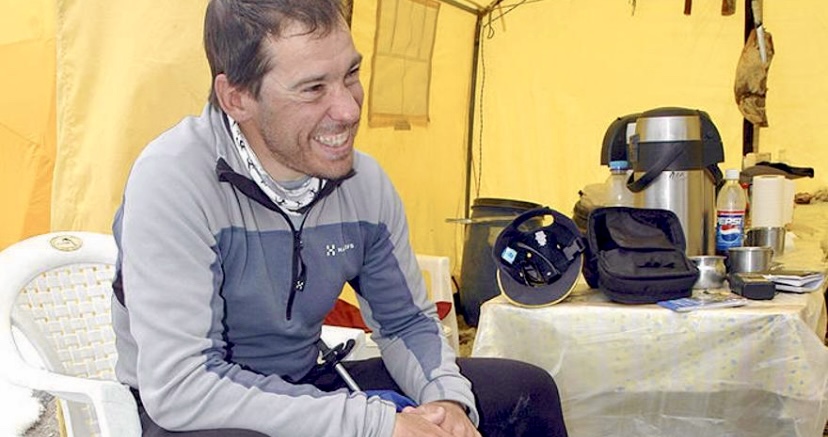
Bartolome Calafat. Photo: EFE
Calafat in distress
Oiarzabal, Pauner, and Dawa pulled ahead during the descent. At 7 pm, Calafat radioed Perez. He and Lhakpa Sonam had lost the trail in the dark, found it again, and were sitting at about 7,600m. Calafat could not stand. Perez told him to move, but he didn’t, and by 9 pm, he could no longer speak.
On April 28 at 5 am, they radioed him back with the only motivation they had left: Stand up if you want to see your wife and children. He tried, but his legs didn’t answer. Lhakpa Sonam, who had stayed with Calafat through the freezing night, finally had to go down alone to Camp 4, reaching Oiarzabal and Pauner at 7 am. The latter two had only reached camp at midnight, after waiting two hours at 7,300m. They were too spent to climb back up.
Colibasanu postponed his own descent and remained with them. (It was not the first time Colibasanu risked his life to stay high and not leave people behind. Two years earlier, he did the same thing for his good friend and climbing partner, Spanish mountaineer Inaki Ochoa de Olza, also on Annapurna I.)
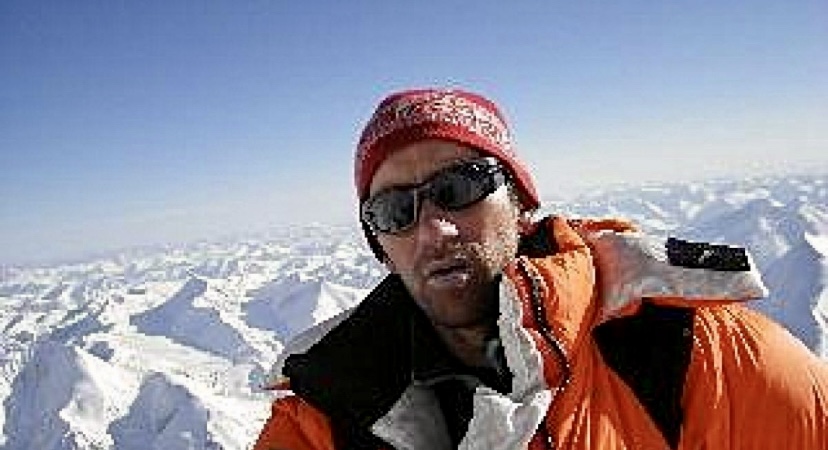
Horia Colibasanu. Photo: Antena3.ro
Around 6:30 am, Perez called Base Camp manager Sonam Sherpa to report the emergency and ask for a helicopter. However, clouds forced the helicopter to wait at Ghorapani. Calafat still could not move.
At 1 pm, Dawa left Camp 4 with oxygen and a mask from Oh’s team, a sleeping bag, and medicine. Two hours later, it began to snow. Dawa went nearly to the summit but saw nothing. Pauner and Perez believed that Calafat was already under new snow, on the same trail that Dawa walked past.
Camp 4
Three men remained in their tents in a bad situation. Oiarzabal had frozen feet and failing eyesight, and Pauner’s hands and feet were frostbitten. Colibasanu was still the strongest of the three, but he had spent too long at altitude. Avalanches ran through the couloirs nearby. They had been high for more than a day and a half since summiting.
Aufdenblatten and Lehner, the Swiss rescue instructors, understood that they were operating on the absolute edge of survival. At 7,000m, an AS350 B3 helicopter has virtually no performance reserves. While aerodynamic lift becomes dangerously marginal at this altitude, the erratic mountain winds are anything but weak. This made their initial approaches utterly chaotic.
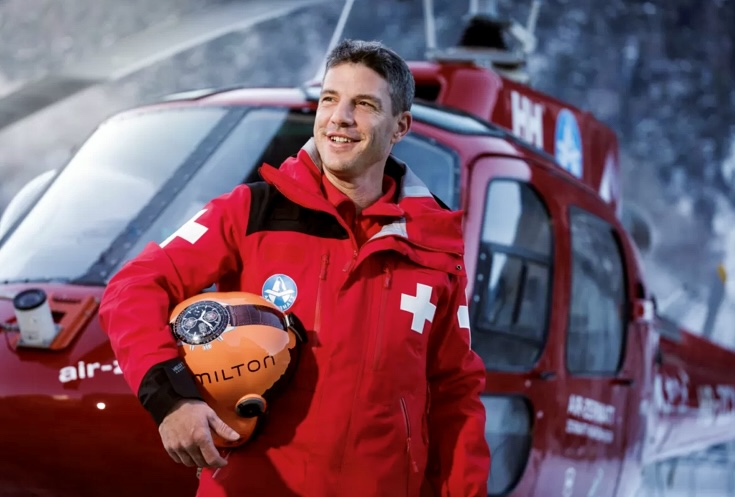
Pilot Daniel Aufdenblatten. Photo: air-zermatt.ch
Longline rescue
Lehner rode the longline on the early, failed approaches. Wind bounced the helicopter so hard that the climbers later said that they thought they were hallucinating, watching a machine materialize through the blinding glare, only to vanish a moment later. On one run, he hung under the machine for roughly 10 minutes, breathing from an improvised nasal oxygen tube, until the helicopter had to retreat to Base Camp. There, the crew stripped the doors and seats. Lehner stayed on the ground and ran the radios.
Aufdenblatten flew back alone. The method used on the three successful lifts was the simplest version left: hover, drop a line of about 25 to 30m, and tell each man by radio to clip in with a carabiner before the power or the wind forced a retreat.
One climber at a time, about ten minutes to fly down, then back up: That was the planned technique, and it was how the first attempts were made. It was not how the three men left Camp 4.
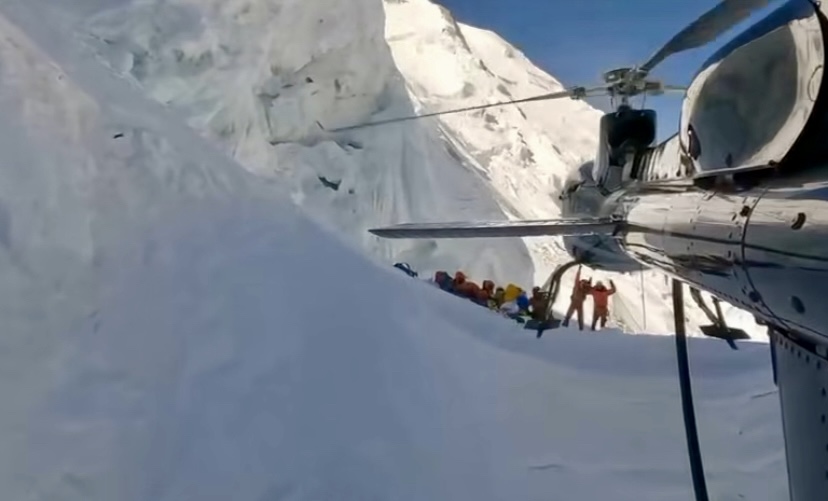
Simone Moro flies toward Camp 3 on Annapurna I with his helicopter during a 2025 rescue. Frame of a video posted on Instagram by Simone Moro
Calafat dies
On April 29, between 7 and 7:30 am, Nepalese pilot Sabin Basnyat flew a reconnaissance flight with the Swiss crew. They overflew Calafat’s last position near 7,600m but saw no sign of him. Then the mission shifted entirely into an evacuation for the three surviving climbers at Camp 4. The search mission officially ended, leaving Calafat’s body to rest permanently along the trail.
While historical accounts differ slightly on the exact order of evacuation, the operational approach remained identical for each run. Oiarzabal was among the first to clip in. He initially missed the swinging longline as it whipped around in the violent rotor wash before successfully securing himself on a second attempt.
Colibasanu, who was still functioning better than the others, stayed on the slope to patiently guide his colleagues through the clipping process. He helped secure Pauner before finally hooking himself into the line for the last flight.
Every single trip down was a battle against the razor-thin air. Meanwhile, the two Sherpas who had stayed with the party — Dawa Sherpa, often called Dhaulagiri Dawa, and Lhakpa Sonam — declined the helicopter ride and made the long descent on foot.
The three evacuated climbers were safely deposited near 4,000m, where emergency treatment for their severe frostbite promptly began.
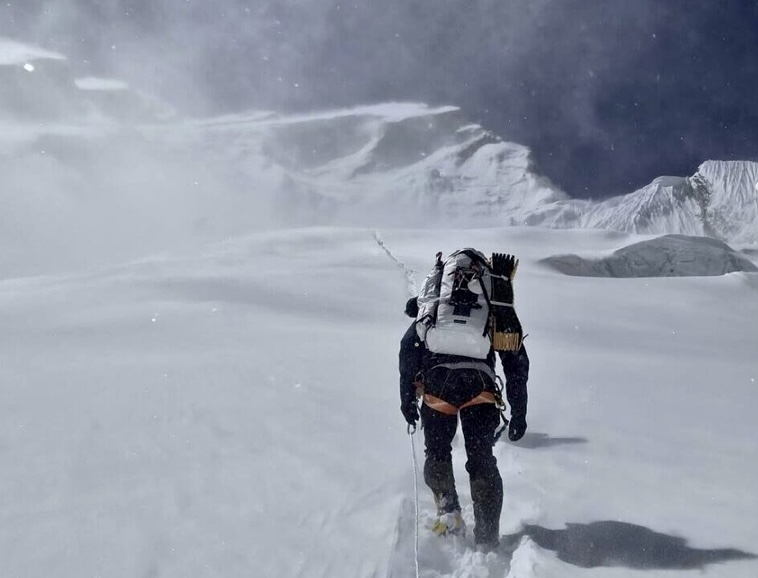
A climber moves in blustery winds toward Camp 2 on Annapurna I. Photo: Charles Page
Calafat’s background
Calafat died after two exposed nights at 7,600m, unable to walk. Doctors in radio contact said he remained mentally clear and did not show High Altitude Cerebral Edema. They blamed exhaustion, dehydration, likely electrolyte failure, and hypothermia. Those doctors denied the early speculative reports of cerebral edema.
Calafat was a technician at the Telefonica company and a mountain marathon runner. Before Annapurna I, he had climbed Cho Oyu in 2004 and Everest in 2006. Broad Peak Central and Shisha Pangma’s foresummit were also on his CV. Annapurna I was his third 8,000’er. He had also climbed Aconcagua, peaks in the Cordillera Blanca, and several mountains in the Alps. His passing left behind a grieving wife and two young children in Mallorca.
Aftermath
This was the highest longline helicopter rescue completed at the time.
In March 2011, Aufdenblatten and Lehner received the Aviation Week Heroism Award in Washington. In the autumn of 2010, Sabin Basnyat, the Nepalese Fishtail pilot the Swiss pair had been training, along with technician Purna Awale, died when their helicopter struck Ama Dablam on another rescue.
In 2024, Daniel Aufdenblatten became the CEO of Air Zermatt.
Before 2010, the working assumption in the Himalaya was that above a certain height, you had to get yourself down. The flights of April 29, 2010, showed that a carefully flown longline could reach further than most people believed. What followed — genuine emergency extractions mixed with the later grey area of insurance and convenience flights — is another debate.
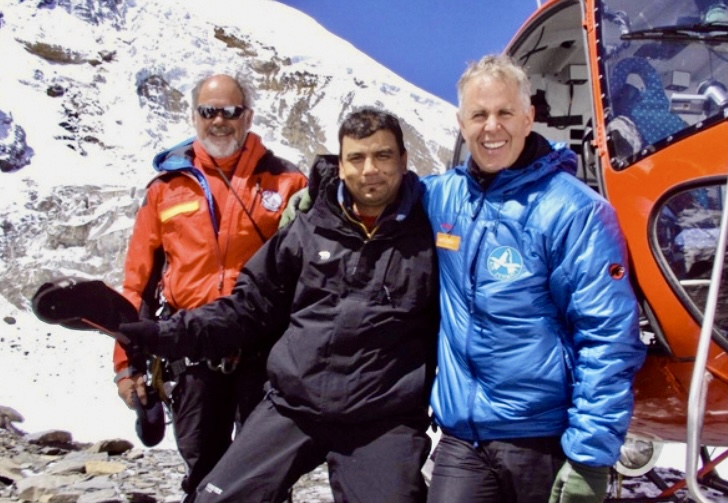
In the middle: Nepalese pilot Sabin Basnyat with Swiss rescuer Bruno Jelk on the left, and Swiss pilot Gerold Biner on the right, at Dhaulagiri Base Camp. Photo: Air Zermatt/Fishtail Air via PlanetMountain
That spring in 2010, a total of 26 climbers summited Annapurna I, 23 of them without supplemental oxygen. Calafat was among the summiters and the only person to die on Annapurna I that season.