The Russian team is preparing to head up Everest’s West Ridge for a fourth time. While no easy option exists, they want to avoid the extremely exposed, difficult, and uncertain ridge route. Their only alternative is the Hornbein Couloir, which would force them to stray temporarily into Tibet.
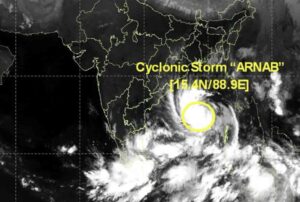
Andrei Vasiliev, Vitaly Shipilov, and Sergey Kondrashkin are in Kathmandu recovering from a viral infection and waiting out Cyclone Arnab, which is now weakening. They will return to their base in Lobuche this weekend, determined to climb Everest without supplemental oxygen.
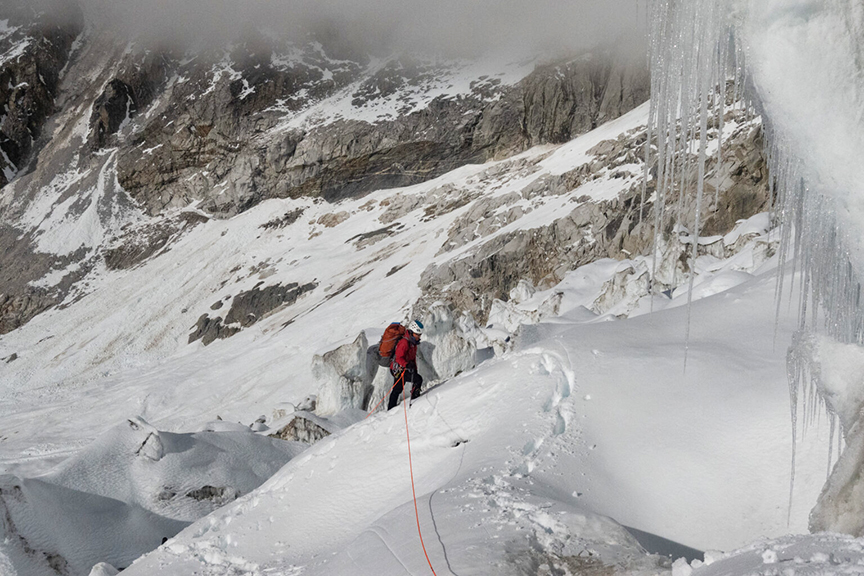
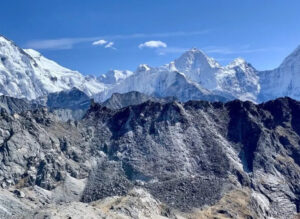
Everest West Ridge some days ago. Photo: Andrei Vasiliev
Progress so far
“So far, we have completed three rotations on the mountain,” leader Vasiliev told ExplorersWeb. “Part of this time was spent exploring different options for accessing the route.”
The Russian team has a permit to climb Everest from Nepal, as long as they attempt a route other than the standard Khumbu Icefall-South Col-Southeast Ridge. This has become the normal South Side route since Hillary and Tenzing’s first ascent in 1953.
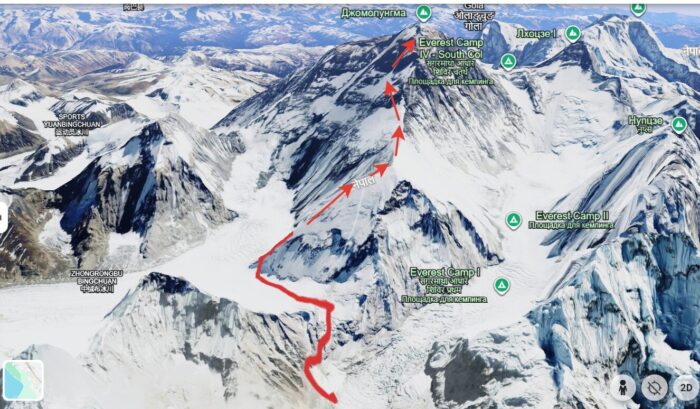
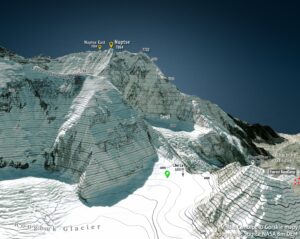
Topo of the Russian team’s planned route on Everest, courtesy of Andrei Vasiliev
First, the Russians tried to bypass the Khumbu Icefall via the Nuptse Shoulder toward Camp 1, but heavy snow forced them to find another route. Crossing the Icefall (sharing paths with the normal route) was also too hard in the deep snow and on the shaky snow bridges over the innumerable crevasses.
“Eventually, we selected a third option, via the Lho La,” Vasiliev said. “From that pass, our planned route continues across the West Shoulder, along the West Ridge.”
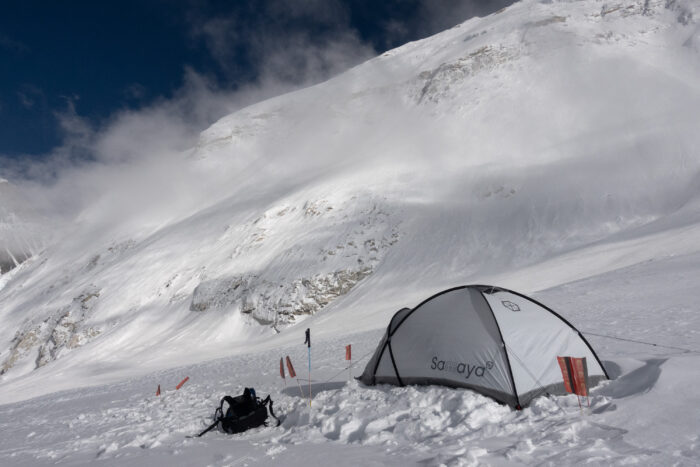
At the Lho La col. Photo: Andrei Vasiliev
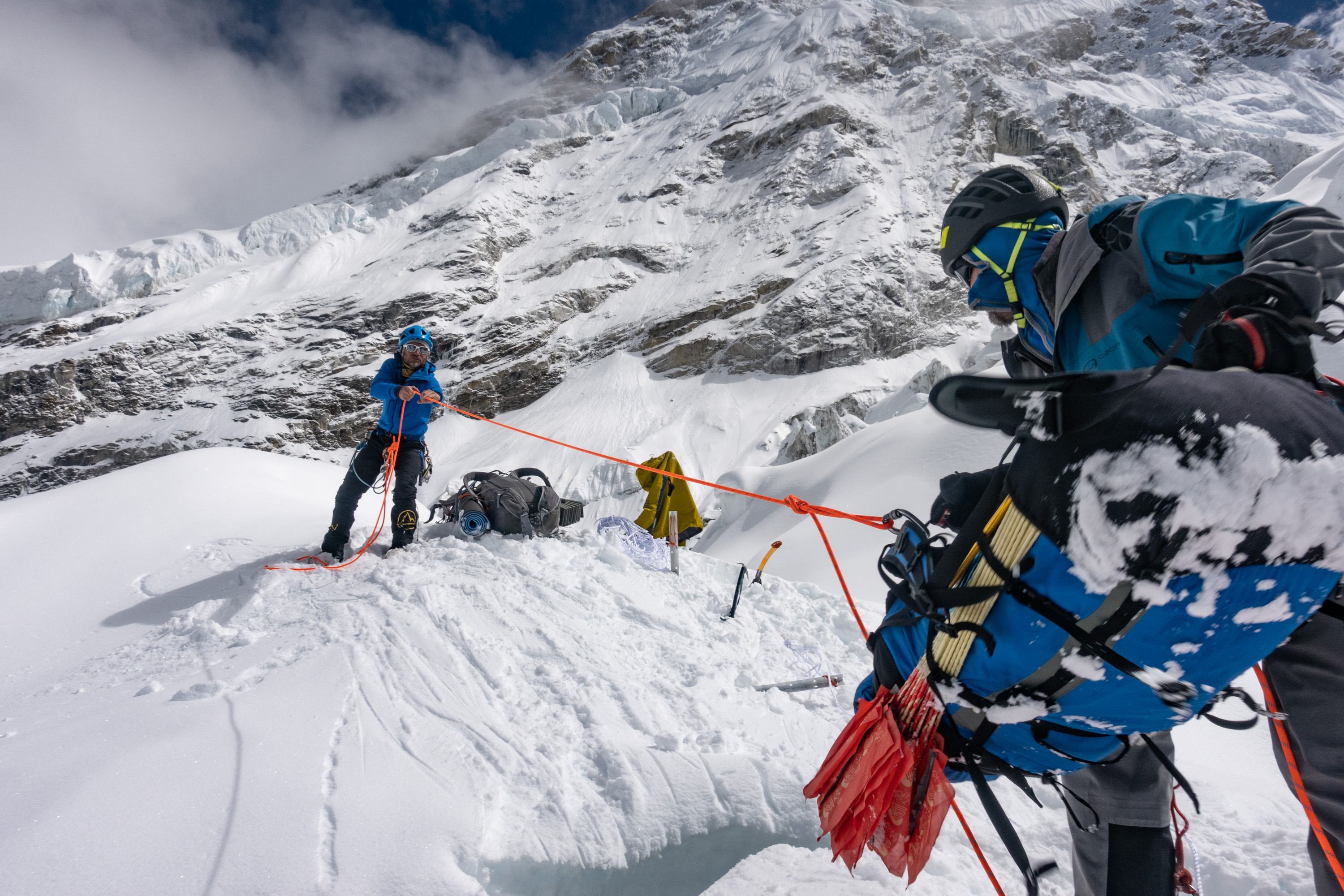
On their latest foray, the team reached 6,400m. “We climbed approximately twelve 60m pitches over rock, snow, and ice of moderate difficulty,” said Vasiliev.
He noted that on the way to the West Shoulder, they found traces of previous expeditions, including old ropes and snow anchors.
As for the terrain ahead of them, Vasiliev said:
From our highest point reached, the terrain ahead looks manageable. We can see two more steep rock steps, each approximately 100m high, along with possible bypasses on steep snow slopes. Beyond these obstacles, the terrain appears easier, and we hope to be able to move simultaneously.
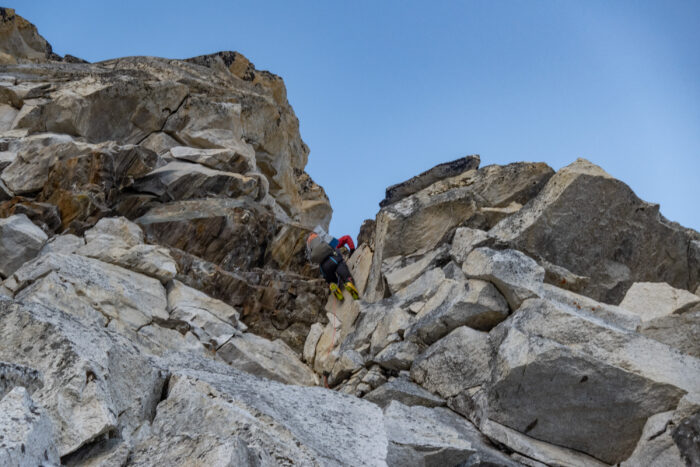
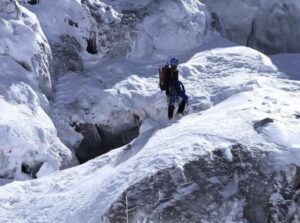
Rocky section on the way to Everest’s West Ridge. Photo: Andrei Vasiliev
Vasiliev and his team are confident they can manage this route, despite doing so in increasingly wintry conditions.
Hornbein Couloir?
The route linking the Lho La, the West Shoulder, and the West Ridge of Everest has been completed only twice. A Yugoslavian team led by Tone Skarja did the first complete ascent in 1979. They used the Hornbein Couloir variation on their descent.
The only repetition was done by a Bulgarian team in 1984. Hristo Prodanov reached the summit on his own and retraced his steps down the ridge but never made it back alive. Some of his partners who summited days later descended via the normal route. Three other teams who climbed the West Shoulder-West Ridge summited by traversing to the North Face, on the Chinese side, and climbing the Hornbein Couloir.
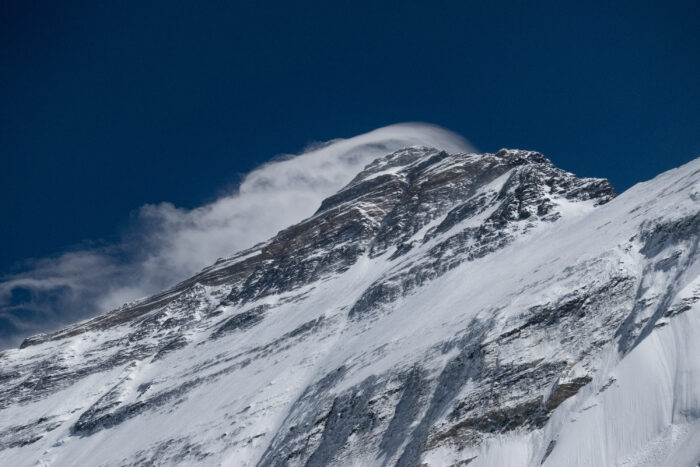
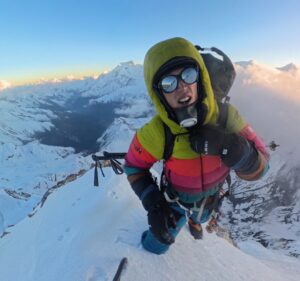
The North Face of Everest from the West Shoulder. Photo: Andrei Vasiliev
Objectively speaking, the Hornbein Couloir offers more summit (and survival) chances than the upper part of the West Ridge. However, it requires traversing into Chinese territory. The Russian team has a permit to climb only from Nepal. It is unclear if a brief border trespass could be considered, and Vasiliev has not confirmed what they will do. “First we need to complete one more rotation,” he said.