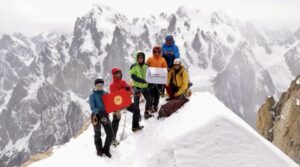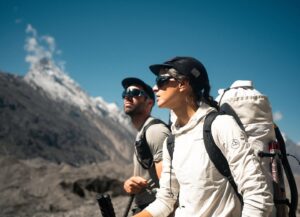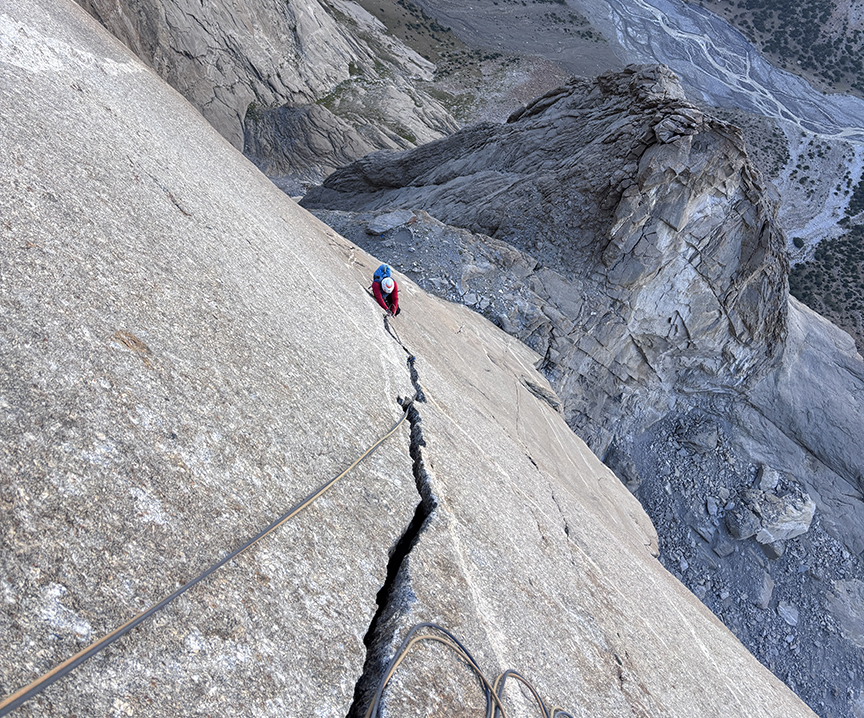
A mix of nine young and veteran Croatian climbers spent the month of August in one of the world’s great big-wall destinations — Kyrgyzstan’s Karavshin Range in the Pamir-Alay Mountains. Reaching up to 5,509m, the once-unknown granite cliffs now draw dozens of international climbers each summer. The two core valleys, Ak-Su and Kara-Su, have become known as Central Asia’s Patagonia.

The two leaders, Sinisa Skalec and Lukas Grbac Lackovic, spoke to ExplorersWeb about the place and their expedition. First, a summary of their four weeks.

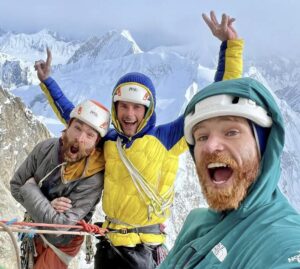
The Croatian team.
Plagued with illness
Though suffering from stomach issues for most of the month (more on this later), the team repeated several granite classics, did a new route on 4,430m Pik Breeze, and attempted another new line.
Three climbers — Bruno Crljenic, Eva Pejic, and Lackovic — identified a potential new line below Pik Breeze’s west ridge. They knew of only one previous route on the mountain, done by Russians Marina Popova and Denis Prokofiev.

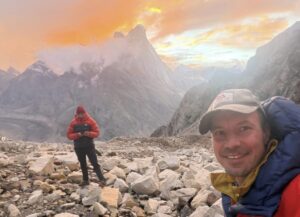
Crossing a scree slope on Pik Breeze.
Beginning at 5am, the three crossed a broad scree slope, then began climbing a couloir below Pik Breeze’s west ridge. They negotiated loose rock, briefly followed an existing line, then moved left into crack systems.


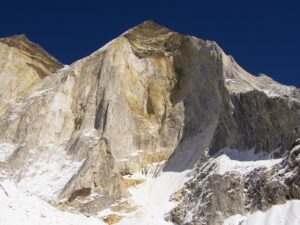
Canned Horse, 6c A0, top. Below, previous attempts and possible other lines on the face.
They climbed until 9pm, when they bivouacked on a tiny ledge with space for only two people sitting and one lying down. Resuming at 8:30am, they reached a col after three pitches and continued directly up slabs and cracks. They finished on easier IV/V terrain and followed a 200m ridge to the summit.
‘Canned Horse’
They called their new line Canned Horse, 930m, 23 pitches, 6c A0. It took them a further eight hours to get back to base camp. During the climb, they found pitons on two pitches. They believe these belonged to another route on the west ridge, but the history of that line, and whether it was finished, is uncertain.

Pejic, Grbac Lackovic, and Crljenic on top of Pik Breeze.
Later in the month, one of those climbers, Eva Pejic, became quite ill and couldn’t leave base camp on her own. Five teammates helped evacuate her, carrying her for 11km, with assistance from other climbers in the area. She later recuperated in the Kyrgyz city of Osh.
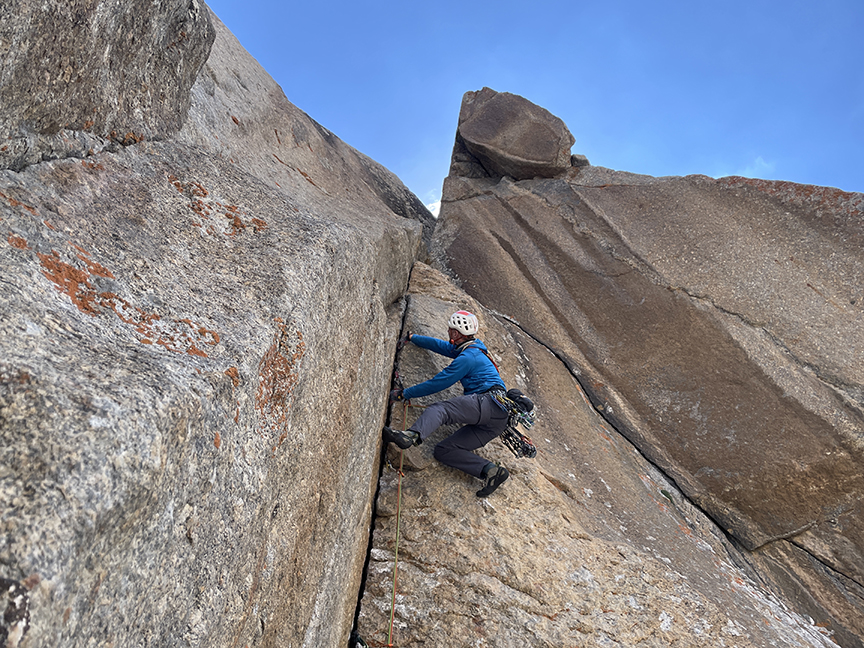
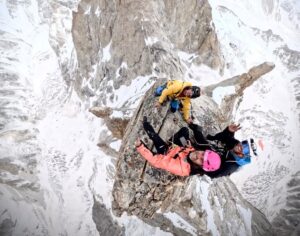
On the first crux of ‘Perestroika Crack.’
Three small teams of Croatian climbers also repeated Perestroika Crack, one of the best-known long granite routes in Central Asia. It rises about 900m up the north face of 4,240m Pik Slesova and is graded 7a. Three members reportedly free-climbed the route. One pair, Sinisa Skalec and Ivan Vitez, completed the line in a single marathon day, beginning at 5:45am, summiting at 5:40pm, and returning to base camp at 11pm.
Skalec and Vitez also repeated the French Ridge of 4,510m Kyrkchilta, 2,000m, 6b to 6b+. They needed one bivouac. Toward the end of August, this same pair attempted a first ascent on the Central Pyramid of Ortotyubek, overlooking base camp. Their attempted route mounted slabs and cracks to the left of the established Take It Easy line, which other Croatians had repeated during that month. The pair gave up their attempt on August 26 because of illness.
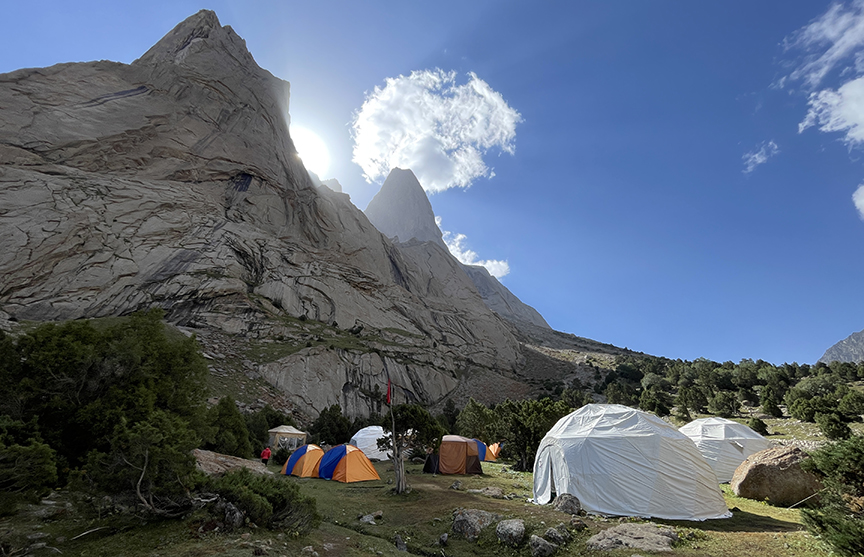
Base camp with Ortotyubek and Slesova in the background.
Here is our interview with Lukas Grbac Lackovic and Sinisa Skalec about Kyrgyzstan and the Ak-Su Valley.

Lukas Grbac Lackovic repeats the Central Route on a peak called Small Russian Tower.
Was Eva Pejic’s health problem related to altitude or something else? What was the illness you experienced on Ortotyubek?
Eva’s health problem was unrelated to altitude exposure or the expedition environment. However, most of us experienced gastrointestinal infections, with symptoms including diarrhea, bloating, fever, and general malaise.
This significantly hindered our climbing, as everyone in the team got sick at least once, and some even twice. Recovery was slow and never quite complete –- we felt weak for most of the trip.
One thing that helped us recover was having plain rice with some of our meals, which we could get from the cook if we asked nicely. If we were to go again, we would definitely bring our own food and cooking equipment. This can be inconvenient, but it could potentially save you at least a week of being sick and unable to climb.
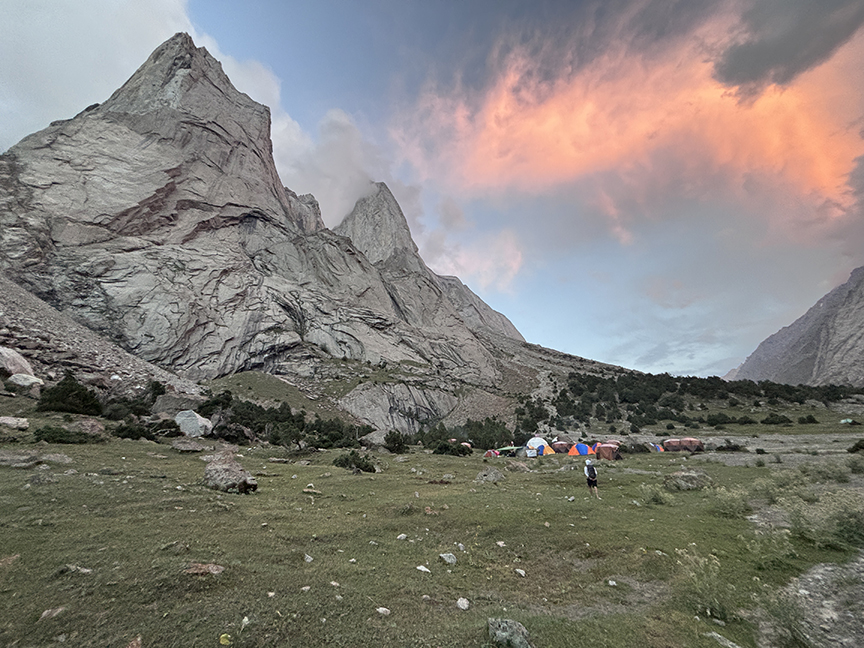
Another view of base camp and peaks Ortotyubek and Slesova.
The Karavshin Range
Can you describe the Karavshin Valley? How large is it? Are there many side valleys?
The two main valleys are Ak-Su and Kara-Su. Adjacent to them is the Jaupaya Valley, which provides a descent route from Pik Breeze and is home to several peaks around 5,000m high. The rock quality there appears poor, and we are not aware of any established rock routes in the valley.
Another interesting area, west of Kara Su, is the Orto-Chashma Gorge. An Italian team made a first ascent there during our visit.
Here in the West, we first heard about the area following the kidnapping of four American climbers in Kara-Su in 2000. Since then, it seems to have calmed down and become a popular climbing destination. Is the area considered safe nowadays, or are there still things climbers should be aware of?
Currently, the security situation in the valley is good. There is always the possibility of tensions, of course, as the valleys lie close to the border with Tajikistan. However, in recent years, the number of climbers visiting the area has increased exponentially, reaching around 100 climbers this year.

How many other climbing teams were in Ak-Su and neighboring Kara-Su while you were there? Where were they generally from?
During the three weeks we spent in the valley, up to 50 climbers were in BC at the same time. Climbers came from all over the world — Chile, U.S., Spain, Slovakia, Poland, Belgium, Slovenia, France, Italy, Germany, Japan, Russia…
Why did your group decide to go there?
We had originally planned a different expedition, but had to change our destination just a few months before departure. Some friends from Croatia and Slovenia recommended the area because of its straightforward logistics and relatively good security, while still offering impressive big walls and proper crack climbing. It didn’t take much to convince us!
Military checkpoints
Are there any military checkpoints? Do you need special permission to enter the valleys?
Yes, you have to pass through a military checkpoint when entering the area. However, the outfitter handles the application for the necessary permits and ensures everything goes smoothly.

Some call the Karavshin Valley the Patagonia of Central Asia because of its aesthetic granite walls. Do you think that’s a fair description?
Patagonia is definitely more spectacular, but you pay the price with poor weather. If your goal is to climb almost every day, then the Karavshin Valley is a better choice.
Climbing in Patagonia requires much more logistical planning and preparation, and the approaches themselves are a whole different story. In the Karavshin Valley, on the other hand, there is no snow or ice during the season we visited (August), at least on the walls we climbed. Some of the walls are just a 15-minute walk from BC, and you can reach them all in approach shoes.
Perestroika Crack and some of the classic routes in the Karavshin region are arguably just as good as the best rock routes in Patagonia.
Type of granite
How does the granite compare to Yosemite and Patagonia?
The granite is more similar in texture to that found in Patagonia; it is not as smooth as in Yosemite. The overall rock quality is generally good, although, as everywhere, some sections are of poorer quality. One downside of the mild climate in the Karavshin Valley is the dirt and grass that accumulate in the cracks, which can sometimes detract from the aesthetic appeal of the routes. The more popular and frequently climbed routes have already been cleaned and are pleasant to climb.

You climbed 4-1/2 pitches of the route on Ortotyubek. How much did you have left to complete it?
There were still two-and-a-half pitches left to complete the route up to the junction with Take It Easy. We envisioned the second half of the fifth pitch following the line up to a point just below the overhang that runs diagonally to the left.
From there, the sixth pitch follows a thin crack, from which you need to traverse left and move into another system of thin cracks that runs across the roof and joins the Take It Easy belay (seventh pitch). The last pitch of Take It Easy offers a logical exit, and we don’t think there is any need to come up with an alternative.
At the point where we stopped (first half of the fifth pitch), we left two pitons that we used as a temporary rappel anchor. Repeating parties are welcome to remove them, as they were only left for temporary use. We think a few bolts may be needed in the second half of the fifth pitch, but that obviously depends on the abilities of those planning to complete the route.
All belays are equipped (the first and fourth belays have two 8mm bolts each, while the second and third have two pitons each). In addition, we left two or three pitons in the first pitch and two in the second pitch.
Crack cleaning needed
As in the rest of the valley, some sections of the route are filled with dirt and grass. We made an effort to clean the cracks in the first four pitches, but there is still plenty of work to be done, especially on the sixth pitch, which we didn’t climb, where a thin crack is completely filled with dirt.
How much unclimbed rock remains? Are the obvious lines already established, or are there still many promising routes?
The most obvious and accessible lines may have already been climbed, but there is still plenty of potential. Anyone willing to put in the effort can establish a new route. The area is vast, and there is still plenty of room for new routes.
Your website mentions that there are guidebooks to certain routes in that area. Where are these available?
Most of the guidebooks we used are available online. We received some Russian guidebooks from climbing friends, although we didn’t use them very much. We’re not sure how easily they can be found online. Climbers from all over the world bring various materials to the camp, so most route topos and information can be obtained there.
A pleasant surprise
What was the most unexpected experience on your expedition — something that might surprise climbers familiar with other big-wall areas?
We were pleasantly surprised by the kindness and honesty of the Kyrgyz people. When traveling to remote parts of the world, many of us tend to expect that someone will try to rip us off and that we will have to haggle over everything, but that was not the case here.
Although some things took longer than expected, everything we had agreed on in advance was respected, and all the logistics for transportation and accommodation worked very well.
As we mentioned earlier, our only complaint concerns the food and hygiene conditions at the camp, which were most likely responsible for the digestive problems experienced by virtually all the climbers staying there.