So far, two climbers have confirmed plans for new routes on rarely visited Nepalese peaks. In an earlier story, we reported that Lucien Bocansaud will try to solo unclimbed Kangri Shar (6,792m). He’s currently acclimatizing. Meanwhile, Peter Hamor of Slovakia has set his sights on 7,132m Api in Western Nepal. However, unlike the French soloist, he doesn’t want to go it alone and is still looking for a partner.
From East to West
Twice in recent years, Hamor teamed up with Italian couple Romano Benet and Nives Meroi. On both occasions, the trio opened new routes on remote peaks in the Kangchenjunga region of eastern Nepal: Kabru South in 2023, and Kabru I in 2025.
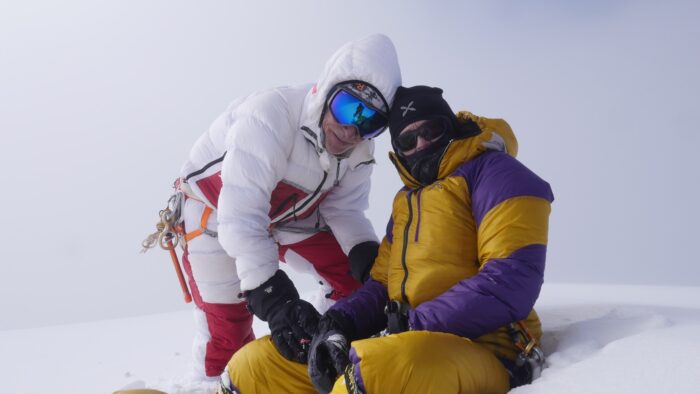
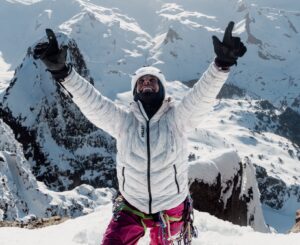
Peter Hamor, left, and Nives Meroi on the summit of Kabru I last year. Photo: Romano Benet
This time, Hamor looked for a suitable goal on the opposite, western side of the country. He decided on Api, also known as Api Himal, the highest peak of the Gurans Himal range, in Nepal’s far west. Hamor’s former partners, Meroi and Benet, confirmed to ExplorersWeb that they have to stay in Italy this spring.
Horia Colibasanu, another regular partner of the Slovakian veteran, says he lacks the necessary time. Colibasanu will fly to Nepal later this season for some acclimatization before moving on to Pakistan’s Gasherbrum II. “Peter was looking for at least one climbing partner; he is still looking, as far as I know,” Colibasanu told ExplorersWeb.
Seven successes
A Japanese expedition from the Doshisha Alpine Society, led by Katsutoshi Hirabayashi, first climbed Api via the northwest ridge on May 10, 1960. The Himalayan Database lists six other successful expeditions. The last ascent took place in the fall of 2015 by the late Kazuya Hiraide and Kenro Nakayima, who perished in 2024 on the west face of K2. Takuya Mitoro joined them on the Api climb. See a video of the expedition below:
In the last few years, three expeditions from Czechia have attempted different routes on Api, but all retreated due to insurmountable difficulties.
A different era
Api is rarely visited due to its remoteness. To attract visitors to Western Nepal, the government has waived the permit fees for 97 peaks, including Api and Api West (7,076m). Last year, at least one team obtained a permit for Api but reported no summit. Interestingly, Api II, a lower peak in the same massif, remains unclimbed.

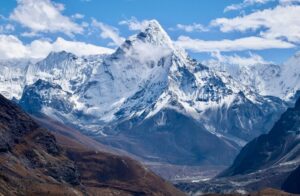
The south face of Api, in western Nepal. Photo: Wikipedia
Even before the moratorium on permit fees, Api’s permit only cost a modest $500 in spring and $250 in autumn. On the other hand, the remoteness of western Nepal is evident in fewer flights, longer approach treks, basic logistics, and a lack of helicopter airdrops. It’s like returning to a previous era — and that is precisely what Peter Hamor, a Himalayan veteran who avoids crowded peaks and large base camps, is after.
Bocansaud prepares on Kyajo Ri
Preparing for Kangri Shar, Lucien Bocansaud has been acclimatizing on 6,180m Kyajo Ri near Namche Bazaar. He climbed up to Camp 2 but was unable to reach the summit due to bad conditions on the route after a rather dry winter. Bocansaud wrote he is happy with his acclimatization, but didn’t indicate whether he is ready for a summit attempt on Kangri Shar.