Here are the Antarctic expeditions for 2026-27. There will be more, as a few still scramble to raise the money or choose to keep their plans to themselves until the last minute. Because of the long charter flights, an expedition to Antarctica, even a “tourist” Last Degree trip, costs close to $100,000 — more, if you want to do something unusual. These are the journeys announced so far. Skiers hit the ice later this month.
Hercules Inlet to the South Pole
Hercules Inlet is the common starting point for South Pole skiers. Skiers need to travel around 1,130km, averaging around 20km per day.
Brit Nathan Lumb originally planned a fully unsupported round-trip to the South Pole but scaled back due to “expedition logistics and funding realities.” He will now ski solo and unsupported from Hercules Inlet to the South Pole. Lumb previously completed a crossing of Norway’s Finnmarksvidda with guiding company Ousland Colliard.
Indian Neeraj Choudhary also trained with Ousland Colliard, crossing the Greenland Ice Sheet in 2024. He hopes to become the second Indian to ski solo and unsupported to the South Pole, following Satish Gogineni, who became the first in 2024-2025.

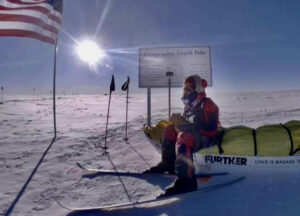
Satish Gogineni at the South Pole in 2025. Photo: Satish Gogineni
American Lucas Czarnecki will also ski solo and unsupported and claims he will livestream every moment of his journey: “What sets South Signal [his expedition name] apart from other polar expeditions is my commitment to bringing you along for every moment of this extreme adventure. Each day, I will be live-streaming my experience directly from the ice, sharing the raw reality of life on the polar plateau.”
Another American, Meghan Buchanan, will also tackle the route. She plans to start early, leaving for Antarctica on November 12.
Finally, German Dirk Langer will also attempt the route unsupported.
Berkner Island to the South Pole
A Berkner Island start means a few extra kilometers, with skiers required to cover around 1,400km to the South Pole.
Max Worsley of the UK and Martin Nesse of Norway also plan to start in early November, but from the edge of Berkner Island. Max is the son of Henry Worsley, who died following an Antarctic expedition in 2015-2016. Max intends to follow much of his father’s final route.
Messner start
At least two expeditions will begin at the Messner start, 911km from the South Pole. James Garnett of the UK and Norwegian Marius Rehn will each ski solo and unsupported.
Longer routes
Satish Gogineni will be back in Antarctica this year, hoping to build upon his Hercules Inlet experience. Gogineni’s 2026 plan is more ambitious: a solo, 2,000km journey from the outer edge of the Filchner–Ronne Ice Shelf to the inner edge of the Ross Ice Shelf via the South Pole. Gogineni is billing this as a “world-first human achievement” and the “longest solo traverse ever completed on the Antarctic continent.”
If successful, his route would indeed be longer than the truncated crossings of Colin O’Brady and Lou Rudd in 2018. However, his distance would still be well short of Borge Ousland’s 1997 expedition. Ousland became the first person to cross Antarctica solo and unsupported, though he occasionally used a rudimentary handheld kite known as a ski sail. Ousland skied for 65 days and covered 2,845km. At the time, sails were not considered “support.”
Last year, O’Brady tried a significantly longer expedition than his 2018 effort, attempting to ski from the edge of the Ross Ice Shelf to the tip of Berkner Island on the edge of the Ronne Ice Shelf, a total distance of over 2,800km. He eventually ended his crossing attempt after 100 days, with roughly 40% of his total distance remaining.
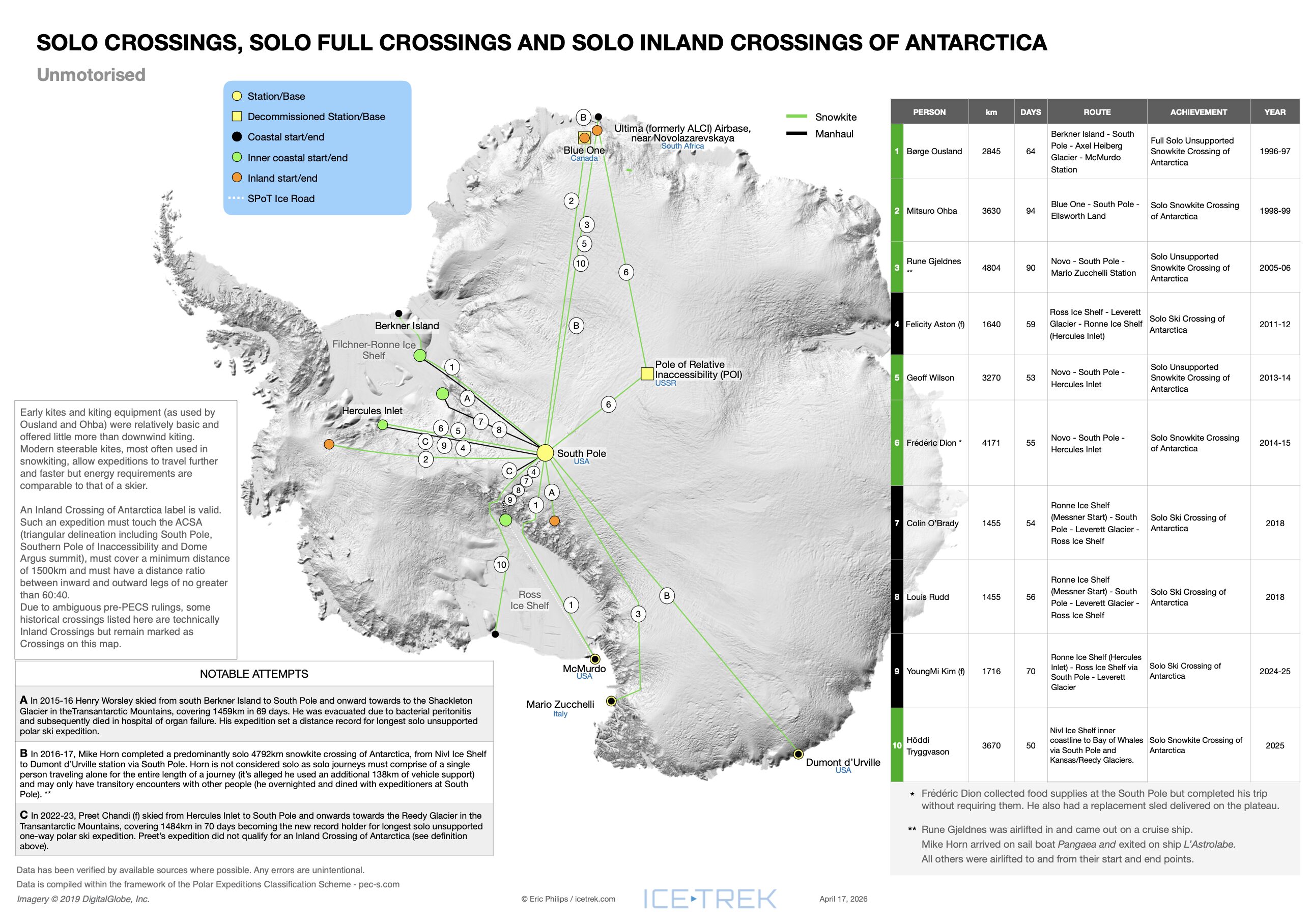
A map by PECS (the Polar Expeditions Classification Scheme) showing previous solo Antarctic crossing routes. Photo: PECS
Sled weight
Gogineni’s main challenge might be the weight of his sled. With so much weight spread over two sleds, O’Brady was forced to double carry in soft snow on the Ross Ice Shelf last year. A double carry involved shuttling half of his gear forward, then returning to pick up the rest. This meant he had to cover 15km for every 5km of progress. Gogineni says his sled will weigh 181kg.
Mardi Philips, Ida Olsson, and Nia Owens are calling themselves the Antarctic Valkyries and aim to become the “first all-female team to reach the South Pole of Inaccessibility.” They will start at Thorshammer Station (a spot near the Russian Novolazarevskaya Station in Queen Maud Land) and plan to kite-ski 2,500km, first aiming for the Pole of Inaccessibility (the middle of the Antarctic continent), and then continuing to their finish point at the South Pole.

The Antarctic Valkyries proposed route. Photo: Antarctic Valkyries
By wind-sled or kayak
A Spanish scientific expedition will cross Antarctica by a new route in a unique wind-powered vehicle.
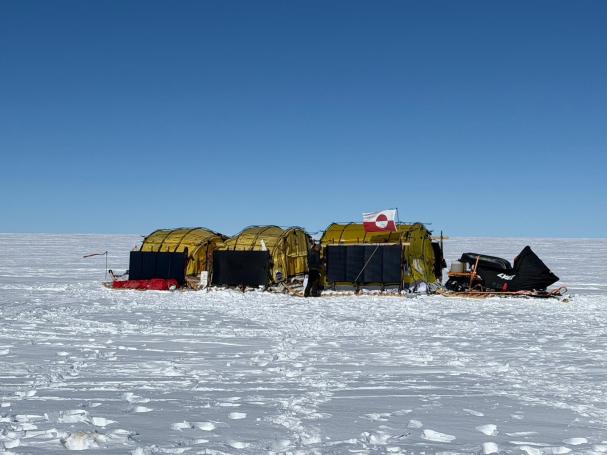
Part of the wind-sled involves a series of tents. Photo: La Vanguardia
Their “wind-sled ” is 15m long and consists of four modules. It is propelled using 20 kites of various sizes. The largest kite measures 150m² and the smallest 5m². The four-man team plans a 3,400km, 85-day journey from near Novolazarevskaya Station to the Italian research station Concordia, known as Dome C, on the Antarctic Plateau.
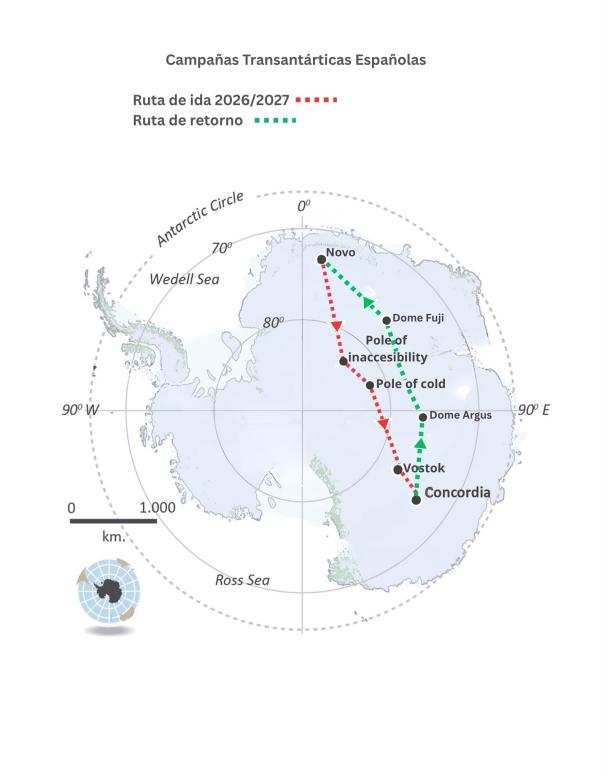
The wind-sled team’s proposed route. The green return route is planned for a future expedition. Photo: La Vanguardia
Meanwhile, three Argentine kayakers are preparing to paddle roughly 900km along the western coast of the Antarctic Peninsula, from Argentina’s Esperanza Base to San Martín Base. Diego Linares, Juan Tomaselli, and Javier Siede will start their journey in January and plan to spend 30 to 40 days on the water.