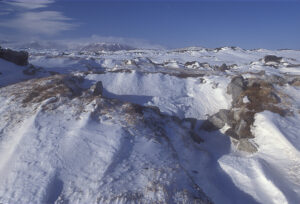
In 1907, Ernest Shackleton was in Antarctica on the Nimrod expedition. Small and underfunded, Shackleton’s team nevertheless succeeded in getting less than a hundred and sixty kilometers from the South Pole. The expedition won him international fame and honors, including a knighthood courtesy of King Edward VII.
Back in Ireland, his brother Francis was, well, otherwise occupied. He would end up receiving recognition of a very different kind from the king. As his brother strove pole-ward, Frank Shackleton was about to become the prime suspect in the theft of the Irish Crown Jewels.
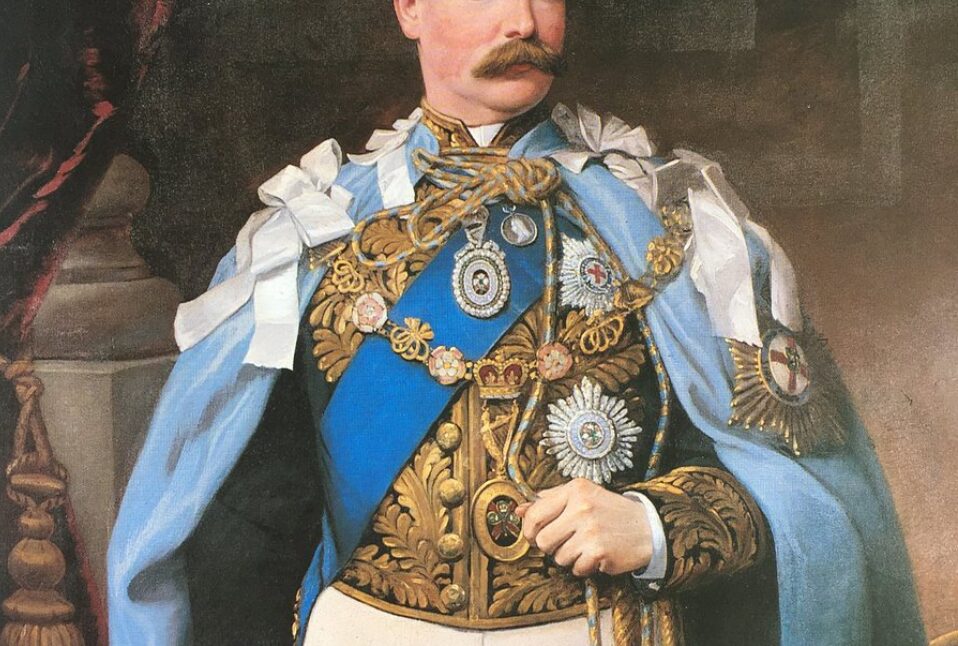
Detail from a portrait of The Marquess of Londonderry, wearing the now-missing jewels. Photo: Wikimedia Commons
The scapegoat: Sir Arthur Vicars
I’ll get back to the Shackletons shortly, but first we should meet one of the other principal characters in our tale. Sir Arthur Vicars was the younger scion of a prominent Anglo-Irish family, whose passion was genealogy. This is a useful passion to have if you happen to live in a society with a hereditary peerage. Soon, Vicars was made Ulster King of Arms and Principal Herald of Ireland, Registrar, and Knight Attendant of the Order of St Patrick. That’s a long title for what was essentially an office job.
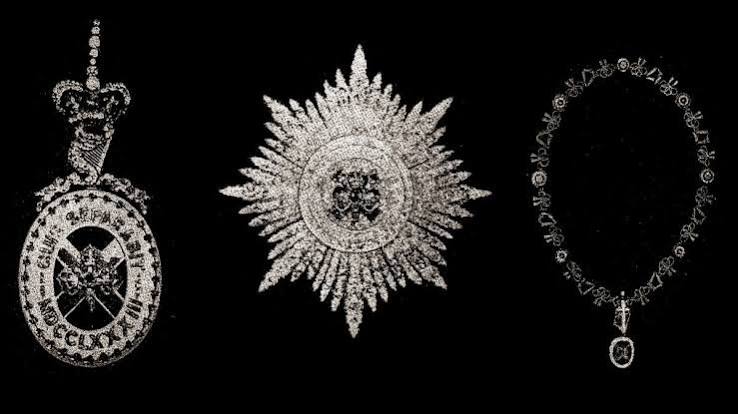
Among other duties, Vicars managed ceremonies when the British monarchs, who still ruled Ireland at that time, visited. This meant he was in charge of the Insignia of the Order of St Patrick, which were known as the Irish Crown Jewels.
The jewels consisted of two rather tacky gem-encrusted badges. Consisting of 394 precious stones, the breakup value alone was equivalent to millions in today’s money. As historical and cultural relics, of course, they were priceless. These baubles resided in a locked safe in the secure strongroom in Dublin Castle’s Bedford Tower.
Rather, they were supposed to. Some renovations, under Vicars, were completed before anyone thought to measure the strongroom door against the size of the safe. The safe was a little too wide to fit into the strongroom, so Vicars stashed it in the library instead. He then proceeded to hold private after-hours parties in that library.
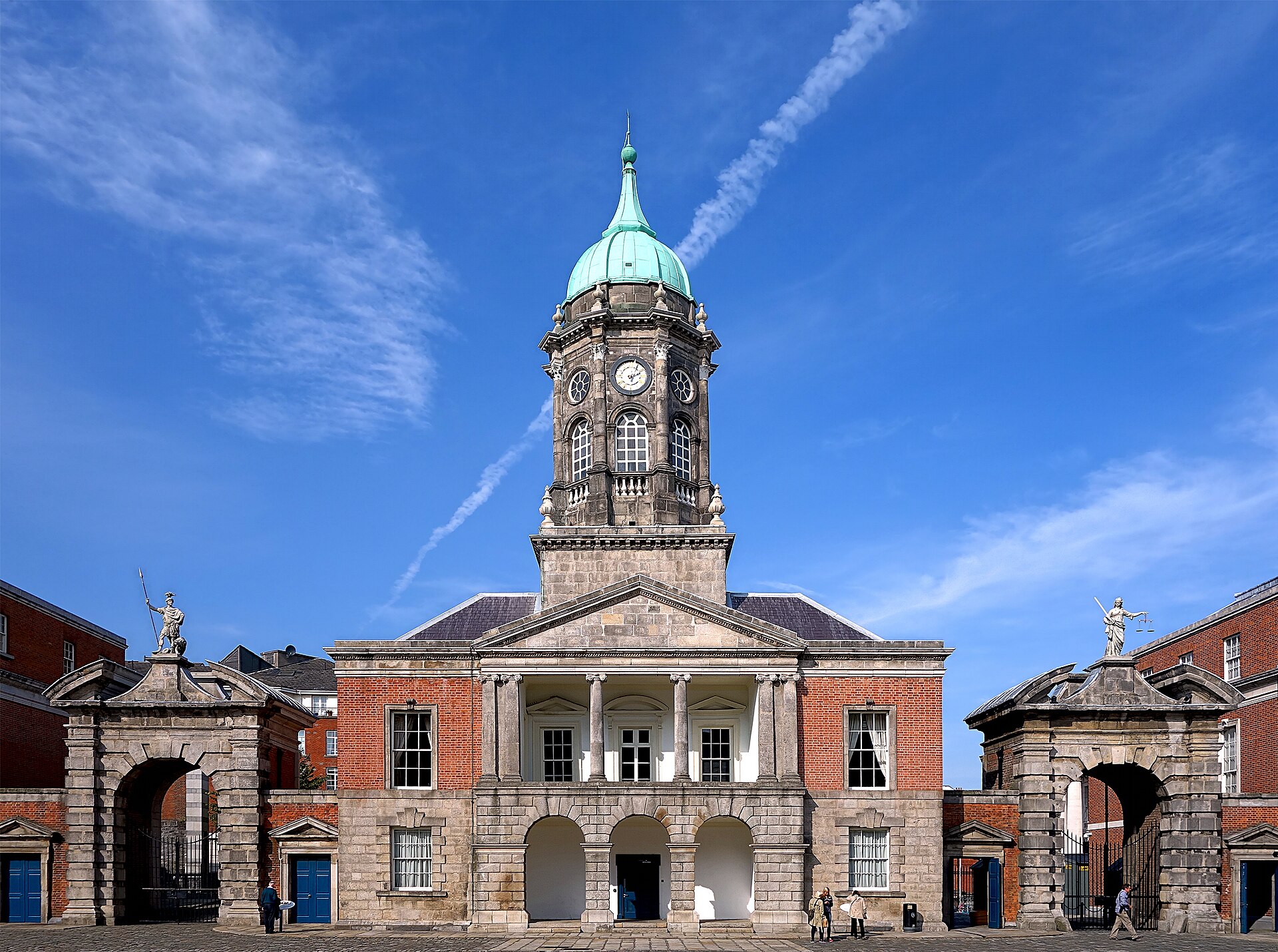
Bedford Tower dates to the 18th century. Photo: Wikimedia Commons. I live in Ireland but was unfortunately unable to get pictures in person because the entire complex is closed to host the EU Presidency. All I can say is, I hope security has improved since 1907.
Uh oh, Arthur
On the morning of July 6, 1907, the cleaning lady, Mrs. Farrell, found the strongroom door open. She duly reported the incident, as she had three days before when she found the tower entrance unlocked. Both times, Vicars was unconcerned. It was only later that afternoon, when Vicars discovered the safe itself unlocked, and its contents gone, that he became alarmed. Even then, he wasn’t in as much of a panic as he should have been. This had happened once before, and everything turned out fine.
At one of those after-hours parties, Lord Haddo, the son of the Lord Lieutenant of Ireland (head of the Irish government), had thought of a fine joke. Haddo, presumably fairly drunk, lifted the safe keys from Vicars, who was very drunk, and went home with the crown jewels. The next morning, a hungover Vicars received a package in the mail, containing the jewels.
But this time, the missing regalia did not turn up in the post. The police were called in, and they confirmed that the safe had not been broken by force — the thief had a key. The king was furious, and Vicars swiftly found himself out of a job. Lord Aberdeen, the aforementioned Lord Lieutenant and father of the mischievous Lord Haddo, appointed a commission to investigate.
They soon concluded that they were dealing with an inside job. With Vicars’ lax security and frequent visitors, there would have been many opportunities for an enterprising thief. But who was it? And what had they done with the jewels?
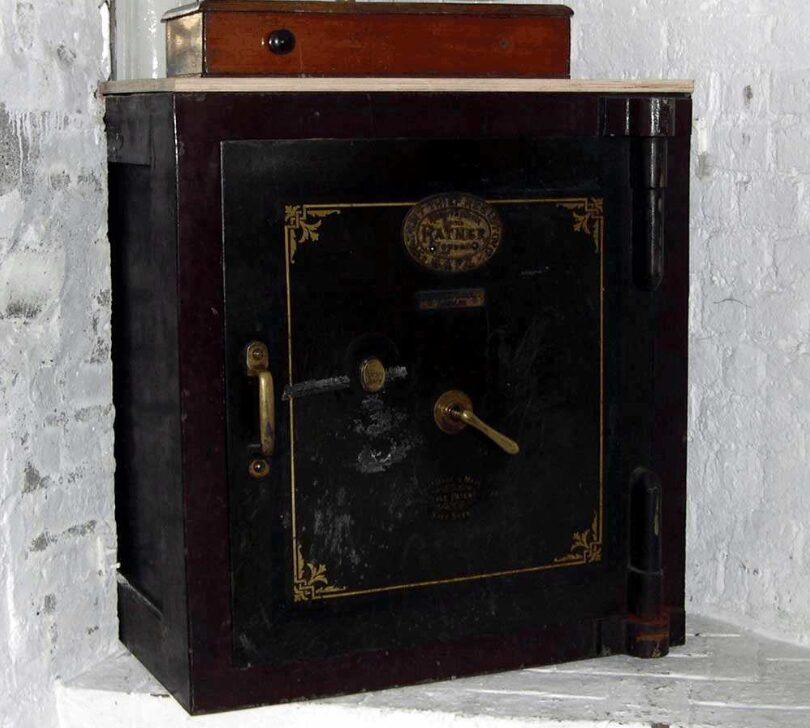
This slightly too-wide safe formerly housed the Irish Crown Jewels. Photo: Garda Museum, Dublin
The prime suspect
Remember those after-hours parties Vicars was throwing? One of the regular attendees was one Francis “Frank” Shackleton, the younger brother of Ernest Shackleton. The Dictionary of Irish Biography describes him as “dapper and flamboyant,” which in the historical biography context usually means one is either gay or a con man. Our friend Frank was both.
In 1907, Frank was, in fact, living with Arthur Vicars. Vicars had gotten him the position of Dublin Herald, which was more or less a sinecure. Between that and the parties, Frank was regularly seen coming and going from the tower. Much like his brother, Frank Shackleton was in perpetual financial straits. He owed a great deal of money and had convinced Vicars to guarantee several bills for him, stretching Sir Arthur’s own financial capabilities.
Their coworker, Francis Goldney, testified to his suspicion of Frank. Vicars refused to cooperate with the commission, but they had his written and oral statements, showing that he, too, suspected Frank. Then there was the letter which Vicars had written to Frank in August, expressing his hope that Frank would cooperate with the investigation, since “you evidently know the whereabouts of the Jewels, from what you have said to both [Goldney] and me.”
That letter, Frank Shackleton testified, only referred to a false report he’d seen in the paper, stating that the jewels had been recovered. On the stand, Frank made an excellent show of it. Frank admitted that he had frequently commented on how easy it would be to steal the jewels. He also made frequent allusions to certain powerful friends and connections. His implication must have been clear. Frank moved in powerful circles and attended certain private parties both in England and Ireland.
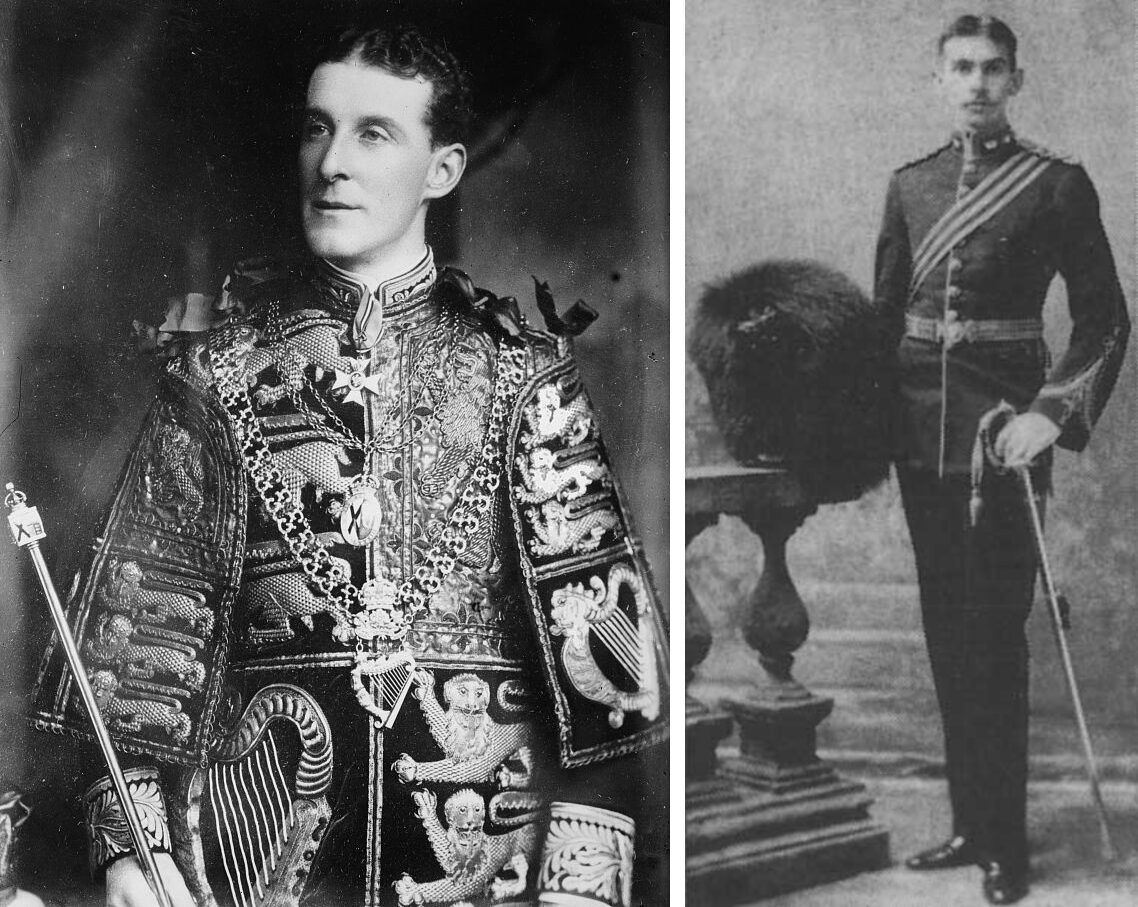
Left, Sir Arthur Vicars. Right, Francis Shackleton. Photo: Wikimedia Commons
Why was Frank Shackleton not charged?
The commission never acknowledged what was soon revealed in the press: Those drunken parties that Vicars threw in the Office of Arms, which prominent lords and government officials attended, also involved same-sex activity. If Shackleton was charged, he could take fellow attendees, like the Lord Lieutenant’s son and even Edward VII’s brother-in-law, down with him.
Sodomy was still illegal under the law of the British Empire, and would be until 1967. It was an especially delicate situation due to the specific time and place. Ireland was only a few years out from the 1916 Easter Rising, and trust in the British colonial government was low. Another public humiliation was the last thing they needed, especially at Dublin Castle, which had been the site of a similar scandal in 1884. Then, several prominent British administrative officials and castle staff members had been prosecuted or implicated for engaging in homosexual activities on castle grounds.
With this in mind, the commission never charged Shackleton, and his name was suppressed in at least one press report. The earlier theft by Lord Haddo, likewise, did not appear in official reports.
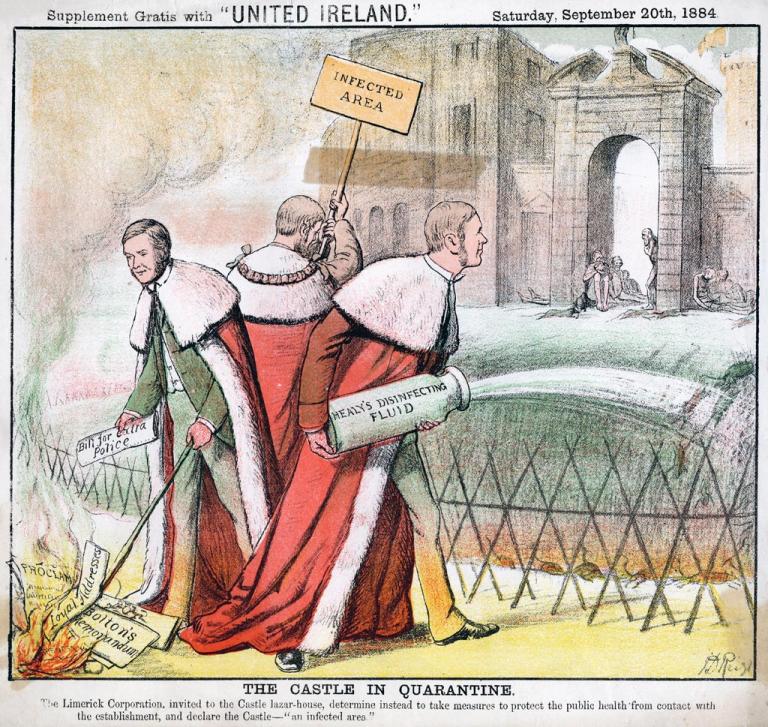
Irish Nationalists made much hay of a similar 1884 sex scandal as a symbol of corruption among British colonial administrators, as in this political cartoon. Photo: Dublin City Council
Arthur Conan Doyle gets involved
With the prime suspect essentially unprosecutable, the burden of blame fell on the negligent Vicars. Sir Arthur Vicars was in a truly difficult position. Luckily, his distant relation, another Sir Arthur, was something of an amateur detective, and rushed to solve the mystery, using only the most modern, accurate methods: ghosts.
While his world-famous creation was a master detective, driven by logic and observation, Sir Arthur Conan Doyle himself was superstitious and gullible. A pair of children once convinced him that fairies were real and living in their garden. It was almost certainly Conan Doyle’s advice that led to the holding of a seance. There, the spirits revealed that the missing jewels were buried in a churchyard. Vicars followed up on the clue, but digging revealed nary a diamond.
So Conan Doyle’s help was a bust. The case did end up immortalized in literature, however, as the barely disguised inspiration for a Sherlock Holmes short story titled The Bruce-Partington Plans.
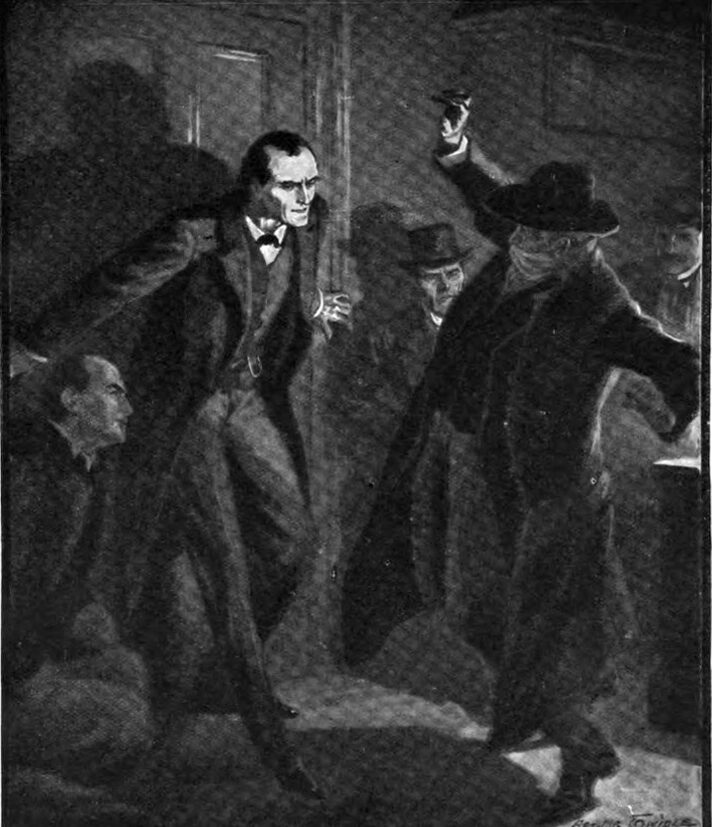
In the realm of fiction, the great detective succeeds where his creator failed, apprehending the stolen item — in the story, plans for a submarine. Photo: Illustration published alongside the story in The Strand, 1908
One last clue
The case stayed cold until 1927, when a Parisian jeweler reached out to the newly independent Irish government. They had the jewels and would be willing to sell them back for “£2,000 or £3,000” if the Irish Free State was interested. They weren’t. A year later, the empty jewel case arrived in the mail without a note.
The commission was unable to confirm whether Frank Shackleton, who traveled frequently between Britain and Ireland, was in Ireland at the time of the theft. Several theories hinge on his having an accomplice, a known associate named Captain Richard Gorges.
According to Vicars’ half-brother Pierce O’Mahony, Shackleton and Gorges had worked together to steal the jewels, then secreted them away to Amsterdam. The commission concluded without an official suspect, but both Shackleton and Gorges were quietly asked to leave the country. Gorges later went to prison for an unrelated manslaughter incident. In prison, he allegedly bragged about his involvement in the theft.
A centenary report from the Centre for Irish Genealogical and Historical Studies notes that several relevant documents have since gone missing. Whether this is the result of a cover-up or the natural effect of a revolutionary war, civil war, and time, the report did not determine.
Whoever took the jewels almost certainly broke them up and sold them as individual, anonymous gems. In my opinion, no great loss; they were fairly tacky, and if they were recovered today, they’d only go back to the British Crown, which has enough glittering colonial plunder cluttering up the place as it is.
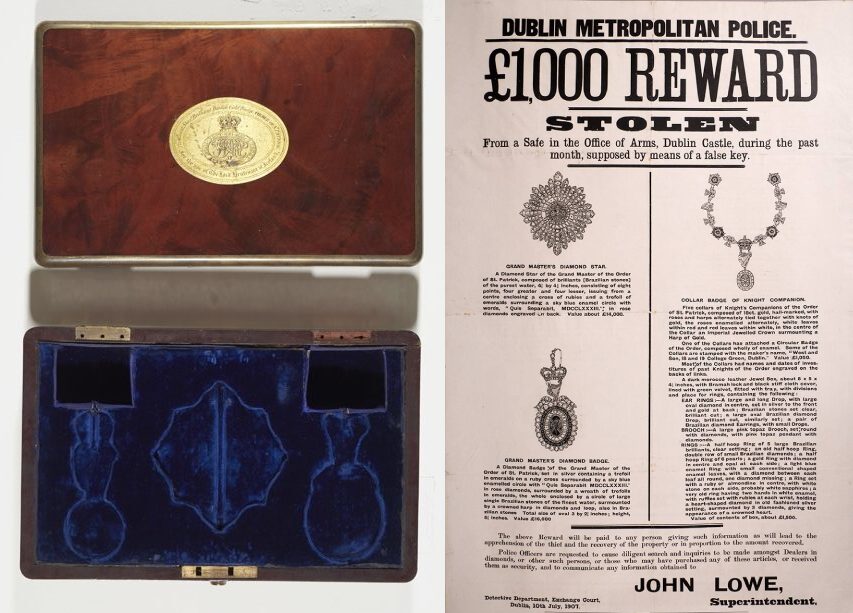
Left: The empty case which formerly housed the Irish Crown Jewels. Right: A missing poster put out by Dublin police. The £1,000 reward has never been claimed. Photo: Dublin Castle
Forever unsolved?
For Vicars’ part, he seemed fairly certain what had happened. After he was shot by a local IRA unit in 1921, his will was discovered to include a rather personal note. In it, he said he might have had more to dispose of if he had not become a scapegoat for the loss of the jewels. Officials, he claimed, had “shielded the real culprit & thief Francis R. Shackleton (brother of the Explorer who didn’t reach the South Pole).”
I’m not sure what exactly poor Ernest Shackleton did to Vicars to deserve that particular parting shot. It was true, though, that he continued to look after his brother’s interests throughout his scandalous misadventures. Ernest once borrowed £1,000 (around £100,000 today) to help pay Frank’s debts, money he did not have, as he was raising funds for an expedition at the time. Only a few years later, Frank went bankrupt with over £85,000 worth of debt. He fled to Portuguese West Africa, but authorities caught up with him in 1912 and arrested him.
Back in England, Frank stood trial for an unrelated fraud case. Once again, his potential blackmail kept him from the most serious charges. After serving a short sentence, he changed his name, and Ernest got him another office job. Frank Shackleton outlived his brother, moving to Sussex where he ran an antique shop with their unmarried sister Amy, until his death in 1941.