In the famous photograph of Tenzing Norgay standing on the summit of Everest on May 29, 1953, he holds his ice axe aloft, strung with flags. What you can’t see is the wool helmet under his hood. It had been left to him by a Canadian named Earl Denman, who six years earlier had convinced Tenzing to join him on a doomed, poorly equipped, illegal attempt on the mountain from Tibet.
Jennifer Peedom’s new film, Tenzing, recreates the triumphant 1953 conquest of Everest, with Genden Phuntsok in the title role, Tom Hiddleston as Edmund Hillary, and Willem Dafoe as expedition leader John Hunt. Denman’s name doesn’t appear in the cast list.
I first came across Earl Denman in 1997, in Jon Krakauer’s Into Thin Air, which describes him as a “poverty-stricken Canadian engineer” who “somehow” talked two Sherpas, one of them Tenzing, into accompanying him to Everest in 1947. Denman had written his own account of the attempt, Alone to Everest, published in 1954 and long out of print. The photograph facing the title page shows a lean man in a pale hooded smock on what looks like a ship’s deck, a coil of rope beside him, staring into the distance. With the hood pulled up and tied under his chin, he resembles a cross between Lawrence of Arabia and John Cleese.
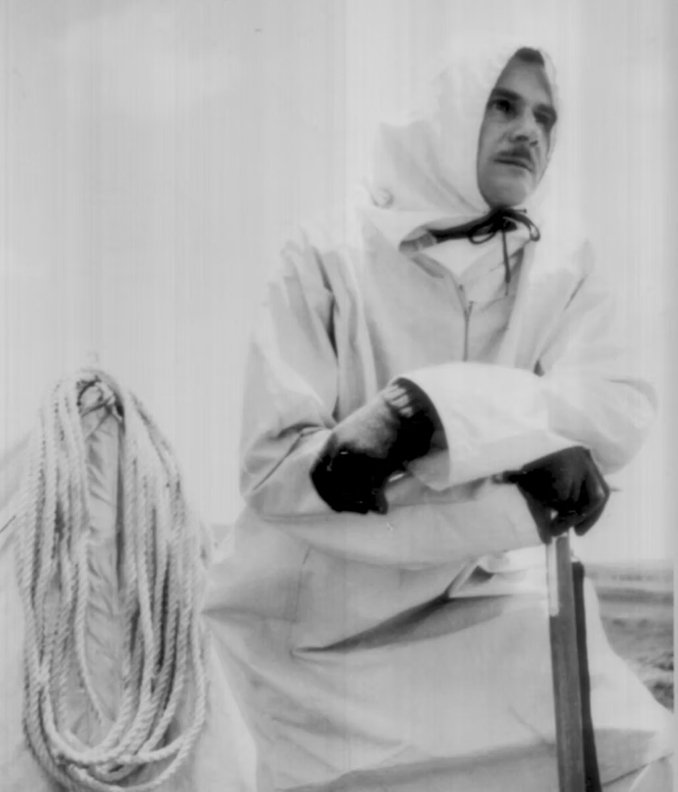
Photo: earldenman.com
Rockies roots
Earl Denman was born on December 11, 1914, at Tod Inlet on Vancouver Island, Canada, where the Butchart family, founders of the famous Butchart Gardens outside Victoria, B.C., ran a cement works. His father worked there as an engineer until rheumatoid arthritis left him unable to walk. When Earl was about four, the family returned to England, as he later put it, “in the forlorn hope of gaining relief for a completely paralyzed father.” His father was bedridden for “seven painful years,” Denman wrote, nursed by Earl’s mother, and the family’s savings were “whittled away to nothing.”
According to Denman’s great-niece, Lisa Jones, the boys were sent to live with other people while their father was ill. Earl went to a couple named Topps at Heckington Fen in Lincolnshire. How long he stayed isn’t clear.
By his own account, Denman was “never really happy” in England. “How could I have been?” he wrote. Canada was another matter. “Childhood glimpses of the Canadian Rockies formed a lasting impression,” he wrote, “a first link in a chain of events leading from one mountain range to another.” Even as an adult, he still felt a nostalgia for his birthplace, “which distance and time cannot remove.” He grew up, in his own words, with “the far-away look of a dreamer.”
After five years as an apprentice electrical engineer, Denman departed for Africa and secured a job in the Anglo-Egyptian Sudan. “I had dreamed of mountains, but had to be content with a barren desert,” he wrote.
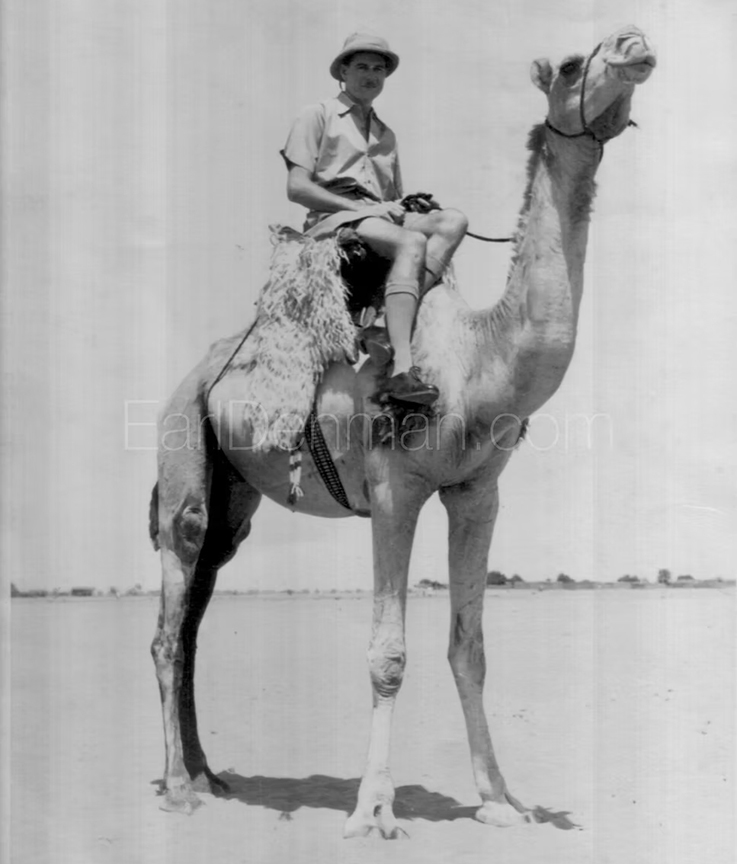
Denman hamming it up in the ‘barren desert.’
Virunga Mountains
On his first leave, he rode fish lorries south to the Ruwenzori, the Mountains of the Moon, in the Belgian Congo. Camped alone below the snow line, he “first came to think about Everest,” and decided he wanted to be the first to climb all eight of the Virunga Mountains, a chain of volcanoes straddling the borders of today’s Democratic Republic of Congo, Rwanda, and Uganda.
After serving “rather unspectacularly” in the Second World War, he set out from Bulawayo, in what was then Southern Rhodesia, for the Virungas, climbing them with local porters and guides and, often, no boots. Years later, he still claimed to be “the only one to have climbed all eight.”
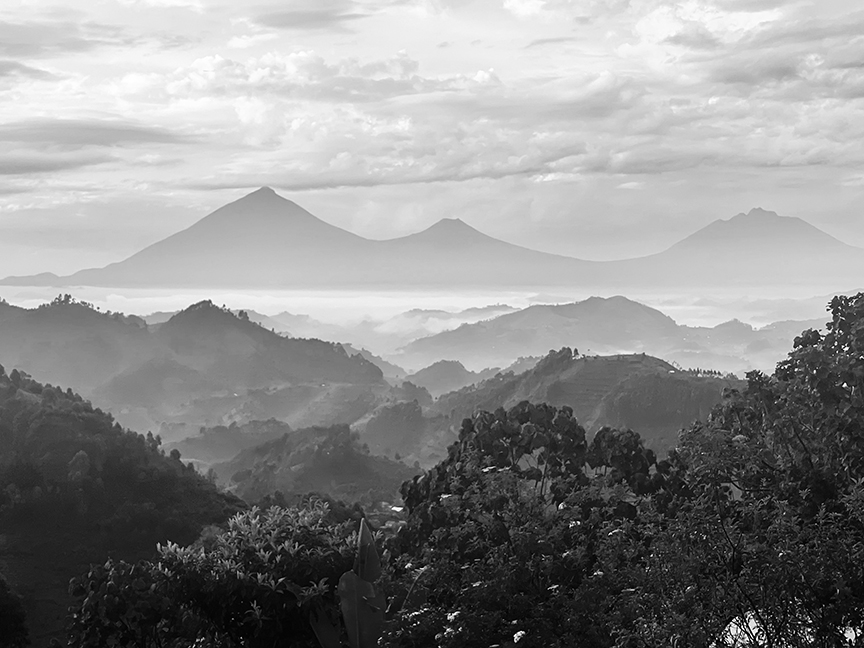
Virunga Mountains. Photo: Shutterstock
Denman meant to climb Everest the same way, with a couple of local men and no army of porters. To him, the mountain was “essentially a mountaineering project pure and simple,” as he put it in his book, “wholly a matter of man pitting himself against the highest mountain in the world.”
Anything grander was out of reach, anyway. By his own count, he had “only £250 left over from my Virunga expedition” to cover his equipment, food, and the whole journey from Bulawayo to Darjeeling and back. His camera was “a cheap second-hand one, with punctured bellows,” and a watch was beyond his means. Nor did he have permission to enter Tibet.
Denman left Bulawayo in February 1947 and landed in Bombay on March 15. On the long train ride across India, the clickety-clack of the wheels “seemed to say, ‘You fool, turn back. You fool, turn back,'” he wrote.
Karma Paul
In Darjeeling, a shop window full of mountain photographs caught his eye, and the name over the door, Paul, reminded him of someone from his reading on Everest: Karma Paul, the interpreter who had worked with the prewar British expeditions. A few questions inside the shop brought Karma Paul himself. He was no climber, but he listened to Denman’s mad plan. His response was one word: “Impossible!”
Karma Paul “took a lot of convincing,” Denman recalled, but told him to come back at 11 the next morning, when, Denman wrote, “he would introduce me to a capable Sherpa who might be willing to go with me.” In the meantime, Denman needed a permit to enter Sikkim, which meant signing a declaration that he would not go beyond Sikkim into Tibet. “I hated the duplicity that was involved,” he wrote, “but it was unavoidable.”
The Tiger
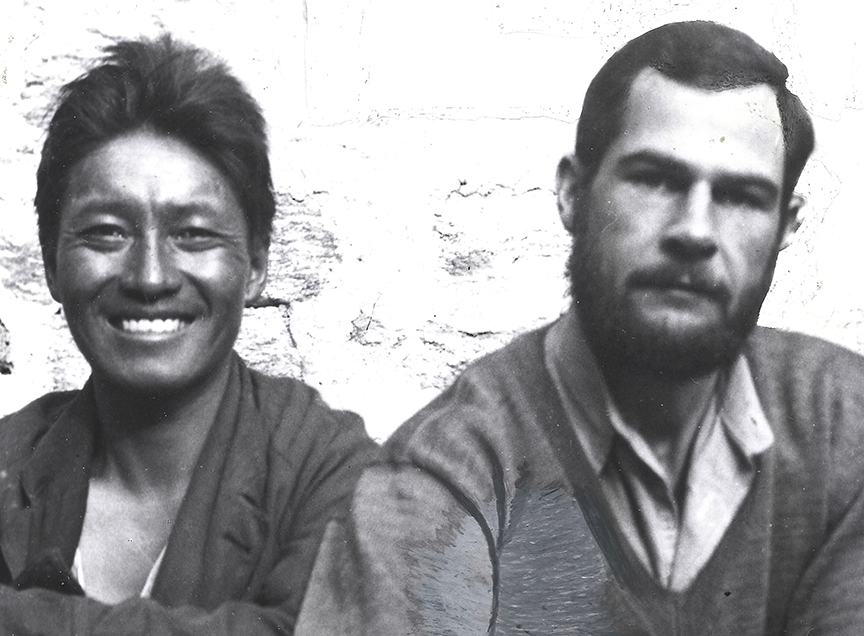
Two men were waiting in Karma Paul’s office the next morning. One was Ang Dawa. The other was Tenzing Norgay, a “Tiger” of the prewar Everest expeditions, who had already climbed to 27,000 feet on the mountain. Denman thought him wiry and vigorous. At first, he noted, Tenzing “remained unsmiling.”
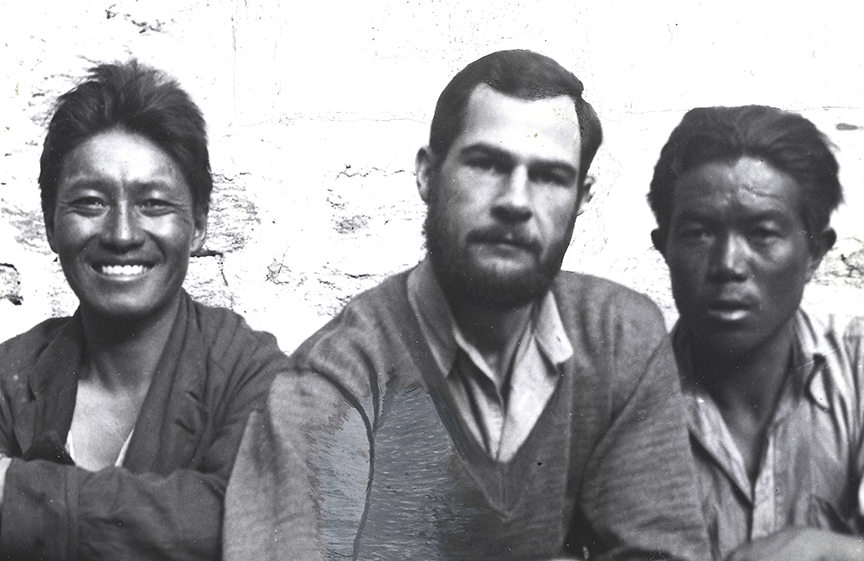
Tenzing, Denman, and Ang Dawa. Photo: earldenman.com
Karma Paul, who called the plan “sheer suicide,” washed his hands of it, so Denman took the Sherpas back to his “bleak little apartment” and was frank about how little he could pay. Then he played his last card. With an official expedition, he told Tenzing, he would be just a porter, left in camp while the sahibs went for the top. With Denman, “If I succeed, you will succeed as well.” After a quiet word with Ang Dawa, Tenzing answered with a half-smile: “We will try.”
In Tiger of the Snows, the autobiography he told to author James Ramsey Ullman (Tenzing never learned to read or write), he admits he knew better. “Any man in his right mind would have said no,” he said. “But I couldn’t say no. For in my heart, I needed to go, and the pull of Everest was stronger for me than any force on earth.”
Because of that declaration, secrecy mattered. The three men left Darjeeling separately, met at an agreed spot outside town, and took the standard expedition route through Sikkim. At the Tibetan frontier, Tenzing steered them off the patrolled trade route and over a little-used pass.
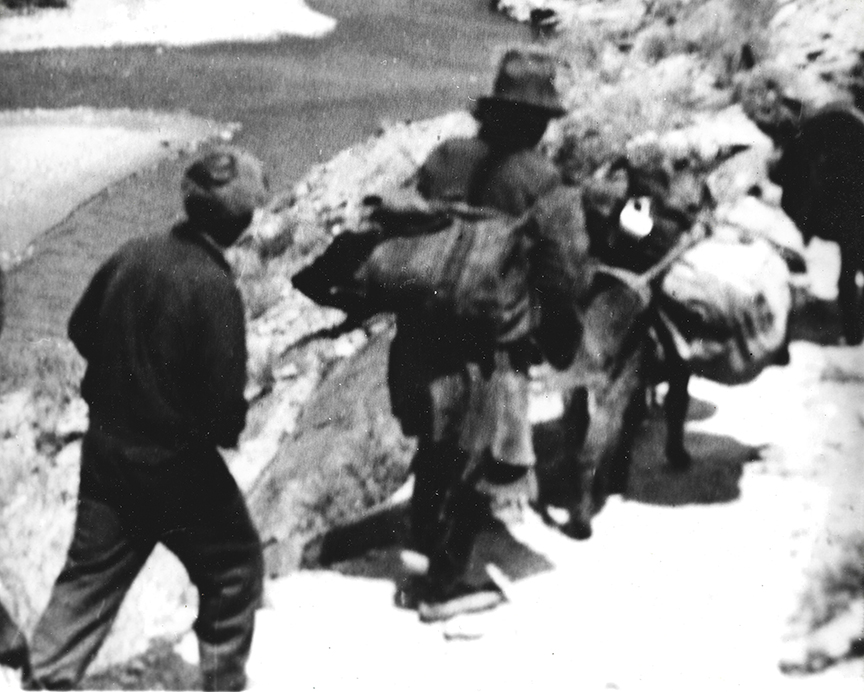
On the trek to Everest. Photo: earldenman.com
By his account, hardly a day went by without trouble. Food ran short. At one point, the loaded yaks tumbled down a slope, very nearly taking the party’s supplies with them. When a patrol stopped them and ordered them back, they talked their way out of arrest, made a show of retreating, and then looped around. After that, they gave every town and village a wide berth until they reached the Rongbuk Monastery, at the foot of Everest’s North Side.
Tenzing hadn’t seen the mountain in nine years. “The old excitement returned, as strong as ever,” he said. “Here I was again where I was meant to be.”
The mountain
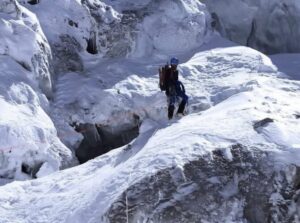
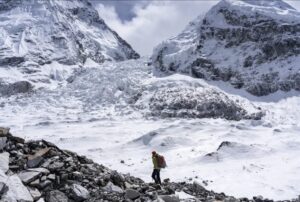
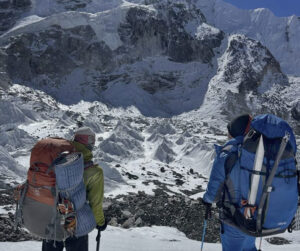
From Rongbuk, they moved quickly, carrying everything themselves and pitching a new camp every day. Denman later calculated that the 1933 British expedition had needed 16 to 24 days to get as far as they got in four. Speed was their only advantage. Their clothes weren’t windproof, they had run out of tea, and their two tents, Tenzing recalled, “gave as much protection as a sheet of paper.”
Denman hardly slept. On his second night on the mountain, he wrote, sleep “would not come,” and he lay pummeling himself for warmth and wondering whether dawn would ever arrive. The Sherpas, meanwhile, hauled the loads without complaint. Reaching one camp after barely resting all the way up, they set them down, he wrote, “as though they were only slight encumbrances, like a load of children on a zoo elephant.”
That night, the weather turned. A “savage wind, like the breath from a Tibetan mastiff,” came up, and Tenzing shared his sleeping bag with him. Lying there, Denman wrote, “I realized properly, for the first time, how miserably poor we were and what little chance we stood.” By then, food had lost its taste, apart from cheese and slabs of milk chocolate studded with nuts and raisins. He kept the chocolate within reach at night, peeling off his gloves for every bite and sucking it slowly off the nuts to pass the hours. Outside, the ice pinnacles cracked “like pistol shots.”
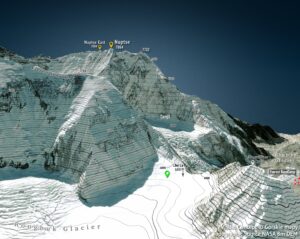
The North Col
At the foot of the North Col, they wrestled their single tent into the wind, piling rocks on the guy ropes where the pegs wouldn’t go into the frozen ground. The col itself looked less frightening than Denman had expected. Three men could climb it safely, he thought, but not in that wind. That night, he prayed, “Help me to do the right thing. Do not rob me of the chance to go forward, but give me strength to go back if I must.” He was frank about how little he cared what happened to him. “My whole life was Everest,” he wrote. “I did not want to live if we failed.”
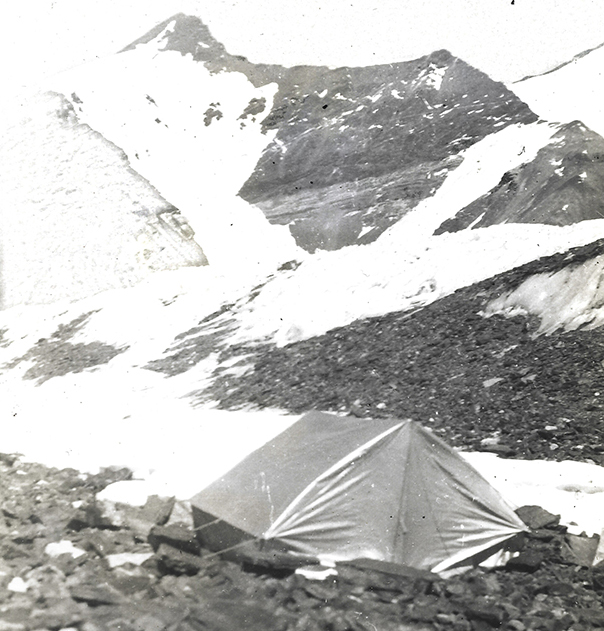
Photo: earldenman.com
The tent flapped all night, and two pegs tore loose. By morning, he admitted, his prayers had turned to “bitter oaths.” They drank hot cocoa at first light. Nobody discussed what to do next, but all three began taking down the tent, and they went up rather than down. “We would not give in so easily,” Denman wrote. On the slope below the col, the wind returned at full strength, and the sky turned to “an unrelieved dark mass, almost black.”
Turning back
They turned around at about 23,500 feet by Denman’s reckoning. Jon Krakauer, in Into Thin Air, puts it closer to 22,000. Their hands were “on the verge of frostbite.” “We held our consultation, if it could be called a consultation,” Denman wrote. “We had played our hand.”
Denman, Tenzing said later, was “a determined, almost fanatic man with a fixed idea. But he was not crazy.” He agreed to turn back, and for that, Tenzing said, “I am as grateful as for anything that has happened in my life.” They came down almost at a run. Denman was in a hurry to put the mountain behind him, Tenzing remembered, “as if it were a thing he no longer loved but hated.”
His boots fell apart, and for a few days he walked barefoot. “My bitterness was like an open wound as we hastened down,” Denman wrote. He knew they had “attempted more than was humanly possible,” and that there was no disgrace in that. He felt humiliated all the same. The whole trip, from Darjeeling to Everest and back, took five weeks.
Pen pals
Denman returned in January 1948 with warmer boots and proper sleeping bags. What he didn’t have was a permit. Tenzing met him in Darjeeling, “all smiles,” assuming he had one, and when Denman said he didn’t, the smile faded. Tenzing told him it was too dangerous. Tibetan authorities were now looking for them, and neither Sherpa would risk another illegal crossing. So, a dejected Denman left all his gear with Tenzing, including a wool balaclava, in “the unwarranted hope” of a permit within a year or two. “It was the last time I was to see either of them,” he wrote.
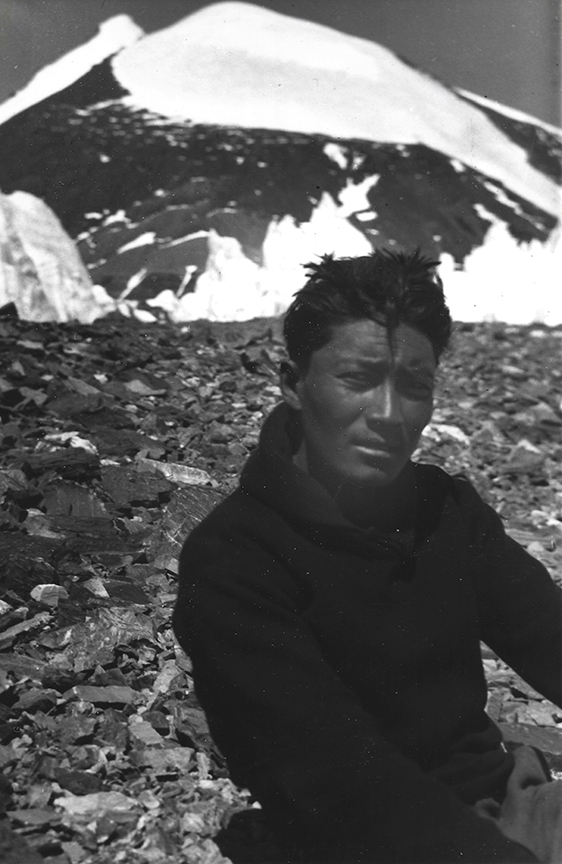
Tenzing. Photo: earldenman.com
Tenzing didn’t give up on his Canadian friend. That June, his wife wrote that Tenzing was in Lhasa, “trying his utmost to procure a pass for you.” Tenzing, who had his mail read to him and dictated his replies, kept writing. Of the gear Denman had left him, he wrote in a later letter, “Now and then I use them.” In January 1953 came another: “If you get permission, I rather prefer to accompany you than any other party.” Denman quoted it in an application to climb Everest in 1954 with a party of Sherpas led by Tenzing. Success, if it came, he wrote, “would be shared equally.”
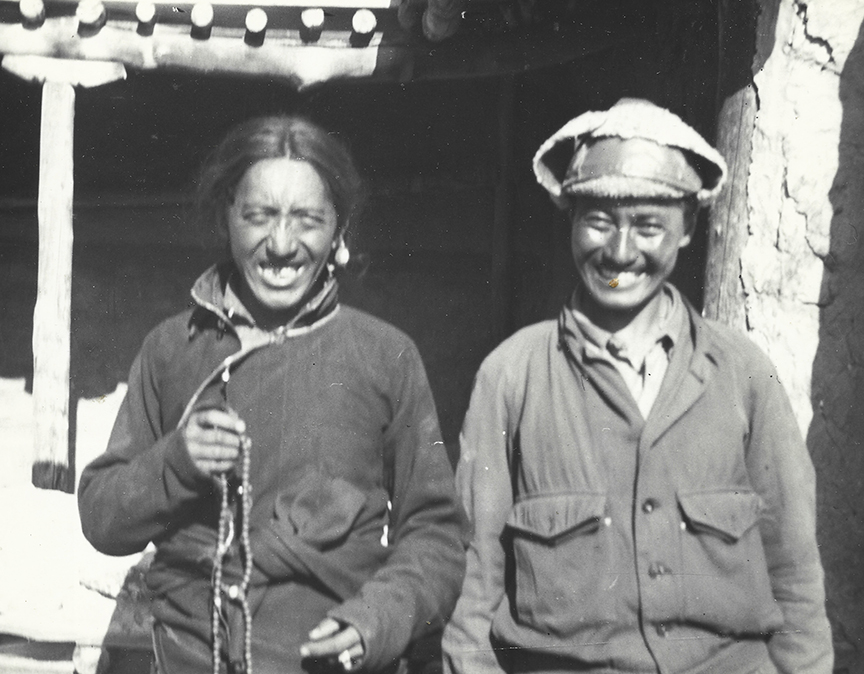
Tenzing, right, and his wife. Photo: earldenman.com
It didn’t come to that. Tenzing joined John Hunt’s British expedition instead, his seventh trip to Everest, or “six times, including Denman,” by his own count. Looking back, he called Denman “a strange man” but “a brave one, a man with a dream,” and was sorry he had never come closer to realizing it. “In 1953, when I gained the top of Everest,” Tenzing said, “I was wearing a woolen balaclava helmet that he had left to me; so at least a little part of him has reached his goal.”
Denman, for his part, wrote that he was delighted a Sherpa had been given the first chance at the top, and especially this one, a man “for whom I have such a special affection and admiration.”
Coda
Denman did get to see the first film about Tenzing’s historic climb. At a private preview of Conquest of Everest, reported in the Johannesburg Sunday Express in January 1954, he said, in what the reporter called “his quiet, unassuming voice,” “I’d like to have another crack at her. Perhaps I will, too.” But with Tibet closed to him, he admitted the following year that he had “neither chance nor money” to go back.
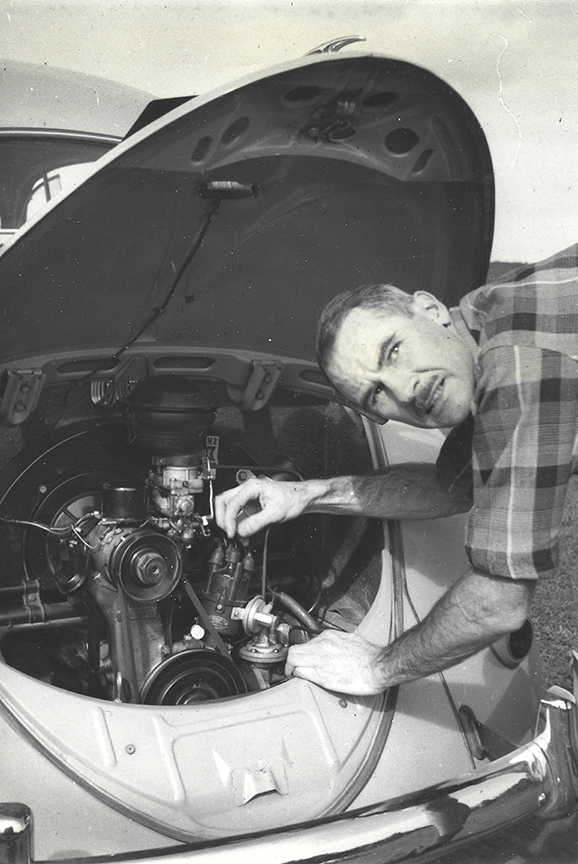
Denman at work on a Volkswagen. Photo: earldenman.com
In South Africa, Denman wrote wildlife talks for SABC radio and newspaper columns against apartheid and, by 1961, worked at a Volkswagen assembly plant. That year, Tenzing got back in touch after a long silence. “Believe me, I often think about you and talk to my friends about our days in the mountains together,” he wrote. As for the factory job, “A man of the mountains cannot be happy with machines.”
Denman was eventually forced out of South Africa, which he blamed in part on those columns. His wife, Mary, stayed behind, and he later settled in New Zealand, where he received a letter from Tenzing in 1976, addressed to “My dear friend Denman.” Of their trip through Tibet, Tenzing wrote, “It was rather a tuf time, but I enjoyed it.” Denman kept writing and, in 1985, published The Fiercest Fight, an account of the struggle against apartheid.
Late in life, Denman was hit from behind by a car while cycling into town and never fully recovered. He died in December 1994, two days before his 80th birthday, from injuries his family chiefly blames on the accident.
Pilot light
Lisa Jones, a therapist in Bristol, England, learned about Earl Denman from her father, Graham, his nephew. She and her son, Frank, now look after his papers, which she keeps in a trunk in her living room. The family remembers a grumpy, solemn man, insular and quiet, with “no belly laughs.” Frank, who read more of the papers than anyone, called him privileged and arrogant. “I’m not sure he did it all through charm and good looks,” Jones says.
As a therapist, she sees a link to his childhood. For a boy of four sent away from his parents, she says, it would have felt like abandonment, which she believes left him wary of people and more at home in wild places. But she doesn’t think fame was the point. “It feels like he’s doing it for him.”
In 1984, Toronto filmmaker Vic Sarin wrote to Denman about making a documentary. His last question was the hardest: “Did you feel that you had failed or won in your attempt?” Denman had answered it, in a way, 30 years earlier in his book. Failure, he wrote, “though painful, is better than frustrated longing.”
Alone to Everest reads like something from the age of Burton and Livingstone, earnest and old-fashioned, and what stayed with me was its wistfulness. Every decade or so, around the anniversary of the climb, I pitched his story. Nobody seemed interested.
Lisa Jones knows the feeling. The rest of the family, she says, showed little interest in the papers. “There’s a little pilot light here,” she says, “and I’m going to ignite it again.”
Earl Denman may not be in Tenzing. But he is in that famous photograph of his old friend, if you know what you’re looking at: the wool helmet on Tenzing’s head, at 29,000 feet, where its owner never got to go.
Tenzing, directed by Jennifer Peedom, opens in select theaters on October 9 and streams on Apple TV from October 16.
More information at www.earldenman.com