A question from a reader planning a trip to Upper Mustang drew our attention to the hurdles that independent climbers face when planning their own Himalayan projects, especially solo ascents or attempts on unclimbed peaks in restricted areas.
We asked a Nepal-based outfitter, Asian Trekking, for the nuances on obtaining such permits.
Q&A
“I’m hoping you can provide me with some clarification on Nepal’s rules for [lone] climbers, particularly in restricted areas like Upper Mustang and the Nar Phu Valley,” Matt Powell of the U.S. asked ExplorersWeb. “Is it possible for a single climber (me) to obtain a permit for a peak in a restricted area, as long as I enlist the services of a Nepali guide? And if so, how do I do it?”
Dawa Steven Sherpa of Asian Trekking explained that this is possible. “However,” he added, “[the climber] must obtain the permit through a legally registered and certified trekking agency in Nepal.”
The key question, however, is which permits the climber needs and the requirements for each. It turns out this depends on the altitude of the peak and involves different permits and procedures.
Expedition peaks
Peaks above 6,500m are considered expedition peaks and require a permit and the presence of a sirdar/guide and a liaison officer, which adds costs. Permits for these peaks are issued by the Department of Tourism (DoT), part of Nepal’s Ministry of Culture, Tourism, and Civil Aviation.
Once the climber has paid for the permit, the agency receives a letter from the Department of Tourism that must be presented to the immigration department, which issues a second permit: a Restricted Area Permit (RAP). This allows the climber to enter the restricted area without further cost, since he has already paid for a climbing permit.
If the climber or climbers intend to be accompanied by other non-climbers who will reach no further than base camp, they will need to pay for corresponding trekking permits and the RAP. The RAP cost depends on how long they intend to spend in the restricted area. Moreover, there must be at least two non-climbers/trekkers in the group.
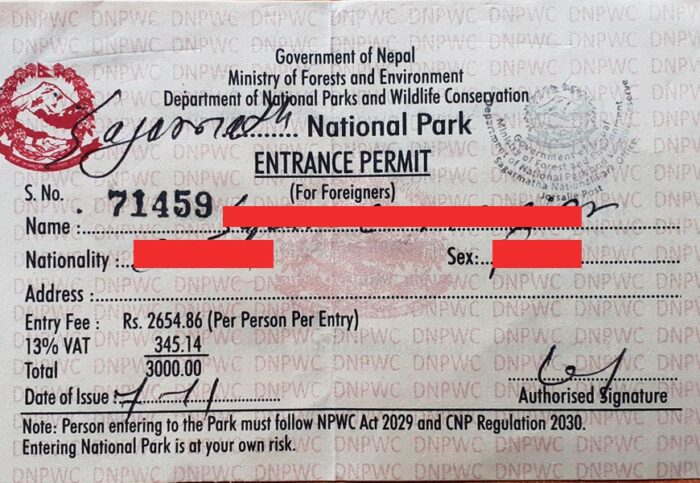
Example of Restricted Area Permit. Photo: Everest Sherpa Expeditions
For trekkers (or base camp visitors) heading for the Upper Mustang and Nar Phu Valleys, for instance, the RAP is $500 for the first 10 days, and $50 per additional day. They will also need the corresponding trekking permits. For that area, this includes the TIMS card (a general trekking permit) and the ACAP (Annapurna Conservation Area Permit).
Trekking peaks
Trekking peaks are those between 5,800m and 6,500m. Climbing teams do not need a liaison officer, but do require a climbing permit and a Nepali guide. Again, the permit application has to go through a registered trekking company. However, while not specifically mentioned in the rules provided by the Nepal Mountaineering Association (NMA), the team must have at least two members, says Dawa Steven.
In the fall of 2024, Nepal opened 57 peaks to climbers, mainly in Dolpo, Upper Mustang, and West Nepal. Many but not all of them were still unclimbed, according to the American Alpine Journal. Most were also 6000’ers classified as trekking peaks. Last year, authorities waived the royalty fees for 97 peaks; many of these were the ones opened in 2024.
The NMA grants permits for popular trekking peaks. The institution has 27 peaks listed as suitable for a permit but — here’s the problem — none of the recently opened peaks are on that list.
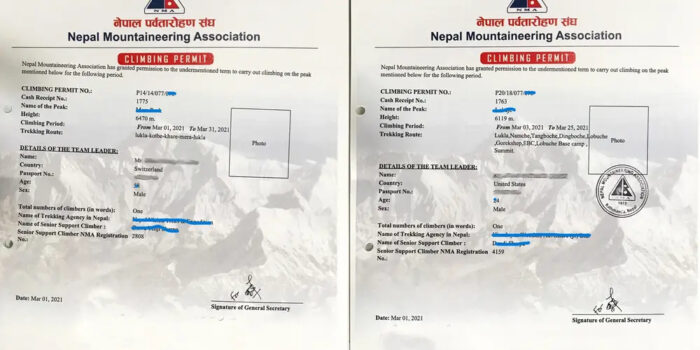
Climbing permit for a trekking peak, issued by Nepal Mountaineering Association. Photo: Everest Sherpa Expeditions
The fine print
If a team’s chosen peak is not on the list of 27 (such as those mountains recently opened to climbing), the climbers need to apply to the DoT through a local agency for a climbing permit, as if it were a higher mountain.
It thus seems that the DoT might issue a solo climber a permit for a lower 6,000m peak, which is usually considered a trekking peak. In any case, you’d be wise to consult the trekking/climbing agency, says Dawa Steven, as some regulations have changed recently. More changes are likely coming when the new Tourism Law passes in the next few months. “This is a grey area,” cautions Dawa Steven.
Everest Sherpa Expeditions’ blog has a comprehensive guide to climbing permits in Nepal, although the climbing fees are out of date.
Our reader’s experience
Matt Powell describes himself as a “medium-level climber” with a clear priority: to explore remote areas of the Himalaya and see the world from the top of mountains off the beaten track, preferably unclimbed, but not necessarily technical. Three years ago, he looked for such an unclimbed yet straightforward mountain, and found it in Western Nepal.
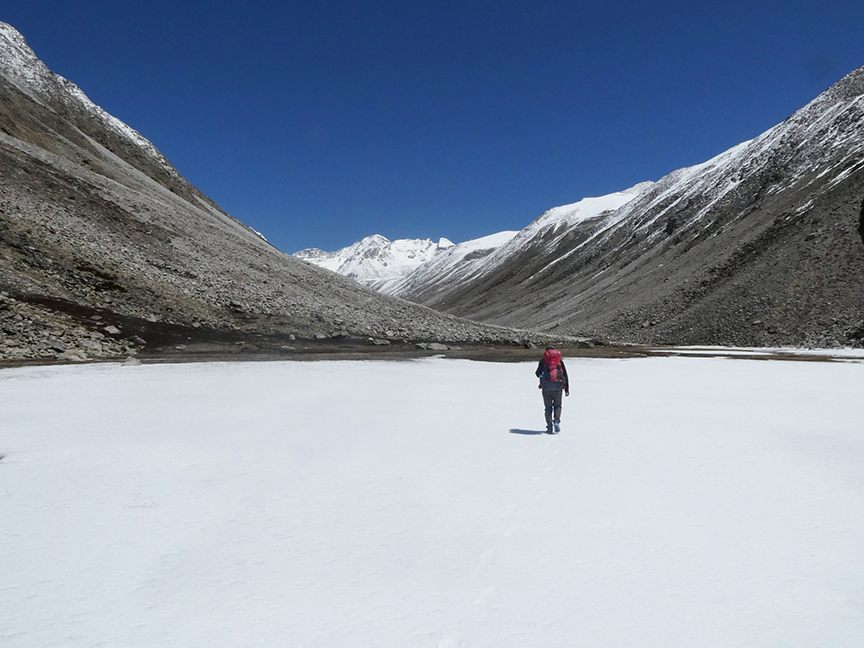
With two friends and a hired guide, a base camp crew from a small local company, and mules to carry their gear, Powell’s team spent days approaching the region, then trekked for two weeks. Along the way, they spent four hours summiting Chandi Himal from a high camp. For Powell, traveling in a wild region where the only footprints they saw were from a snow leopard was as worthwhile as the summit.

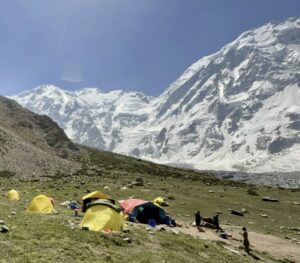
Advanced Base Camp at the foot of Chandi Himal. Photo: Matt Powell
Next project
This year, Powell started planning for a similar experience in the Upper Mustang. However, he was not the only one interested in the area, a desert region with a large number of peaks around 6,000m on the border with Tibet.
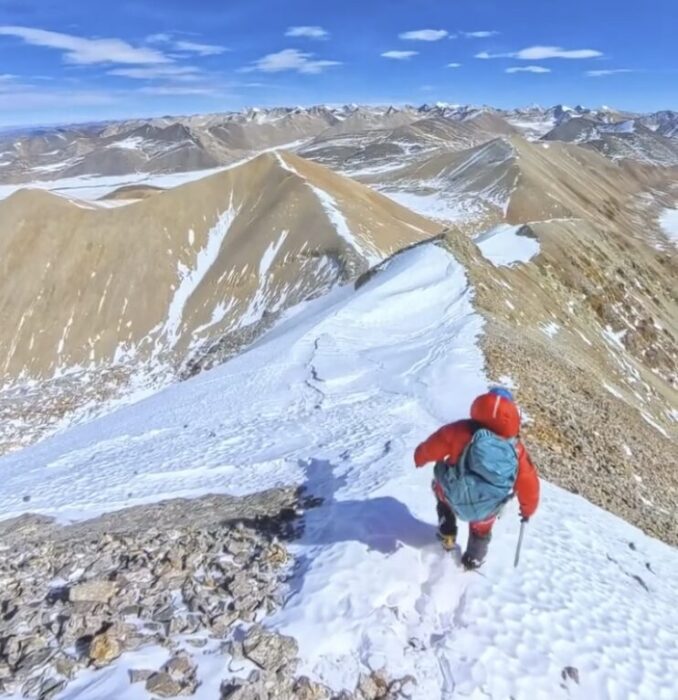
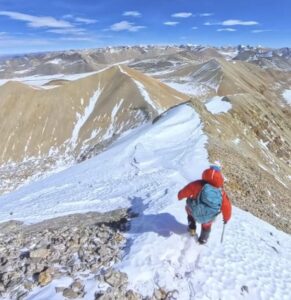
A member of the Seven Summit Treks team on the summit of Kekyap Ri, Upper Mustang. Frame of a video shared by Dawa Sherpa