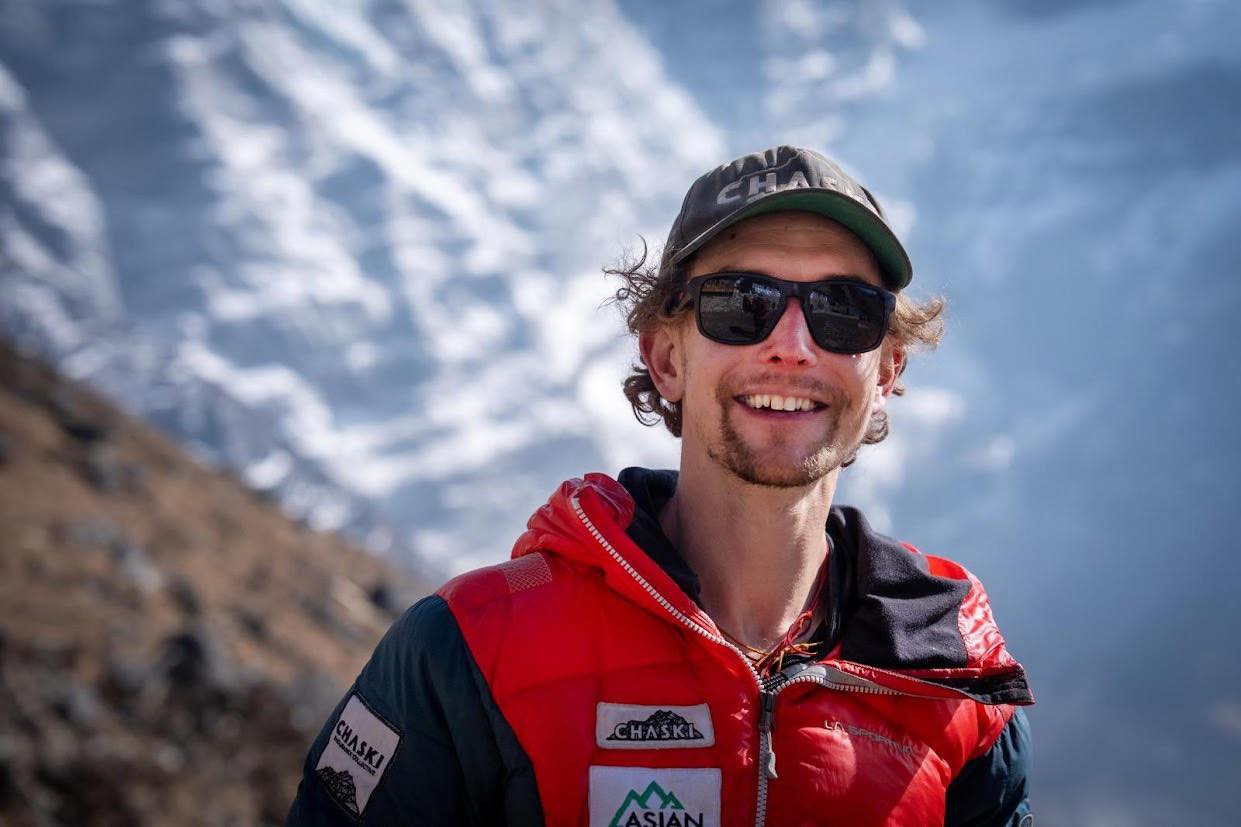
Tyler Andrews of the U.S. is back in Everest Base Camp after an attempt to make the fastest-ever Everest climb without supplemental oxygen. The attempt was a failure twice over, even before it ended. First, the climber’s team posted a surprising prerecorded video stating that Andrews had started using oxygen due to bad weather. Then Andrews aborted even this attempt near the Balcony with no reason given. Today, the athlete’s team posted the following vague message on Instagram:

Tyler Andrews’ Instagram story on May 25.
The record referred to in the post above is the oxygen-assisted time, held since 2003 by Lakpa Gelu Sherpa. This is a different record than the one he’d previously announced as his goal. As we noted in a previous update, at some 8,200m, Andrews’ time was already above Lakpa Gelu’s total summit time of 10 hours and 56 minutes.
Questions posed
There is debate in the trail running and climbing community because, despite announcing a no-O2 attempt, the team prepared a video changing the goalposts midway and had oxygen supplies ready in higher camps. Other climbers on Everest, such as Saulius Damulevicius (in Camp 3), were reporting fairly high winds on the upper slopes, so conditions were tough, but not unexpected.

Screenshot from Andrews’ pre-recorded video explaining he had turned to oxygen during the Everest FKT attempt. Photo: Tyler Andrews/Instagram
But there is something more. A commenter asked the following question on one of Explorersweb’s stories about this FKT attempt: “If Tyler Andrews tries again without O2 after a failed attempt using O2, does it really count as a no-O2 climb?”
The Ryan Mitchell Case
It turns out that’s a tricky question. On the one hand, one may consider that if Tyler climbs again without oxygen at any point, it would count as a no-O2 climb. However, a few weeks ago, we reported on young Ryan Mitchell of the U.S., who hoped to climb Everest without oxygen but had to resort to it at Base Camp when he fell ill.
In his case, the debate was whether, if Mitchell recovered and climbed again without bottled oxygen, his climb would be valid. We checked at the time with The Himalayan Database, and their reply was negative: “We believe that if on the same expedition, you use oxygen for whatever reason, it is an oxygen-supported climb,” they said.
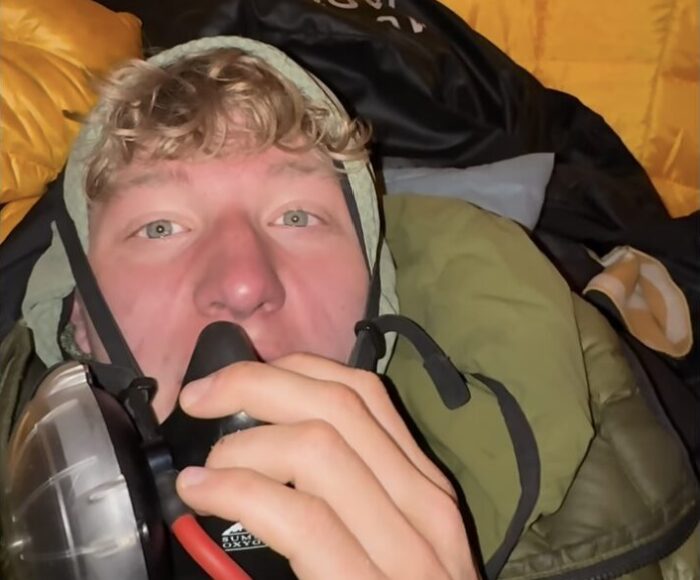
Ryan Mitchell on oxygen at Everest Base Camp. Photo: Ryan Mitchell/Instagram
The Himalayan Database’s criteria were established back in the era of the late Elizabeth Hawley. That was when climbers would either use small amounts of oxygen or not consider it at all, except in a medical emergency and only on the way down.
What the FKT runners do is something different — or is it? After all, it’s still Everest, and it’s still oxygen.
To make comparisons harder, a second runner at Base Camp has a different point of view. Karl Egloff of Ecuador is determined not to use oxygen at all on his attempted FKT round-trip on Everest. If conditions prove too hard, as they did last year, he will just turn around and return to Base Camp.
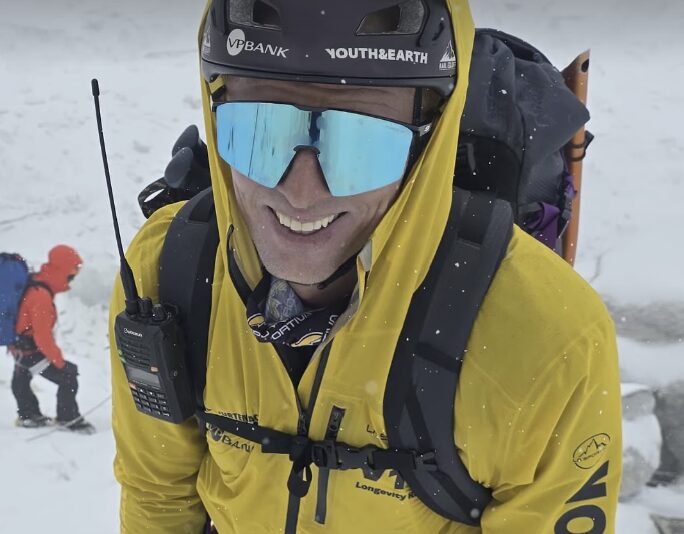
Karl Egloff this week on Everest. Photo: Karl Egloff/Instagram
We welcome further comments to this debate, but in the meantime, we asked The Himalayan Database again.
The age of pure climbers
Billi Bierling of The Himalayan Database confirmed that times have changed. “In [Miss Hawley’s] time, the question of making one ascent with oxygen and a subsequent ascent without it hardly ever arose,” she said. “Most climbers attempted only one mountain per season and generally made just a single summit push on that mountain. Moreover, those climbing without bottled oxygen were usually purists who would not even consider putting on an oxygen mask.”
Yet, she noted that Tyler Andrews contacted her HDB team a week ago, asking if a no-O2 ascent after an O2-assisted ascent on Everest in the same season would be considered valid. Here is the HDB team’s statement on the issue:
When Tyler Andrews contacted us with his request, we revisited the issue within The Himalayan Database team. We also consulted high-altitude specialist Dr. Mike Grocott regarding any possible physiological advantage gained from prior oxygen use.
His view was that there is no real evidence for a significant physiological advantage. Based on these discussions, we concluded that we needed to adapt to modern climbing realities and accept an ascent from Base Camp to the summit and back to Base Camp without supplemental oxygen, even if oxygen had been used on a separate climb within the season.
Bierling quoted Dr. Grocott as noting: “It seems to me that it may be easier to make a subsequent ascent without additional oxygen if you have already climbed the same route with supplemental oxygen, but this is from a climbing and psychological perspective rather than a physiological one. It is very difficult to know the definitive answer to this question, but I would say it is the physiological equivalent of a redpoint ascent.”
Bierling also said Andrews’ file on the HDB will have “a section with 1st attempt and 2nd attempt, so it will be visible that he used oxygen before.”
Consequences for the future
The debate remains open. However, if Andrews tries again on Everest and summits without supplementary oxygen, and it counts, this will establish a precedent that should therefore be applied to everyone on the mountain. From that point of view, Ryan Mitchell would have deserved a chance to try Everest no-O2 this season if he had wanted, and have it validated in case of success.
Whatever happens, Andrews’ ascent will be somehow different from the one Karl Egloff is about to start, and that will be the subject of further exchange of opinions and, perhaps, a change of criteria in the future of high-altitude FKTs.