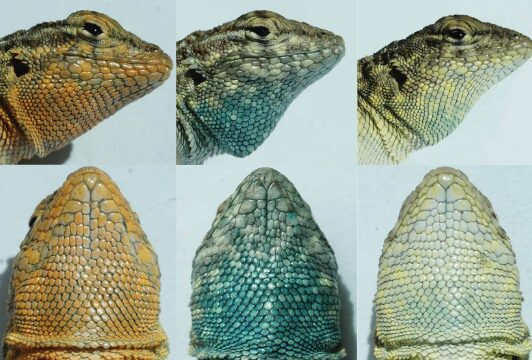
At this moment, the male side-blotched lizards of the American West are engaged in dating drama beyond human comprehension. Three different morphs of lizard, all with different colors and different mating strategies, are vying for females. New research uses a model based on the game Rock-Paper-Scissors to explain the genetic setup behind this lizard’s love life.
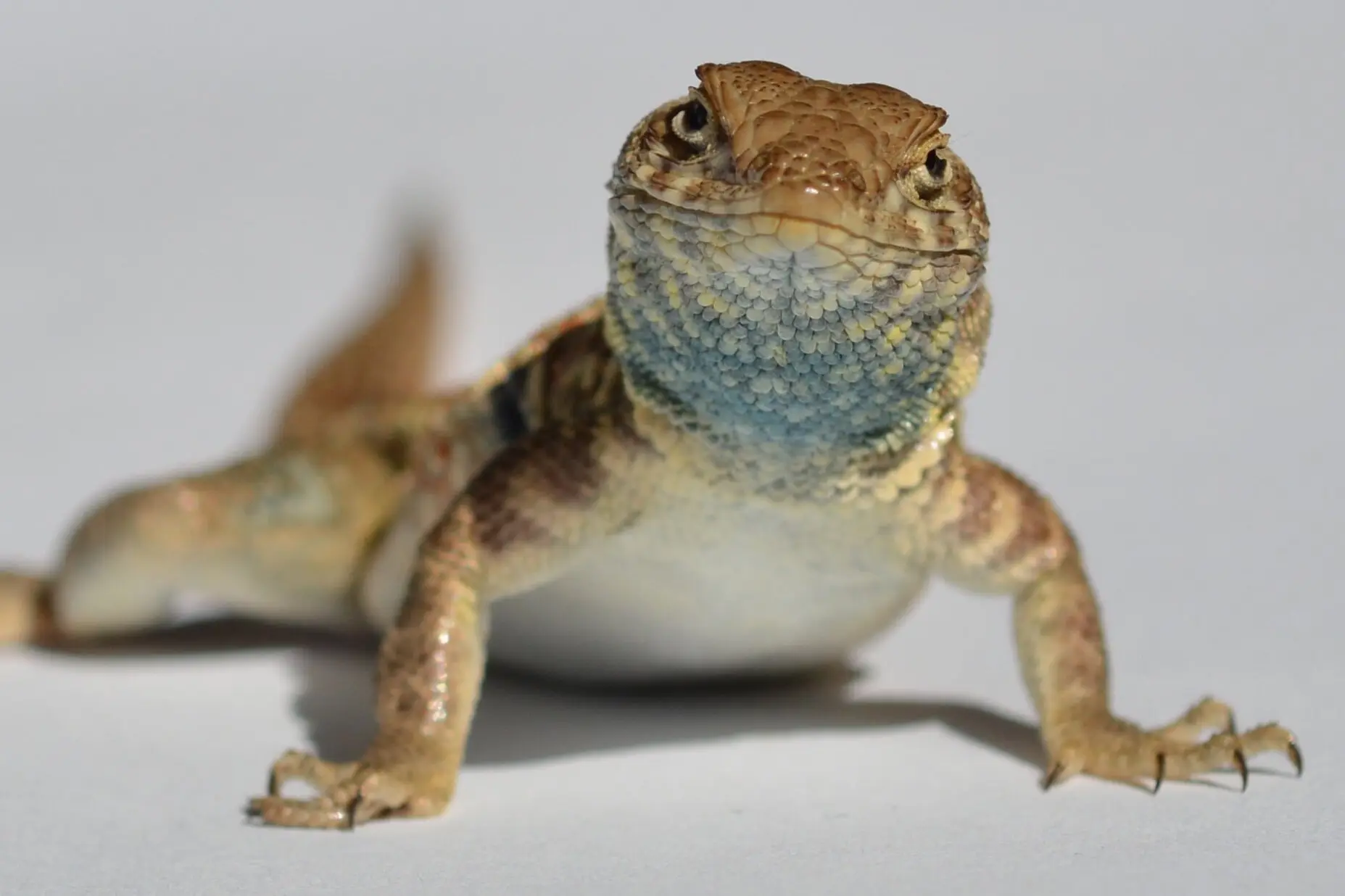
This polite lizard will likely exhibit loyalty to a single mate. Photo: Ammon Corl
Rock-Paper-Scissors
In the world of the side-blotched lizard, morphs come in and out of style. The orange-throated male conquers large swathes of territory and engages in copious affairs with females. The blue-throated lizard, meanwhile, focuses all his attention on one female lizard. This offers him the benefit of ensuring his partner bears only his children. Finally, the yellow lizard sneaks around, trying to find a fling in the blue lizards’ territories.
Different alleles, or permutations of the same gene, often arise out of the genetic lottery. Typically, over time, one allele tends to beat out the others via natural selection. But the side-blotched lizards have held onto their three alleles for 15 million years. Over the course of a few years, different colors dominate the lizard population. First orange, then blue, then yellow. This isn’t a game of chess; it’s endless rounds of rock-paper-scissors. So far, no one has won, which is peculiar.
Disentangling the genetic mutations behind this stable lizard polymorphism is harder than for most species. For reasons the research team still doesn’t understand, the lizards don’t express their different morphs in captivity. They all stay white-necked and unstylish.
A genetic puzzle
In a study published last week in Science, lizard researchers sampled the genomes of 44 orange morphs, 45 blue morphs, and 20 yellow morphs in the wild. This was the first time anyone had sequenced the side-blotched lizards’ genomes, and it revealed a surprise. The blue and yellow morphs were not, in fact, genetically different lizards. On the inside, they were identical.
The orange-necked lizards, however, were not. Their genomes differed only in one gene, not in the cluster of genes or supergene that often controls traits like color. But that gene also alters the production of hormones affecting brain chemistry, such as dopamine and adrenaline. Potentially, this could explain why the orange lizards are more territorial and aggressive than the other two.
These results — that only two alleles, rather than three, determined a lizard’s morph — sound subtle, but they were totally unexpected. To verify them, the team returned to the analogy of Rock-Paper-Scissors. They applied the same mathematical model for consecutive rounds of Rock-Paper-Scissors to different genetic scenarios for the lizards. The models with three separate alleles failed 91% of the time, in that by the end of the model, the lizards had lost one morph. In contrast, the two-allele model with yellow and blue morphs arising from the same gene change succeeded in each trial.
The researchers still don’t know what causes the difference between blue and yellow morph lizards. It may arise from developmental or social differences within the lizards. But answers will most likely come from work in the wild, not in the lab.