The organizers of the Piolet d’Or have published their “big list” of significant ascents during 2025. The list includes novelties that broaden the scope of the awards, but also selections that may spark debate. The lifetime achievement award will be presented to Everest pioneer Peter Habeler.
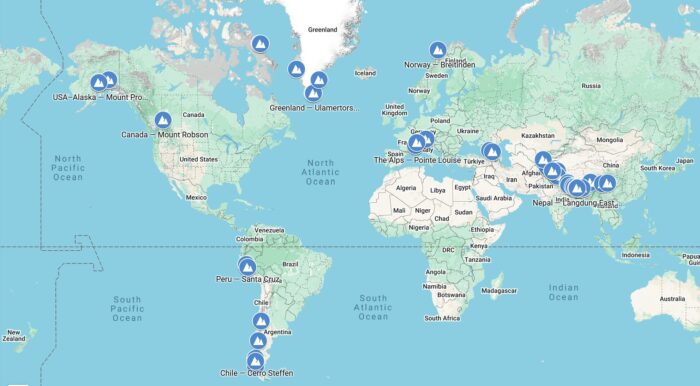
The fifty expeditions selected in the Piolets d’Or Big List overlaid on a Google world map. Map: Piolets d’Or
Best 50 activities
The 2025 list includes 15 activities in Pakistan, 10 in Nepal, three in India, four in China, two in Kyrgyzstan, four in Greenland, one in Russia, one in Georgia, two in Canada, two in the U.S., four in Peru, and four in Chile-Argentina.
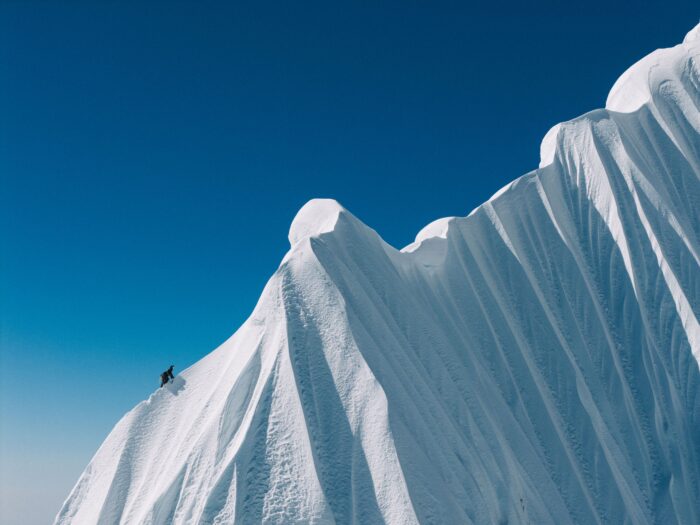
The first ascent of Jannu East is nominated in the big list. One of the climbers, Benjamin Vedrines, received a career award last year, despite his young age. Photo: Thibaut Marot
“While not every climb listed here would be considered eligible for a Piolet d’Or, all are regarded as noteworthy and adventurous within their particular regions,” the award organizers explained. “Most involve new ground and technical climbing in lightweight style.”
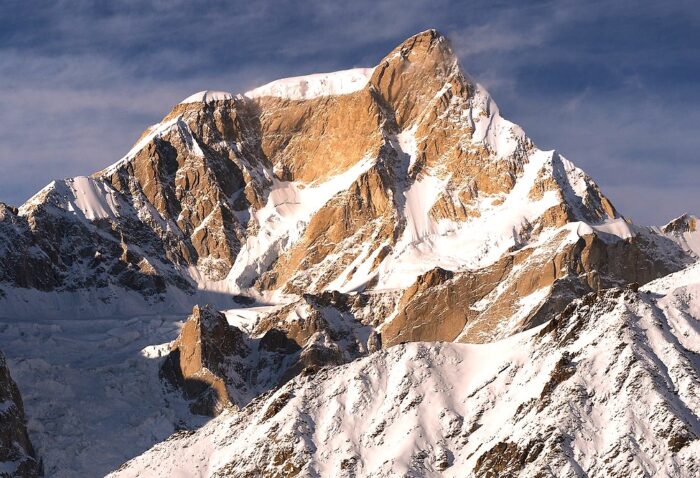
Michał Czech and Wadim Jabłonski (Poland), and Adam Kaniak (Slovakia) are nominated for an impressive new route and traverse of Chumik Kangri, in the remote Saltoro mountains. Photo: Alpine Mountain Guides Pakistan
Two new routes on 8,000’ers
After several years focused on alpine-style new routes on 6000’ers and 7000’ers, this year features two new routes or variations on 8,000’ers: Pipi Cardell and Denis Urubko’s Nezabudka route on the Northwest Face of Nanga Parbat, and the first ascent of the South-Southwest face of Manaslu by Natalia Belyankina, Kirill Eizeman, Sergey Kondrashkin, Vitaly Shipilov, and Andrey Vasilyev of Russia.
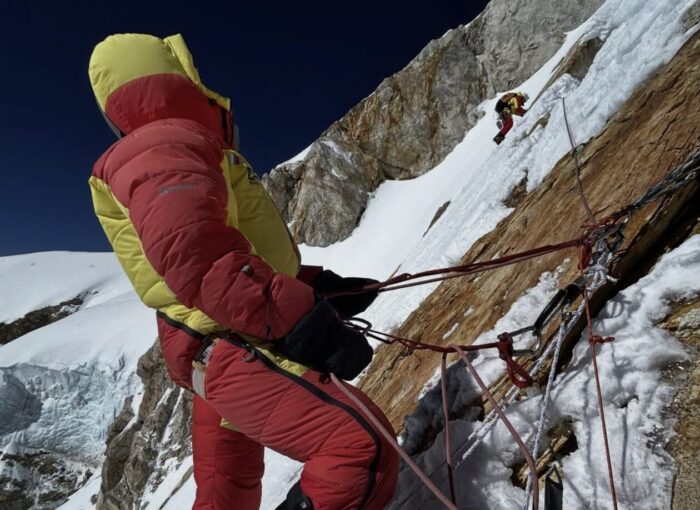
The Russian team on the Southwest Face of Manaslu. Photo: Natalia Belyankina
Tough work for the jury
The jury — Lise Billon (France), Jordi Corominas (Spain), Luka Lindic (Slovenia), Young Hoon Oh (South Korea), Paul Ramsden (UK) and Enrico Rosso (Italy) — will surely have a tough time deciding who deserves an award. It will be interesting to see if the activity selected by ExplorersWeb as our top expedition of last year, the first ascent of the southeast pillar of Ultar Sar (7,388m) by Canadians Ethan Berman and Maarten van Haeren, and Sebastian Pelleti of Australia, is one of the awarded expeditions.
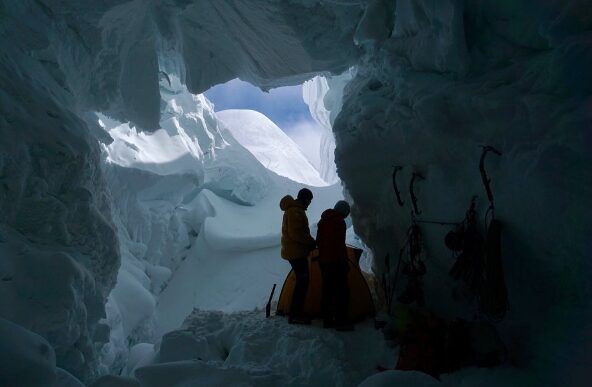
The Ultar Sar team in an ice cave among seracs. Photo: Sebastian Pelleti
Miscellaneous awards
The novelty comes with a second list of performances in the greater ranges. These aim to highlight “a small selection of outstanding ascents or descents of established routes.”
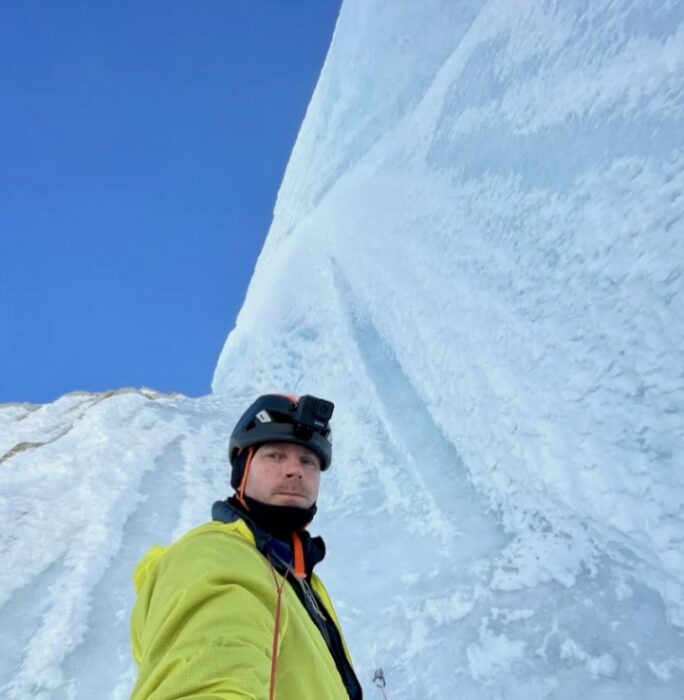
Colin Haley takes a selfie during his solo winter ascent of Cerro Torre. Photo: Colin Haley
The selection includes two winter ascents of Patagonian spires (including Colin Haley’s solo of Cerro Torre’s Ragni Route), the fast solo ascent of Begguya (Mt. Hunter) by Balin Miller, and four ski descents. The ski descents include Nanga Parbat’s Rupal Face by French skiers Typhaine Duperier and Boris Langenstein (with David Goetler of Germany paragliding from the summit), the ski descent of Mt. Robson’s great couloir by Christina Lustenberger and Guillaume Pierrel (sadly lost this year in Pakistan), and, perhaps surprisingly, two ski descents on Everest.
Heavily supported expeditions
The Everest descents — Jim Morrison down the Hornbein Couloir on the north face (on oxygen) and Andrzej Bargiel on the normal route on the south side — are firsts and impressive performances. However, they were also done in heavy expedition style with large human, technical, and financial resources.
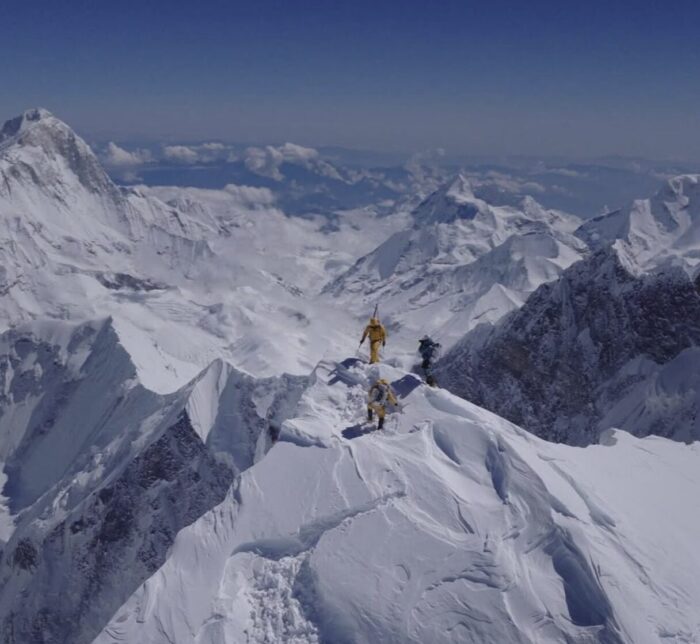
Drone image showing Morrison and his team on the summit of a lonely Everest. Photo: Jim Morrison/Instagram
Strictly speaking, these heavily supported Everest expeditions seem to go against the principles of the Piolets d’Or, as stated in the same press release:
The Piolets d’Or promotes progressive mountaineering, alpine style, doing more with less. Our awards reflect this ethos but also champion a spirit of exploration, a high level of commitment, and self-sufficiency.
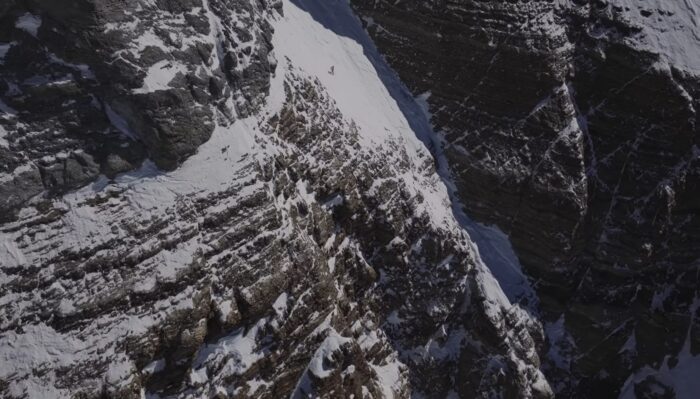
Jim Morrison looks tiny while skiing the huge Hornbein Couloir on the North Face of Everest. Photo: Frame from a video/National Geographic
Both Morrison and Bargiel counted on large teams to fix the routes, break the trail, and lead the way to the summit. Support teams monitored their descent and filmed everything. Oscar-winner Jimmy Chin filmed the North Side Everest descent for Disney+ and Red Bull released a video of Bargiel’s expedition.
This new Piolets d’Or category could open the door to different activities, some of them sponsored. For some, this would represent a drift away from the soul of the golden ice-axes. We look forward to listening to the organizers’ comments and welcome an open, healthy debate on the subject.
You can read the entire Piolets d’Or list here.
Lifetime award to Peter Habeler
The Walter Bonnati Award for lifetime achievement is a classic award. This year it goes to Peter Habeler of Austria. Together with Reinhold Messner, Habeler completed the first no-oxygen summit of Everest, at a time when scientists believed it was not humanly possible.
Starting at home in the Austrian Alps and then in the Mont Blanc massif, Habeler later became the first European to climb a big wall in Yosemite’s El Capitan. With Doug Scott, he climbed the Salathe Wall route. Soon after, he met Reinhold Messner. Together they climbed Yerupaja Chico (6,121 m) in Peru and then completed fast climbs of the Matterhorn and the North Face of Eiger while working as stuntmen for Clint Eastwood’s film The Eiger Sanction.
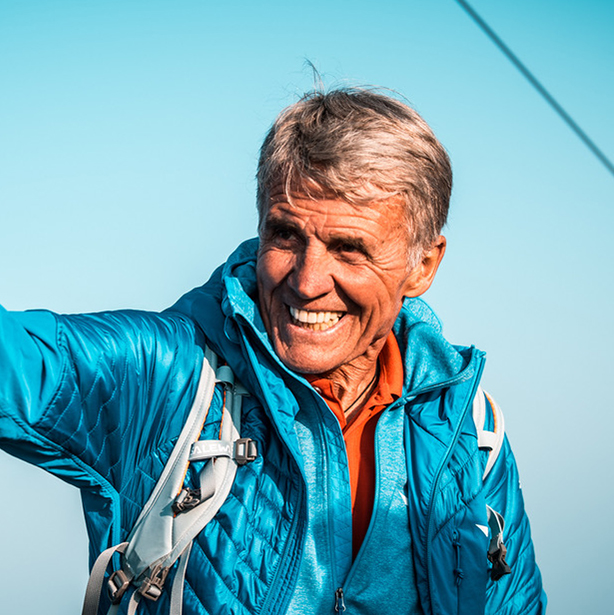
Peter Habeler. Photo: Collection P. Habeler/Piolets d’Or
The pair applied their ‘fast and light’ and ‘by fair means’ philosophy to Gasherbrum I (climbed in a five-day alpine push). Three years later, they achieved what was considered impossible: Everest without supplementary O2. Habeler did not pursue the 14 8,000’ers, but did return to the Himalayas during the 1980s to climb several of the highest peaks. Perhaps the highlight was his ascent to the north side of Kangchenjunga with American Carlos Buhler and Basque climber Martín Zabaleta in 1988.
Awards coming next
Piolets d’Or will publish the list of winners in September and will hold the awards ceremony in Saint-Christophe-en-Oisans, in the Massif des Ecrins of the French Alps between October 21 and 25.
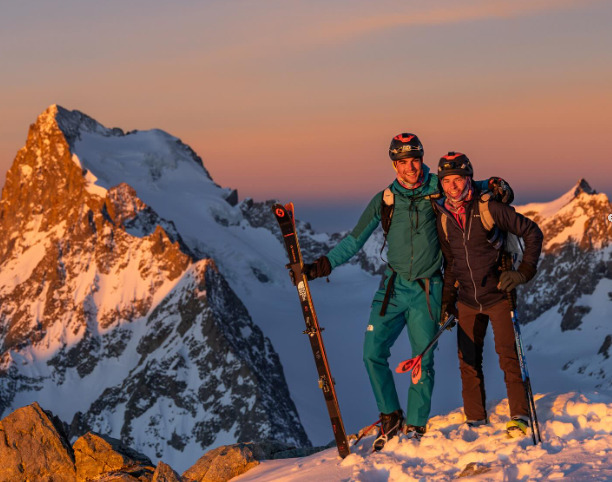
Benjamin Vedrines and Nicolas Jean at home in the Écrins Massif, French Alps. Photo: Benjamin Vedrines/Instagram