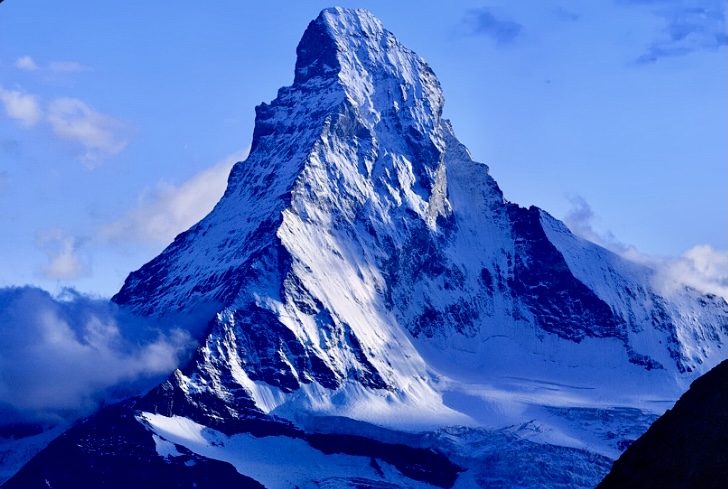
The first ascent of the Matterhorn marked the end of the Golden Age of Alpinism. After years of attempts by various parties, on July 14, 1865, a seven-man team led by Edward Whymper topped out.
While that day is mostly remembered for that climb and for the fatal accident during the descent, it’s interesting to note a petty event that took place at the summit. Today, we revisit that July 14 climb to understand the competitive atmosphere surrounding it.
The 4,478m Matterhorn (known as Cervino in Italy) lies on the border between Switzerland and Italy. It’s considered one of the most beautiful mountains in the Alps, thanks to its perfect pyramid shape. There’s no way to take a bad photo of it, because from every angle, it’s really impressive.
The Matterhorn has four faces and four main ridges. The true summit is on the Swiss side of a narrow, knife-edge ridge that marks the border. There is a secondary summit on the Italian side that is a couple of meters lower. The 100m-long connecting ridge is exposed and dangerous. Of all climbing routes, the Hörnli Ridge on the northeast side is the normal route from Zermatt.
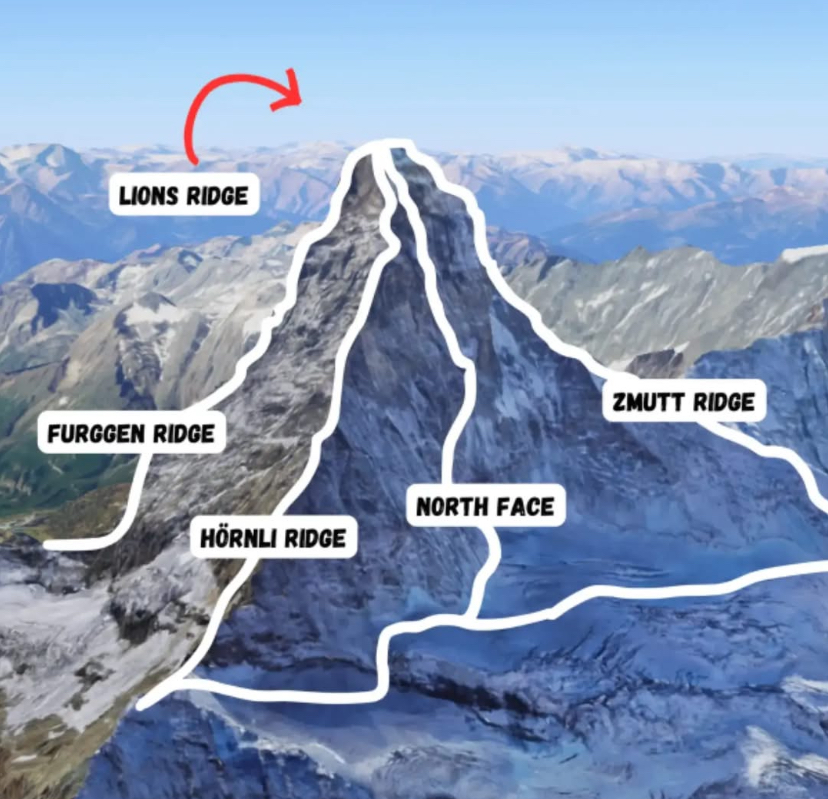
The ridges of the Matterhorn. Photo: Pako Crestas
Early attempts
For a long time, many considered the Matterhorn impossible to climb. Before its first ascent, most attempts took place via the Lion Ridge on the Italian side. It seemed more feasible than the steep Swiss side of the peak.
An Italian local guide, Jean-Antoine Carrel, was the first to attempt it from the Lion Ridge, between 1857 and 1859. He reached up to 3,700m.
In 1862, John Tyndall of Ireland (climbing with Carrel) set a new high point of 4,241m (known now as Pic Tyndall). From here, they retreated due to the difficult terrain.
Edward Whymper of England (who was born today, April 27, in 1840) also wanted to summit the mountain. Between 1861 and 1865, he made seven attempts, most of them on the Italian side and often in the company of Carrel. Storms, winds, and falling rocks thwarted those early attempts. Local guides were also cautious and turned Whymper back due to what they considered dangerous circumstances. In 1862, Whymper survived a 60m fall while climbing alone.
While almost everybody was focusing on the Italian side of the Matterhorn, a few British climbers made some quiet but quite significant progress on the Swiss side. In 1860 and 1861, the Parker brothers attempted the Hörnli Ridge without professional guides. They reached 3,500-3,570m and saw that the Zermatt face was not as difficult as it appeared from the valley. It was instead a series of rocky steps and ledges that could be climbed carefully.
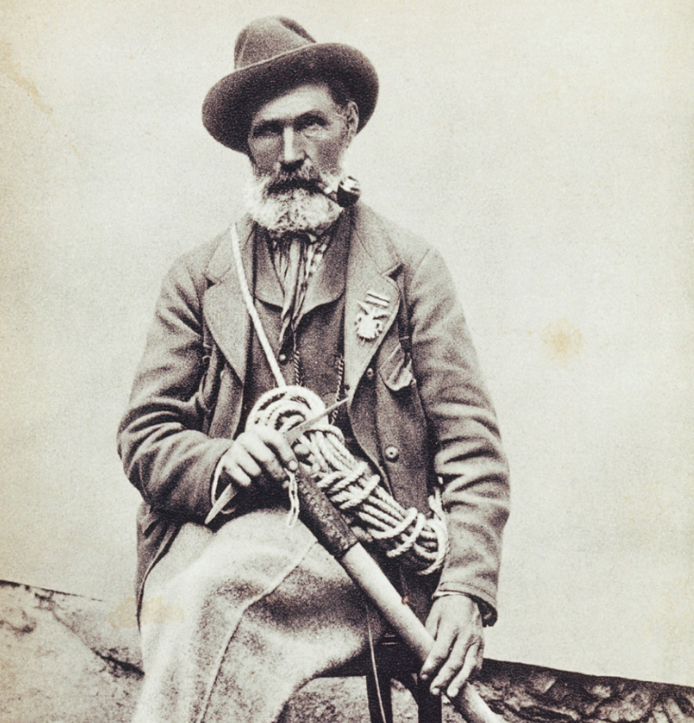
Jean-Antoine Carrel. Photo: Wikimedia
Rivalry
By the summer of 1865, almost every major peak in the Alps had been climbed. The Matterhorn was the only big one left. For climbers, it would be a great trophy. Everyone knew that whoever would reach the top first, it would close a chapter in history. Therefore, rivalry was inevitable, too.
For Italians, Cervino represented something that should rightly be claimed by their own climbers. For Whymper, after so many unsuccessful attempts, it had become a personal obsession.
On July 11, 1865, Carrel and a determined Italian party, including Jean-Baptiste Bich, left Breuil and headed up the Lion Ridge. They were supported by the Italian Alpine Club, and Carrel was driven by the patriotic desire to plant the Italian flag first.
When news of the Italian start reached Whymper in Zermatt, he acted quickly. He organized a mixed team, and in the morning of July 13, they set off up the Hörnli Ridge. Whymper’s group included Lord Francis Douglas, Charles Hudson, and Douglas Hadow, along with French guide Michel Croz and father-and-son Swiss guides, the Taugwalders (both named Peter). Most of these men had never climbed together before.
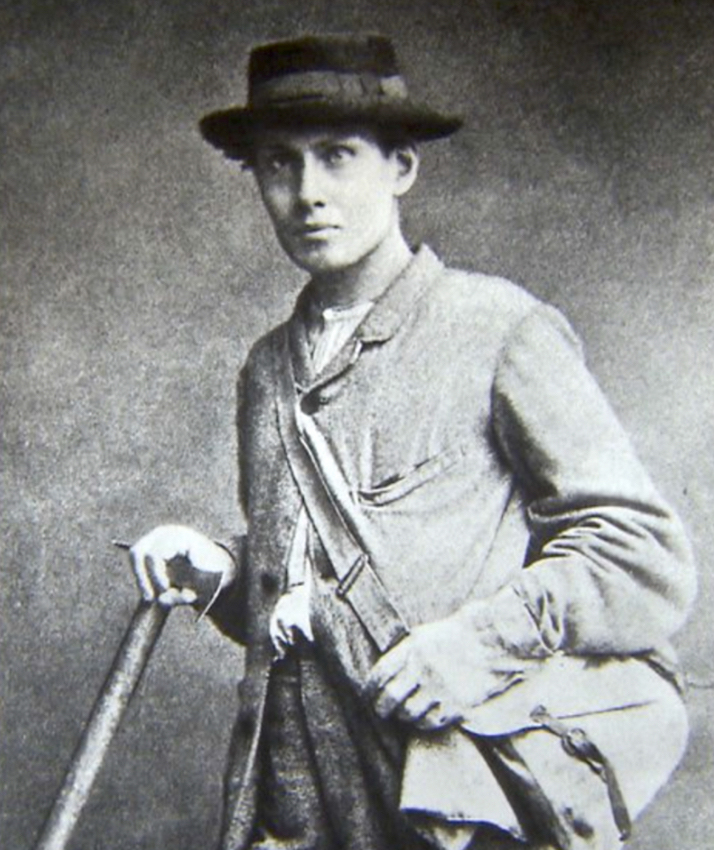
Edward Whymper. Photo: Wikipedia
Summit, and a petty event
Although Whymper and his team started two days after the Italians, their route on the Hörnli Ridge turned out to be a bit simpler than they had expected. On July 1, at about 1:40 pm, they topped out while their Italian rivals were still struggling upward.
Whymper’s group spent one hour on the summit. Whymper, fueled with adrenaline, wanted to know where his rivals were. Alongside Croz, he hurried to the southern edge of the summit ridge and looked down. The two men spotted Carrel’s party some 200m below.
Eager to leave no doubt about the outcome, Whymper and Croz began shouting and waving their hats. When the Italians couldn’t hear them because of the distance and seemed not to react, they began to throw stones over the precipice. It wasn’t a simple greeting, but a message of triumph.
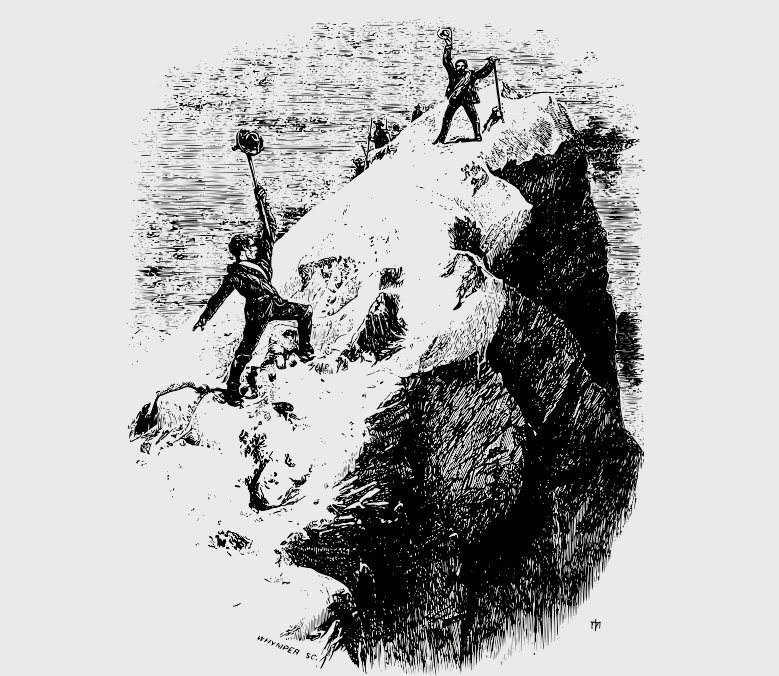
Illustration from the book ‘Scrambles Amongst The Alps, by Edward Whymper.
As Whymper wrote in his book Scrambles Amongst the Alps:
“We yelled until we were hoarse. The Italians seemed to regard us — we could not be certain. ‘Croz, we must make them hear us; they shall hear us!’ I seized a block of rock and hurled it down, and called upon my companion, in the name of friendship, to do the same. We drove our sticks in, and prized away the crags, and soon a torrent of stones poured down the cliffs. There was no mistake about it this time. The Italians turned and fled.”
Struck with panic
This stone-throwing, which Whymper later recounted with a mix of pride and bluntness, was the climax of his obsession. Unable to see Whymper’s team from their position, the rockfall panicked the Italians. Many of Carrel’s men, fueled by local superstitions about mountain spirits, believed that the Matterhorn itself was attacking them.
But for Carrel, that moment was the confirmation that others had conquered “his” mountain. (Three days later, on July 17, Carrel returned, and with Bich, completed a fine first ascent of the Italian route.)
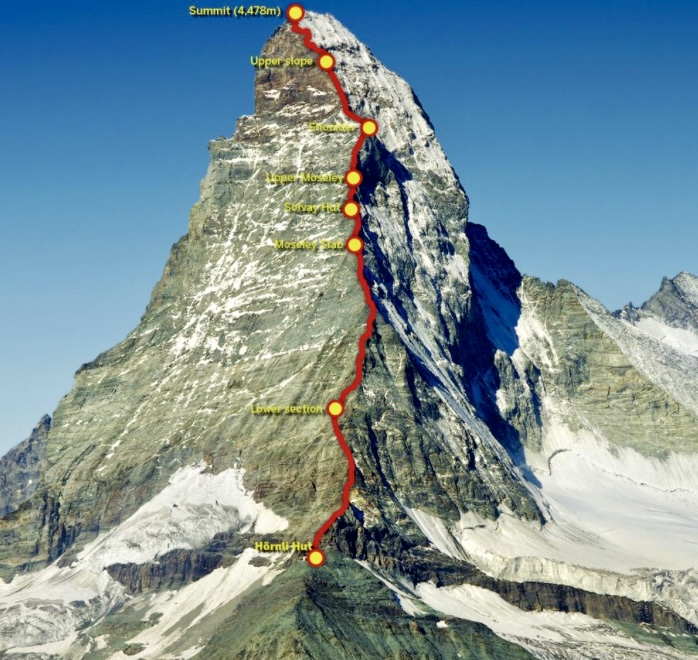
The Hörnli Ridge: the route of the first ascent. Photo: trekandmountain.com
Whymper’s team began to descend. About an hour later, tragedy struck. Hadow slipped, knocking over Croz and dragging Hudson and Douglas with them. Whymper and the Taugwalders, higher up, could only watch in shock as the thin backup rope snapped. In an instant, their four companions fell 1,200m down the north face to their deaths.
The Matterhorn disaster became a national scandal that reached Queen Victoria herself. The Queen was so outraged with the loss of those young men that she asked the government to consider banning mountaineering. She couldn’t understand risking lives for something she saw as useless.
An official inquiry was opened in Zermatt to determine what happened to the rope. Although the survivors were cleared, the rumors never went away. For years, people whispered that someone might have cut the rope to save themselves, a shadow that followed Whymper and the Taugwalders for the rest of their lives.
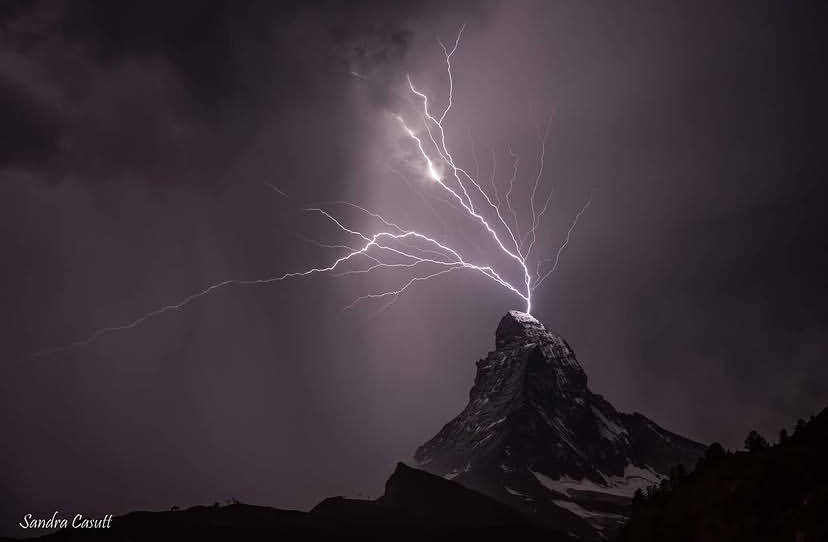
Lightning strikes the summit of the Matterhorn. Photo: Sandra Casutt/Instagram