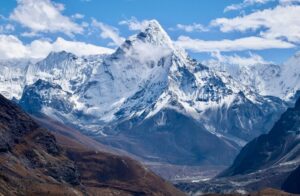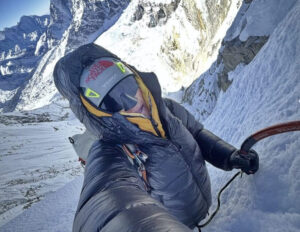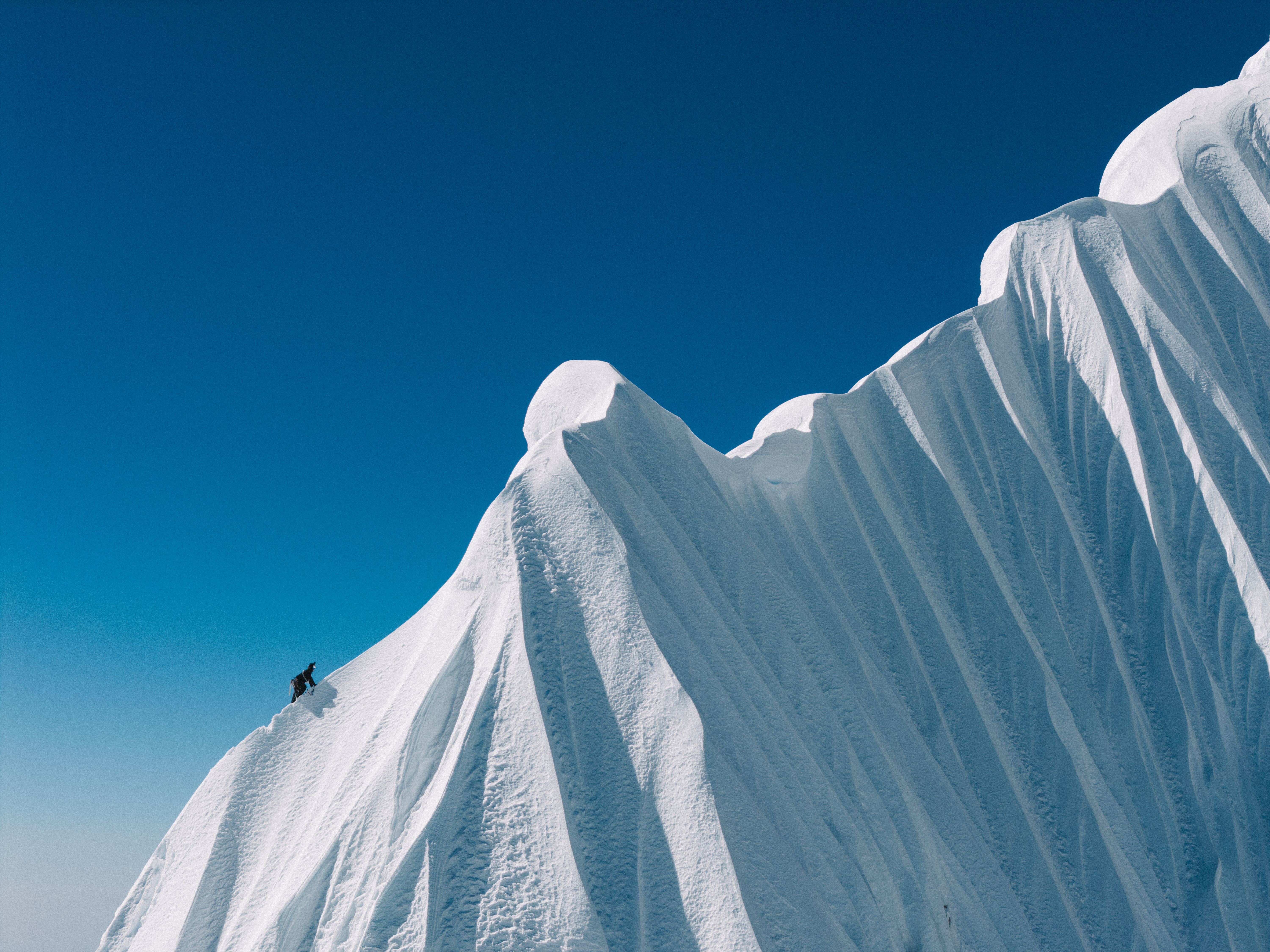
The North Face of Jannu is one of the largest and most formidable ice walls on Earth, and Benjamin Vedrines is one of the most outstanding alpinists of the new century. Combining the two could only result in an epic achievement, thanks also to Vedrines’ young climbing partner, fellow Frenchman Nicolas Jean.
An American team did the main summit of 7,710m Jannu via the North Face in 2023, but Vedrines and Jean had an alternative goal: the unclimbed East summit (7,468m). In 2024, they launched their first attempt, sharing the wall with Americans Mike Gardner and Sam Hennessey, who were on their second and third attempts, respectively.
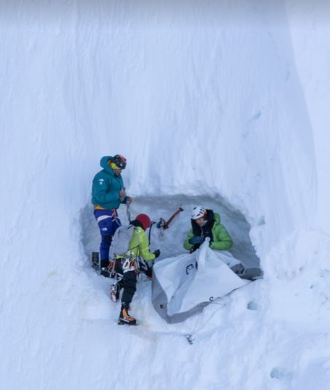
Vedrines, Billon and Jean bivouac on the North Face of Jannu in 2024. Photo: Benjamin Vedrines
Vedrines and Jean’s attempt ended when the third member of the 2024 team, Leo Billon, fell sick due to acclimatization problems. It ended worse for the two Americans: Gardner fell to his death from a bivy ledge.
The return
Vedrines left Jannu, promising he would return. So did Nicolas Jean, while Billon decided not to join this time. In the preceding months, Vedrines and Jean trained intensively at home in the Alps, including climbing and skiing nonstop the four faces of Mont Blanc.
Vedrines also made a record speed traverse that he called the Great Alpine Trilogy: a nonstop, human-powered traverse of the ridges of the Grandes Jorasses, the Matterhorn, and the Eiger. Climbing, paragliding, and cycling from one peak to the next, Verdrines finished in a stunning 39 hours.
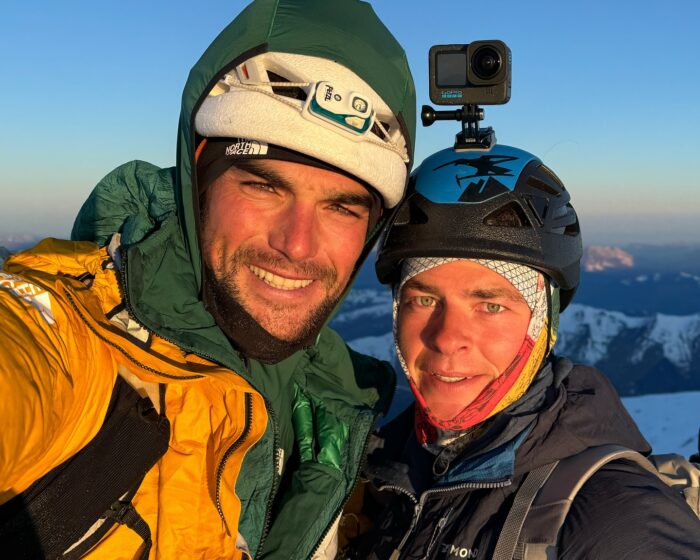
Benjamin Vedrines and Nicolas Jean in the Mont Blanc massif. Photo: Benjamin Vedrines
Vedrines and Jean adapted as a team of two, although it meant carrying heavier backpacks and climbing less efficiently, since only two climbers must lead all the pitches. Three is the ideal partnership for these big walls.
“Luckily, Nicolas [Jean] and I have climbed extensively as a pair in the Alps, so we are used to working together,” Vedrines said. “Besides, I’ve always liked to climb in a team of two, so this was quite natural.”
The preparation
They, along with cameramen Thibaut Marot and Quentin Degrenne, landed in Nepal at the beginning of September. Vedrines and Jean then started a careful acclimatization plan to prepare for their alpine-style attempt on Jannu East. They took it easy at base camp and gradually gained altitude.
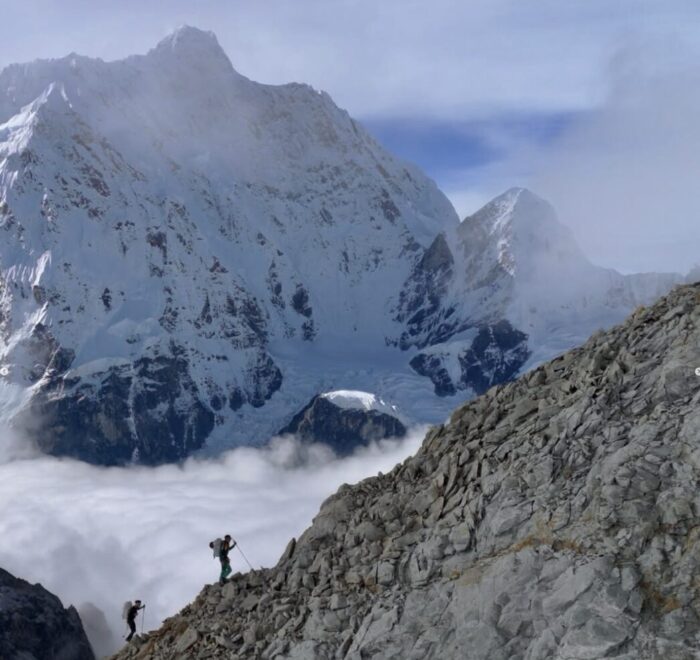
Vedrines and Jean acclimatize in the Kangchenjunga region, as the North Face of Jannu looms behind. Photo: @quentin_degrenelle
Their preparations included a first ascent of 6,808m Anidesh Chuli, a beautiful snowy peak also known as the White Wave. After this, they waited patiently for the right weather window to begin. Vedrines planned a fast, three-day ascent. They needed the right conditions on the wall, as well as stable weather. In the end, it took them four days.
The summit news
We heard about their success on October 19, after the climbers had returned safely to base camp. Jannu’s vertical North Face and the sharp and icy summit ridge looked breathtaking. Both climbers agreed it had been the peak of their climbing careers.
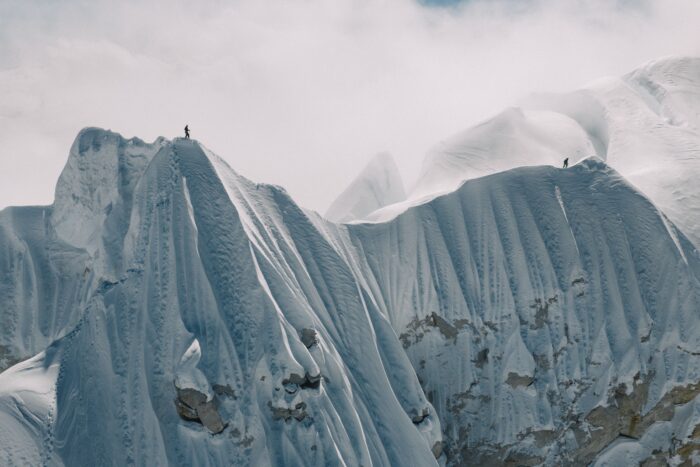
The climbers on the final meters of the ridge, as seen from a drone. Photo: Thibaut Marot
“Concentration, commitment, self-improvement, and emotion…all the ingredients of high-altitude Himalayanism,” Nicolas Jean said.
“I feel like I drew on all my knowledge and abilities to ascend this 2,300m Himalayan wall,” wrote Vedrines. “Once we reached the summit, after so many trials and tribulations, tears flowed. A dream had come true.”

Topo of the route. Photo: @quentin_degrenelle
We had all the details from Vedrines when he returned to Kathmandu, in an exclusive interview.
The climb
The climbers had intended to start on October 11 but had to postpone at the last minute because the gale-force winds that were supposed to drop kept hitting the peak at over 100kph. The following day, the two climbers moved from base camp to Advanced Base Camp, trusting in their meteorologist, who remained confident of a weather window.
On October 13, they started off from ABC (5,100m) at 5 am, simul-climbing part of the time — “soloing in a team of two,” is how they put it. They set their first bivouac at 6,200m.
The following day, they passed the point where Leo Billon had retreated in 2024, and the altitude from which Mike Gardner fell to his death. Beyond that, they were entering unknown terrain.
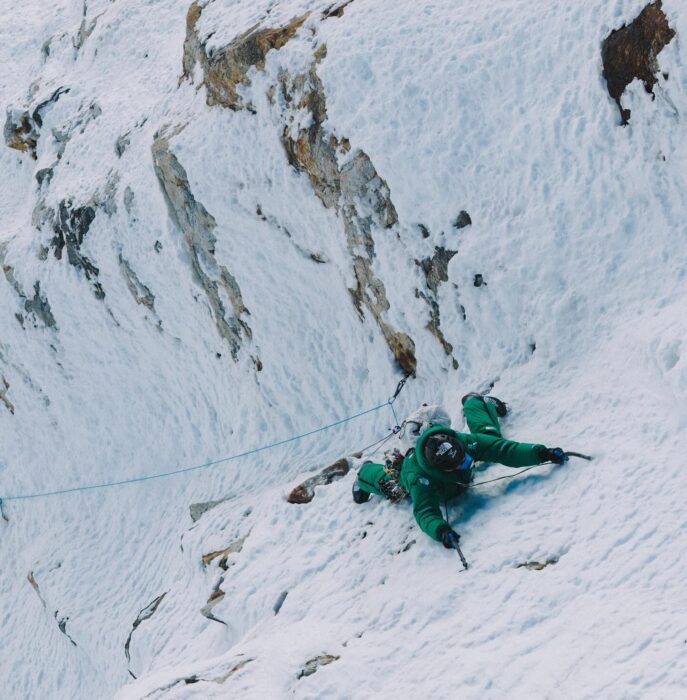
Vedrines on the vertiginous North Face of Jannu. Drone image by Thibaut Marot
For the sake of transparency, Vedrines notes that they fixed 100m of rope through a particularly difficult section, right before their second bivouac at 6,900m.
At 3:30 am on October 16, the climbers left their bivy in –20°C, toward the razor-sharp summit ridge, which they reached at dawn. But their difficulties were far from over.
“The ridge was completely wind-loaded,” Vedrines wrote. “It was impossible to go straight up, so I had to traverse slightly into the face on the right side, on steep snow, with no solid protection. [At 7,400m,] I found a thin ice band, just enough to climb 10 meters and get back on the ridge. It was [exposed, but it was] the only option.”
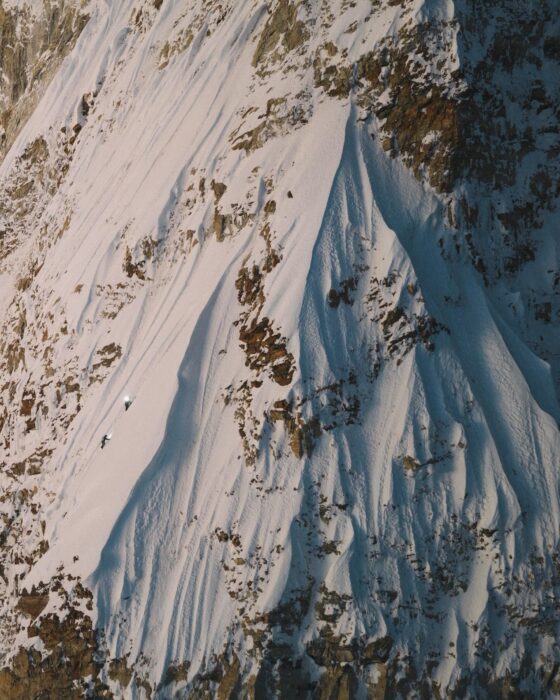
The climbers, left, on the upper part of the face. Photo: Thibaut Marot
At 1 pm, the duo thought they had reached the summit, but drone pilot Thibaut Marot warned them over the radio that the highest point was actually a second peak at the end of a corniced ridge. Disappointed and exhausted, Vedrines and Jean pushed themselves forward for another hour until they stood on the true summit of Jannu East at 1:40 pm.
Vedrines said they enjoyed very good ice conditions until the second bivy spot.
“After 7,000m, we reached the most exposed part,” he explained. “It was all soft snow, and we didn’t have anywhere to put an anchor or a belay. We had no idea how we would manage to get down.”
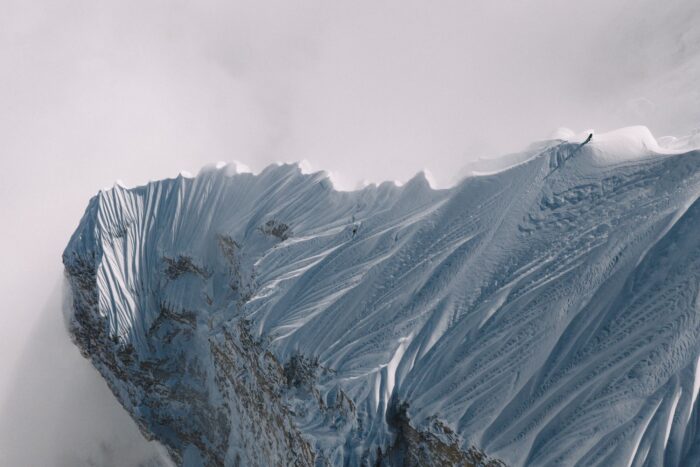
The ridge as seen from a drone. Photo: Thibaut Marot
“However, we were so motivated to go to the top that we went on, and left the questions about the return until after the summit,” Vedrines added. “In that sense, the real crux of the climb was the descent.”
The descent
The descent started at 6 am on October 16. Vedrines describes it as “wild.” All 50 rappels were delicate, but the upper 400m were the worst.
“We couldn’t place protection, and we had only three snow pickets,” Vedrines said. “It was clearly not enough, so we had to make a difficult decision to go down a different line, on a completely unknown face. It was very stressful, and the conditions were very, very bad.”
They only allowed themselves to relax back in base camp, which they reached at 5:30 pm, “mentally and physically done.” Both managed to evade frostbite despite the extremely low temperatures.
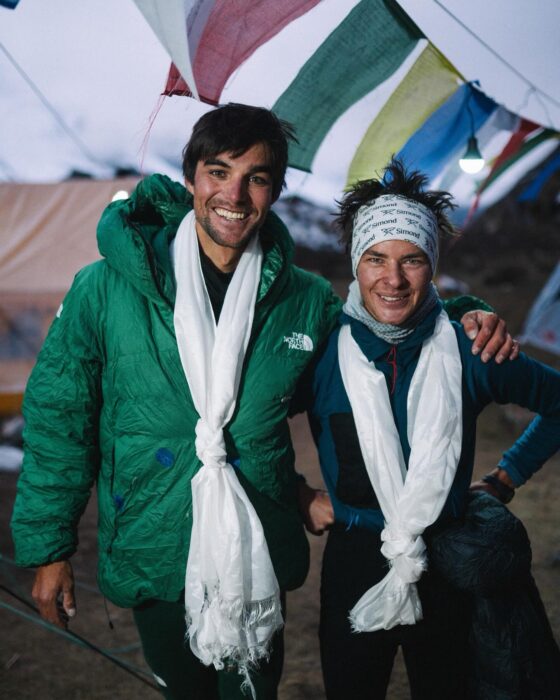
The climbers arrive safely back in base camp. Photo: Quentin Degrenelle
Made it look easy
In 2023, Americans Alan Rousseau, Jackson Marvell, and Matt Cornell achieved the first ascent of the North Face of Jannu to the massif’s main summit. The herculean effort pushed the climbers beyond their physical limits. Rousseau was frostbitten, and the team suffered hallucinations from extreme exhaustion during the last part of the climb.
While extremely tired at the end, Vedrines and Jean never reached that state. Somehow, they made their climb look easy, though surely it wasn’t.
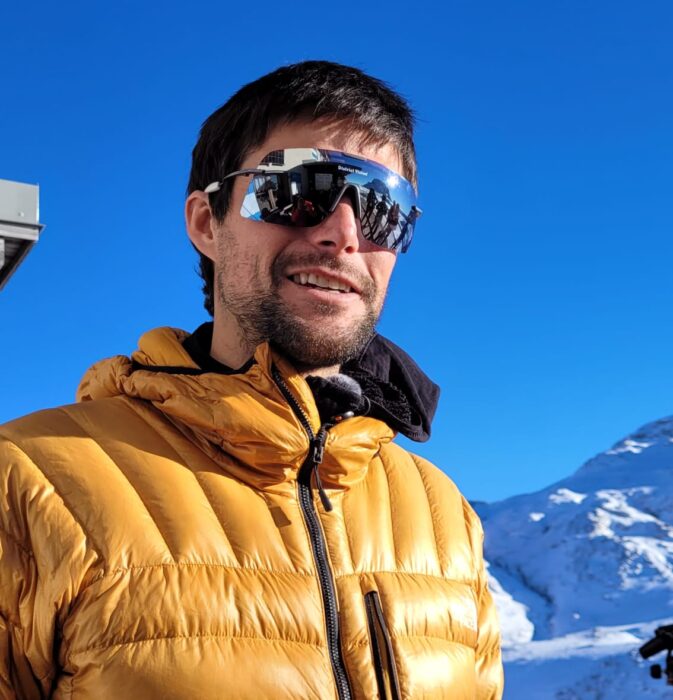
Benjamin Vedrines, back from Jannu East. Photo: Angela Benavides
According to Vedrines, the key was good acclimatization. At the same time, he admits he felt utterly exhausted on the final part of the climb.
“I was surprised at how tired I was. I thought my [fitness] was better!”
Months later, Vedrines was awarded a Special Mention at the Piolets d’Or for his previous climbs in the Alps and the fast ascent of K2. As he explained at the ceremony, all his activities explore different aspects of alpinism, from climbing to skiing to paragliding. They also test his own limits. He is already planning for 2026.