Greenland
Last week, we reported that Australian adventurer Marcus Arnold abandoned his planned 400km circumnavigation of Milne Island. Things didn’t get any better for Arnold from this point, as he had to wait out a storm for several days, which made a helicopter pickup impossible.
“The storm has deepened and is only due to get worse, it’s hard to stand up outside, insanely cold, any skin exposed is instantly numb. I’m not so sure my tent would have held up in this,” the Australian wrote on social media.
Arnold was eventually picked up in 70-80kph winds, thanks to a particularly resilient pilot.
British chef turned adventurer Mike Keen is now in Upernavik, western Greenland, awaiting a helicopter flight further north to Kullorsuaq. From here, Keen intends to haul a sled 320km across the sea ice of Melville Bay to Savissivik, the next settlement on the Northwest coast. Keen’s route avoids the North Water Polynya (an area of permanently open water) at the far northwest end of Melville Bay.
“Helicopter has been brought forward to tomorrow now — fingers crossed I’ll be in Kullorsuaq this time on Friday,” Keen wrote on social media. “A few days there getting used to my gear, the ice, making chums with a dog, a coupla seals, tech, etc., and I’ll be off!”
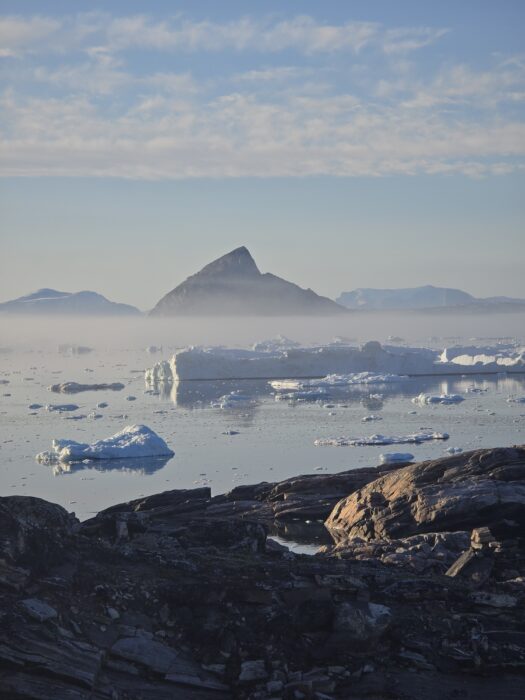
Melville Monument, an island in Melville Bay. Photo: Mike Keen
Keen will be pulling a sled carrying the name of the late Ole Jorgen Hammeken, a Greenlandic polar explorer and Inuit elder, and husband of Galya Morrell, the polar traveler, artist, and ExplorersWeb writer.
“He will cross Qimusseriarsuaq alone, pulling that sled, carrying Ole Jorgen’s name across the ice he knew so well. We crossed Melville Bay together many times, but never like this. Never with one man, one dog, and a single, stubborn idea of devotion,” wrote Morrell.
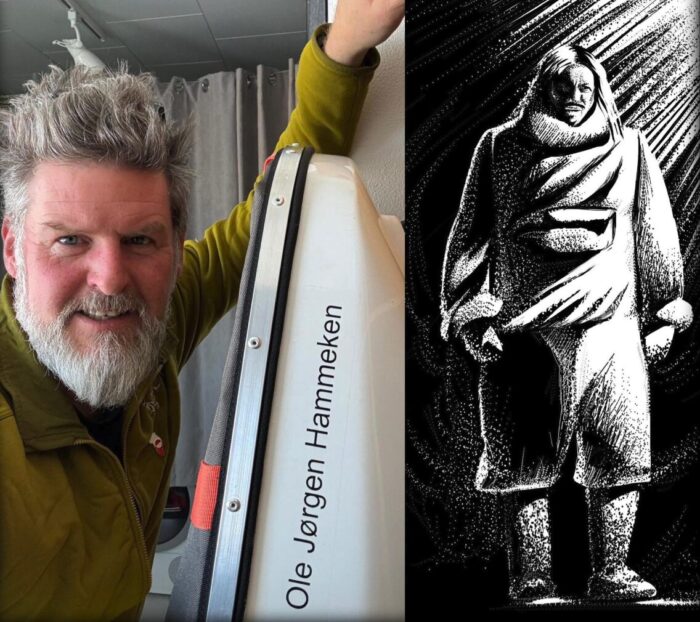
Mike Keen with his sled. Photo: Galya Morrell
“Some people send flowers. Mike skis 320 kilometers, from Kullorsuaq to Savissivik, eating seal, and naming his suffering after my loved one,” she added.
The four-man international team of Gilles Denis, Sasha Doyle, Ed Luke, and Wilson Cheung is also in Greenland, about to start a 1,700km kite journey across the ice sheet, from Kangerlussuaq in the southwest to Qaanaaq in the northwest.
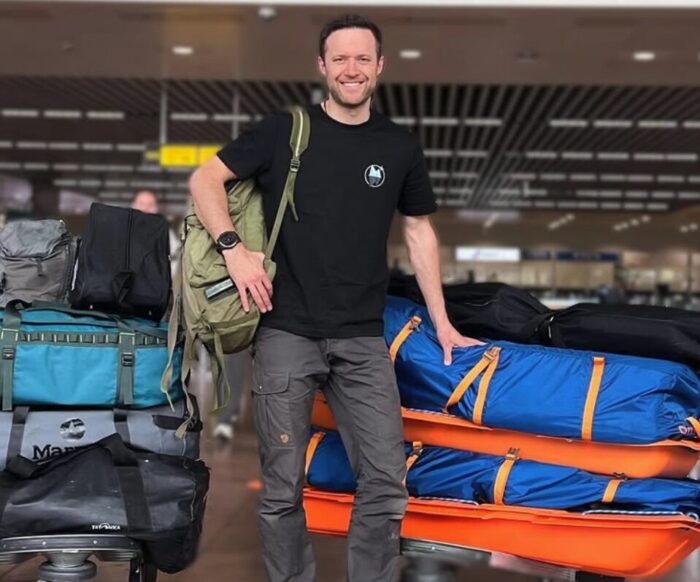
Gilles Denis on the journey to Greenland. Photo: Gilles Denis
Elsewhere on the ice sheet, several guided teams are undertaking crossings, though details are sparse. Finnish guide Nina Teirasvuo is leading five clients on a west to east crossing from Point 600 on the west coast to Isortoq on the east coast. They are one day and 8.7km into their journey.
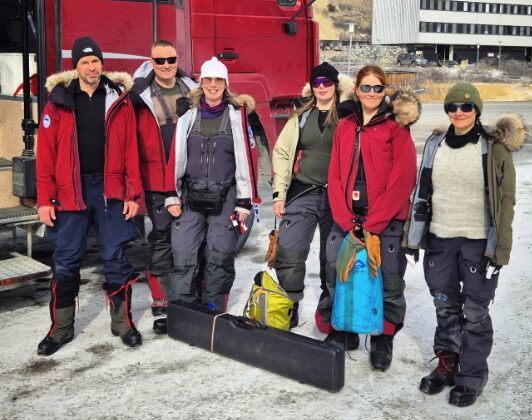
The Finnish-led team in Kangerlussuaq. Photo: avotunturit.fi
“The traditional ‘direct’ route is shorter, but if conditions allow, we will make a 100km detour a little further south to the abandoned DYE3 radar station,” wrote Teirasvuo.
Svalbard
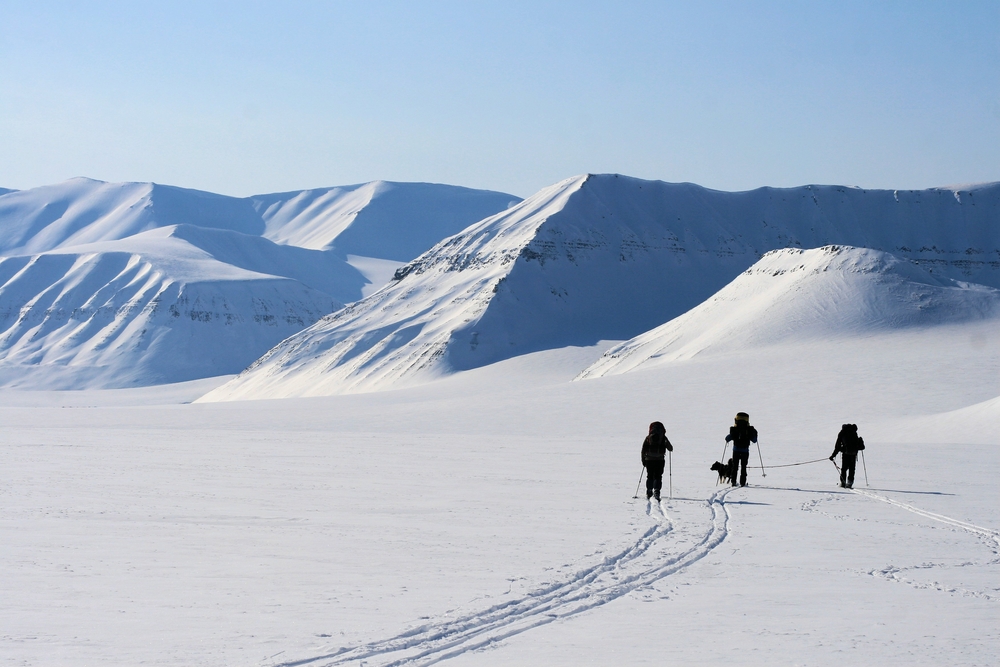
Norwegian Alexander Read and his 10-year-old daughter Mina are 23 days into their 600km sled journey from south to north Spitsbergen, guided by Norwegian polar guide Are Johansen.
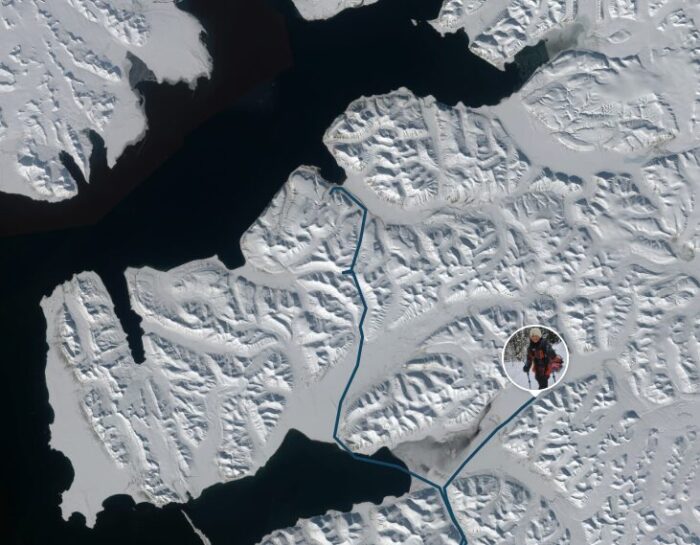
The Reads’ current location shown in the pictured circle. Van Mijenfjorden is the fiord immediately to the left of their location.
The trio has covered 398km according to their tracker, around 100km further on from last week. They are close to Nordenskiold Land National Park, having skied west past the frozen northern shore of Van Mijenfjorden.
Writing on social media earlier this week, Read Senior wrote that the trip so far had been “rough but great…We are now very happy to point our nose north again. We’ve seen polar bear tracks and a few birds.”
The six-woman Norwegian team of Karen Kylleso, Christine Fors, Veronica Fors, Cecilie Rydberg, Ellen Burchard, and Ingvild Feragen is further north than the Reads on day 23 of a similar journey — 600+km from south to north Spitsbergen. The all-female team is currently northeast of Longyearbyen.
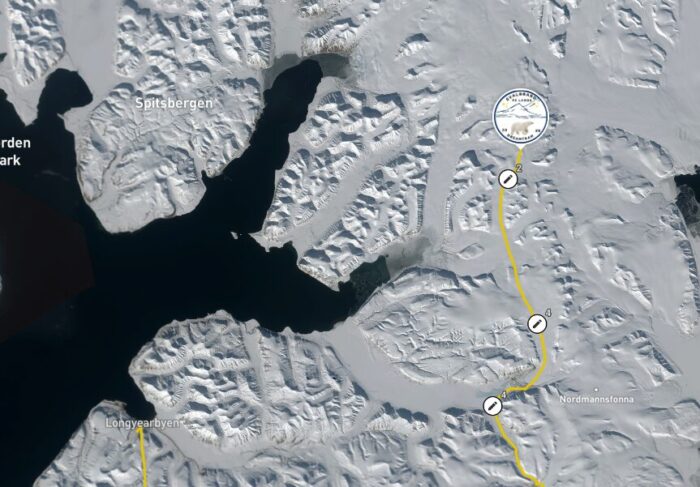
The location of the all-female Norwegian team in the pictured circle. Longyearbyen, the capital of Svalbard, is bottom left.
In the last few days, the six women skied through Sassendalen, the largest valley in Svalbard. They will be traveling on glaciers for the rest of the trip.
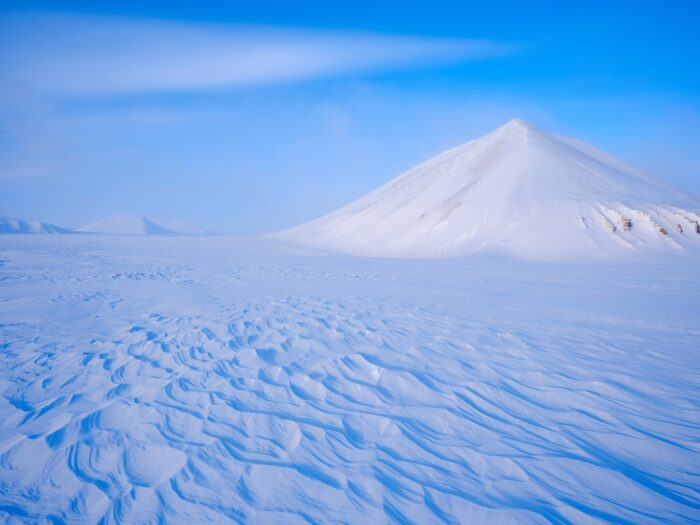
The Rabotbreen Glacier in Sassen–Bunsow Land National Park, where the all-Norwegian team has been skiing over the past few days. Photo: Shutterstock
The five-man Belgian and French team of Merlin Cerise, Gael Loicq, Jean-Simon Gerard, Fabrice Yencko, and Nicola Sanchez is 21 days into a 35-day ski expedition from Longyearbyen to the north of Spitsbergen and back. But they have run into difficulty.
Jean-Simon Gerard abandoned the expedition on day 7 due to foot problems and physical fatigue. On day 9, Fabrice Yencko also exited due to a herniated disc. A recent social media post from Cerise shows a helicopter evacuation, but suggests the remainder of the team is continuing, albeit with a revised route.
An all-female team of Britons Cat Burford, Amelia Rudd, Amelia Steele, Emma Maher, and Jen McKeown, along with Japanese-American Ayuka Kawakami, will attempt a 200km ski journey across Svalbard’s glaciers, from Ekmanfjorden to Magdalenefjorden.
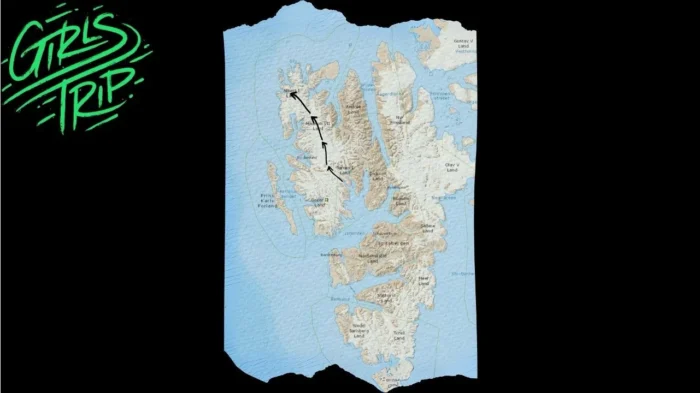
The proposed route. Map: Girls Trip
A boat will drop them at their starting point. From there, they begin their 18–20 day expedition on sea ice before moving onto glaciers.
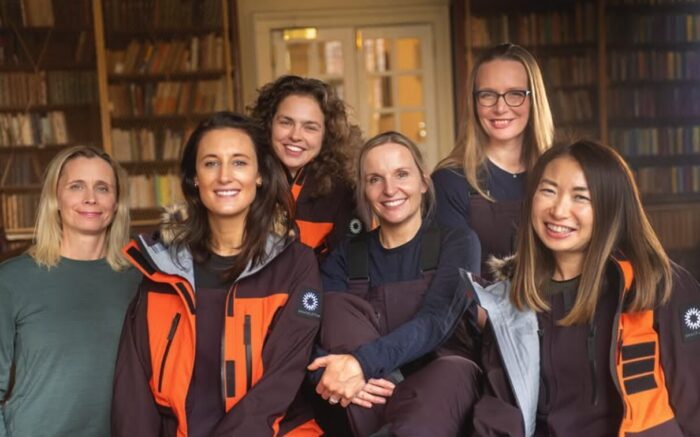
The ‘Girls Trip’ Team. Photo: Girls Trip
Nunavut, Canada
British adventurer Preet Chandi has completed a full circuit of Cornwallis Island in Canada’s High Arctic. Over 37 days, she has skied a total of 486km, maintaining an average pace of around 13km per day.
Chandi’s route brought her back to her original starting point in Resolute, one of the northernmost permanent settlements in the world and a key hub for polar expeditions.
Tracking data suggests she briefly reached Resolute before turning west again, likely to extend her time on sea ice and build further experience, in preparation for a renewed attempt at organizing a solo expedition to the North Pole.
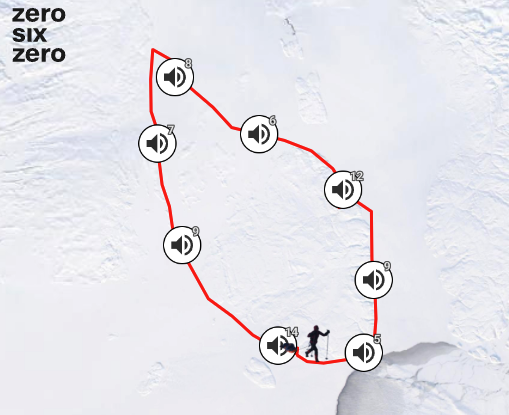
Chandi’s route so far.
Yesterday Chandi’s team reported that she had another polar bear encounter on April 14. “Last night, Preet’s alarm system was put to the test once again when another polar bear approached her camp. Luckily, her perimeter fence worked perfectly; the tripwire triggered a flare, waking her instantly. She was able to fire a second flare to scare the bear away, but the encounter has left her in a state of hyper-vigilance,” wrote her expedition manager on social media.
Northwest Territories, Canada
At 81, veteran polar traveler Will Steger is now 15 days into a solo, 1,300km journey that is expected to last roughly 60 days. He set out from the northeastern edge of Great Bear Lake in Canada’s Northwest Territories and is heading north to Paulatuk, a small Arctic community on the coast of the Arctic Ocean.
The first 10 days saw Steger hauling his sled through deep, energy-sapping snow. Over the past week, he has made steadier progress along the Bloody River, before tackling a 40m snow bank, using a rope-and-pulley system to drag his sled up the slope.
From there, he crossed higher, firmer terrain and has since joined the smaller Haldane River, which offers a better line of travel, since it runs directly north rather than bending off to the northeast like the Bloody River.
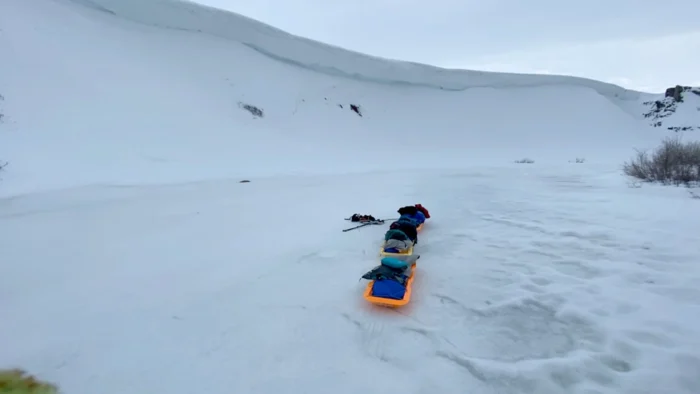
This image from Steger’s 2023 solo expedition in the Northwest Territories helps visualize the kind of snow bank he ascended on the Bloody River. Photo: Will Steger
“The 24 hour light is coming and spring is on its way…But it was a beautiful day, though. It probably got to minus 5 [Fahrenheit] or so, maybe close to zero. No wind, absolutely clear. Very hard-packed travel on the Haldane River,” Steger reported two days ago.