As the Arctic spring draws to a close, most expeditions on the Greenland Ice Sheet are either finishing up or entering their final stages. While activity elsewhere in the North has largely ended, veteran travelers continue to push on in the Canadian Arctic, where conditions are rapidly shifting from spring’s ice and snow to early summer’s thaw.
Greenland
Live Skattum, 25, and Marta Flotve, 23, of Norway are currently four weeks into an independent ski traverse of the Greenland Ice Sheet, from Point 660 toward Isortoq.
Their goal is to arrive on the east coast by June 8. So far, however, there have been no recent updates on their position or progress. In what is unusual for contemporary expeditions, they appear to have opted out of sharing tracking information or providing regular field reports.
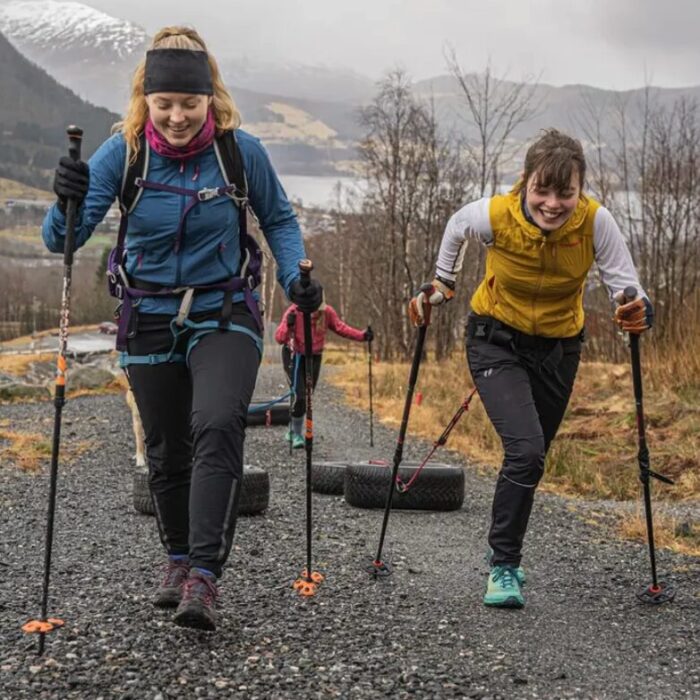
Live Skattum and Marta Flotve train before leaving for Greenland. Photo: Over Gronland
Also on the Ice Sheet, a five-person team guided by the Dutch company Arctic Adventure has covered roughly 530km on a ski traverse from Point 600 toward Isortoq. After crossing the top of the ice cap last week, they have encountered highly variable weather conditions. Earlier this week, temperatures fluctuated between -22°C and -3°C, leading to damp, sticky snow. They anticipate reaching the east coast, and completing their crossing, by tomorrow.
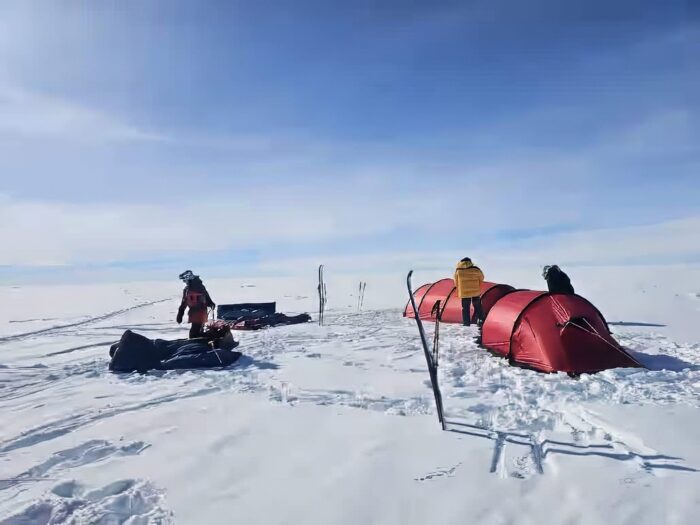
Photo: arcticadventure.nl
A 10-person team from Icetrek Expeditions, guided by Mardi Philips and Steven Giordano, is now about four weeks into a west-to-east ski traverse of the Greenland Ice Sheet, from Point 660 to Grill Hut on the east coast. They have roughly 36km remaining, followed by a 1,200m descent through the icefall to reach a hut, from which a helicopter will promptly come to pick them up, weather permitting.
“Our sense of time will be warped a little over the next 24 hours,” the team reported this morning. “We are having dinner and going to bed at lunch time, then we’ll wake up at 8:40 pm, have breakfast, pack up camp and start skiing at 11 pm. This will be the safest time to travel over the crevassed terrain, when the snow is at its firmest, and will have us arrive at the finish point a few hours before our scheduled helicopter pick up.”
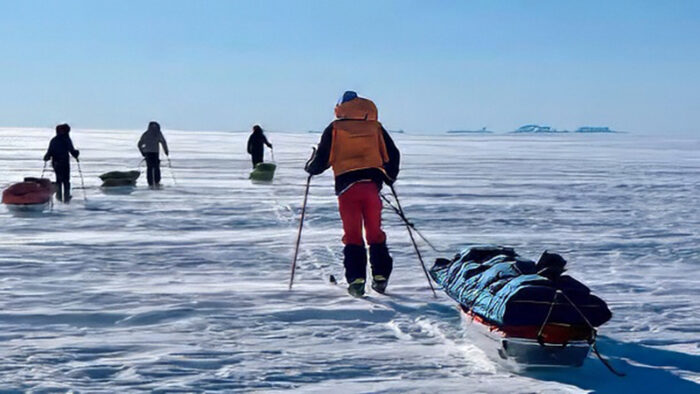
Members of the Icetrek team are making progress in good weather. Photo: Icetrek
A four-member group guided by Annie Aggens of Polar Explorers has successfully completed their ski traverse of the Ice Sheet, from Point 660 to Isortoq. The team finished yesterday after 30 days on the ice.
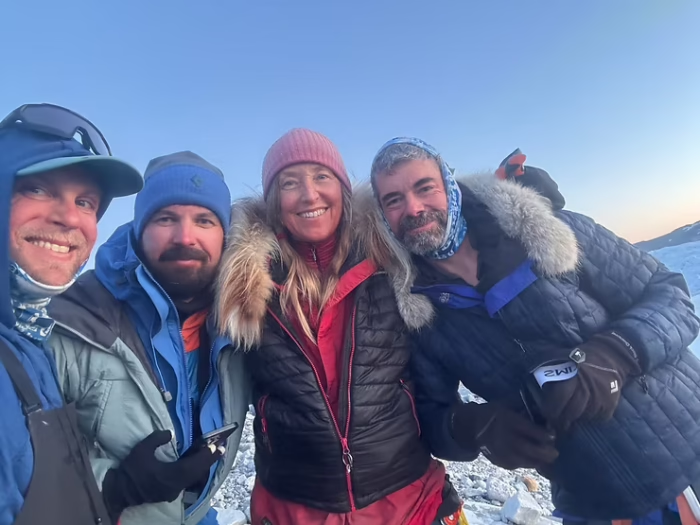
The Polar Explorers team at the finish. Guide Annie Aggens is centre.Photo: polarexplorers.com
Nunavut
Erik Boomer, a Baffin Island-based adventurer known for his multidisciplinary pursuits, remains in the field with British climber Leo Houlding and his team as they attempt a big-wall ascent at an undisclosed location. Meanwhile, Boomer’s partner and expedition teammate, Sarah McNair-Landry, has returned to their home in Iqaluit after earlier joining him to establish new ice climbing routes during the trip.
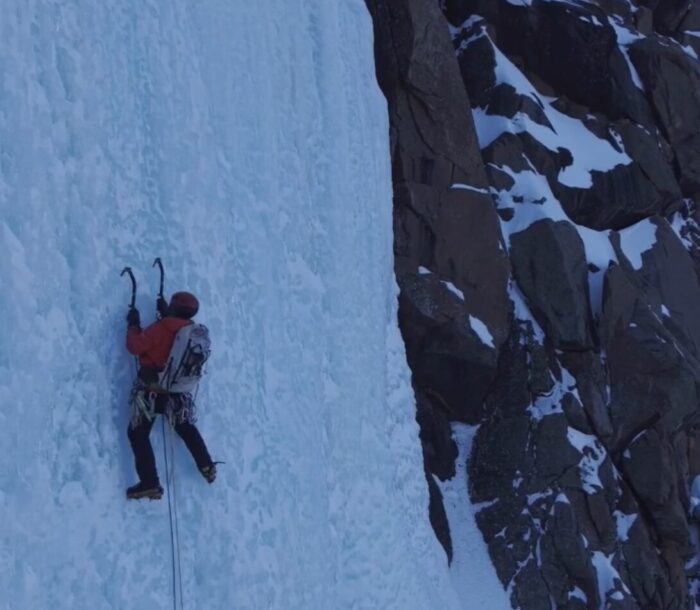
Boomer on an ice route earlier in the trip. Photo: Erik Boomer
Farther north on Ellesmere Island, Ingrid Ortlieb of Germany and Jose Naranjo of Spain completed a 600km ski journey on May 17 after 42 days. Regular expedition partners, the pair traveled through a series of remote fiords, including the island’s two largest fiords.
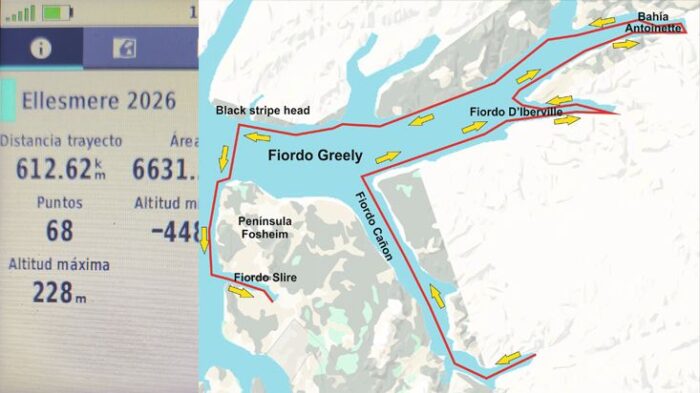
The route of Orlieb and Naranjo. Photo: Ingrid Ortlieb and Jose Naranjo
After first covering 700km by snowmobile to reach their starting point, they set out from Canon Fiord in west central Ellesmere, skiing its length across frozen sea ice before continuing north toward Antoinette Bay. From there, they turned south, following the northern shoreline of Greely Fiord, a vast inlet named after American explorer Adolphus Greely, who led the ill-fated Lady Franklin Bay Expedition in the 1880s. The route then carried them across to the northwestern edge of the Fosheim Peninsula, where they concluded their journey near the remote Eureka research station.
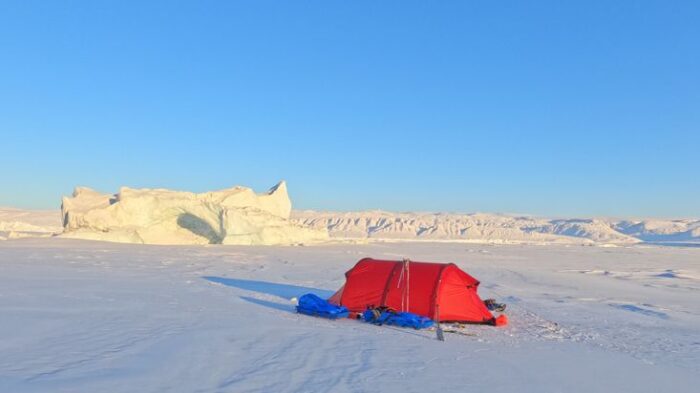
Photo: Ingrid Ortlieb and Jose Naranjo
Although the expedition spanned 42 days in total, only 35 of those were spent skiing, with a week devoted to exploring the Canon, D’Iberville, and Antoinette Glaciers along the way.
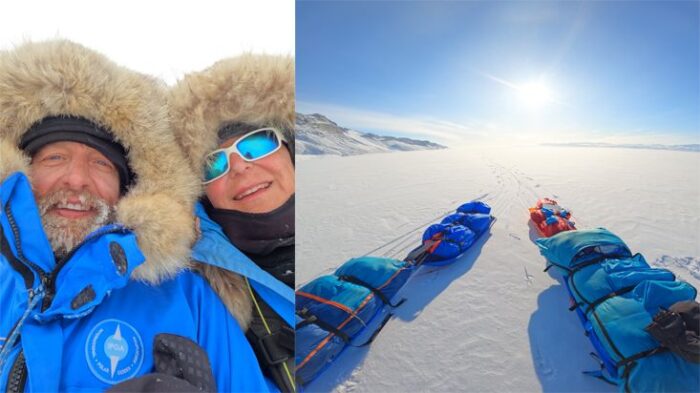
Photo: Ingrid Ortlieb and Jose Naranjo

The cliffs along Greely Fiord, Ellesmere Island’s largest fiord. Photo: Jerry Kobalenko
Northwest Territories
Veteran American explorer Will Steger, now 81, is 57 days into an ambitious 1,300km solo Arctic journey, initially expected to take around 60 days. He set off from the northeastern shores of Great Bear Lake and is travelling north toward Paulatuk, an Inuit community on the Arctic coast.
For the past two weeks, however, Steger has been camped beside the Horton River, waiting for spring breakup to allow safe onward travel by raft.
“It looks like this is a major thaw. The wind is blowing pretty strong from the south all day here. So I think that thaw is coming back again…[after] cold weather came in. This may be the one that will loosen these rivers up so I can start here pretty soon. And so I’m pretty happy about that,” Steger reported on Wednesday.
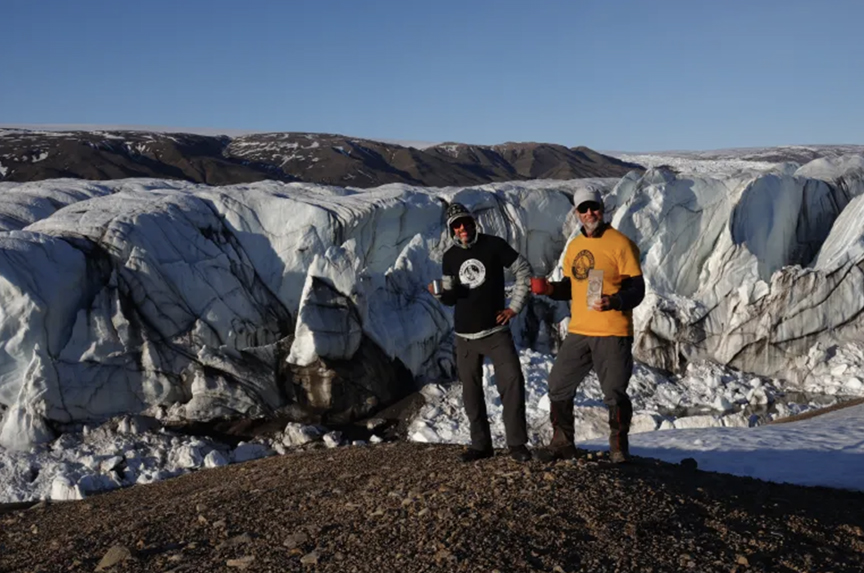
Paul van Peenen and John Dunn on Ellesmere Island in 2019. Photo submitted by John Dunn