Greenland
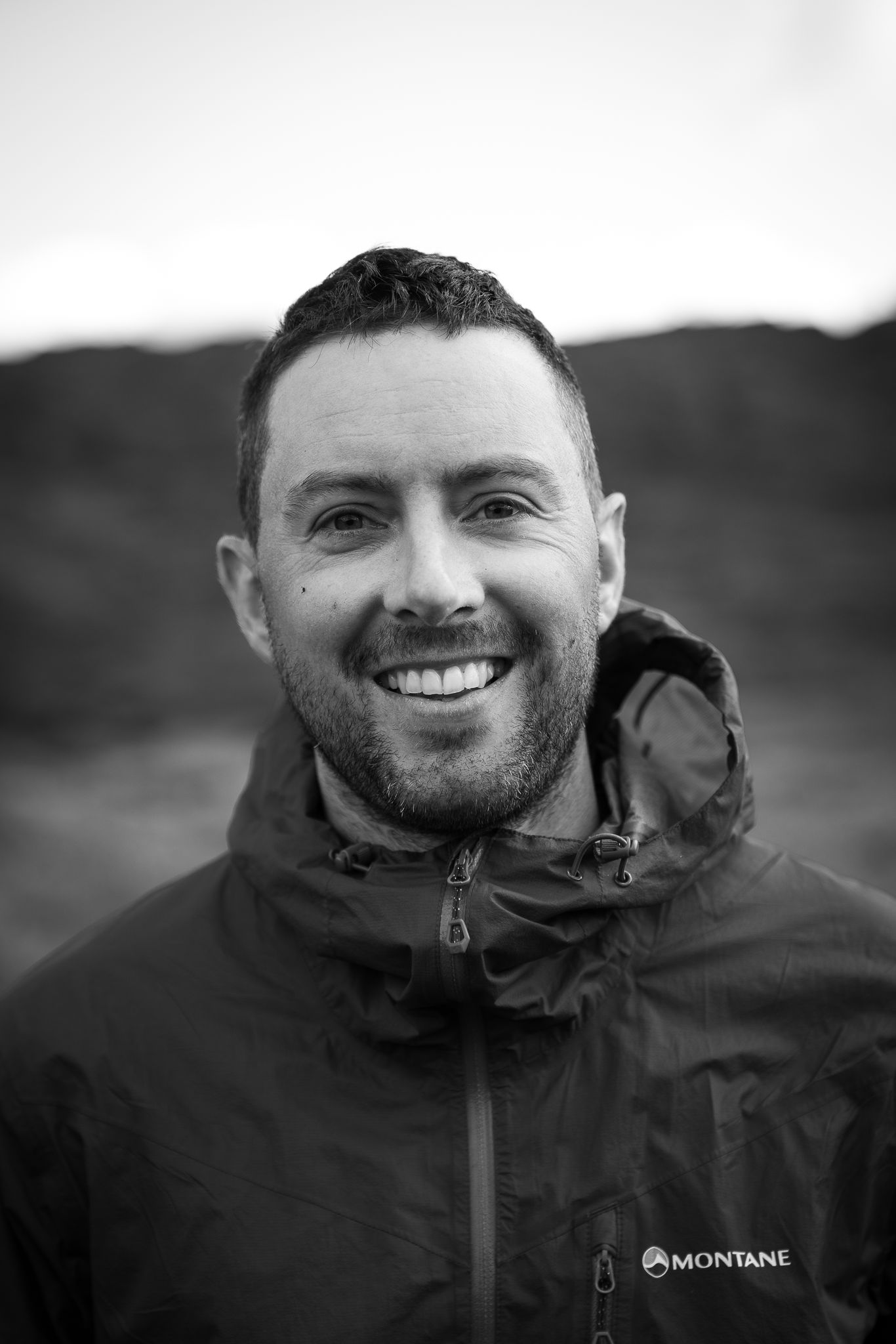
British chef-turned adventurer Mike Keen has canceled his planned 320km sled trip across Melville Bay in northwest Greenland, from Kullorsuaq to Savissivik. Poor weather delayed Keen’s helicopter journey to Kullorsuaq by two weeks, and by then, local ice conditions had deteriorated. In the past week, Keen has instead been out on the ice with local hunters, eating raw or fermented seal as part of a self-imposed dietary experiment.
An international four-person team (Gilles Denis, Sasha Doyle, Ed Luke, and Wilson Cheung) set out on April 19 to complete a 1,700km kite-powered crossing of the Ice Sheet, traveling from Kangerlussuaq in the southwest to Qaanaaq in the northwest.
The expedition is now 19 days underway. According to the team’s website, by day 15, they had completed 42% of the route, roughly 714km. Their tracking data currently shows them positioned at 73°N.
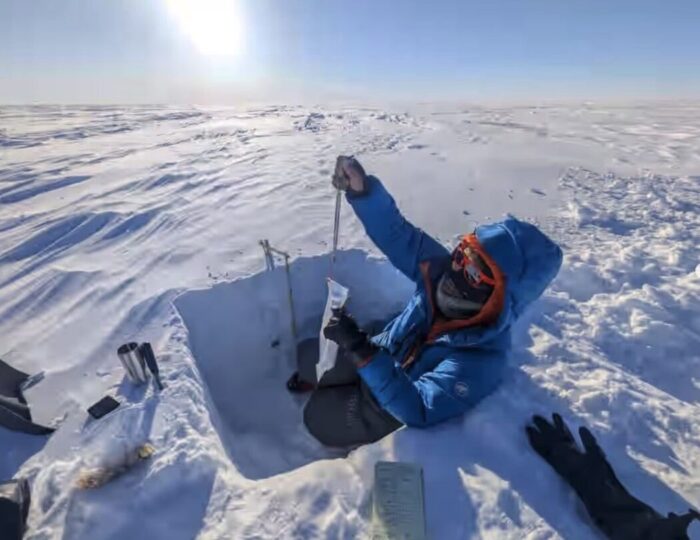
One of the kite skiers takes snow samples for the various scientific projects associated with the expedition. Photo: Gilles Denis
Still a long way to go
Posting on social media three days ago, Denis wrote that “Qaanaaq is still a long way off. But we’re going.”
He went on to describe the harsh weather they have faced: “For the past six days, the Greenlandic plateau has imposed its unforgiving conditions upon us. The storm of the preceding days had left behind a field of sastrugi stretching as far as the eye could see,” said Denis.
Despite the extreme cold, progress has continued. “In windchills of -47°C, with frostbite beginning to form on faces and skin cracking, the team continued to advance,” he added.
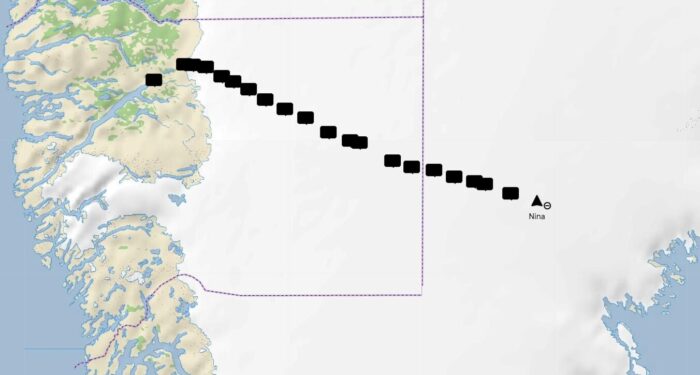
The current location of the Finnish guided expedition
Finnish guide Nina Teirasvuo and her five clients are 22 days into a west-to-east crossing from Point 600 on the west coast to Isortoq on the east coast. They have been putting in solid days of over 20km in the past week. Their tracker shows them over three-quarters of the way across the Ice Sheet, near the east coast.
Elsewhere, a four-man team led by Dutch outfitter Arctic Adventure is 97km onto the Ice Sheet, on a ski crossing from Kangerlussuaq to Isortoq.
Svalbard
Amid a season where several teams have abandoned Svalbard expeditions, Caroline Cote successfully guided a multinational team of six on a crossing of Spitsbergen from south to north in 35 days for Ousland Explorers.
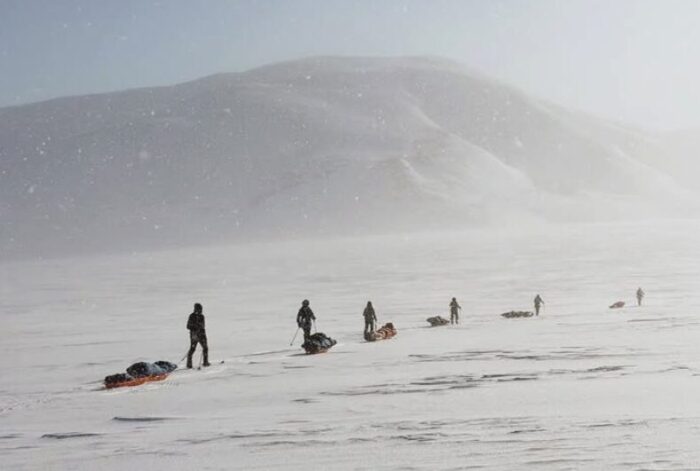
Photo: Caroline Cote
Ten-year-old Mina Read and her father, Alexander Read, have completed their south-to-north ski crossing of Spitsbergen in 44 days. The father-and-daughter team skied with guide Are Johansen from the southern end of Spitsbergen to Verlegenhuken, its northernmost point. They finished on May 5 after 600km and 7,000m of total elevation gain.
The journey establishes Mina as the youngest person to complete a south-to-north crossing of Spitsbergen.
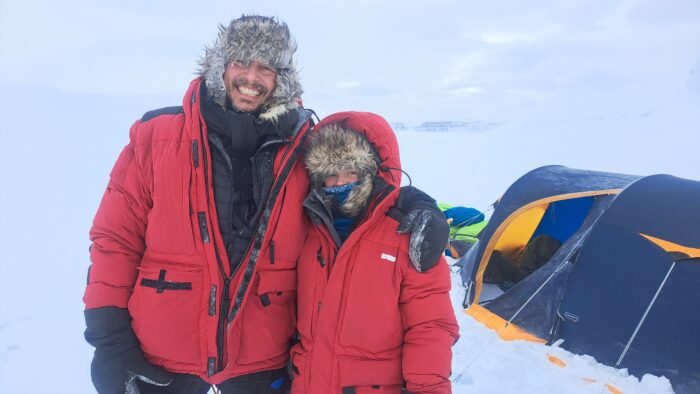
Alexander and Mina Read. Photo: Alexander Read
“The original plan was to be picked up by snowmobiles, but weather and snow conditions forced us instead to return to Longyearbyen by boat…a journey of around 30 hours,” said Alexander Read.
Reflecting on the experience, Mina described both the challenges and quieter moments of the expedition.
“The nature in Svalbard is incredibly beautiful,” she said. “It is completely silent in the icy wilderness, and everything feels so huge. Some days, there was a lot of wind, and it was hard skiing while pulling a 24-kilo sled, but there were also many beautiful days with good weather and lots of rest time in the tent where daddy and I played games.”
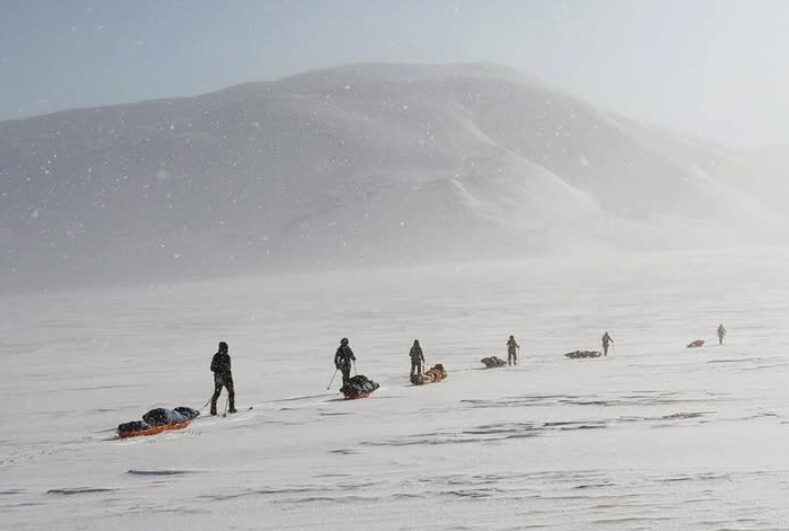
Photo: Caroline Cote
Other Svalbard teams
The all-female team of Britons Cat Burford, Amelia Rudd, Amelia Steele, Emma Maher, and Jen McKeown, along with Japanese-American Ayuka Kawakami, is 16 days into a 200km ski journey across Svalbard’s glaciers from Ekmanfjorden to Magdalenefjorden.
In the past few days, the team has spent some time tentbound, as they wait out clear visibility to ski through a heavily crevassed area, where they will travel roped together. Their tracker shows them around three-quarters of the way along their planned route.
Nunavut, Canada
Bertrand Delapierre and Hubert Sagnieres have completed a 500km sled journey across a remote section of Canada’s High Arctic, traveling from Dealy Island to Mercy Bay over 36 days.
The route followed terrain associated with 19th-century British Arctic exploration. Along the way, the pair compared historical expedition records with current conditions on the ground, partly tracing the routes of explorers including William Edward Parry, Francis Leopold McClintock, and Bedford Pim.
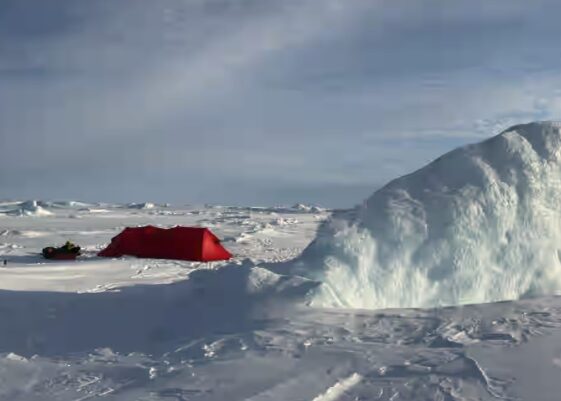
Camped at the entrance to Mercy Bay. Photo: routesnouvelles.com
Mercy Bay holds a prominent place in Arctic history. HMS Investigator, under the command of Robert McClure, was beset by ice there for several winters. When Bedford Pim arrived in 1853, on a ski crossing from Dealy Island, he encountered a weakened but surviving crew, an event that later became one of the era’s most notable Arctic rescues.
Two days before reaching Mercy Bay, Delapierre and Sagnieres experienced a close call of their own when strong winds tore their tent from their grasp while setting up camp.
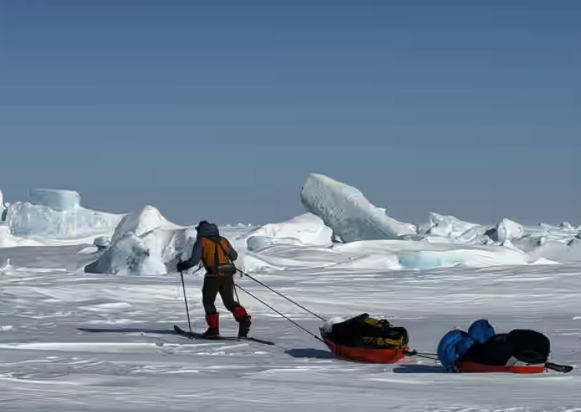
Delapierre sledding past ice hummocks on day 34. Photo: routesnouvelles.com
A near disaster
“We stop to set up camp. In the wind. We secure the tent, start putting it up…then gust after gust, suddenly everything flies away! In less than a second, the tent is already 30 meters away! We plunge into the hummocks, hard snow, ice, soft snow, the wind keeps pushing it,” wrote Sagnieres.
“Bertrand, always quick, leaps from hummock to hummock! And we were saved by our enemies: the tent wraps around a big hummock, and Bertrand dives,” he added.
Elsewhere in the Canadian Arctic, Baffin Island residents and versatile adventurers Erik Boomer and Sarah McNair-Landry are on a 45-day multisport expedition on Baffin. They are focusing on finding unclimbed ice and plan to include rock climbing later in the journey. In the last week, the pair have put up a new ice route (WI6) in the Scott Inlet area, on the east coast of Baffin Island, north of Clyde River.
In recent days, Boomer and McNair-Landry have joined British big-wall climber Leo Houlding and a larger team in Sam Ford Fiord, where they intend to attempt routes together.
Northwest Territories, Canada
At age 81, veteran American traveler Will Steger is more than a month into a solo Arctic traverse of roughly 1,300km, a journey expected to last about 60 days. He set out from the northeastern shore of Great Bear Lake and is heading north toward Paulatuk, an Inuit community on the Arctic Ocean.

“I’m just always just watching and observing.” On day 34, Steger watched a 50kg wolf moving across the riverbed. Photo: Will Steger
Over the past week, Steger continued west along the frozen Horton River. He often progressed steadily by hauling all three sleds together but relayed the sleds when conditions demanded.
Visibility during the previous 10 days was consistently poor, slowing forward momentum. With more than half of his planned time elapsed, Steger still has a significant distance remaining, and tracking data indicates he has yet to reach his halfway point.