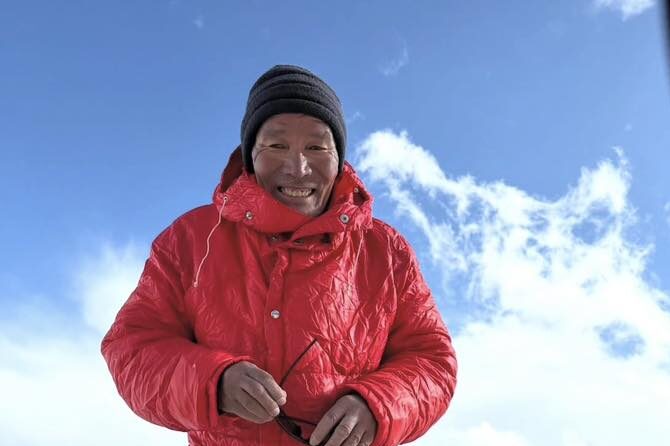
There is no hope for Hillary Dawa Sherpa, who went missing on May 29 while descending from near the summit of Everest. While another Sherpa and two clients continued down the mountain, Dawa was left behind. This morning, 8K Expeditions launched a helicopter search but found no trace of him.
“Hillary Dawa Sherpa was not working for us, but we sent the helicopter at the request of the family. We have searched everywhere from the top of the icefall to the surroundings of Camp 3, as high as the helicopter could fly, and we have found no trace of him,” Pemba Sherpa, founder of 8K Expeditions, told Explorersweb.
Dawa was working for a small company called Himalayan Traverse Adventure. “We had only managed the climbing permits for their two clients,” Pemba Sherpa explained. It is common practice for small companies to include their climbers in the permits for bigger groups.
Kathmandu-based 8K Expeditions is one of the biggest outfitters for 8,000m peaks, and they put 72 clients on Everest’s summit this year. Asked how something like this can happen, Pemba Sherpa suggests many things must have gone wrong with the outfitter: Himalayan Traverse Adventure.
Sherpas help each other
“As a company director myself, I have to tell the truth and note some serious mishaps,” Pemba Sherpa said. “The team reportedly summited on May 28, when they should have already been down and preparing to leave. The Sagarmatha Pollution Control Committee (SPCC) had already announced they would retrieve the ladders from the Icefall that day, so having clients on the upper side of the mountain is dangerous. If something happens, there are no options to organize a rescue. Sherpas help each other when someone is in need, but there were no other Sherpas around that day. This is a risky strategy on high mountains, most of all on the 8,000’ers.”
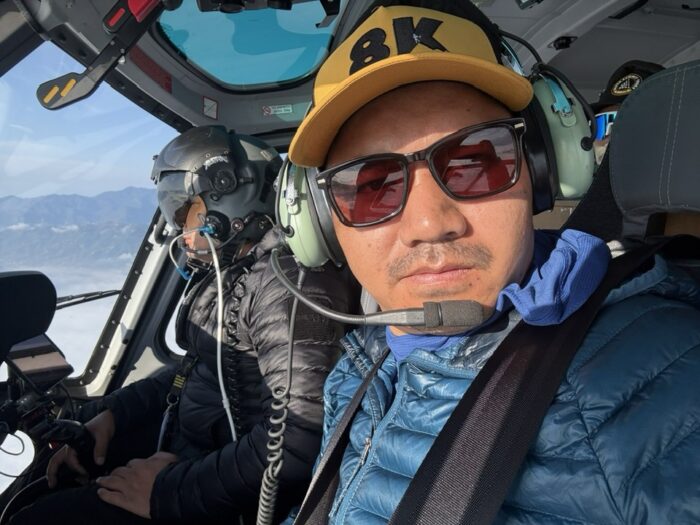
Pemba Sherpa, some days ago on his way to Everest Base Camp in a helicopter. Photo: Pemba Sherpa
“Moreover, they summited at 5 pm, which is an unacceptably late time,” Pemba Sherpa added. “That means the team’s progress was too slow. They should have turned around.”
Reportedly, the team had left Camp 4 on their summit push at 11 pm the previous night. This means they took 18 hours to reach the summit. Most teams need less than 10-12 hours from Camp 4, even on the most crowded days.
No search requested
“The real negligence is that the moment Hillary Dawa lost contact with Base Camp, they should have sent crew members — other Sherpas — immediately up on a ground search,” Pemba Sherpa explained. “If he’s alive but sick or injured, a group of Sherpas could have helped him down.”
Pemba Sherpa explained that Hillary Dawa’s family reached out to them and requested today’s aerial search. “There was a cameraman and a member of the family in the helicopter. We searched up and down the route twice, but we found no trace of Hillary Dawa. Imagine how difficult it is to tell that to the waiting family.”
Pemba Sherpa suggested Dawa could have fallen into a crevasse. “We will keep looking when we return to the mountain next season and, if we find him, we will retrieve the body,” he promised.
Witness account
We have tried to contact the owner of Himalayan Traverse Adventure, as well as the second Sherpa in the team, but have received no reply. However, yesterday, one of the company’s clients posted his version of events.
The Himalayan Traverse Adventure summit team comprised two clients, each with a supporting Sherpa. The clients were a Polish national whose name has not been shared and Chris Thrall of the UK. Thrall is a military veteran who has used social media to highlight mental health issues among veterans.
In a video (included later in the article), Thrall says he summited Everest at 5 pm on May 29 (though this may be a mistake; other sources suggest they summited the day before, on May 28) with an unnamed Sherpa.
“On the way down, we came across my fellow client, a very nice Polish chap, who was battling frostbite,” Thrall said. He reports that the Polish climber was supported by Hillary Dawa, and that they had turned around without reaching the summit.
Dawa’s last location
According to Thrall, the four of them reached Camp 4 that night. “The following morning, the Polish guy left with my Sherpa, and I was left alone with Hilary Dawa Sherpa. We got our stuff, and we started to descend to what was supposed to be Camp 2.”
At some point on the Yellow Band (Thrall called it the Yellow Belt and warned he was not 100% sure of the location), Dawa sat down for a rest.
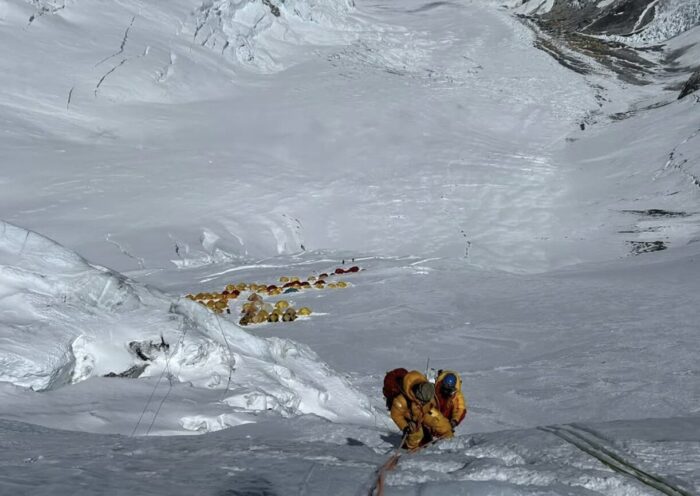
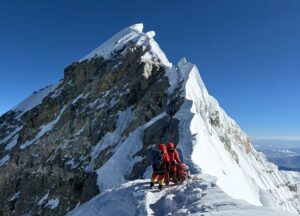
Climbers between Camp 3 and Camp 4 on Everest. Photo: Rupert Hauer
“I turned around, and I said, ‘Hillary [Dawa], are you okay, brother?” He said Yes, yes, fine, please, go, go!” Thrall recalls.
He went on ahead, noting that it was normal to overtake his Sherpa. However, “during the descent, I think it was on the yellow band, on one of the abseils, I found my Polish buddy at the bottom. I thought he had fallen off the abseil and was hurt or dead, but he said he was OK but out of oxygen.”
Thrall spends minutes explaining how he needed to help the Polish climber and that he believed Dawa was okay above them and would join them later on. What he never mentions is what happened to the second Sherpa, the one supposedly assisting the Polish client. That Sherpa is never mentioned for the rest of the descent, which took two more days.
Thrall didn’t reveal the other Sherpa’s name, but only one other Sherpa is mentioned in Himalayan Traverse Adventure’s posts as participating in the summit push: Ang Furba Sherpa.
A struggle
Thrall said that the weather alternated between snow showers and whiteout periods.
“It took us, I think, 11 hours to get into Camp 3, which should have been a two-hour trek,” he said.
He described getting into an abandoned tent in Camp 3 that had a cooker inside. Here, they melted some snow and rested for two hours before departing again. At no point did he see Dawa coming down from the upper slopes. He also recalls that Dawa’s headlamp was not working. “Serious alarm bells were ringing,” Thrall said.
Apparently alone, the two clients reached Camp 2 the next morning.
“That journey [possibly from Camp 4] took 19 hours,” Thrall said. At Camp 2, they radioed their situation to Base Camp. “Someone suggested Dawa had slept at Camp 3. I said, ‘Come on, we were in Camp 3 for two hours, I have been torturing my head the whole time, and he never came‘,” Thrall explained.
The Icefall
“At that point, a decision was made that we needed to descend through the icefall,” Thrall continued.
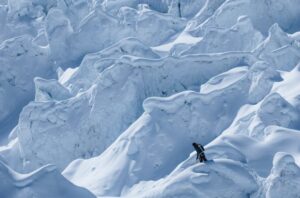
He describes the Icefall as covered in fresh snow, with fixed ropes buried and hidden crevasses. He notes it took them from 10 am that day to 5:30 am the following day. If confirmed, that would include the warmest and most exposed hours of the day. He didn’t mention if there was anyone else with them, or why there was no help sent from Base Camp during these last 19 hours of struggle.
“About a helicopter rescue, I don’t want to talk about it. The weather windows were not favorable,” Thrall said. However, both the Polish client and Thrall were airlifted from Base Camp the following morning.
You can hear Thrall’s full account on YouTube here:
Negligence?
Thrall complains that he has received cruel comments on social media, calling him a “murderer.” He insists that he couldn’t return to search for Dawa with only half a bottle of oxygen left, after reportedly sharing his O2 with the Polish climber.
No one expects clients to lead rescue operations on Everest. Guided clients usually lack the skills and the power, especially when returning from the summit. As Pemba Sherpa explained, expedition companies must deal with these situations and send Sherpa climbers to help immediately.

A rescue helicopter approaches the Khumbu Icefall. Photo: Tim Mosedale
Nepal-based blog Everest Today has published a critical note about Dawa’s situation. They pose an uncomfortable question: Would the situation have been different if the missing climber were a client and not a Sherpa? The question falls entirely on the outfitting company, which is responsible for both its clients and its staff. There was no help for Dawa, but was there any assistance for the two foreign clients? According to Thrall’s account, they were also left alone on Everest during a descent that took days. One of them was frostbitten, and they spent nearly 20 hours in the Khumbu Icefall. They could have died, too.
Further questions
Thrall does not explain the chain of decisions that led to the tragedy. We have contacted Thrall, who told us he’ll respond in a couple of days as he has just landed in London. When we do hear back, we hope to get answers to some key questions.
- Was the team aware that their planned summit day was only hours before Everest was officially closing for the season?
- Why didn’t they turn around?
- What happened to the second Sherpa, who summited with Thrall and then accompanied the Polish climber down from Camp 4?
- Did anyone report on Dawa’s absence during the two hours that they were at Camp 3?
- Was anyone in Camp 2 who could have helped? If anyone radioed about the situation, why did no one launch a rescue operation?
- Were Thrall and the Polish climber alone while crossing the Icefall? If so, why did the outfitter not send anyone to help?
Lessons learnt
Speaking with ExplorersWeb, Pemba Sherpa of 8K Expeditions said he is not going to include other climbers in his group permits moving forward. “It’s the lesson I’ve learned,” he said. He then added a warning for future Everest climbers: clients must be careful which company they choose.
“All those going for higher peaks, especially the 8,000’ers, should carefully check the company they are going to hire. [Check] its portfolio and experience in previous years, its resources, and, most of all, rescue back-up,” Pemba Sherpa said. He noted that small companies may have no backup plans in place to rescue members if something goes wrong.
A family man
Some climbers who have climbed with Hillary Dawa Sherpa have shared condolences and memories on social media.
“I met Dawa Sherpa in April 2025, and he co-guided my friend and me, with Kaji Sherpa, on Chulu East [a technical point near the popular Chulu Far East]. He was super strong and experienced, and he took amazing care of us,” Irem Erden posted.
Erdem said that Hillary Dawa was an older Sherpa in the team, well into his fifties. “He had a daughter, and I guess he was still working for his family.”
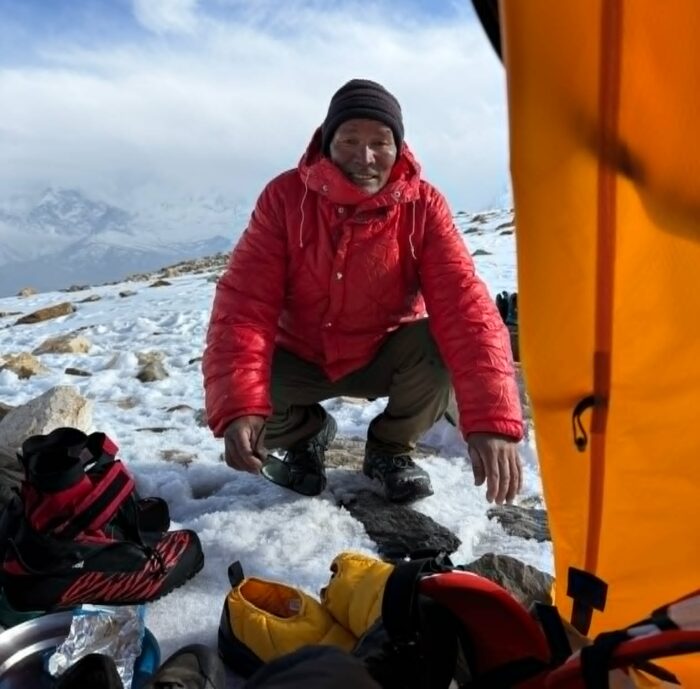
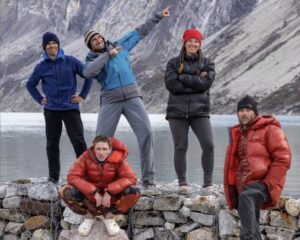
Hillary Dawa Sherpa on Chulu East last year. Photo: Irem Erdem