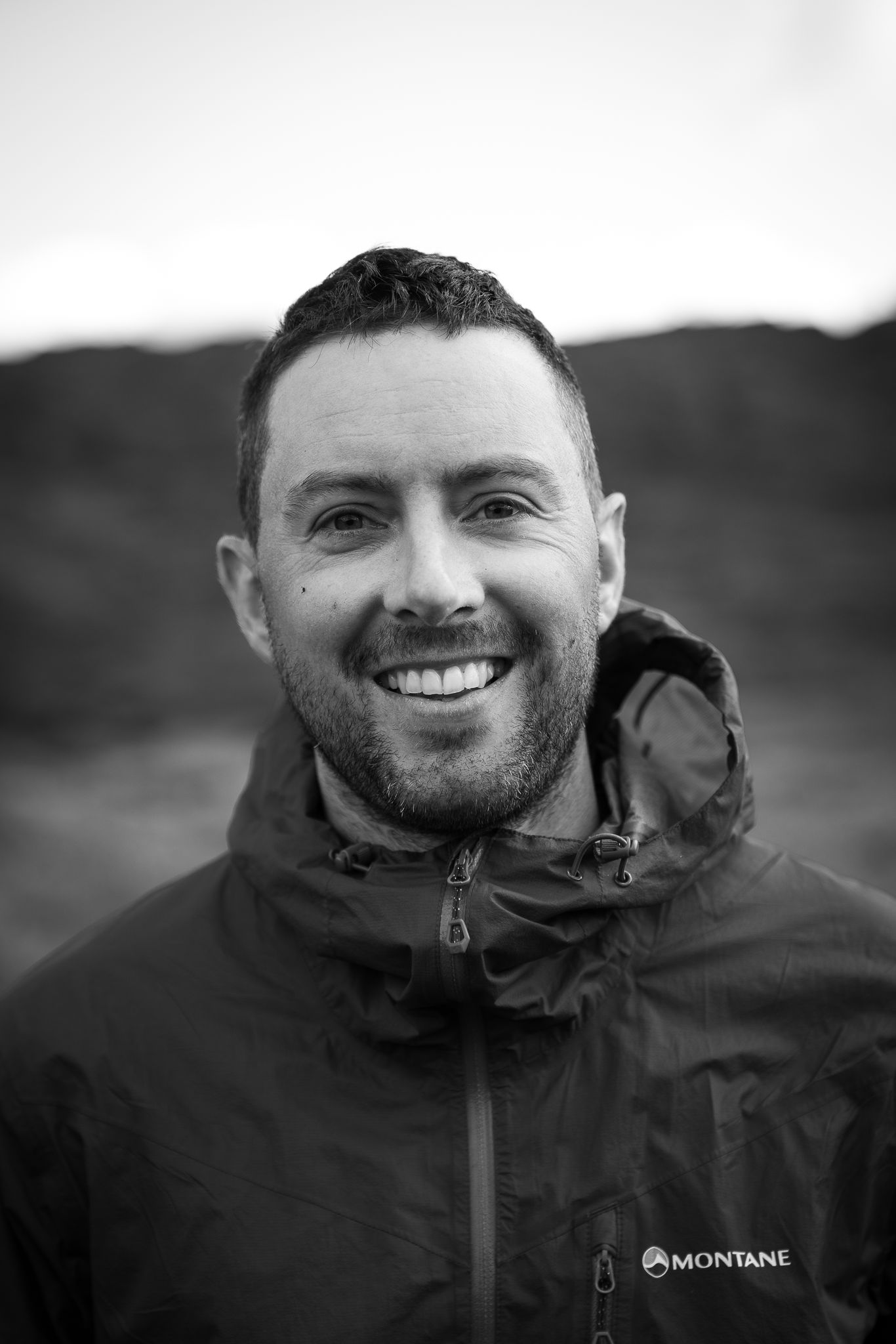
Last month, Mark Gresser completed a 6,023km, 331-day walk across the Australian mainland, between the country’s westernmost and easternmost points.
The Australian began at Steep Point, Western Australia, on July 6, 2025, and reached Cape Byron, New South Wales, on June 1, 2026, after 11 months. His route took him through Lambert’s Centre, the geographic midpoint of Australia.
No stranger to mega-journeys, Gresser previously cycled 29,600km from Perth, Australia to Paris, France, between 2015 and 2018. He works as a zoologist.
The route
Gresser crossed Australia from the Indian Ocean coast of Western Australia to Queensland’s Pacific shoreline, following a broad arc through the continent’s interior.
Instead of taking a direct west-east line, it passed through remote outback regions, skirted the Red Centre near Alice Springs, then continued through South Australia’s arid terrain before crossing the pastoral country of New South Wales and Queensland.
Much of the walk took place in sparsely populated areas, with long distances between settlements and limited water sources.
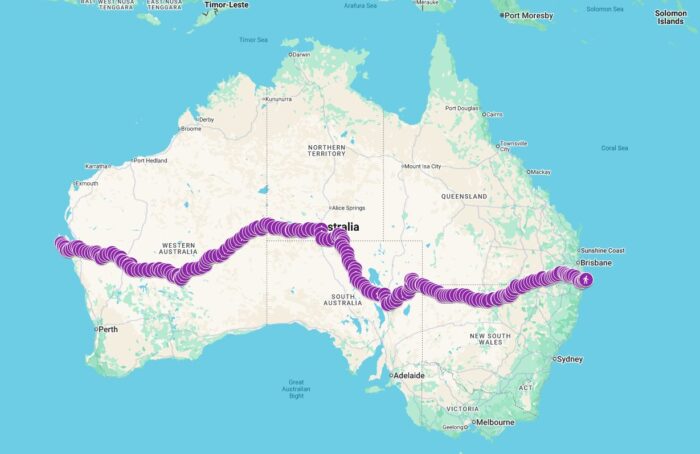
Gresser’s route across Australia. Map: Mark Gresser
Gresser’s GPS track dips notably south when he dodged the Simpson Desert. “It was a sad day when I realized there was no way I’d get my cart through the thousands of sand dunes that form the desert,” wrote Gresser on his website.
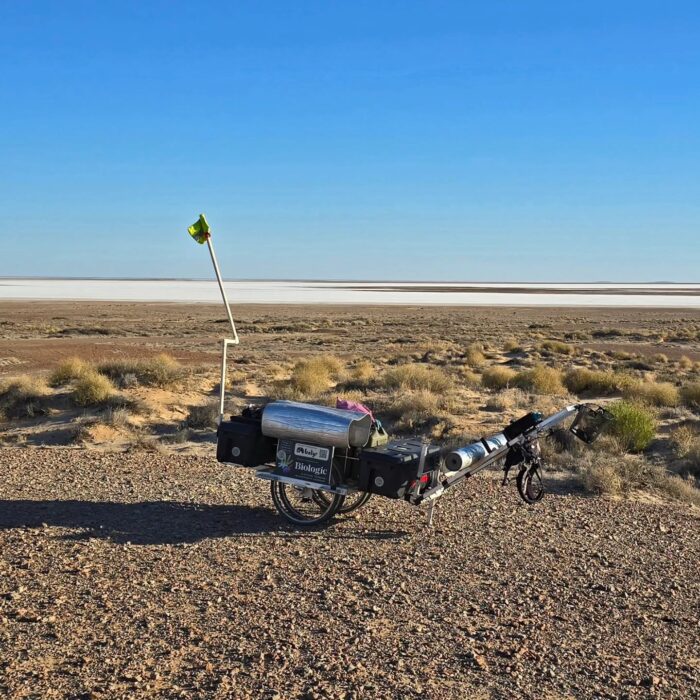
Photo: Mark Gresser
Wheeled cart
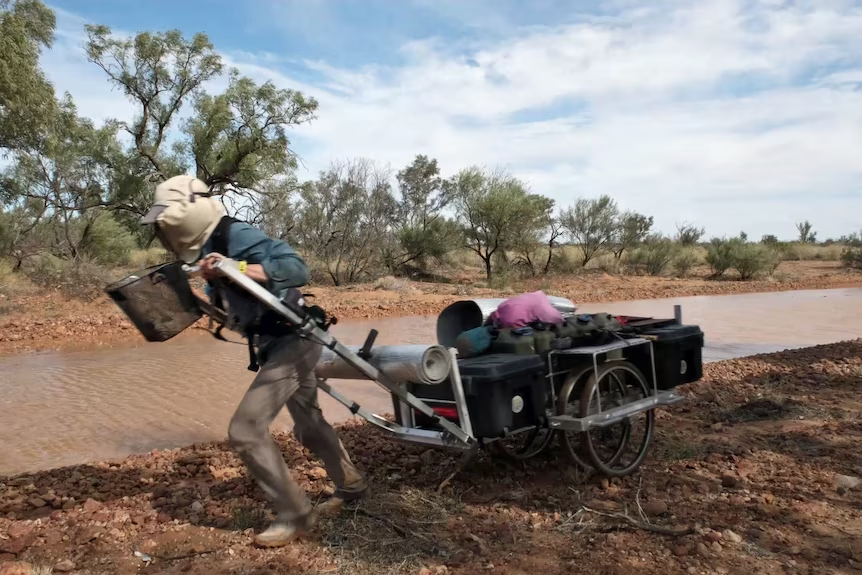
Like many long-distance walkers covering long distances between resupply stops, Gresser chose to pull a 1.9m wheeled cart that could take a payload of up to 200kg of food, water, clothing, and equipment. He used a harness designed for polar expeditions produced by the Australian company Icetrek.
After just 500km, an arm on Gresser’s cart broke, but he was close to a remote work camp, where he was able to have the cart repaired.
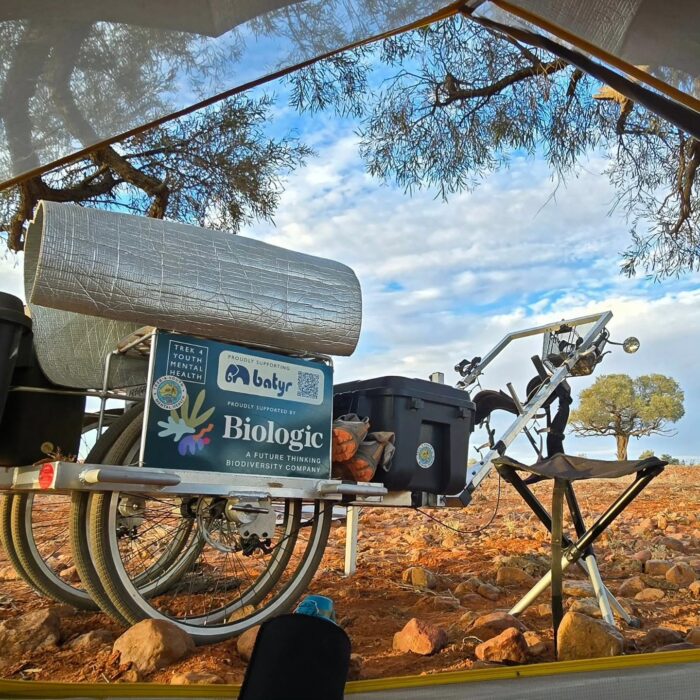
Photo: Mark Gresser
In preparation for the journey, Gresser dehydrated and mailed hundreds of meals to periodic resupply points. Out on the trail, he typically walked for up to eight or nine hours per day, in temperatures up to 50°C.
On some days, he slept only two or three hours, resting during the cooler parts of the day, which were limited in many sections of the walk with no natural shade.
Not the first
Gresser is not the first to undertake a major walk across Australia. The best-known trekker in the modern era was Robyn Davidson, who covered 2,700km with camels in 1977. It became a National Geographic article, and Davidson later wrote a popular book about it called Tracks. An intriguing, independent character, Davidson had romantic relationships with the Nat Geo photographer, later with novelist Salman Rushdie, and with an Indian aristocrat.
In 2001, the hard-core Australian Jon Muir completed a 2,500km south-to-north crossing from Port Augusta to Burketown in 128 days. Muir hauled his supplies in a cart and scavenged his own food and water. The expedition later became the subject of Muir’s book and documentary, Alone Across Australia.
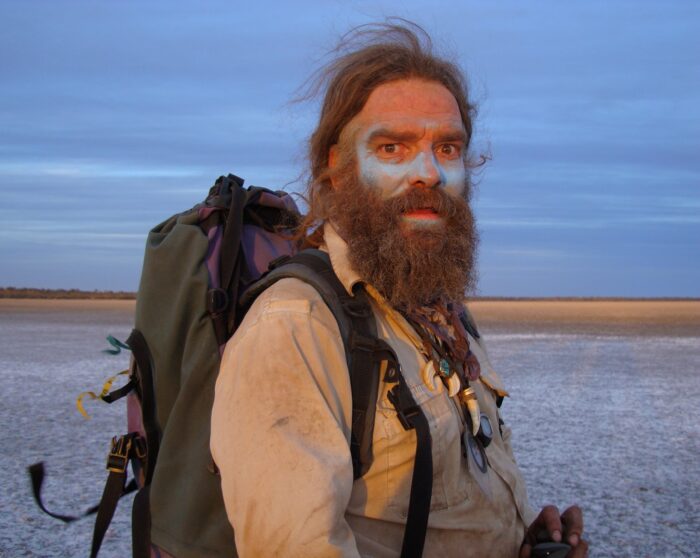
Jon Muir during his 2001 journey across Australia. Photo: Ian Darling
There are an estimated eight people who have completed solo walks across or around the country without a support vehicle, including Aidan de Brune, an English journalist who became the first person to walk the perimeter of Australia unaccompanied. Leaving Sydney in September 1921, he spent two and a half years covering roughly 16,000km around the continent before returning to Sydney in March 1924.
Flash floods and steep dunes
Near Tibooburra, a remote outback town near the borders of New South Wales, Queensland, and South Australia, flash flooding and electrical storms swept across the route. At one point, Gresser sheltered on the ground in heavy rain for more than an hour as lightning struck nearby.
Later, when the tracks became impassable mud, and he found himself about 70km from the nearest town, he sought assistance from National Park rangers.
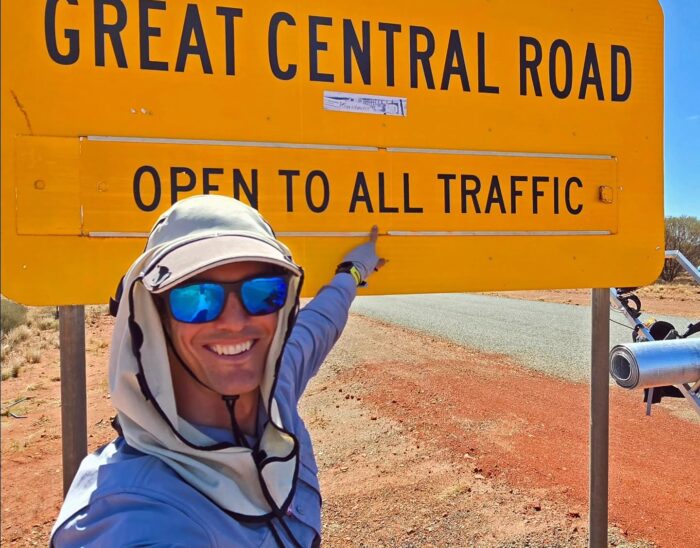
Photo: Mark Gresser
One of the most difficult sections came in the Strzelecki Desert in northeast South Australia. Gresser spent 18 days covering 463km, including a 120km stretch of sand dunes. Many of the dunes were reportedly too steep for his cart, forcing him to repeatedly unload equipment and ferry supplies in stages.