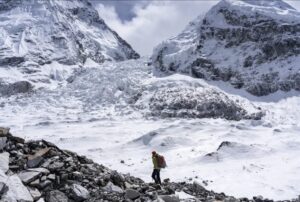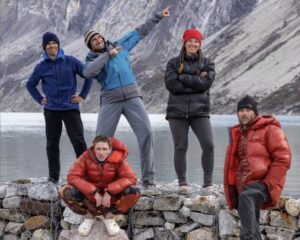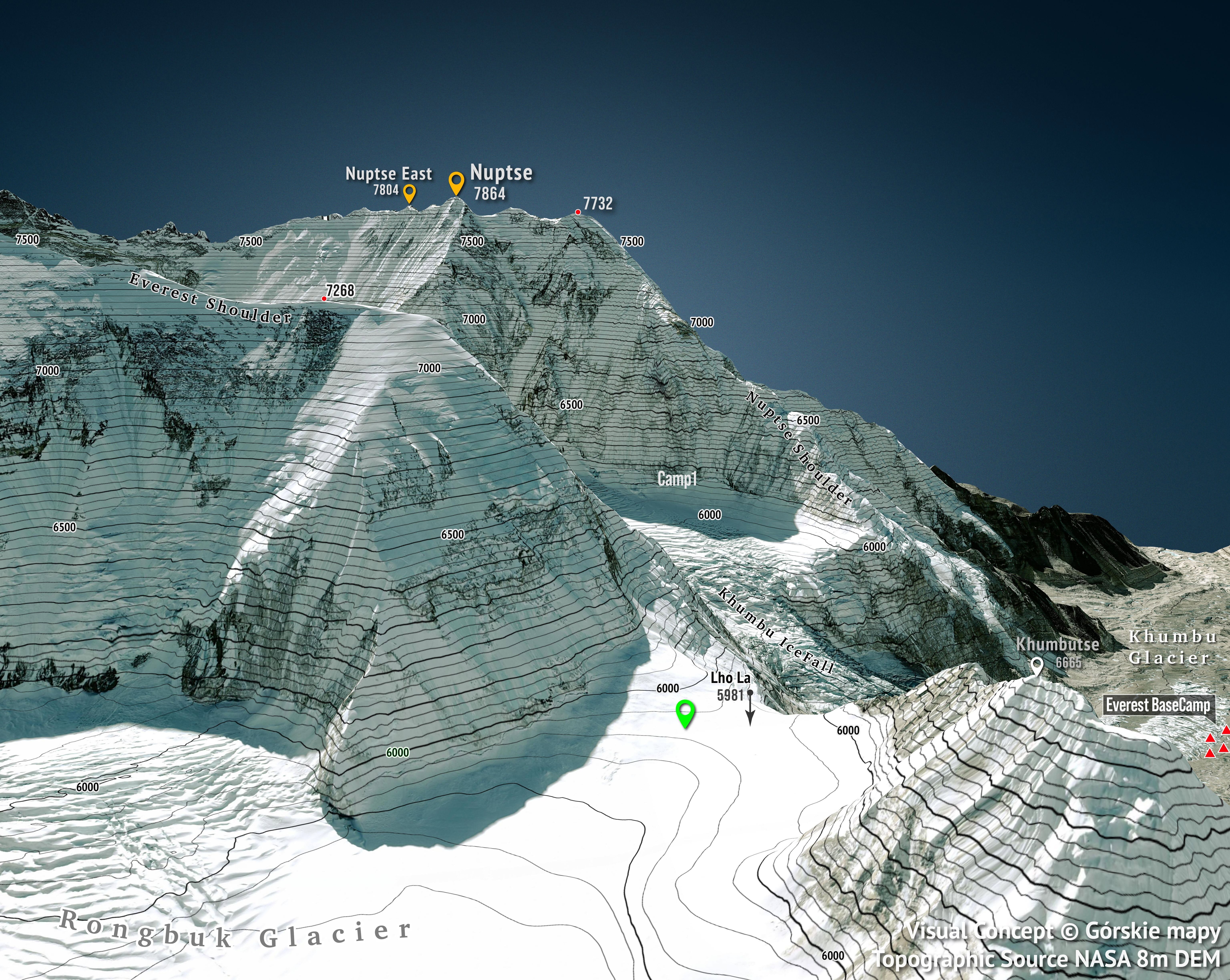
The first steps on a lonely Everest were daunting for four Russian climbers, who tried and failed to cross the Khumbu Icefall. They adapted quickly, heading up to the Lho La instead and setting up camp at that high pass at the base of the West Ridge.
Andrei Vasiliev, Natalya Belyankina, Serguey Kondrashkin, and Valery Sipilov set off from Lobuche on their first round up the mountain last week. Their original plan was to attempt the Khumbu Icefall, which has no ladders or ropes at this time of year. They set off at 5 am on October 9, looking for a way through the maze of seracs and crevasses.
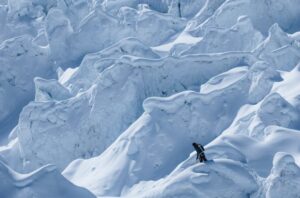
“At first glance, it appears to be pure, unadulterated chaos,” Sergey Kondrashkin later wrote. “Yet on closer inspection, one can discern distinct sections. We opted for the central section, which seemed somewhat more solid — though ‘solid is a relative term…At least, it was easier to envision a viable path here between the seracs, snowfields, and ice walls.”
The recent snowy spell that hit Nepal filled many of the crevasses but also had a downside: loads of hard trail-breaking through deep snow.
Snow too deep
Kondrashkin reported they crossed the most difficult terrain with only a few ropes in some sections and mostly moved as a roped team of four. “Time and again, I broke through the surface, sinking in up to my waist or even my chest,” he wrote. “By the end of the day, we reached an altitude of 5,700m, with still 500 vertical meters to go to the top of the Icefall and the biggest crevasses on the upper part.” They planted their tent on a small, flat platform.
“Conditions did not improve on the following morning,” Natalya Belyankina reported. “We ran out of steam on the second day, having gained only 100m in elevation after six hours, so we decided to head back down.”
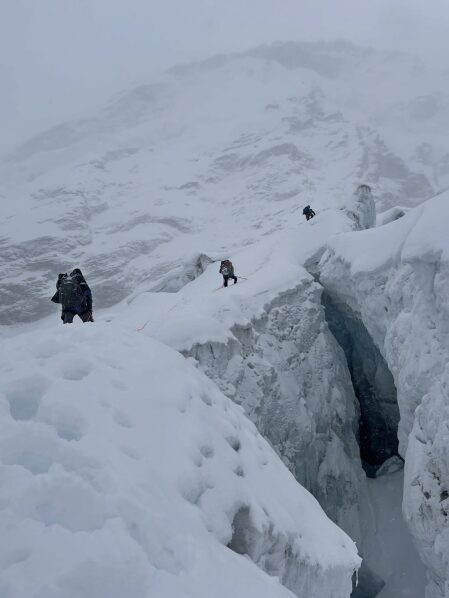
The Russian team in the Khumbu Icefall on Everest. Photo: Natalya Belyankina
However, they had food for four days, so instead of returning to Lobuche, they retraced their steps across the Icefall in three hours (they had spent one day and a half going up) and pitched the tent right below the high pass known as Lho La.
That was their second potential route. The Lho La is the col between Khumbutse, a lesser peak that rises to the left, and the characteristic pyramidal peak known as Everest’s West Shoulder. Lying on the border between Nepal and Tibet, it gives access to the very long West Ridge to the summit. It is also the route that Jost Kobusch will attempt in two months’ time. The German is on his fourth attempt to solo Everest in winter.
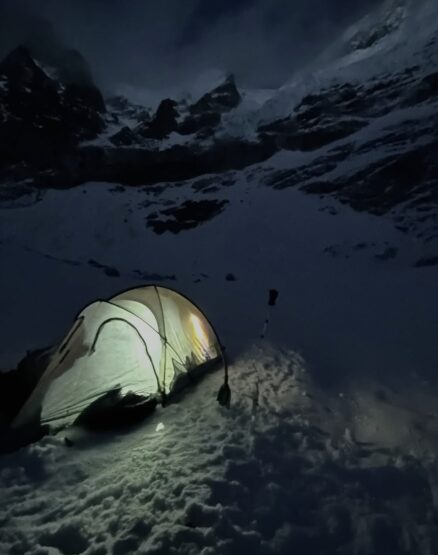
The Russian team’s tent in front of the wall leading to the Lho La between Nepal and Tibet. Photo: Natalya Belyankina/Instagram
Swift progress
Progress up the Lho La was fast, unlike the Icefall. The team completed the mixed terrain of the 600m wall in a single day, then pitched their tent on the col. On the fourth day, they scouted the terrain above and went to the base of the West Ridge, before returning to Lobuche for now, Alpymon reported.
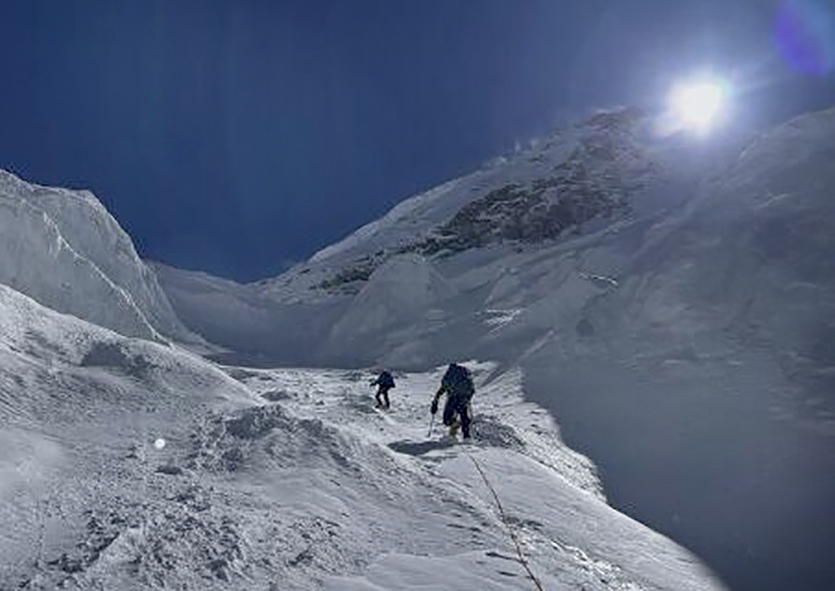
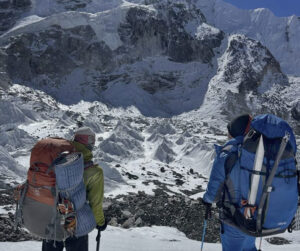
The Russian team on a lonely Everest. Photo: Natalya Belyankina
The climbers loved the experience of being completely alone on Everest. “Groups of trekkers only make it as far as that famous rock — joking, laughing, and congratulating one another,” Belyankina recalled. “Just yesterday, near the Everest Base Camp rock, a young man was playing the saxophone. It sounded wonderful. But once we cross a couple of moraines, that’s it — we’re all alone on the mountain.”