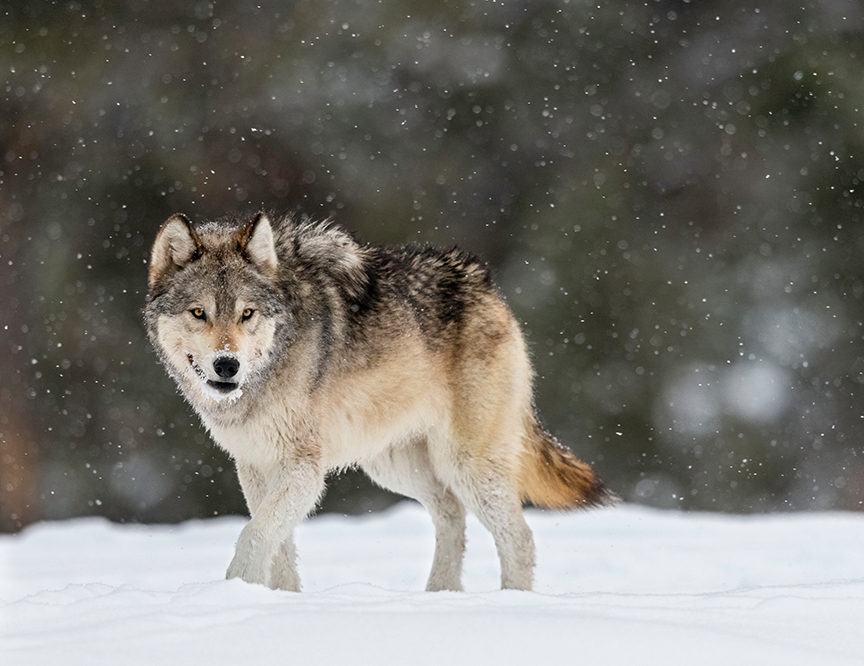
Parks Canada has closed trails in Kluane National Park in the Yukon after a young wolf attacked a visitor, causing minor injuries.
The solitary wolf had been hanging around the area, exhibiting what authorities describe as “lack of wariness and bold behavior” on several occasions.
Human-wolf conflict is extremely rare, especially in North America. Noted wolf researcher Dave Mech of Minnesota described a case that happened 30 years ago. On August 17, 1996, in Algonquin Provincial Park, Ontario, Canada, a wolf grabbed an 11-year-old boy named Zachary Delventhal by the face and tried to drag him off, causing a wound that required 80 stitches.
The boy was in his sleeping bag at the time, and the wolf may have been trying to grab not the boy, but his sleeping bag, explained Mech.
“The wolves I [lived] with in the High Arctic once tried to grab my empty sleeping bag from a tent,” he recalled. “Another time, they tried to run off with a sleeping bag that I was airing on the tundra. Wolves, like dogs, seem attracted to soft, fluffy, or fur-like items, which they like to play with or rip apart.”
Mech also pointed out that the Algonquin wolf was habituated to people. It had eaten human food and had previously run off with backpacks and running shoes.

Dave Mech during his study of Arctic wolves on Ellesmere Island. Photo: Jerry Kobalenko
It’s different in Europe and Asia
In Europe, wolves became accustomed to eating the corpses of battlefield victims in the 19th and 20th centuries, and there are legitimate cases of attacks on living people as well — though never so many as rumors claimed. Mech pointed out that a newspaper report from Eastern Europe claimed that wolves killed an entire wedding party of 130 people in 1911.
Even The New York Times was not immune to wolf hysteria in the past. Between January and March 1929, the paper reported at the time, wolves devoured “five Poles,
sixteen Austrians, an aged Bulgarian priest, and many Czechoslovakians.” They
also besieged villages in Moldavia, Bosnia, and Yugoslavia, threatened Italy, and
“menaced” Istanbul –- a city of more than a million.
In India, Mech reported, several legitimate wolf attacks have also taken place. A wolf or wolves allegedly killed or seriously injured 64 children in the Indian state of Uttar Pradesh in 1996. In 1997, another 9 or 10 died from wolves in the same area.
“Almost all of the victims were children under age 10 who had been by themselves around the outskirts of small villages surrounded by heavy vegetation,” he said.
Wildlife workers have also been killed by captive wolves.
Here is a list of “verified, questionable, and unverified” wolf attacks in North America, both fatal and non-fatal.