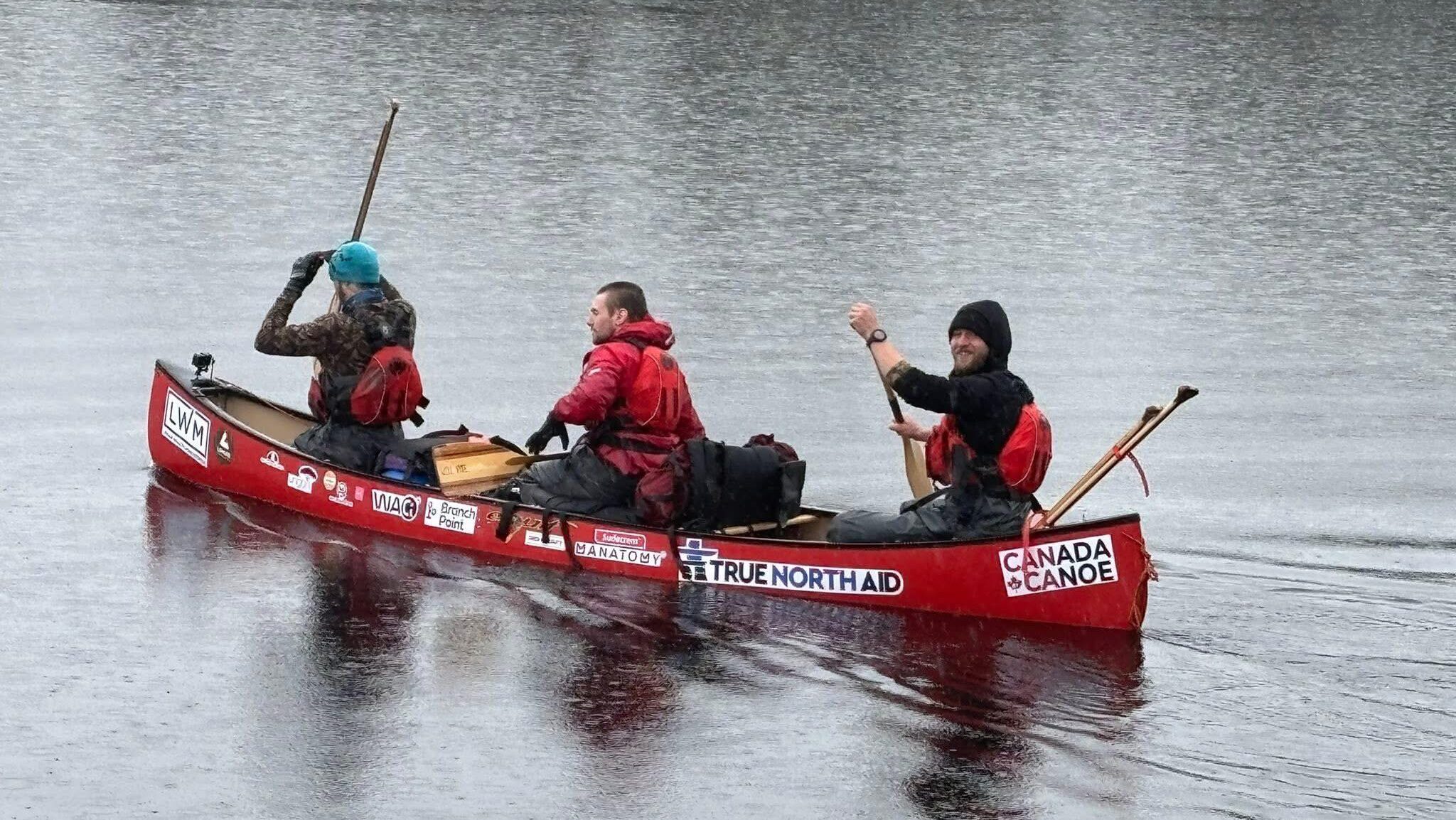
Three Canadian paddlers are now 53 days and 1,241km into their 8,000km canoe journey from the shores of Tadoussac, Quebec, in eastern Canada, to Prince Rupert, British Columbia, on the Pacific Ocean. Will Vyse, Georges Kirijian, and Nolan Aziz left Tadoussac on April 12.
Section 1 of 19
The team has broken its route down into 19 segments. First, they paddled up the spectacular Saguenay Fiord and the Saguenay River to Lac St-Jean and their first food drop at the town of Saint-Felicien.
They canoed through strong North Atlantic winds before spending several cold days edging along the cliff-lined fiord in the company of resident seals. Halfway between Tadoussac and Saguenay, the three 24-year-olds passed the city of Saguenay. Here, the fiord merged into a river as the current picked up.
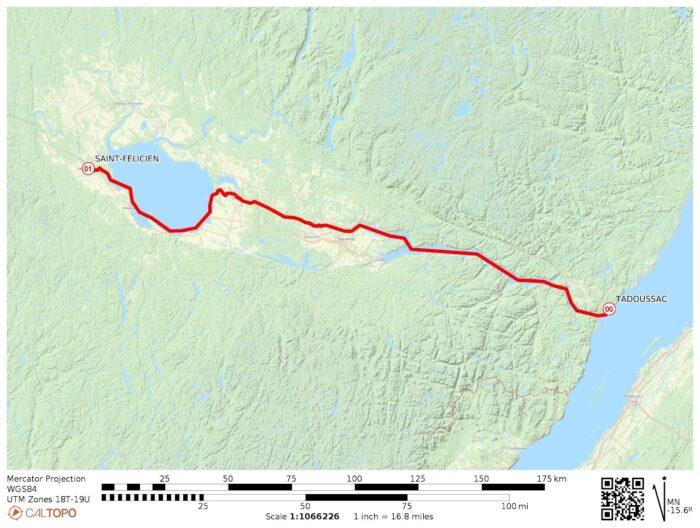
Just before Lac St. Jean, a 50km-long lake locally famed for cold summer marathon swims, the trio’s progress by canoe stopped, as the lake was still frozen. They portaged 262km over 13 days on highways and bike paths from Alma to the city of St. Felicien.
During this first segment, Nolan Aziz sustained a head injury and left the trip temporarily, intending to rejoin later.
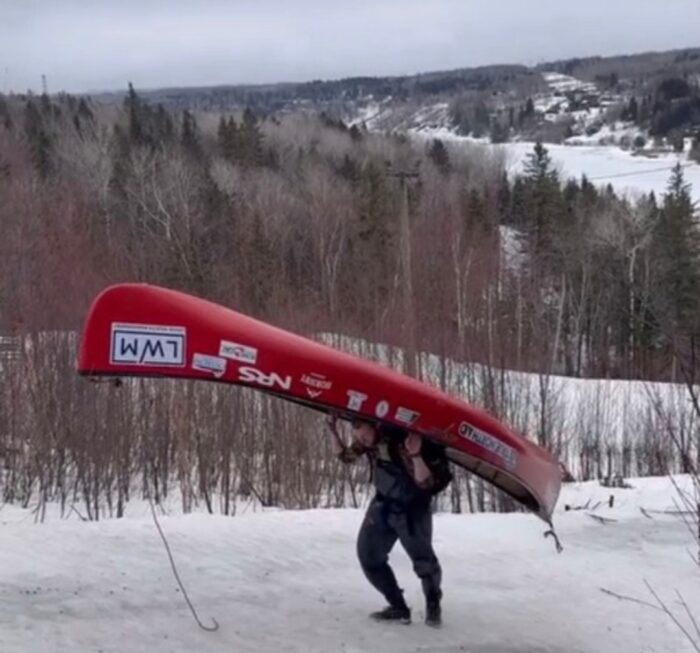
Hard work on a long uphill portage. Photo: canadabycanoe.com
More portaging
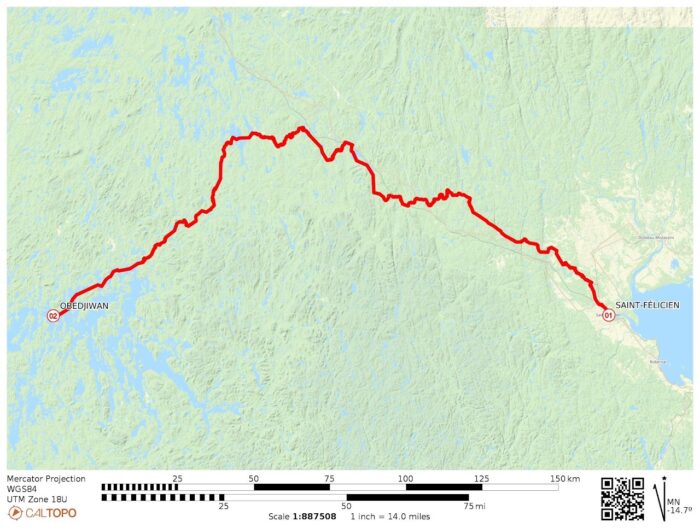
The second segment from St. Felicien to the First Nations reserve of Obedjiwan started with another portage, this time along the frozen Ashuapmushuan River.
“Upon seeing a large, thawed stretch of river, we attempted to paddle, but were quickly met with countless shifting ice floes, forcing us to bushwhack back to the road,” the team wrote on social media.
As they pressed on through late April and into May, the weather warmed a little, but the lakes still had too much ice for paddling. They had to portage the remainder of this segment along a dusty road.
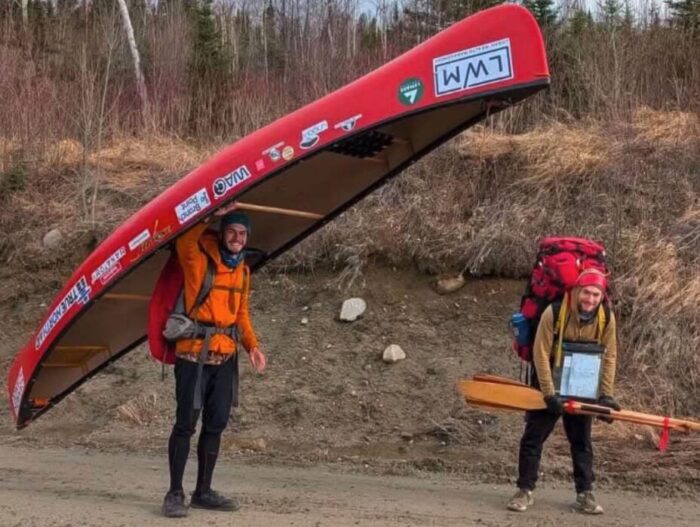
More portaging. Photo: canadabycanoe.com
“Throughout many of our grueling days portaging the road, we received food, water, and kind words from the Atikamekw people of Obedjiwan,” the team reported. “After weeks of portaging, we reached their village, where we were greeted by hundreds of people who performed a traditional cleansing ceremony with drums and singing.”
This segment took 19 days, and they portaged most of the 271km, finishing with 533km portaged to this point.
Ice-free at last
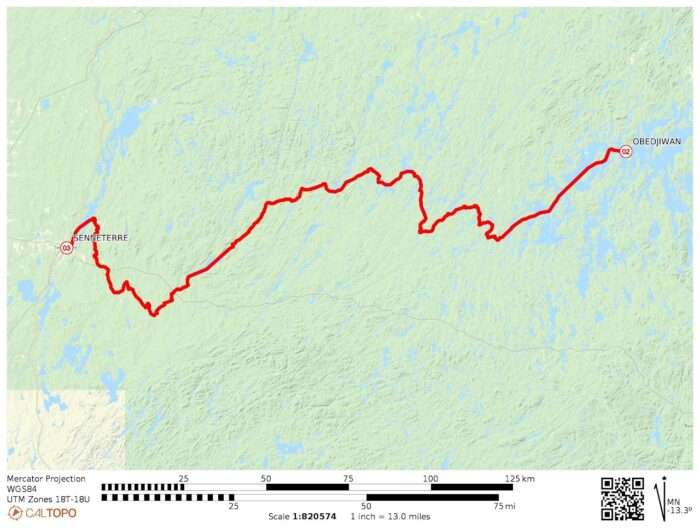
Vyse and Kirijian continued on to Senneterre, in northwestern Quebec, for this third segment. The duo was able to paddle out of Obedjiwam on the Gouin Reservoir, which was largely open, though they had to maneuver through several large ice pans.
From there, they reached the Megiscane River, the first true section of downstream travel on the journey.
“Thankful to be free of ice and massive portages, we took as much advantage of the favorable conditions as possible, often paddling around 60km per day,” they wrote.
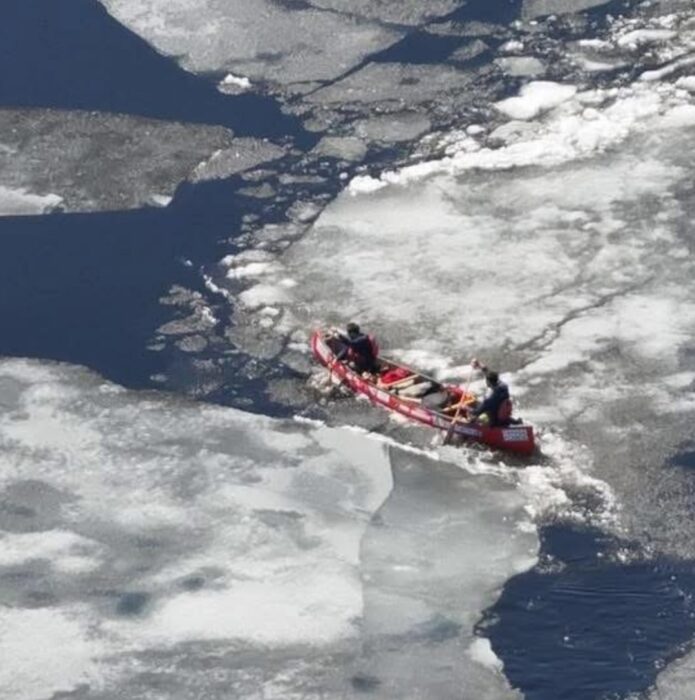
Vyse and Kirijian paddle through large pans of disintegrating ice. Photo: canadabycanoe.com
The upper section of the Megiscane River featured large, island-filled lakes connected by fast-flowing stretches of river. Forest fires had recently torched much of the winding shoreline.
“The lower Megiscane River had some very enjoyable whitewater and solid currents, which assisted us on our journey. As more tributaries joined the river, it grew into a vast and powerful behemoth with some of the largest rapids we’ve ever seen,” they wrote.
“We had to do a few bushwhacks to avoid the most dangerous ones. The raw power and beauty of the seldom-traveled Megiscane cannot be overstated,” they concluded.
This segment took seven days and covered 291km at an average of 41km per day, totaling 822km so far.
Three men again
For this most recent and fourth leg through late May, Aziz rejoined the expedition. Their destination was the town of Latchford, Ontario. “With our spirits high, we dragged, bushwhacked, and portaged up the Bell River’s many rapids,” the trio reported.
“With a large road portage, we crossed into the Ottawa River watershed and entered the familiar territory of La Verendrye Wildlife Reserve. The massive lakes there allowed us to put down some serious distance,” they added.
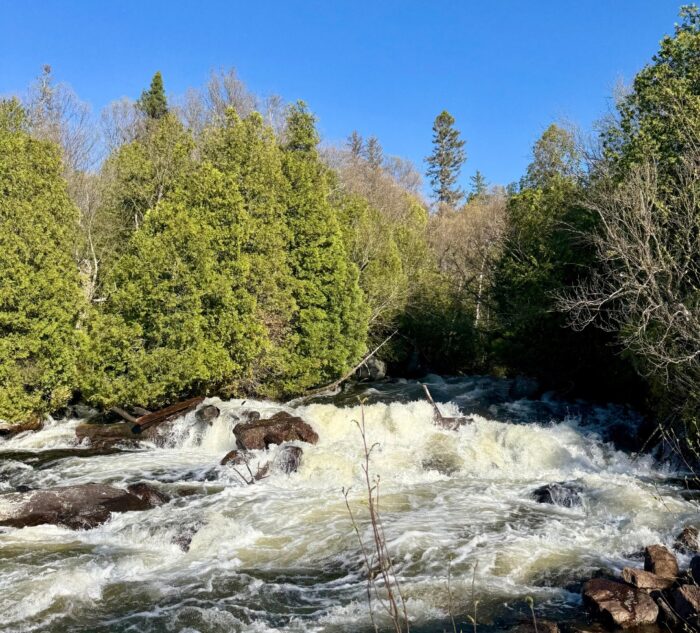 Rapids on the Bell River. Photo: canadabycanoe.com
After passing through this reserve, the three Canadians faced severe headwinds before reaching the Ottawa River, where they had to portage around its many hydro dams. Eventually, they paddled up the Montreal River to their food drop in Latchford.
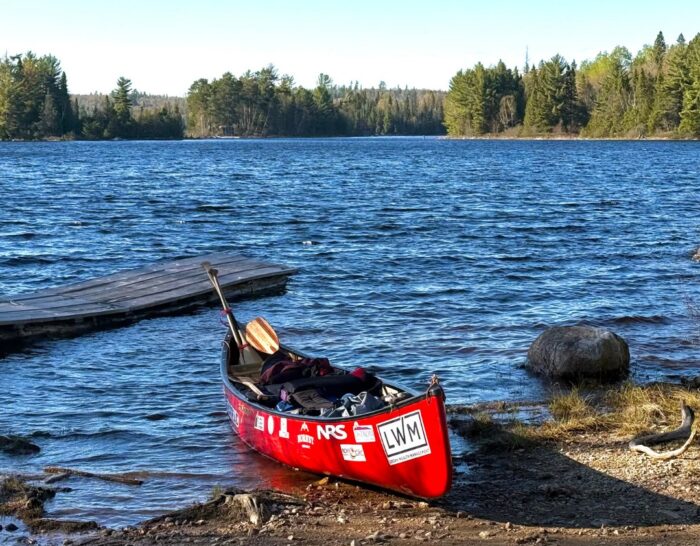
Photo: canadabycanoe.com