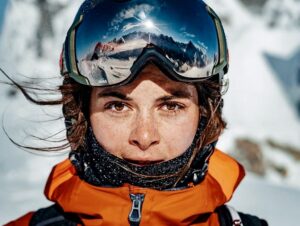
Everyone is impressed with Bartek Ziemski’s no-oxygen ascent and ski descent of Everest — except himself, judging from our conversation with the 31-year-old Polish climber just hours after he arrived back in Base Camp.
Ziemski has likely accomplished the most impressive Everest ski descent ever, thanks to his bold approach, his fitness and skill, and an unexpected stroke of luck with the crowds on the mountain. It took him under five-and-a-half hours to ski the 3,485m (about 11,400 feet) back to Base Camp.
Despite this, he has kept his understated approach to the performance and its potential impact on his career and Everest’s history.
Just Everest
Interviewer: Okay, Bartek, this time I am not going to ask you if you’re tired. But you just skied down Everest, wow! What are your feelings about the feat?
Bartek Ziemski: Well, it’s just Everest.
We last spoke to Bartek Ziemski shortly after he skied down Lhotse. At the time, he told us he had a permit for Everest as well, but was hesitant to attempt the climb+ski descent because the mountain was so crowded.
“In the end, you know, I had paid for Everest and, well, I am Polish, I don’t have much money. So I was like, I’m going to try it somehow,” he said.
But how did he manage a no-O2 ascent with the crowds on the mountain? How did he ski down past those lines of climbers, and the ropes, and the deeply trodden snow trail? His answer confirms that fortune favors the bold.
Slow day in peak season
“I was super lucky, because today almost no one pushed for the summit,” Ziemski admitted. “I don’t know why, because the wind was the lowest yet, and there wasn’t a single cloud in the sky.”
He then reconsidered. “Maybe it was because yesterday evening was super windy, and since people leave for the summit in the early evening, they delayed their plans because the wind was high.
“However, I saw the forecast. It said the wind would drop through the night and be at its minimum at 2 am, so I planned accordingly. That’s exactly what happened.”
Ziemski estimates that there were about 20 summits today, counting both Sherpas and foreigners. Some online sources spoke of 60 summits, but the Polish skier refutes that figure.
To the summit alone
Ziemski followed a climbing strategy similar to the one he used on Lhotse last week. He left Base Camp on Sunday for Camp 3. Yesterday, he moved his tent and gear to Camp 4, grabbed some rest, and set off for the summit around 11 pm.
Surprisingly, he was alone; there was no one else on the ropes. He met some climbers on their way down, and they told him that they had turned around at the Balcony because it was super windy up there.
“I then slowed my pace a bit,” Ziemski explained, “knowing from the forecast that the wind was going to decrease. By the time I reached the Balcony, there was zero wind. Like, literally zero.”
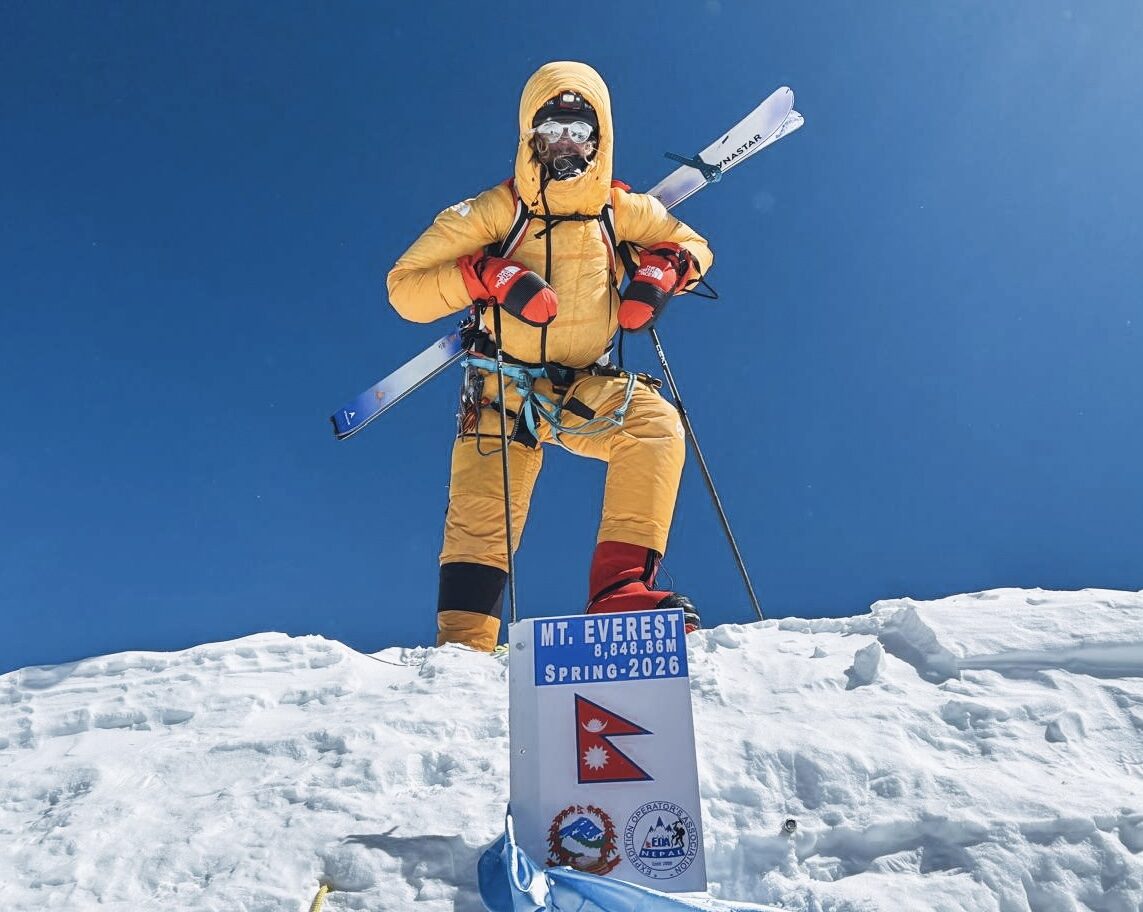
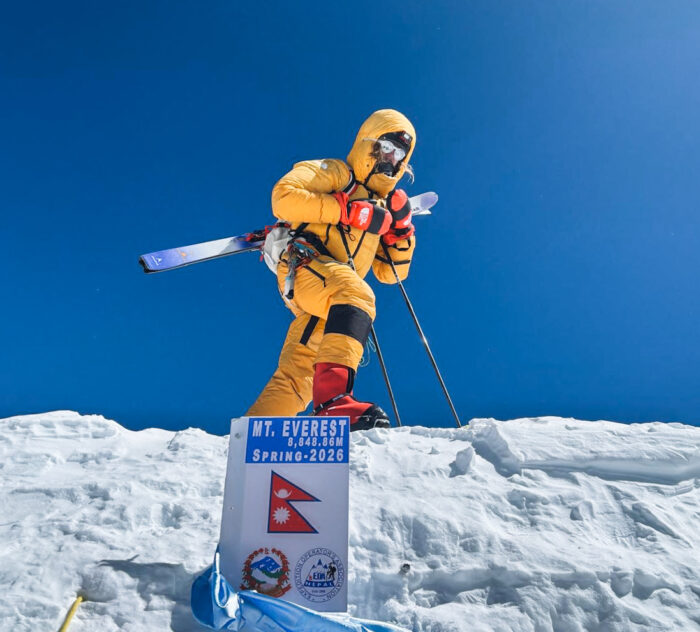
Ziemski kept climbing toward the top as dawn broke. Just before the summit, he again crossed a group on its way back from the summit. Then a guide and his client, both on oxygen, passed Ziemski at the Hillary Step, going up. It was a happy coincidence, as the Sherpa was able to take a summit picture of Ziemski. Until he downloads the files from his GoPro tomorrow, these are the only images we have of his climb.
Bartek Ziemski on the summit of Everest. Photo: Courtesy of Bartek Ziemski
(Ziemski said he didn’t ask for the names of the two climbers, so if they are reading this story and would contact us, we would like to credit the author of the photo.)
Ziemski didn’t use supplemental oxygen at any point during the ascent or the descent. As for the ropes, he said he clipped to them at a couple of sections on the way up, and briefly on the ridge on the way down.
Direct line to Camp 3
“I had the mountain for myself, which was really helpful.”
About the line of descent, Ziemski explained:
“The first section from the summit was easy; it was just snow from the ropes to the edge. There was no cornice, so I skied down right on the top of the ridge.”
To those of us who’ve seen that ridge or pictures of it, that seems exposed, but Ziemski just said: “It was fine, it was just snow.”
Still, he clipped to the ropes for a couple of meters, for safety. “I skied those meters, I didn’t rappel,” he noted.
At Camp 4, he took a short break to pack up his camp, then continued to Camp 3 and beyond.
He then plunged down the Lhotse Face following a direct line to Camp 3, much like Andrzej Bargiel did on his own Everest descent in the fall of 2025.
“You can ski down directly from the other side of the rocky barrier, and then you reach Camp 3 below the rocks,” Ziemski said.
It was also the best way to avoid — and in fact, not even see — the endless line of climbers snaking their way up from Camp 3 to Camp 4. Ziemski spotted them once and was shocked. “I saw those hundreds heading up…the line of people was…insane!”
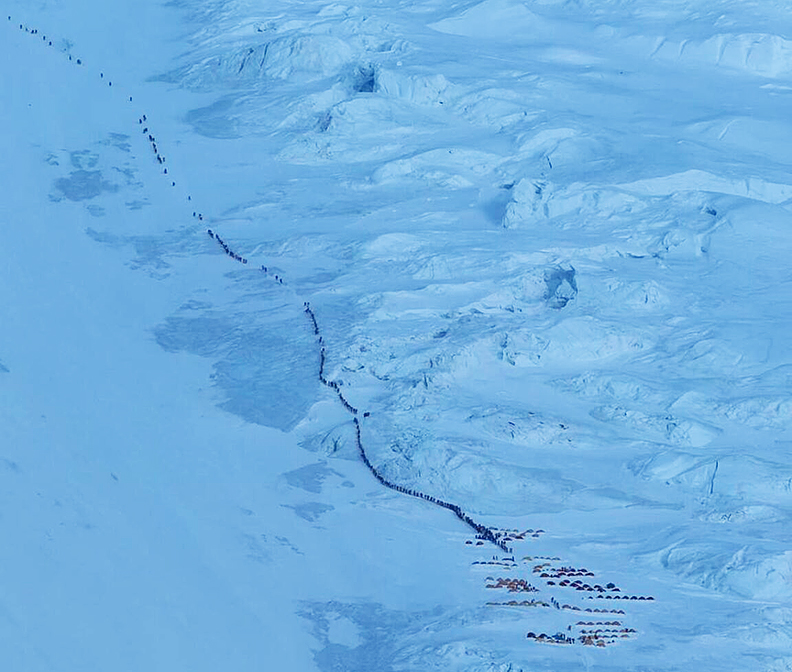
Climbers form a tight line between Camp 3 and Camp 4 today, May 19. Photo: Sanu Sherpa
Snow conditions
Ziemski said the snow conditions on the upper half of the mountain were rather poor. “The summit area was good hard snow, which I like,” he said. “However, below the Balcony, there was not enough snow, just rocks covered with a thin layer of windswept snow.
“Similarly, on the Lhotse Face, the wind had swept away the fresh snow and left the area mostly blue ice.”
Ziemski skied non-stop from Camp 4 to Camp 1, where he had left a gear depot, which he also retrieved. “It was still morning, so I continued to the Khumbu Icefall.”
The Icefall
Ziemski is more than familiar with the Khumbu Icefall, but the line he had followed one week earlier while descending Lhotse was not doable anymore.
“The Icefall had changed a bit, so I had to ski down some different places, but in the end, I managed to reach the end of it. Here, I used the same ladder [as before, with skis on].”
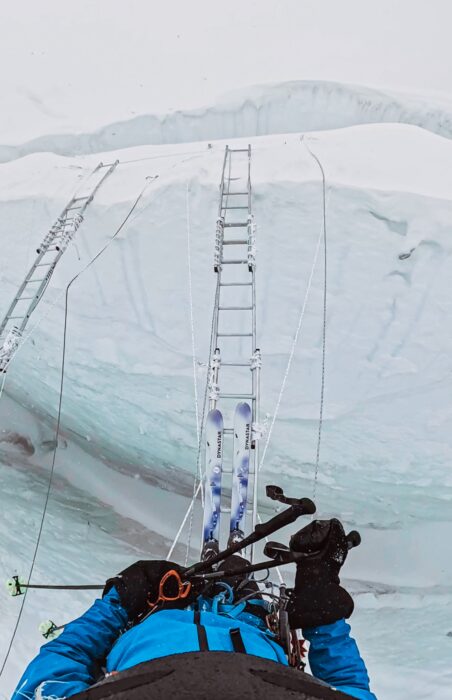
At the end of the Khumbu Icefall, Ziemski had to ski over the same ladder section he had on Lhotse, which is when this photo was taken. Photo: Bartek Ziemski
Bartek Ziemski is just back from the mountain, and he may not have had time yet to process the experience or its impact on the climbing community and his career. Asked if he was ready for the recognition that will accompany this remarkable feat, Ziemski said he hopes to remain perfectly unknown. Everest was not exactly the experience of a lifetime for him.
The Everest experience
“Everest is not interesting, it’s not sexy anymore,” he said. “The crowds are crazy, and what’s happening on the mountain…that’s not about climbing anymore.”
In his opinion, the mountain isn’t even that beautiful. “It’s not like K2, which is a perfect pyramid. Everest’s top is hidden, and it does not have a nice route to the summit…I saw nothing special.”
Ziemski adds that the mountain experience on Everest has been completely destroyed.
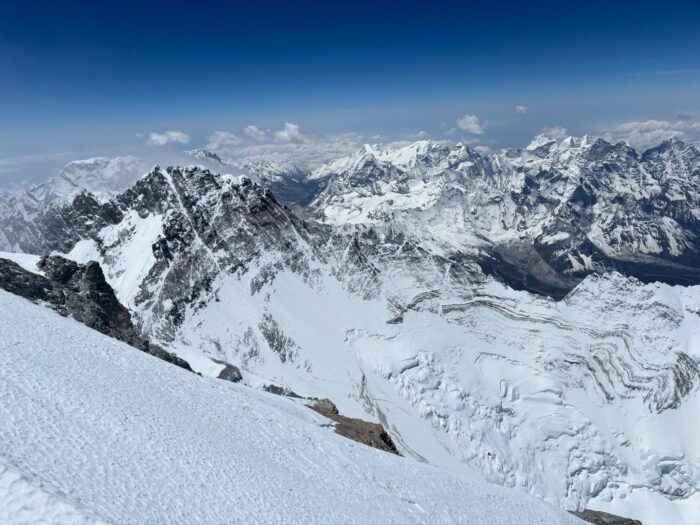
Bartek Ziemski spotted the crowds heading up to Camp 4 from far away as he skied down the Lhotse Face. They were so small that they were almost invisible, yet he was shocked. Photo: Bartek Ziemski
And the other 8,000’ers?
Ziemski might need time to get some perspective after those two intense back-to-back climbs, but presently, Everest seems to have left him fed up with the 8,000’ers.
“Usually when I finish skiing a mountain, I already have some other peak in mind, but this time I can only think, ah, I don’t like the 8,000’ers thing anymore,” he said.
Ziemski has climbed and skied nine 8,000’ers since 2022, all without oxygen or Sherpa support, but seems uninterested in completing the list, unless, he says half-jokingly, someone covers his expenses. “It’s ridiculous to have to pay for such an expensive permit. There are other beautiful mountains to ski all around the world.”
Interviewer: Not even K2?
Ziemski: Ok, that one is interesting.