Three Nepali guides and an American client have bagged the first ascent of Lumbo Himal, a remote 6,250m peak located between the Manaslu Conservation Area and the Ganesh Himal Range.
The team comprised guides Tul Singh Gurung, Sujal Gurung, and Aash Bahadur Gurung, along with American Eric Matthew Soo.
“It was a true Himalayan exploration into an untouched valley where no documented climbing route or summit history existed,” wrote outfitter Himalayan Summit Club.
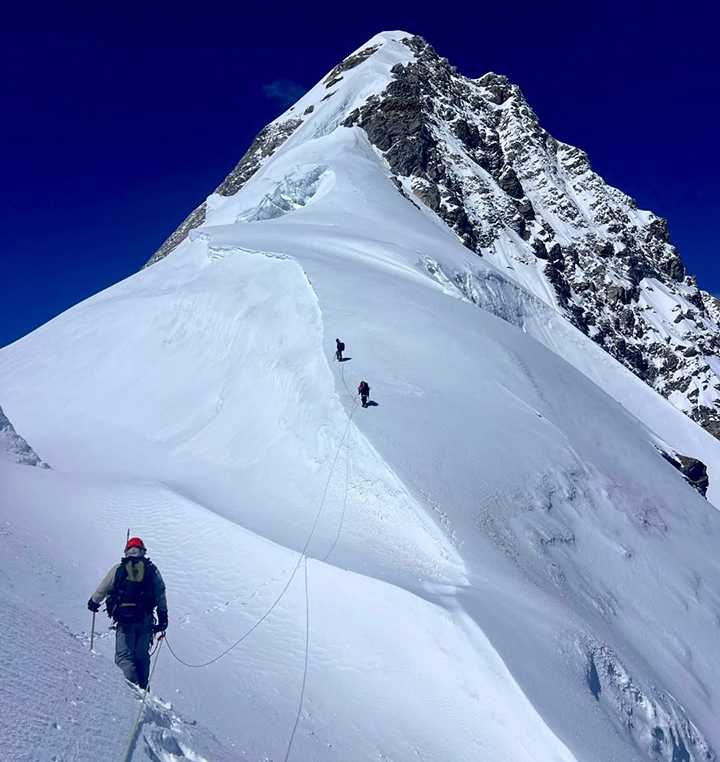
Ascending Lumbo Himal. Photo: Himalayan Summit Club
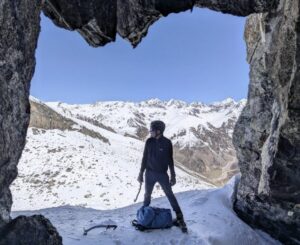
The area is far from popular treks and climbing peaks, so there are no lodges or villages nearby. The Himalayan Database’s peak list does not include Lumbo Himal, but the name appears on the list of 57 new peaks open to climbing, issued by Nepal’s Department of Tourism in the fall of 2024.
Monsoon climbing
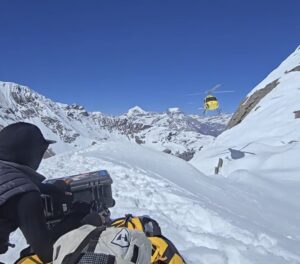
The team set up a base camp at 4,150m and a high camp at 5,049m. The monsoon is already hitting the Nepal mountains, so the climbers endured a few rainy days before forecasts encouraged them to launch a summit push on June 22.
“On summit night, it rained and snowed until around 2 am,” expedition leader Tul Singh Gurung (usually known as “Tulsi”) told ExplorersWeb. “After that, the weather cleared, but we endured strong winds for four more hours. Then the weather stabilized completely.”
Interestingly, Gurung noted that since then, it has not rained in Nepal. Local media are highlighting a strong El Niño effect as a possible cause for an unusually weak monsoon this year.
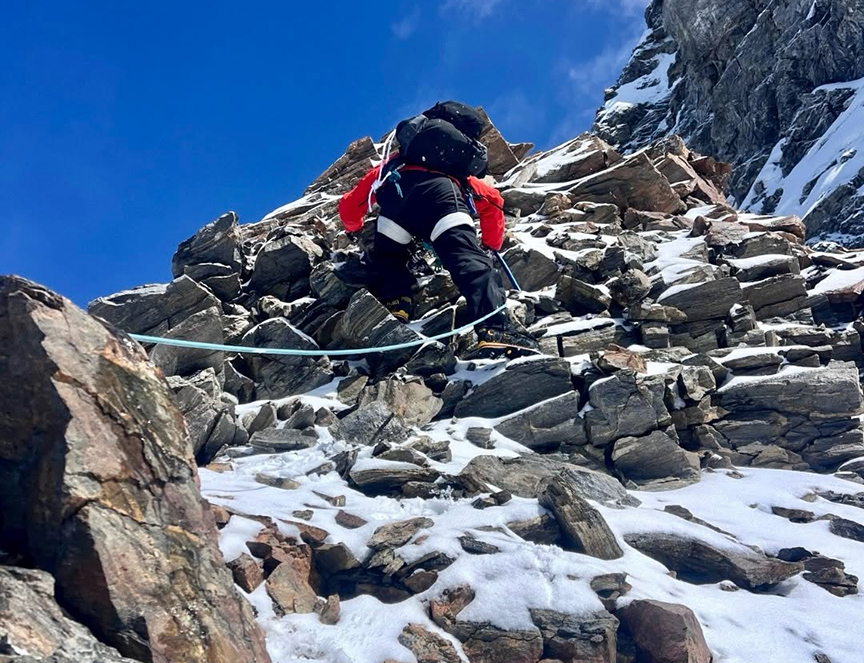
A section of steep, loose rock. Photo: Himalayan Summit Club
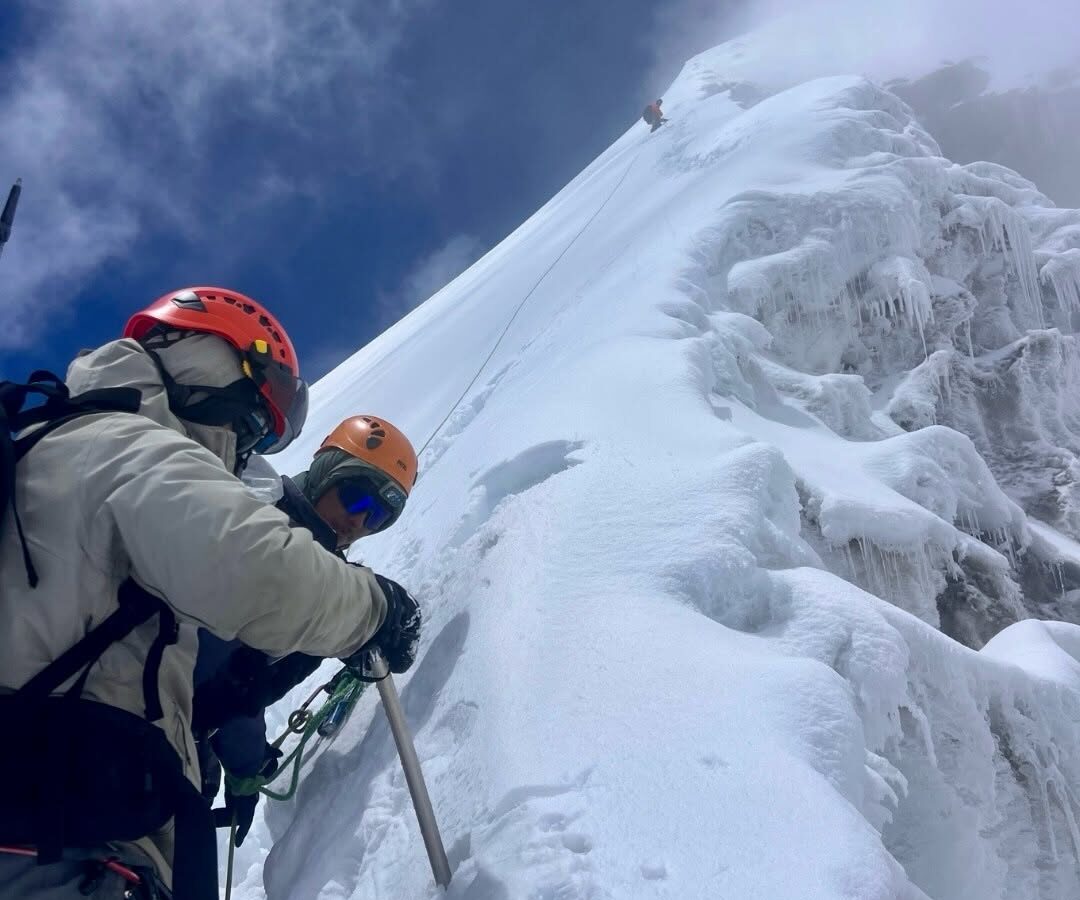
The team climbed up the southwest face, over “loose rocky ridges, mixed terrain, exposed traverses, crevasses, and steep snow and ice sections up to 85 degrees,” according to Guring. The main objective hazard, he notes, is rockfall before the false summit.
“We fixed 400m of rope on the rocky technical section of the route, where additional protection was required,” Gurung said. “On the rest of the route, we used standard alpine climbing techniques.”
The climbers needed 12 hours to reach the summit from high camp, and eight more for the return trip.
Not a trekking peak
According to Peakvisor, Lumbo Himal has a relatively low prominence of 636m (2,087ft), and its summit is dwarfed by the formidable Ganesh group rising to the southeast and comprising several 7,000m peaks. Ganesh I, also known as Yangra Kangri, is 7,422m.
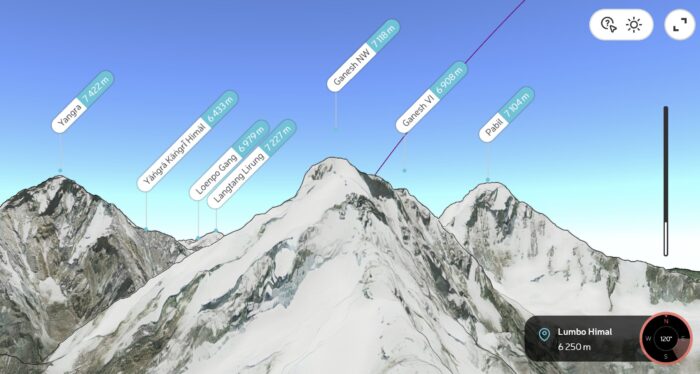
Map of summit views from the top of Lumbo Himal, by Peakvisor
In previous articles, we have mentioned that some outfitters have begun offering guided ascents of unclimbed peaks, marketing them as history-making firsts. Yet unclimbed doesn’t always mean difficult or interesting from an alpine perspective.
However, Lumbo Himal seems to be an exception. The photos provided by the expedition team show a varied, demanding climb.
“Lumbo Himal is not a trekking peak,” insists Gurung, who is also director at the National Nepal Mountain Guide Association. “Based on our first ascent, we consider it a technical alpine climb suitable only for experienced mountaineers. We have graded our route up the southwest face as D+ (French alpine scale).”
Commercial approach…
In addition, the approach to base camp is still very remote. “The Dharche Rural Municipality is working to develop a trekking trail to base camp, but progress is slow due to limited funding,” Gurung said.
In that sense, its remoteness and technical difficulties might be drawbacks for future clients willing to climb a 6,000’er well off the beaten track.
“If the entire route were fixed for future commercial expeditions, it would require approximately 1,200m of fixed rope,” Tul Singh Gurung noted.
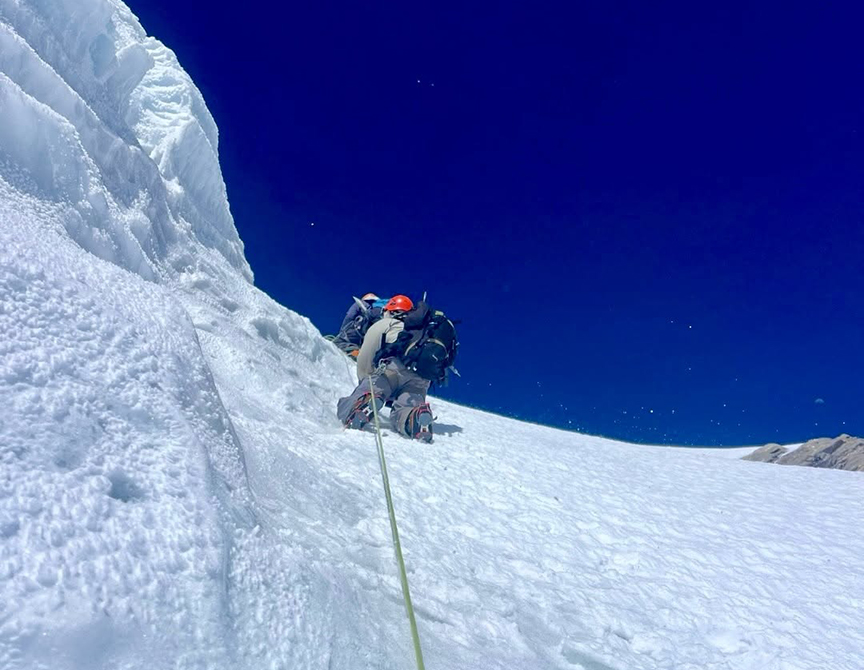
A steep ice section on Lumbo Himal. Photo: Himalayan Summit Club
… and alpine possibilities
So, the peak might not be another Island Peak, but what about for alpinists seeking new routes?
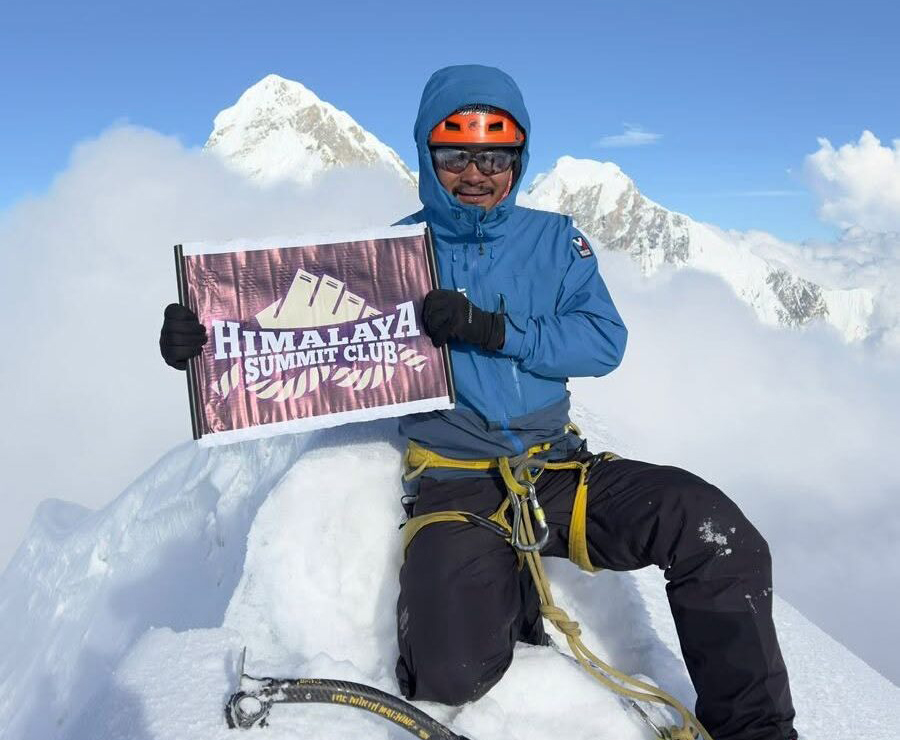
Tul Singh Gurung on the summit of Lumbo Himal. Photo: Himalayan Summit Club
Said Gurung:
During the expedition, we observed several sides of the mountain from different viewpoints. Due to time constraints and our objective to complete the first ascent, we focused on establishing the southwest face, which offered the safest and most practical line.
However, we observed that Lumbo Himal has the potential for several new routes, particularly for experienced independent alpinists seeking technical alpine objectives. There may also be alternative guided routes, but these would require further reconnaissance to assess their safety and feasibility.
More importantly, Gurung believes the entire valley has outstanding potential for future mountaineering once the locals build a proper trekking trail to base camp.
“The valley provides access not only to Lumbo Himal, but also to Lumbo North (6,000m+), another unclimbed 6,000m peak that is not yet open for climbing, and the 7,000m peaks Ganesh II, Ganesh IV, and Ganesh V.”
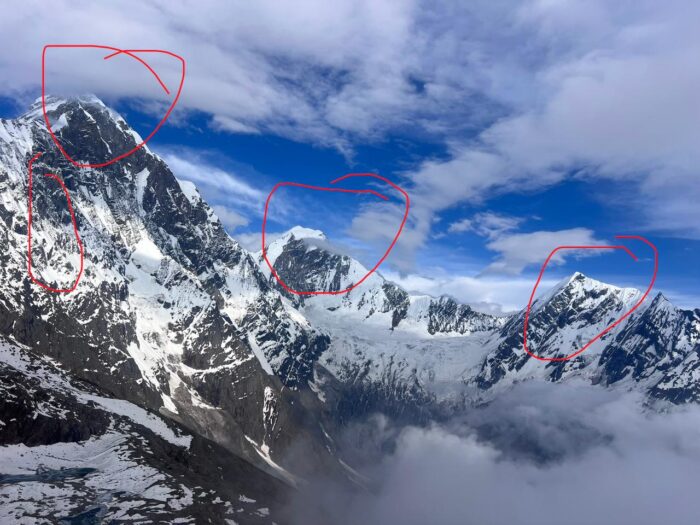
The photo shows Ganesh V on the left, Ganesh IV (Pabil peak) in the center, and, on the right, an unclimbed, unnamed peak 6,000m high. Photo: Tul Singh Gurung