In 1856, British Lieutenant Thomas Montgomerie was surveying the Karakoram range from a distant station in Kashmir during the Great Trigonometrical Survey of India. Because his team could not physically approach the mountains at the time, he assigned them temporary alphanumeric labels based on the order he logged them: K1, K2, and so on, with “K” standing for Karakoram.
That this sequence was never meant to be a complete map or permanent nomenclature. Montgomerie simply logged the giants that he happened to see from his vantage point, leaving hundreds of nearby peaks without a “K” name. Today, most of these have reverted to their local names, although K2, K6, K7, K12, and some others have stuck.
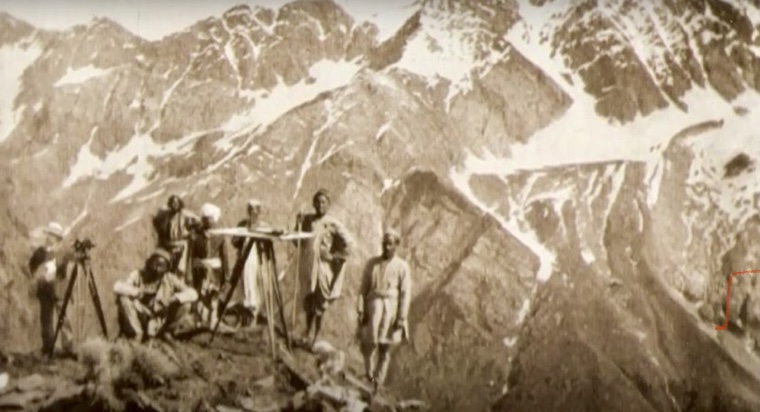
Montgomerie and his team during the Great Survey of India.
We’ve already covered K1 (Masherbrum) and K2 in previous stories. Today, we briefly review the climbing history of others in this sequence.
The remaining “K” peaks, beyond K1 and K2, represent a pivotal era in post-war exploration. They became the primary testing grounds where traditional, heavy siege tactics were gradually replaced by modern, lightweight alpine innovation. Defined by international expeditions, understated tragedies, and immense physical endurance, many of these lesser-known peaks remain highly elusive today, protected by extreme technical difficulty and sensitive geopolitical borders.
It’s ‘Karakorum,’ says Longstaff
British mountaineer and explorer Tom Longstaff, who traveled widely in the region in the early 20th century, wrote extensively about the name of the range itself.
He pointed out that the now-standard spelling Karakoram (with an “a”) came from an early mistranslation of the original Turkic term into English. The word, he explained, actually belongs to the Turkic languages of Central Asia, not to Urdu, and is linked to the ancient Mongol capital of Karakorum.
Longstaff also argues for restoring other local names too (such as the historic Pasu Saltoro, which later became universally accepted as Saltoro) and for keeping the traditional names for peaks like Masherbrum and Gasherbrum.
First, we consider the Gasherbrum massif, the site of peaks K3, K4, K5, and K3a.
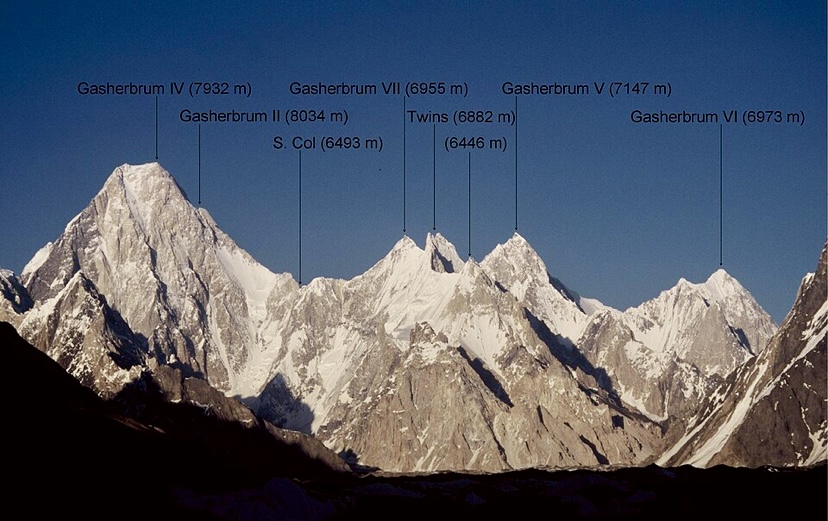
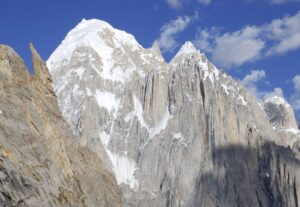
The west faces of Gasherbrum IV, V, VI, and VII. Photo: Florian Ederer/Wikipedia
K4/Gasherbrum II
Montgomerie named Gasherbrum II (8,034m) K4. In 1956, an Austrian team led by Fritz Moravec claimed its first ascent on July 7. Moravec, along with Josef Larch and Hans Willenpart, chose the Southwest Ridge. Their campaign wasn’t without drama. After establishing Camp 1, they returned to find the entire camp and all their supplies buried under an avalanche. Most teams would have retreated. Instead, the Austrians pressed on with a light, fast push.
They climbed from a higher camp, spent a night in a simple bivy sack, and summited by late morning the next day. But this climb was notable not only for the resilience of the Austrians. In an era when large, heavily supported expeditions were the norm, this felt almost modern.
K5/Gasherbrum I
Two years later, in 1958, an American team arrived to attempt 8,080m Gasherbrum I (K5). It is also called Hidden Peak because it sits tucked away behind its neighbors. An expedition led by Nick Clinch put Pete Schoening and Andy Kauffman on the summit on July 5 via the Roch Ridge. Pakistani army officers joined the team, underscoring the growing local involvement in these high-altitude efforts.
Schoening was already a legend from the 1953 K2 expedition, thanks to his famous Belay, in which he held six falling climbers on the same rope by himself. His presence on Hidden Peak added a layer of continuity to the American story in the Karakoram. The mountain’s remote position and the technical demands of its ridges kept ascent numbers relatively low for decades. Even today, it retains an air of mystery compared to more commercialized giants.
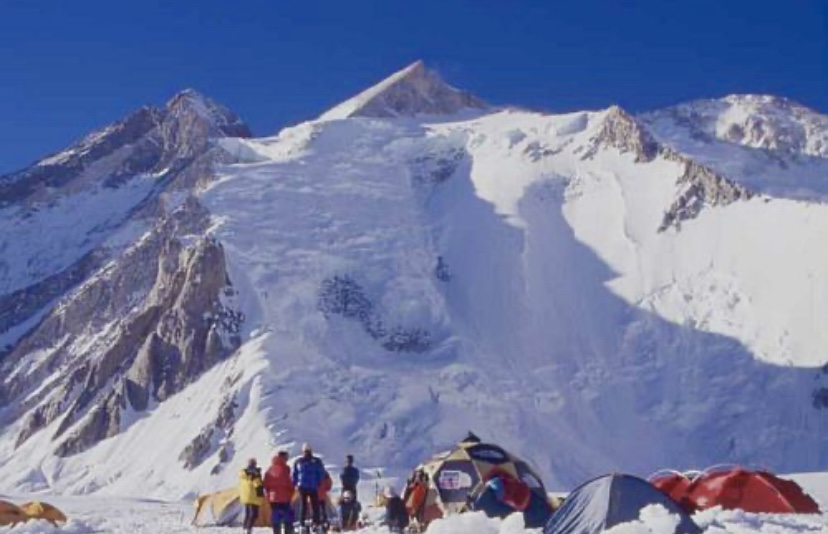
Gasherbrum II seen from Base Camp. Photo: Wikipedia
K3/Gasherbrum IV
Gasherbrum IV, known as K3 on Mongomerie’s list, is renowned for its danger and technical difficulty. An Italian team under Riccardo Cassin made the first ascent on August 6, 1958, with Walter Bonatti and Carlo Mauri navigating the Northeast Ridge. The pinnacled upper section tested their skills to the limit.
In 1985, Wojciech Kurtyka and Robert Schauer tackled the massive West Face (known as the Shining Wall). Their alpine-style push up thousands of meters of steep terrain ranks among the 20th century’s greatest climbs, though exhaustion and weather forced them onto the North Summit rather than the true top. Many other faces and ridges on Gasherbrum IV remain unclimbed or unrepeated, with some attempts ending tragically. It is a mountain that still feels largely untamed.
K3a/Gasherbrum III
Tucked between its taller siblings, 7,946m Gasherbrum III carried the K3a designation. For years, it ranked among the highest unclimbed peaks on Earth. That changed on August 11, 1975, when a strong Polish team (including Wanda Rutkiewicz, Alison Chadwick-Onyszkiewicz, Janusz Onyszkiewicz, and Krystof Zdzitowieczki), made the first ascent. Gasherbrum III remains rarely visited, its location and technical nature keeping it off most commercial itineraries.
K6/Baltistan Peak
Moving away from the Gasherbrum cluster, 7,282m Baltistan Peak, once known as K6, offers a different kind of story. In 1970, an Austrian expedition led by Eduard Koblmueller arrived in Pakistan, intending to climb another peak (the beautiful Malubiting). When permission was withdrawn at the last minute, the authorities offered them K6 instead. They accepted and succeeded on August 15 via the Southeast Ridge from the Nangmah Glacier.
This “mountain by assignment” tale captures the bureaucratic realities that often shaped early expeditions. K6 sits in a dramatic position above the Charakusa Valley, its steep faces and ridges offering serious alpine challenges. It has seen very few ascents, preserving its remote, adventurous character. Nearby, we recently lost extreme skier Guillaume Pierrel, who died during an acclimatization climb before heading to ski down K6 with two partners.
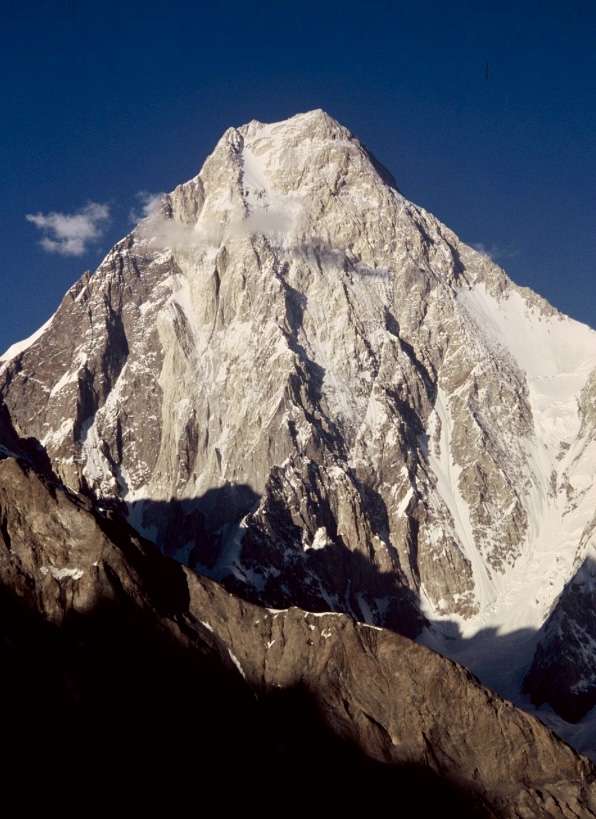
The West Face of Gasherbrum IV. Photo: Flothias/Wikipedia
K10, K12/Saltoro Peaks
Farther east, in the Saltoro Range near the Siachen Glacier, the higher K numbers rise in even more remote and geopolitically charged terrain.
Saltoro Kangri (7,742m), first known as K10, was first ascended on July 24, 1962, via the Southeast Ridge, by a joint Japanese-Pakistani expedition. The summiters were Y. Takamura, A. Saito, and Pakistani Raja Bashir Ahmad. A later Indian Army expedition repeated the feat in 1981.
The mountain’s location in a heavily militarized and difficult-to-access border area has kept overall activity low.
The tragic first ascent of K12
K12 (7,428m) carries one of the more poignant stories in mountaineering history. As often happened with first ascents in the Karakoram, Japanese climbers were involved.
In the summer of 1974, a small Japanese team from Kyoto University set out to climb Pakistan’s K12. Led by Goro Iwatsubo, the expedition included Seiichi Kanayama, Shinichi Takagi, Tsutomu Ito, Satoshi Oku, and Pakistani liaison officer Zaffar Iqbal. Their goal was the first ascent via the Northwest Ridge. The route demanded great technical skill on steep rock and ice.
They established base camp on July 25 at 4,702m on the moraine, beside the Grachmolumba Glacier, according to the American Alpine Journal. Higher camps followed: Camp 1 at 5,182m and Camp 2 at 5,700m. After bridging a massive crevasse with a rope ladder, the team pushed onto a col northwest of the peak, placing Camp 3 at 6,203m and Camp 4 at 7,010m along the exposed ridge.
On August 30, Takagi and Ito launched their summit bid from Camp 4. Battling thin air and technical terrain, they reached the top at 5:40 pm. They were the first people to stand on K12’s summit. Exhausted but elated, they descended that evening to around 7,010m for a bivouac. The next day, worsening weather pinned them down. With their walkie-talkies, they updated Iwatsubo at Camp 2 on their situation.
A lost crampon
On September 1, with conditions still precarious, the pair began their descent. Radio contact revealed a critical problem: One climber had lost a crampon and his boot, making the icy slopes treacherous.
At 6:30pm, disaster struck. While traversing a steep ice face, Takagi and Ito slipped. Their last transmission described them hanging from a rope anchored to a single ice piton. Then silence.
A rescue party reached Camp 4 on September 3, but found it deserted. No trace of the two men remained. Expedition members concluded that the climbers had fallen from the ice slope, likely plunging toward the vast Siachen Glacier far below. Despite searches, their bodies were never recovered.
A second Japanese team returned the following year to complete the second ascent, but the mountain kept its secret. Takagi and Ito remain on K12 to this day.
Earlier reconnaissance by Eric Shipton and others had mapped the area, but the peak’s steep rock and ice demanded serious commitment.
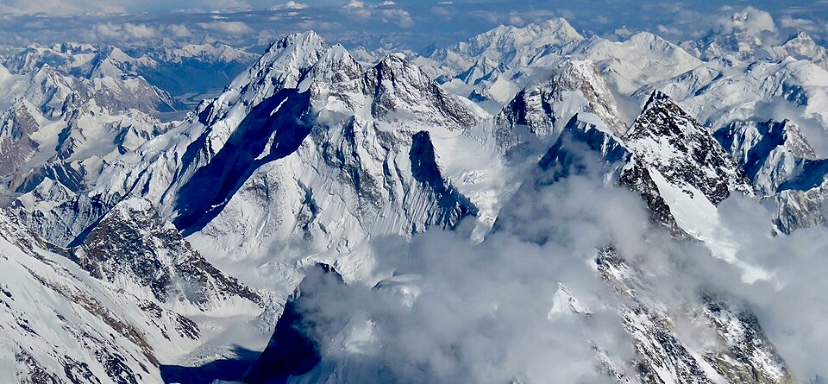
View from the top of K2. K12 is the peak near the top, one-third from the right side. Photo: Wikipedia
Other K peaks
Beyond these, peaks like K7 (Saraska Peak), K8 (Skilma Gangri), and K9 (Gamba Gangri) have seen occasional ascents, often by small, exploratory teams pushing into lesser-known valleys. Farther afield, K22 (Saser Kangri I) and others extend the numbering system into even more remote corners.
These other K peaks continue to attract alpinists seeking technical challenges, remote beauty, and a direct connection to the pioneering spirit that defined mid-20th-century mountaineering. Many of these peaks have seen only a handful of ascents, preserving a purity and sense of exploration that busier mountains have lost.
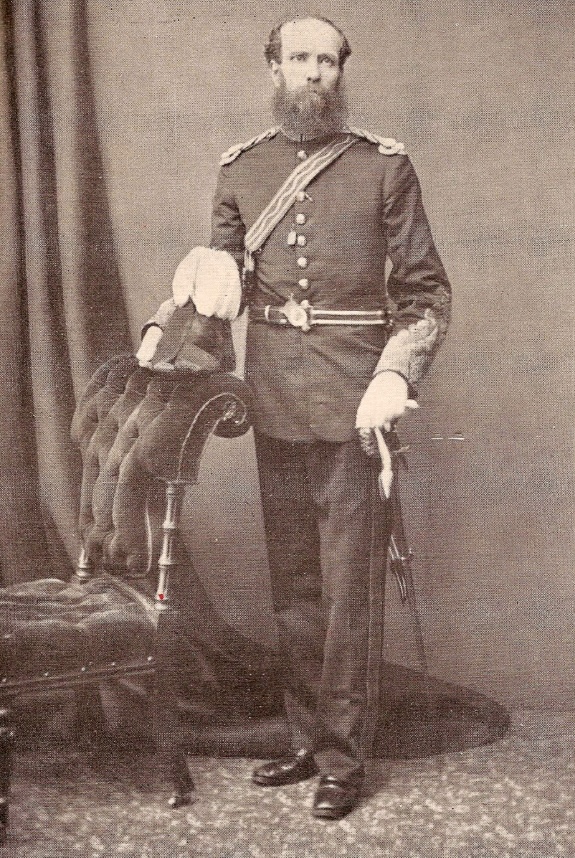
Thomas George Montgomerie.
Editor’s note: With apologies to Longstaff, the common English spelling nowadays is Karakoram, and ExplorersWeb follows this style.