We typically consider the first ascents of Himalayan mountains to be significant in the history of alpinism. However, in this era of commercial mountaineering and social media self-promotion, we need to begin looking more closely at the details. While some peaks remained unclimbed for decades because they were too difficult for the average climber, others were simply not worth the effort.
Upper Mustang firsts
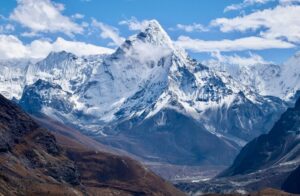
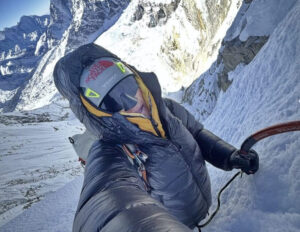
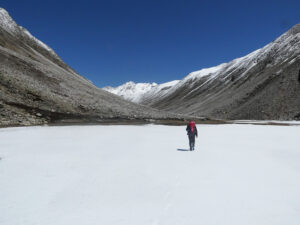
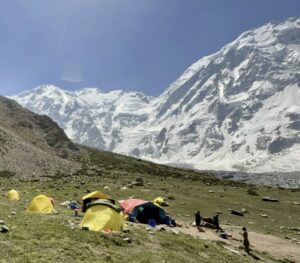
Nepal media and outfitter Seven Summit Treks (7ST) have reported two first ascents on 6,000m peaks in Upper Mustang on February 8 by Chinese woman He Jing “and a strong Sherpa team.” That team included Dawa Phinjo Lama Bhote, Ming Temba Sherpa, Phurba Sonam Sherpa, and Dawa Sherpa.
The group summited 6,062m Jyanglatunpu at around 9:25 am and neighboring Kekyap Ri (6,187m) two and a half hours later, according to the outfitter. They summited and returned to base camp in a single day after an early start (2:25 am).
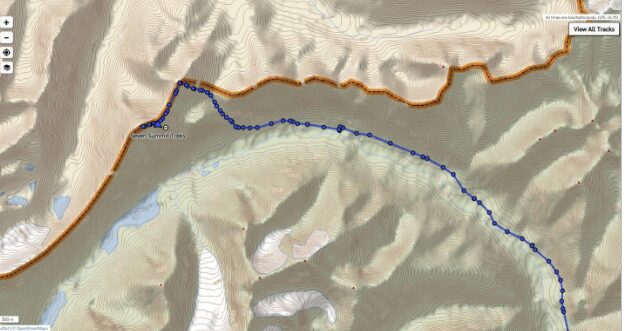
Screenshot of the expedition track, shared by Seven Summit Treks.
The outfitter posted no pictures of the ascent nor a topo of the route, but did include a screenshot of the expedition’s InReach tracker, above. The Tourism Times posted the photo below:
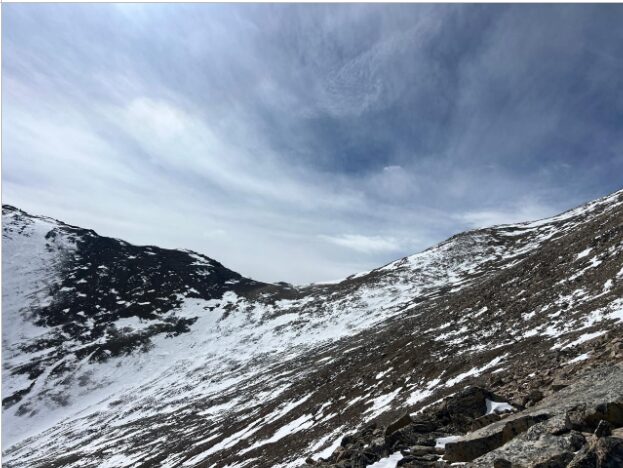
The Chhuama Range last week. Photo: Seven Summit Treks/The Tourism Times
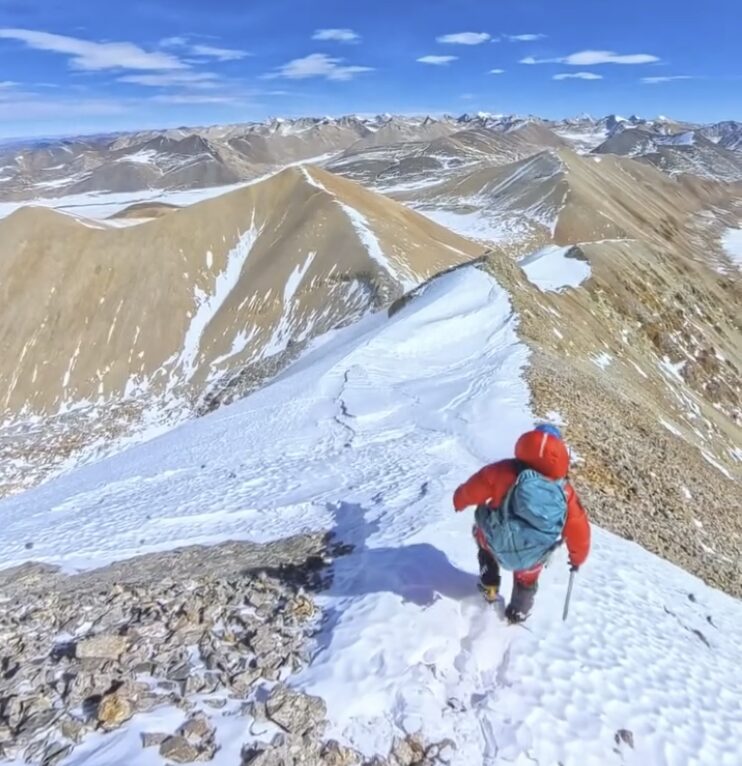
In the last few hours, team member Dawa Sherpa has posted some summit videos, showing a scree top with some snow:
Virgin peaks offered
The team is still in base camp and plans to go up Chhuama IV (6,179 m), the only remaining unclimbed peak in the Chhuama Range. All the other Chhuama peaks have been climbed by commercial teams from Seven Summit Treks. A group that included three South Korean clients, for example, climbed Chhuama III in November 2025.
Chhuama I and Chhuama II were first climbed on the first day of winter by Jenjen Lama, Pasang Rinzee Sherpa, and Ashish Gurung, in an expedition planned and funded by Seven Summit Treks. The team’s goal was both to climb some virgin peaks and to explore possibilities for further expeditions.
“Chhuama II could be suitable as a trekking peak, but Chhuama I is too tricky,” Pasang Rinzee told ExplorersWeb at the time. “The approach is longer, and it has lots of loose rock.”
The three Nepalese climbers also found a new approach route into the Ghyun Valley across the 5,600m Kekyap La pass that He Jing’s expedition has now used.
A dubious record?
He Jing is touted in Nepalese media as the first woman to reach the “true” summit of all the 14 8,000’ers without supplementary oxygen, following the recent hyper-strict criteria advocated by Eberhard Jurgalsky’s 8000ers.com. Agencies searching for new records quickly adopted these criteria, because the accomplishments of some previous record holders thereby became invalid. However, unlike predecessors Gerlinde Kaltenbrunner of Austria and Nives Meroi of Italy, He Jing is also the first to achieve the feat exclusively on guided expeditions, with heavy Sherpa support.
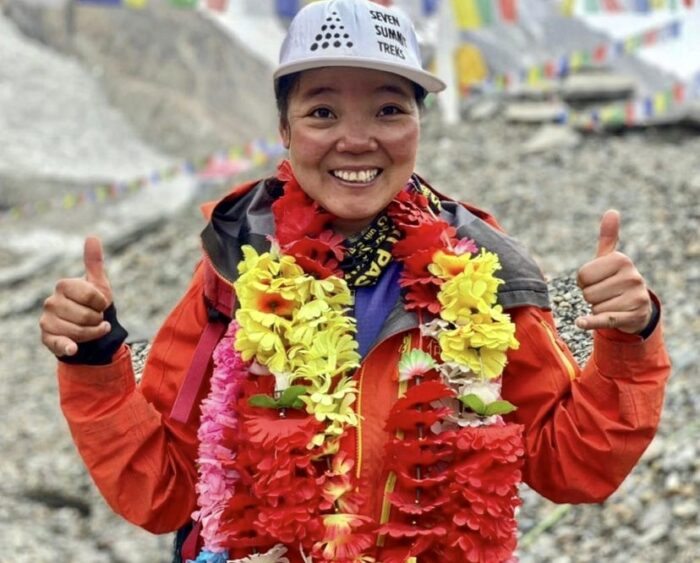
He Jing of China at Broad Peak Base Camp. Photo: Dawa Sherpa
Jing completed her 14×8,000m list on Shisha Panga in the fall of 2024. Her Seven Summit Treks team comprised 15 Sherpas and 13 other international clients, who also achieved some kind of first or completed their 8,000m round.
In Upper Mustang, four of 7ST’s most experienced Sherpa guides have accompanied He Jing. Dawa Phinjo Lama Bhote is an IFMGA-credited guide and rescuer, and Dawa Sherpa, nicknamed “Speed,” broke trail on the upper sections of a deserted Everest for Andrzej Bargiel of Poland last fall. Dawa’s stellar work allowed the Polish athlete to summit without supplementary oxygen and then ski back down to Base Camp.
While Bargiel’s descent was impressive, some Everest veterans criticized him for the massive support he employed. Fourteen Sherpas fixed ropes for his expedition alone. He also had a film crew and base camp team.
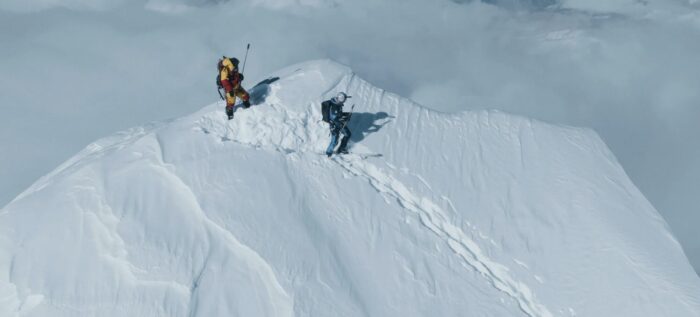
Bargiel, on skis, and Dawa ‘Speed’ Sherpa on the summit of Everest. Drone image: Bartek Bargiel/Red Bull Content Pool
New commercial niche
As commercial mountaineering thrives in the Himalaya, expedition companies compete to add ever more products. Altitude still sells well, although the former prestige of an 8,000m summit has dulled slightly because of the huge number of people who attempt it, the higher summit rates, and a wider mountaineering audience’s inevitable drift from admiration to indifference.
By the end of 2025, a total of 7,563 people had summited Everest (dozens of them more than once), according to The Himalayan Database, so adding to the list in the company of 40 others on the same fixed rope is not as epic as it used to be. Viral photos of dozens of people queuing up a snow ramp don’t exactly help sustain the narrative of an extreme achievement.
Yet, social media glory matters for many climbers, especially those who depend on external sponsorship. Not surprisingly, outfitters have sought to find offerings that include the magical alpine words “first” and “exploratory.”
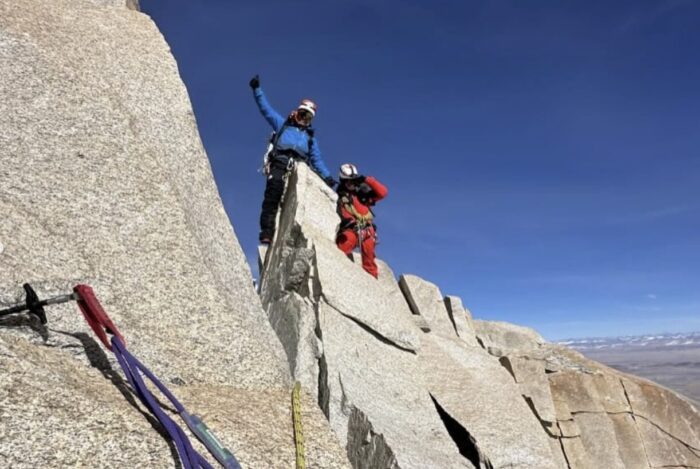
7ST guides traverse from Chhuama II to Chhuama I. Photo: Pasang Rinzee Sherpa
New business opportunities
Seven Summit Treks is not a culprit here. They are just business people pursuing new opportunities, just as Antarctic Logistics & Expeditions may suggest obscure “records” that potential South Pole sledders may pursue. In Nepal, American Garrett Madison was among the first to propose the idea. He offered clients a chance to climb a virgin 6,000’er after they finished Ama Dablam in the fall of 2021. Some big Nepalese companies followed, and the trend has grown from there.
Nepal has identified over 1,300 peaks above 6,000m, and authorities continually open more areas to climbers to increase tourism.
Last year, 15 peaks became available for climbing in the Upper Mustang region, a well-preserved area in central Nepal, with many unclimbed peaks bordering Tibet.
Some months later, the government waived royalty fees for 97 peaks in western Nepal. However, the complicated logistics of organizing an expedition to that remote region have appealed only to hard-core teams willing to spend more time approaching their wild objectives than actually climbing them.
Hardly historic
Organizing guided climbs on unclimbed peaks is, of course, a good idea for outfitters. And no mountain above 6,000m should be underestimated, no matter how gentle the grade. However, most climbers would argue that promoting the ascent as “a historic breakthrough in Himalayan exploration” in the local press and the outfitter’s social media is a little much.
In any form of adventure, not all firsts are the same. A new ascent should include details of the terrain, difficulty, type of climb, length, style, and external support. Only through such openness can we distinguish between an alpine achievement of some magnitude and a personally rewarding mountain trip with no larger value.
For example, the same Pasang Rinzee Sherpa who first climbed Chhuama I and Chhuama II also made a first ascent of Patrasi Peak in western Nepal with Vinayak Jalla Malla and Pasang Kami Sherpa. This truly significant climb was listed as a potential Piolet d’Or in 2024.
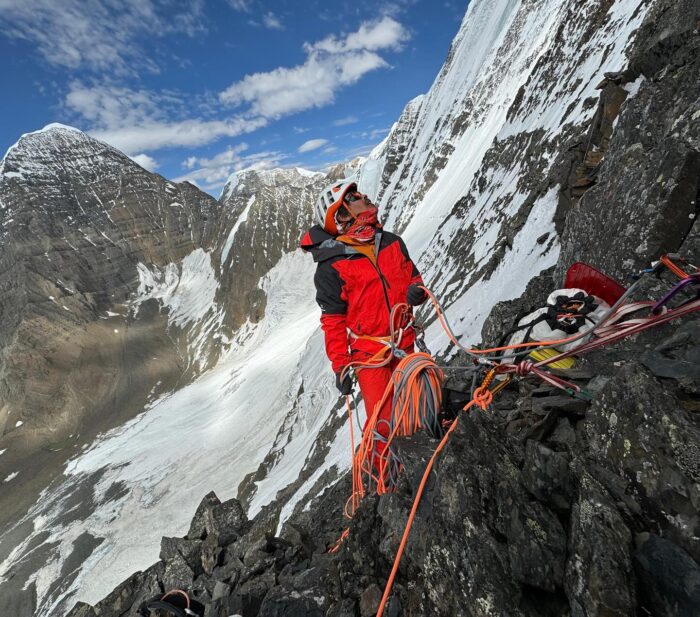
A member of the Nepalese first ascent of Patrasi Peak. Photo: Light and Fast team
This applies not only to commercial teams but also to independent, alpine-style climbers. Piolet d’Or-winner Benjamin Vedrines of France recently pointed out that some first ascents are overrated as cutting-edge exploratory climbs. In fact, he says, “[it] is easy to find a remote peak somewhere in the Karakoram or in the Himalaya, buy a plane ticket, pay an agency to take you to the base of the mountain, and climb something which is remote and wild but not super hard.”