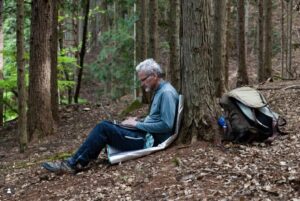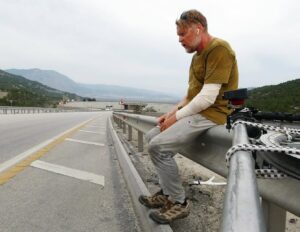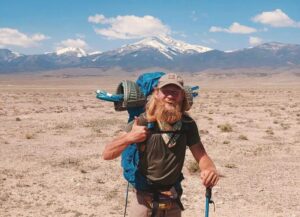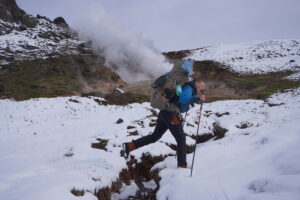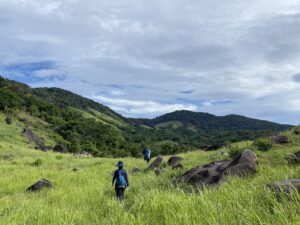
A number of long-distance solo walks have been taking place across Australia this year. Some started in 2026, others ended this year. The walkers have all taken different routes. Some are pulling trailers, others wheelbarrows, and one man is doing it dressed in a leopard-print onesie.
Britt ‘Birdgirl’ Franzman
Musician Britt Franzmann, known as Birdgirl, spent much of 2026 walking 3,125km from Perth to Melbourne. She started in May, camped along the route, and carried her equipment in a cart. Speaking to SuzieScribbles, she said she has been obsessed with the idea of crossing the country on foot since reading Robyn Davidson’s book, Tracks. She wanted to see what it was like to be in the remote areas of Australia and do something far outside her comfort zone. From the start, she has been very clear about the rules for her expedition: no support vehicles and no shortcuts.
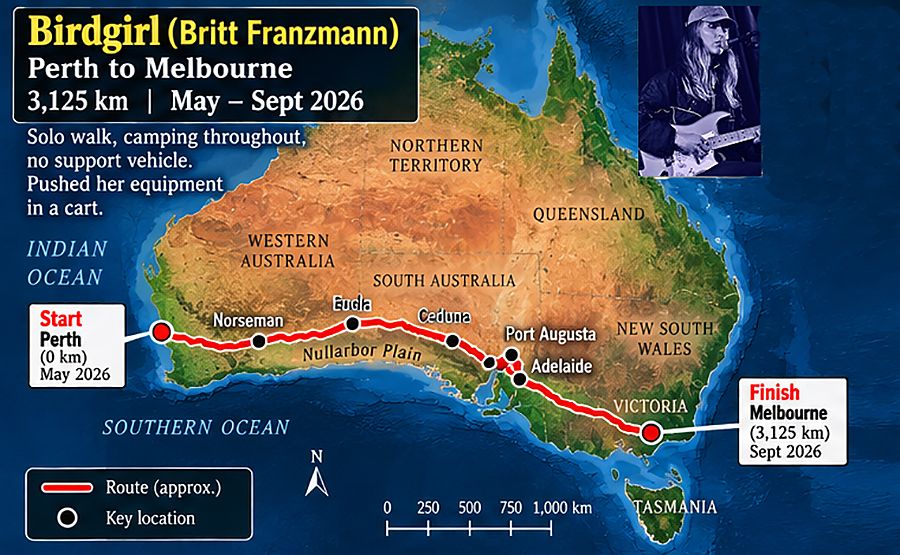
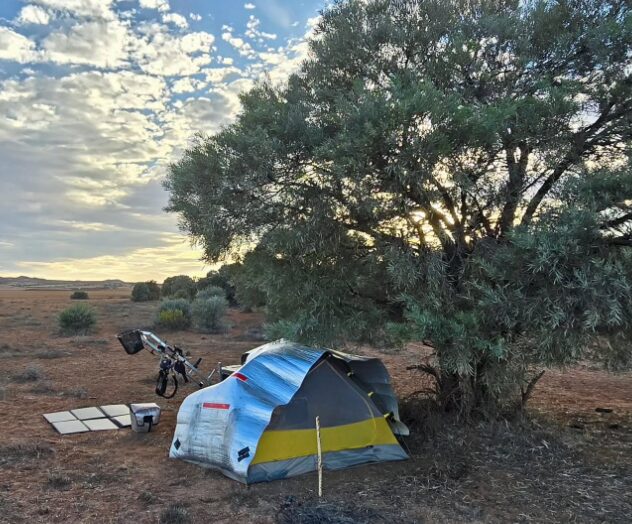
The logistics became one of the defining features of the walk, mainly because Franzmann was pushing her belongings rather than carrying a backpack. Even though this meant she could take more through remote backcountry areas, including (most importantly) her guitar, it also meant that terrain, heat, and the condition of the cart became constant considerations. More than once, the cart fell apart and needed repairs so that she could continue.
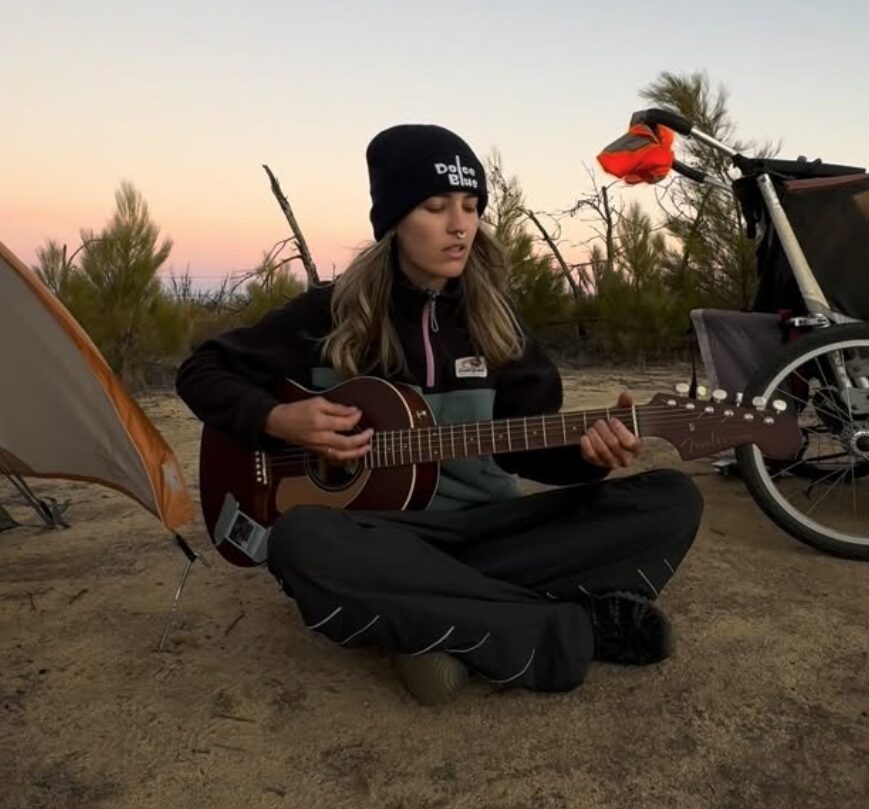
Photo: Birdgirl
The isolation was one of the hardest parts. For huge sections, she had almost no human contact. Franzmann describes herself as an introvert, but she relishes meeting people on the road and having a chat. A huge boost came in mid-June when her dad joined her for a few days. At the same time, it made the loneliness feel more severe when he left.
Along the way, she often focused on reaching the next big town. Two-thirds of the way through, she decided not to do that. She also stopped turning her trek into social media content. After walking for just over four months, Franzmann made it to Melbourne and finished by performing a homecoming concert at the Northcote Social Club.
Mark Gresser
Mark Gresser completed his 6,023km walk across Australia in 331 days. He started hiking from Steep Point in Western Australia to Cape Byron in New South Wales in July 2025 and reached his endpoint in June 2026. Of the 331 days, 223 were spent walking. His route went via Lambert’s Centre, Australia’s geographical midpoint, and he covered around 35km a day, walking up to eight or nine hours daily. With temperatures reaching 50°C at times, he followed the weather rather than a particular schedule.
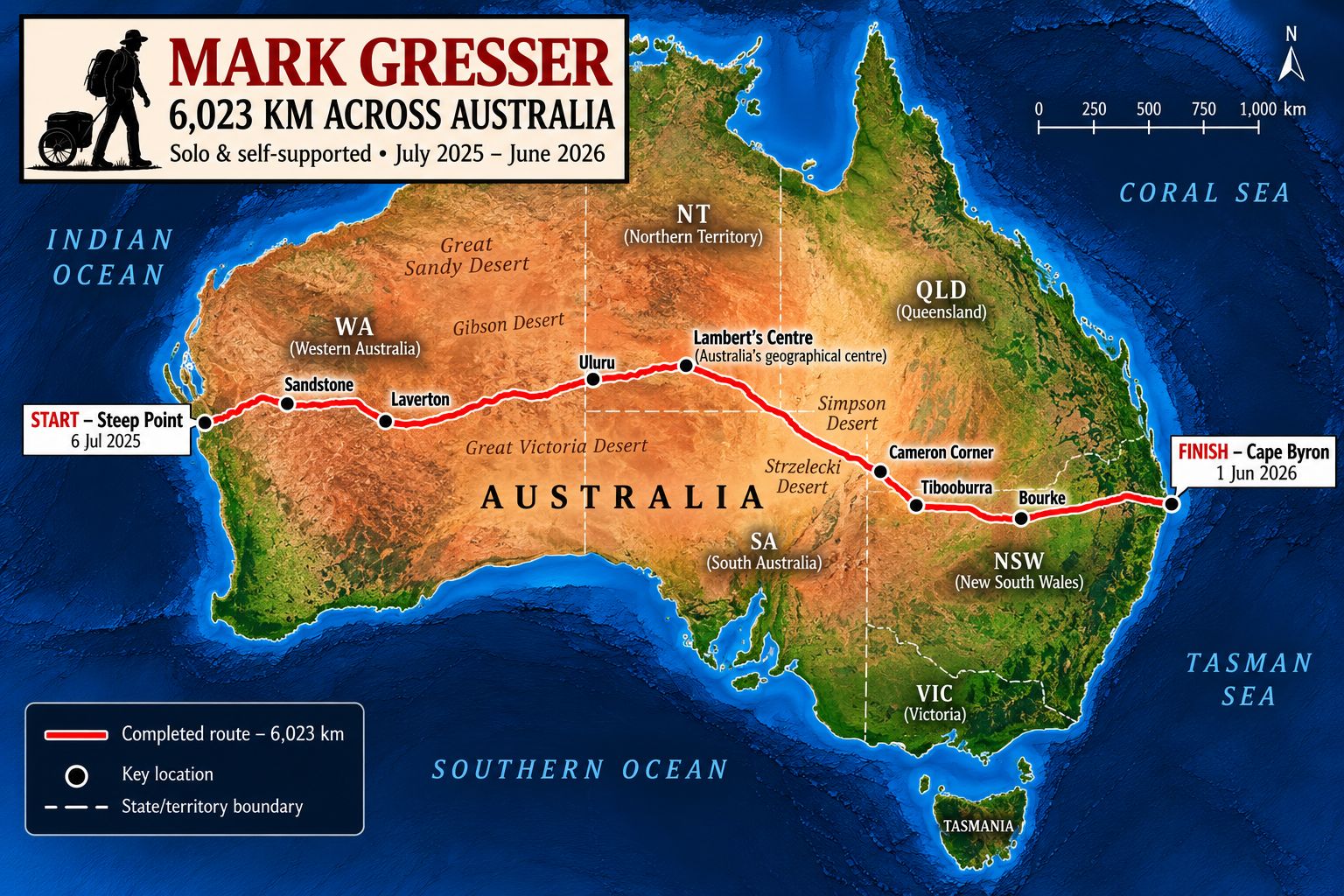
Unlike several other journeys in this roundup, Gresser’s expedition was genuinely solo and self-supported. He had no vehicle support, and his route took him through some of the remotest parts of the country, with limited water sources. His solution to the huge distances between settlements was to pull a 1.9m wheeled cart that carried up to 200kg of food, water, clothing, and equipment. Before setting out, he dehydrated hundreds of meals and posted them to resupply points along the route.
He had to modify the route and take a more southerly path when his cart could not make it over the sand dunes of the Simpson Desert. Yet he could not avoid sand entirely. In the Strzelecki Desert, it took him 18 days to cover 463 km, including 120km over dunes. Many were too steep to pull the cart over, forcing him to repeatedly unpack it and shuttle his load in stages.
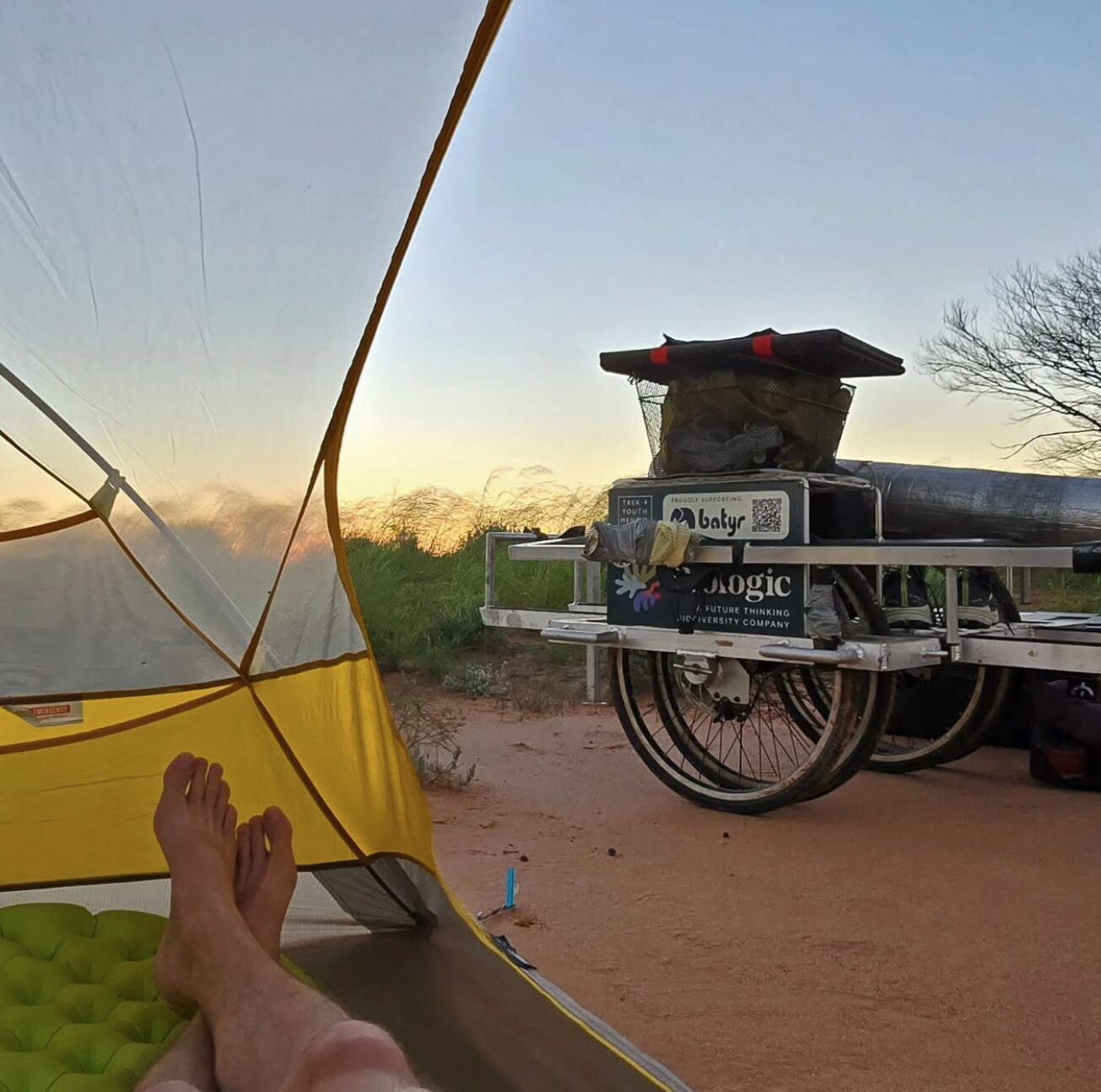
A view from the tent. Photo: Mark Gresser
Kentaro Jin (the Strange Catman)
Kentaro Jin, who dubs himself the Strange Catman, started his journey in November 2023. Armed with a wheelbarrow of supplies and sporting a leopard-print onesie, he set out from Carnarvon, Western Australia, and started walking toward the Sydney Opera House. Two-and-a-half years and 6,400km later, he made it to Sydney.
He started the journey after breaking up with his girlfriend in Japan. Speaking to We Are Explorers, he said he felt that his “reason for living crumbled in an instant” and so decided to do something he had thought of when he was a student — a long-distance journey.
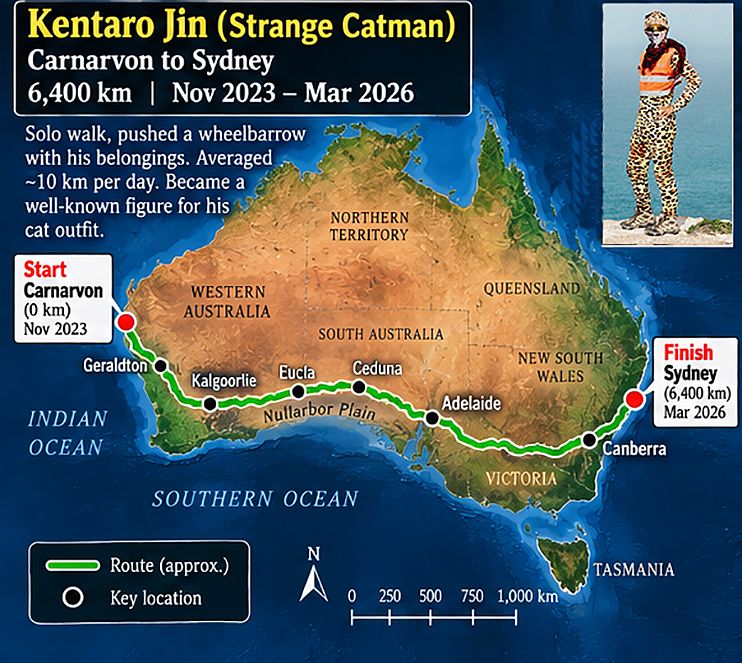
In 2024, when he had passed 1,000km, Jin told ABC that he was walking for 10 hours every day and sleeping in a tent beside the road during the long stretches between towns. In civilization, he often stayed with locals, making the most of any hospitality offered. One reason his walk took years to complete was that he stopped periodically to rest and work.
The wheelbarrow may seem like an unusual choice, but it was not a gimmick. He was just used to using one. “I felt a sense of destiny with the wheelbarrow. I worked in construction for six years, and the wheelbarrow was a familiar tool,” he commented.
He finally reached the Sydney Opera House on March 14, 2026, but decided to extend the journey. Now he is cycling along Australia’s east coast, pulling the wheelbarrow behind him, and still in his cat-man outfit.
Simon Harvey
Simon Harvey, also known as Captain Australia, completed his Big Lap of Australia in April of this year. He began from Brisbane in July 2023 and eventually returned to King George Square in his home city after walking over 15,000km around mainland Australia.
He originally estimated that he would walk 30–35km per day, at least six days a week. That meant around 18 months of walking. In reality, the journey stretched across almost three years due to the number of rest periods he needed and the practicalities of life on the road.
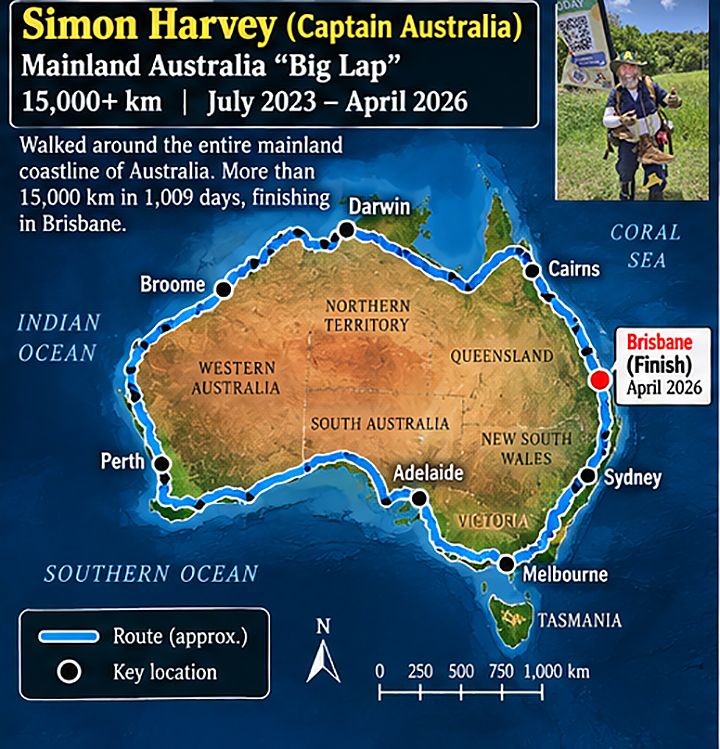
Harvey was never going to do this as an unsupported walk, and relied heavily on the network of people he met along the way. Nor was he always solo. On many occasions, he was joined by his wife, friends, and locals he met along the way. After finishing the walk, he told The Kids’ Cancer Project that he had been given “fresh pairs of boots, hot meals, and countless conversations by people encountered on the road.”
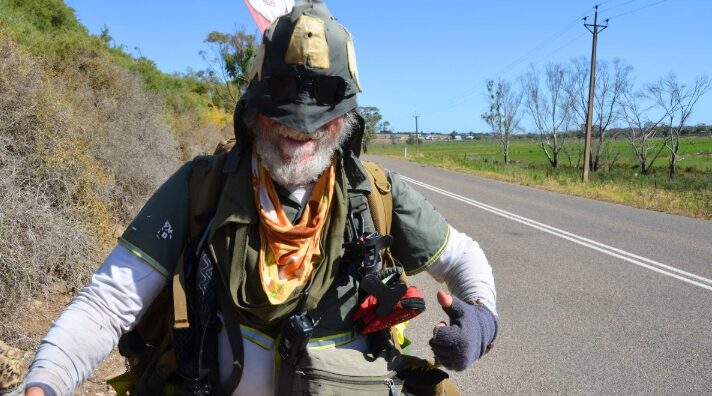
‘Captain Australia.’ Photo: Peri Strathearn
Walking has always been part of Harvey’s life. When he was just 15, he left home and walked from Brisbane to Sydney to live with his grandmother. Years later, having watched his business fall apart during COVID and then battling cancer, he decided it was time to start walking again. “The walk was my vehicle for healing,” he explained.
One Step Max
One Step Max, who has no other public name, is taking a very different approach from everyone else walking across Australia. His journey has no fixed route, no declared finish line, and by his own account, deliberately no plan.
“When I first started this journey, the first rule I made was to make no plans,” he told the Junee Independent. “That way, I can never be disappointed because I never know what’s going to turn up. So, if I need to spend time with somebody, I’ve got time up my sleeve.”
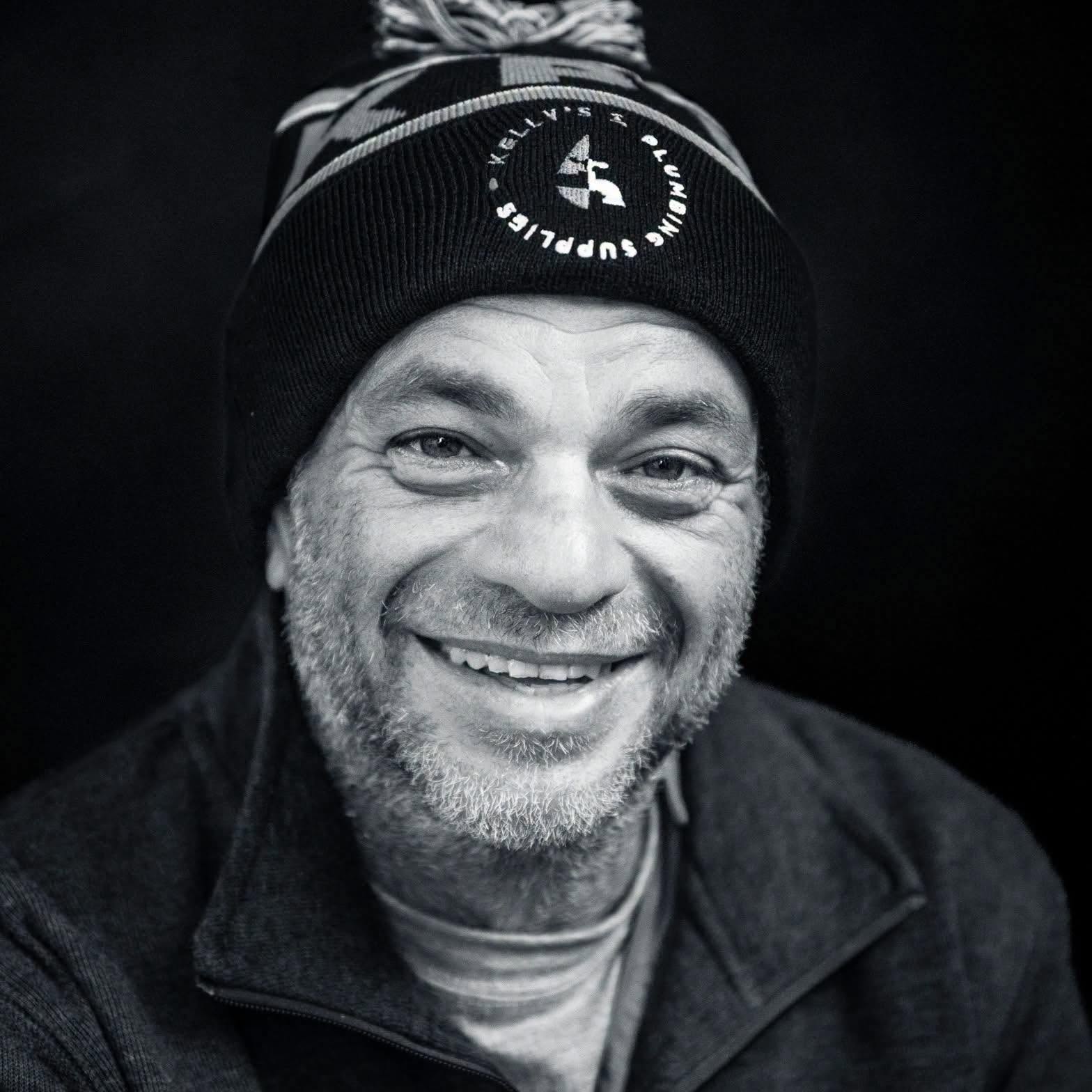
Photo: One Step Max
He set off in October 2025 and walked from Albury to Adelaide for two months along the Murray River. He then took a break to avoid the summer heat before starting to walk again.
“I started on the NSW-Queensland border,” Max told the Junee Bulletin. “I went from Goondiwindi to Moree, Bingara, Narrabri and Tamworth, then from Coonabarabran to Forbes, Condobolin, Lake Cargelligo, West Wyalong, back to Forbes, back to West Wyalong, and then Temora.” Now he is walking through Junee.
Max is also the second person in this roundup who decided a wheelbarrow was the best option for toting his kit and supplies. As the warmer seasons approached, he removed 30kg of winter clothing and gear from his wheelbarrow to pare down his load.
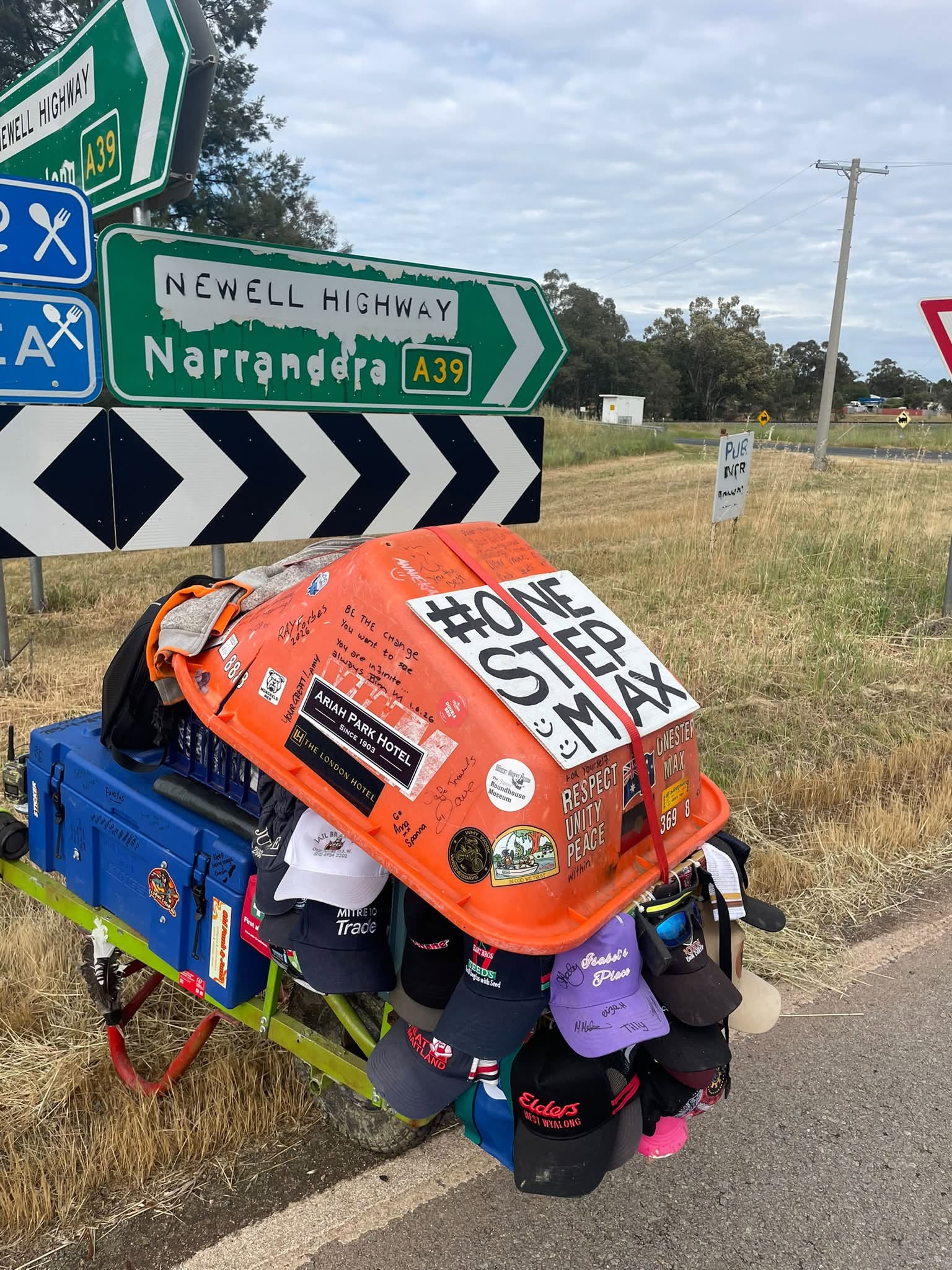
The wheelbarrow setup. Photo: One Step Max
His journey is part of a much larger campaign to walk 700,000km, representing the more than 700,000 people estimated to die by suicide globally each year. That would mean walking the equivalent of 18 circuits of the Earth’s equator. According to the Junee Independent, “The suicide awareness advocate has walked almost 155,000 kilometers so far and is now on his fourth lap of the Earth.”
Steve Roberts
Steve Roberts began his 4,200km walk across Australia on September 14. At first, he considered starting on the east coast at Cape Byron, but as he has no personal connection to that area, he decided to switch the starting point to Coonamble, the town where he was born. His planned route takes him west through Bourke and Broken Hill before crossing the Nullarbor to Perth.
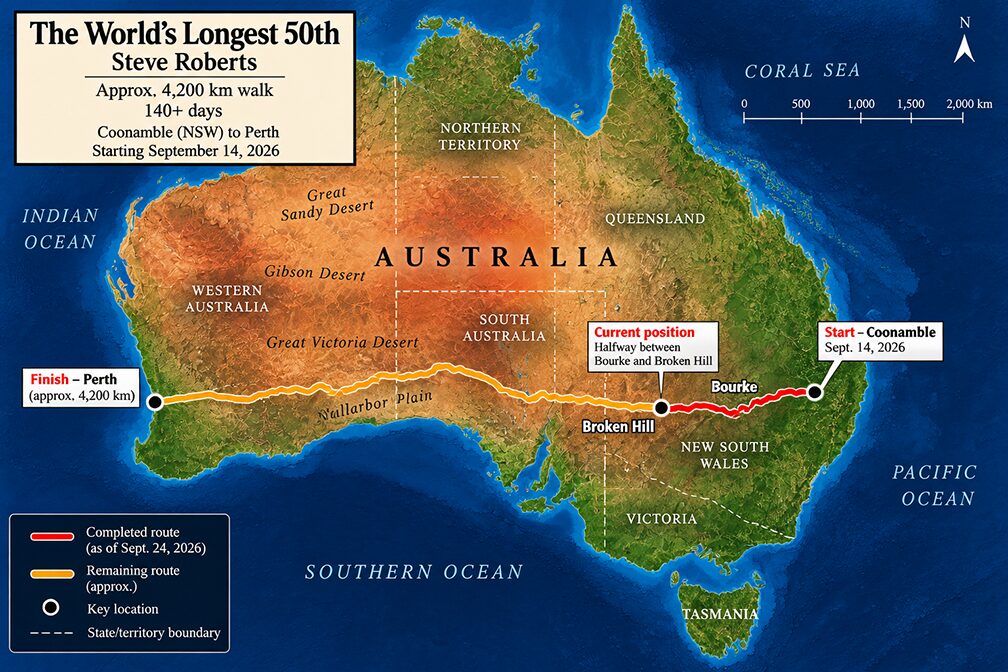
By the end of September, he had walked 350km and reached Bourke. As with the other walkers, meeting locals is an important part of the journey. He regularly chats to people along the route, and has found himself accepting water top-ups, hot showers, and home-cooked meals.
On reaching Bourke, he rested for a few days. The expedition is not about setting speed records. Robert’s father died at the age of 50 — the age he is now. This walk is to prove “that turning 50 isn’t the end of the story.” Roberts has given himself more than 140 days for the 4,200km route, an average of around 30km per day, though this fluctuates depending on the terrain, weather, and how he is feeling on the day. He is now making his way toward Broken Hill.
Unlike other expeditions, this is not an unsupported hike. Apart from many pre-positioned caches of food and water, his family is accompanying him in a support van.
At the end of November, he will take a 10-day break with his family, then resume from where he left off. Regardless of the style of his journey, he has been very clear about one thing — he will walk every one of the 4,200km on foot.