Several people are engaged in enormous, multiyear treks, mostly around the world. Two have been on the trail for over a decade; others just started months ago. Here is a roundup of where they are at the moment.
Paul Salopek
Paul Salopek’s Out of Eden Walk remains one of the most unusual — let’s say cerebral — long-distance expeditions. He is following the original human migration route from Africa to the tip of South America and documenting it as he goes. It is the ultimate slow journalism story. In all, he will cover 42,000km.
Since leaving Ethiopia in 2013, Salopek’s route has aligned closely with early human migration corridors. After heading north through Djibouti and Saudi Arabia, he crossed Jordan and Turkey before turning east into Central Asia. From there, he covered the Himalaya, China, South Korea, and Japan.
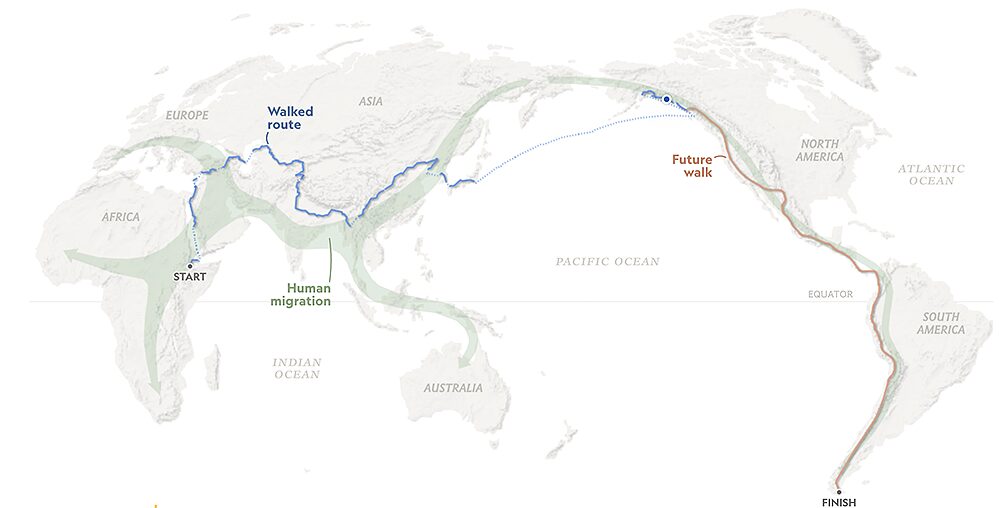
The ‘Out of Eden’ route. Image: Sam Guilford
Salopek’s progress is intentionally slow, structured around his reporting rather than continually moving. “I’ve likened it to a listening journey, where I just open my ears and my eyes and kind of let people, hopefully, if they trust me enough, open their hearts and share their concerns and their dreams,” he told The World.
A huge milestone came in 2025 when he reached North America. Crossing the Pacific Ocean in a container ship, he landed in southeastern Alaska and resumed walking. “Alaska is important in that global picture,” he said. “It’s the bridge to the Americas, where people, you know, on foot and by skin-covered vessels, presumably dispersed into this continent.”
Based on this, he changed his mode of transport for part of the walk, once again, to mimic early humans. Rather than walk all of Alaska, when he reached Gustavus, he decided to travel south by sea kayak.
“The reasoning there is that ancient humans who dispersed into this continent also used watercraft, and I want to honor that passage.”
He describes how the process of passing from country to country has changed over his project. “I just get a sense, kind of a gut sense…that just crossing borders has become a little bit more fraught…And now, I think there’s just a bit more scrutiny, and I’m not sure why. I have certain theories, but I don’t have any way to prove them.”
Many find the concept of such a time-consuming journey a bit mad, but Salopek disagrees. “We, Homo sapiens, have been nomadic, have been ramblers, right? For the vast majority of our time frame on the planet, we’ve been moving freely across landscapes that change every day…What you generally are doing when I’m talking to you is probably sitting down somewhere, that’s kind of unnatural.”
Karl Bushby
Karl Bushby has now almost completed his Goliath Expedition, which started an astonishing 28 years ago in Punta Arenas, Chile, in 1998. His route has crossed South America, Central America, the United States, Canada, and then beyond to Alaska, where he crossed the Bering Strait into Siberia. He then spent years trekking through Russia before heading into Mongolia, China, Kazakhstan, Uzbekistan, Turkmenistan, and Azerbaijan. In 2025, he finally made it back to Europe after 47,000km of walking and a little swimming.
The rules of Bushby’s walk are simple: He can’t return home to the UK until he finishes, and he can’t use any conveyance, including self-propelled ones like bikes or kayaks. He can and has taken breaks at various stages, just never in the UK.
His journey has been plagued by visa issues, funding problems, border crossings, geopolitical challenges, and the pandemic. In 2024, Bushby solved one of the expedition’s biggest barriers by swimming across the Caspian Sea from Kazakhstan to Azerbaijan, something he had never intended to do. After reaching Turkmenistan, he was unable to get a visa for Iran, then COVID struck, and he could proceed no further for a time. As with many points on the journey, he defected to Mexico to wait and came up with a new plan: retrace his route back to Kazakhstan and swim to the next point.
Once in Azerbaijan, he crossed Georgia and Turkey before entering Europe via Istanbul in 2025. He then moved steadily through Bulgaria, Romania, and Hungary before continuing into Austria and Germany.
Since the spring of 2026, he has been in Belgium and closing in on France. The big challenge is now logistics. Bushby has been refused permission to walk through the Channel Tunnel. He is still trying to persuade Eurotunnel to let him walk through their service tunnel, while also researching swimming the English Channel. This last section has become much more complicated than expected.
A certified English Channel swim currently has a two-year waiting list, mainly due to the limited availability of boat pilots. However, Bushby does not need his crossing to be official and has secured a suitable support boat for an attempt this October.
The bigger challenge lies with the direction of the swim. Regulations introduced in the 1990s make it illegal to swim from France to England. Bushby is now seeking an exemption that would allow him to start his crossing from France. After speaking with several organizations that support Channel swims, he learned that several swimmers have sought similar exemptions in recent years, all without success. His request is currently under review by the French government.
Despite the uncertainty, Bushby remains determined to complete his journey and return home before the end of the year, though he will now miss his September deadline. He is currently back in Mexico waiting to find out if he will be allowed to swim from France.
Alexander Campbell
Alexander Campbell’s circumnavigation attempt is now firmly in its European phase after more than three years on the road. Leaving Sydney, Australia, in February 2023, he planned to walk 40,000km across 30 countries and four continents.
He expected the expedition to take him four years. Now it seems it will take much longer: Three years in, he is just over halfway. He started by crossing Australia before moving into East Timor and Indonesia, then continuing through Southeast Asia into Bangladesh, India, Nepal, and Pakistan.
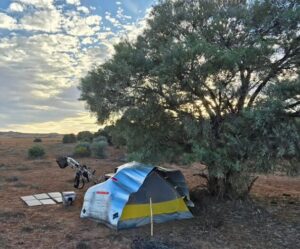
From there, he pushed into western China and Central Asia, crossing Tajikistan, Uzbekistan, and Kazakhstan. One of the more notable stretches came in Uzbekistan, where he walked a 120km desert section between Navoiy and Bukhara, camping by the roadside.
After walking for over two years, he needed a break, so he traveled to Kazakhstan and relaxed for a few months. Friends and family flew out to meet him during this time.
From there, he continued through the Caucasus and Turkey. Campbell entered Europe via Istanbul, then made his way across Bulgaria and into North Macedonia, his current location.
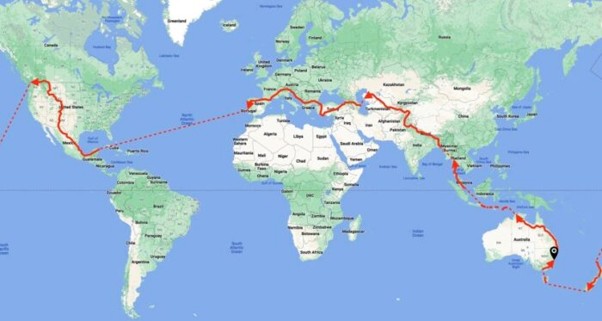
Alexander Campbell’s planned route. Image: Alexander Campbell
Campbell has covered more than 21,000km across 16 countries, maintaining daily distances typically between 30 and 40km. He carries everything he needs in his backpack and replenishes his supplies in towns along the way.
He has flown across all the oceans. Campbell tends to camp along the route, but like most long-distance travelers, accepts hospitality on the trail and occasionally checks into a hotel for a bit of comfort.
Campbell hopes to finish Europe by the end of 2026. He will then fly to the Americas and traverse Mexico and the United States. Finally, he’ll trek through New Zealand before heading back to Australia.
Though it is a way off, Campbell is also interested in seeing what life is like when he is back in Australia. His academic thesis was based on how long-distance hikers reintegrate upon returning home. Once he is done, he will get to experience it firsthand.
Enric Luzan
Enric Luzan’s Walking World Tour started in Barcelona in November 2025. He plans to hike 26,323km (that’s precise!) over five continents and 25 countries. The idea came about during the pandemic:
“I felt a craving for nature like never before,” he notes on his website. “I went on YouTube and became obsessed with videos of people undertaking epic adventures. One day, I discovered Nacho Dean, a man from Málaga who walked around the world from 2013 to 2016, and I thought: I want to do that!”
For his circumnavigation, he is following the criteria used by others who have completed similar challenges: He must start and finish in the same place, walk a minimum distance of 26,323km, cross all longitudinal lines, and walk a minimum of 3,000km in each of four consecutive continents while passing through the Earth’s antipodal points.
Luzan began by traversing the Mediterranean. From Spain, he crossed into France and Italy. By February 2026, he had already covered over 2,000km and reached the Croatian coast near Zadar. He then continued southeast through Montenegro and into Albania, maintaining a pace of 30-40km per day.
From Albania, Luzan pushed toward Greece and Turkey, eventually reaching Istanbul and completing his crossing of Europe within his first year. Now he is making his way through Georgia and has almost completed the first 6,500km of his walk.
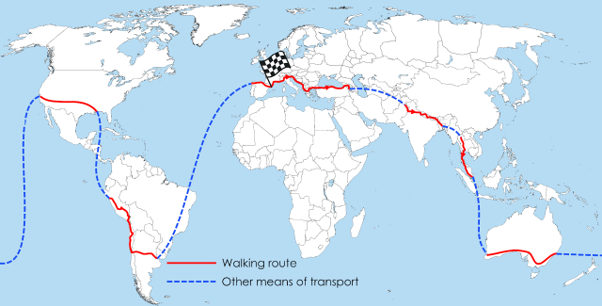
Enric Luzan’s route across the world. Image: Enric Luzan
Before starting, he realized it was important to be flexible. To this end, he has roughed out several possible routes around the globe, using various modes of transport across bodies of water. He will continue to assess which route is the most suitable, based on visas, season, and politics, and adapt where necessary.
Wesley Tils
Wesley Tils is walking 12,800km across the United States. Unlike most others in this roundup who have been on the road for years, he is a relative newbie: He just started last May. Tils is a hugely experienced hiker and has previously completed 20 thru-hikes, including the Triple Crown — the Appalachian Trail, Pacific Crest Trail, and Continental Divide Trail.
This time, he is trekking between the easternmost and westernmost parts of the country. Setting off from West Quoddy Head State Park in Maine, he will cross 13 states, ending in Cape Alava in Washington. His route covers around 10,500km of designated trails. For the remaining 2,300km, he will map the route himself. He hopes to complete the walk in 500 days.
He has had a few big milestones since setting off. Just days ago, after 63 days on the trail, he completed his first 1,000 miles (1,609km). He finished crossing Maine, including summiting Mount Katahdin (1,635m), the state’s highest point, at the end of June. He then crossed into New Hampshire and a few weeks later reached Vermont, his third state.
Another notable point came as he said goodbye to the Appalachian Trail he had been following and hit his second trail of the trek –- the North Country Trail. He will remain on this trail for 7,700km until North Dakota.