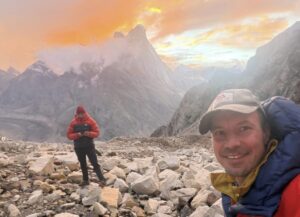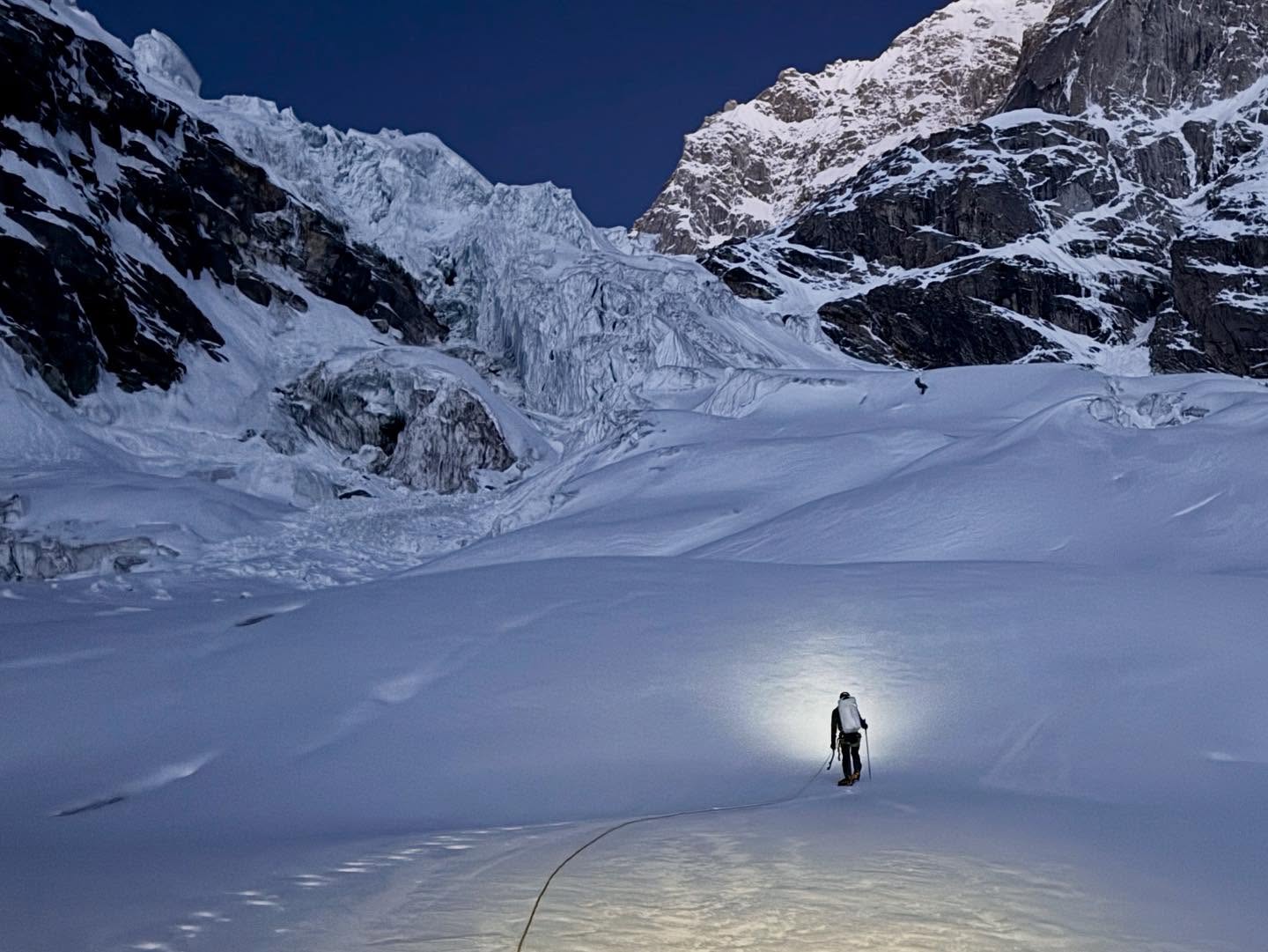
A powerful American team is on its way to a monster wall in India’s Himalaya to attempt a pure alpine-style ascent.
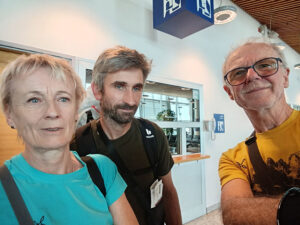
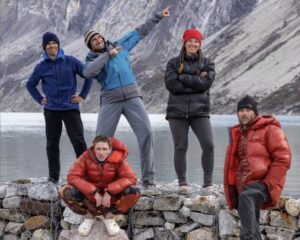
The team, led by Vitaliy Musiyenko, quietly left at the beginning of this week. “No noise, just the team, the mountains, and what I believe will be an adventure of a lifetime with Sean McLane and Christian Black,” Musiyenko wrote.
Asked by ExplorersWeb, Musiyenko revealed some details about their goal. He explained that the challenge is so big that the climbers felt sort of shy to speak about it.
“We have very little probability of success, and creating buzz around it feels unnecessary, though it’s not a secret,” he said. “We are attempting Chaukhamba III (6,974m), hoping to do a line left of where Michelle Dvorak and Fay Manners tried.”
Dvorak and Manners went there in the fall of 2024 but lost most of their gear in a rockfall and had to be rescued after being stranded for days. Chaukhamba III is in the Gangotri area of the Garhwal Himalaya.
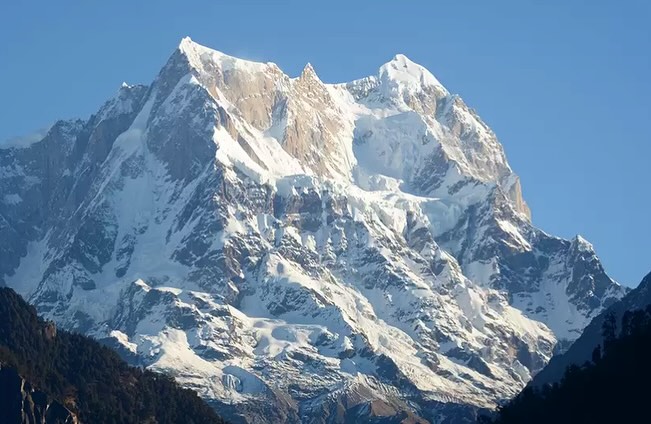
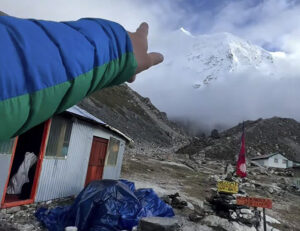
The Chaukhamba Massif in the Indian Himalaya. Photo: Vitaliy Musiyenko
Why is it remarkable?
“It looks like a steep big wall similar to one climbed in the Meru movie, but on a peak about 1000 meters higher in altitude,” Musiyenko said, referring to the documentary about the ascent by Conrad Anker, Jimmy Chin, and Renan Ozturk up the northeast ridge of Meru Central (6,310m), in the Garhwal Himalaya, in 2011.
“We are attempting our route in full alpine style, unlike the capsule style used on Meru. I am not sure an alpine-style ascent has been done on a wall this high on a big Himalayan peak,” Musiyenko said. He points out that climbers usually turn to capsule style during such big-wall climbs.
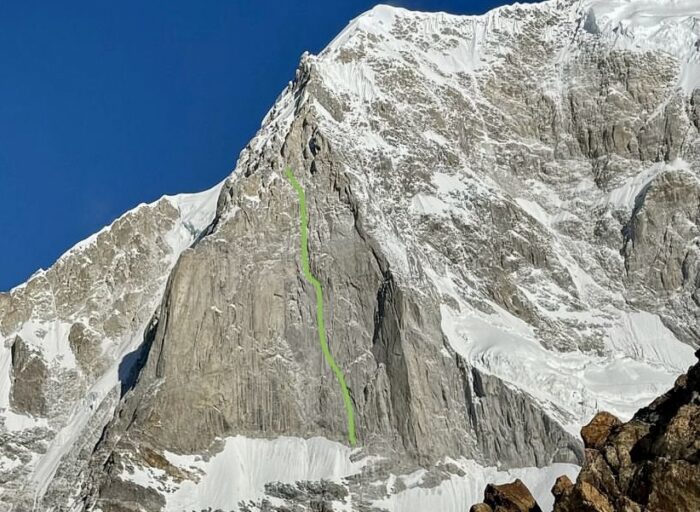
Chaukamba III’s face, showing the line climbed by Fay Manners and Michelle Dvorak. Photo: Fay Manners
Capsule style in Himalayan climbing involves using portaledges on the wall, which climbers return to (by rappelling down) after progressing throughout the day. They leave the ropes fixed so they can jumar up the following morning.
That was the case, for instance, of the ascent last year up the north face of Jannu East by Benjamin Vedrines and Nicolas Jean. Vedrines notes that they fixed 100m of rope through a particularly difficult section, right before their second bivouac at 6,900m.
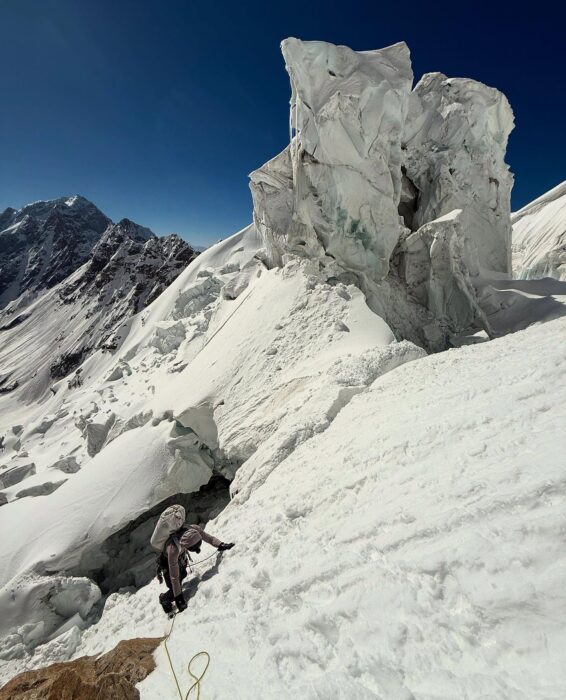
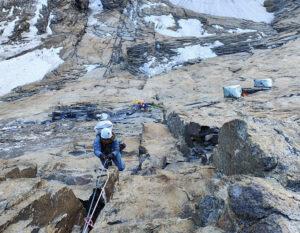
Sean Mclane on Chaukhamba last year. Photo: Vitaliy Musiyenko
While most climbers agree that the term “alpine style” accepts a certain (small) degree of flexibility, in a strict sense, a single pitch previously equipped with a rope to secure an exposed passage would invalidate the “pure” alpine style of a climb. Check more about alpine-style criteria in this article on ExplorersWeb.
“If we get up the thing, I think the buzz will create itself, LOL,” Musiyenko concluded.
Back to the Chaukhamba Massif
Vitaliy Musiyenko and Sean McLane know well what the objective looks like and are equally aware of the hazards it poses, because they attempted to climb a neighboring peak last year. However, that first attempt was actually not planned.
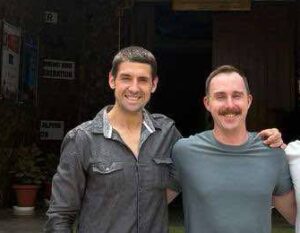
Vitaliy Musiyenko and Sean McLane in India last year. Photo: V. Musiyenko
Last year, Musiyenko and McLane actually planned to climb Kishtwar Shivling (5,935m). However, tensions at the time between India and Pakistan in the Jammu and Kashmir regions, where Kishtwar Shivling is located, made it impossible for them to get a permit.
Since they were already in India, the climbers had to find an alternative objective quickly and opted for Chaukhamba I (7,138m), a peak they had little beta on. They confronted a wild region with serious challenges even before setting crampons and ice axes on the face.
“[There were] active seracs over avalanche-prone slopes, serious icefalls to cross, and wet slides that started soon after the sun’s rays touched the slopes,” Musiyenko reported at the time. He had a close call when he almost fell into a crevasse.
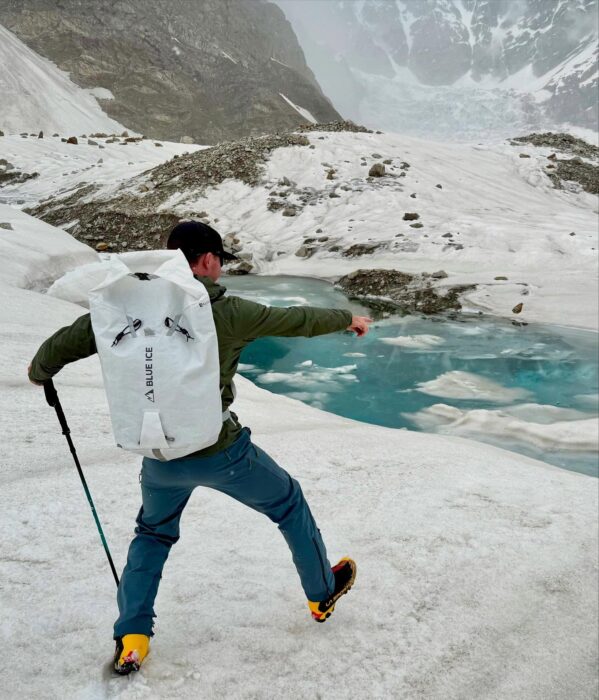
Melting glaciers on the way to Chaukhamba, Indian Himalaya. Photo: Vitalyi Musiyenko
Still, they made two attempts on Chaukhamba. On the first try, high winds forced them to retreat. On the second, scorching heat made the route unclimbable.
This time, the Americans are back in India, at a calmer political moment, with Christian Black as the third member of the team. The three reached the town of Badrinath two days ago and will shortly start trekking to Base Camp.
They intend to spend the next six weeks climbing in the Indian Himalaya.
Black and Musiyenko have just returned from climbing in Patagonia.
Vitalyi Musiyenko is also listed on an expedition in Pakistan this summer. Together with Ethan Berkeland and recent Piolet d’Or recipient August Franzen, they will attempt a new route on the formidable 6,960m Baintha Brakk II, known as The Ogre II.