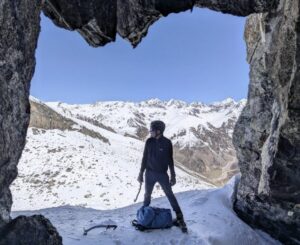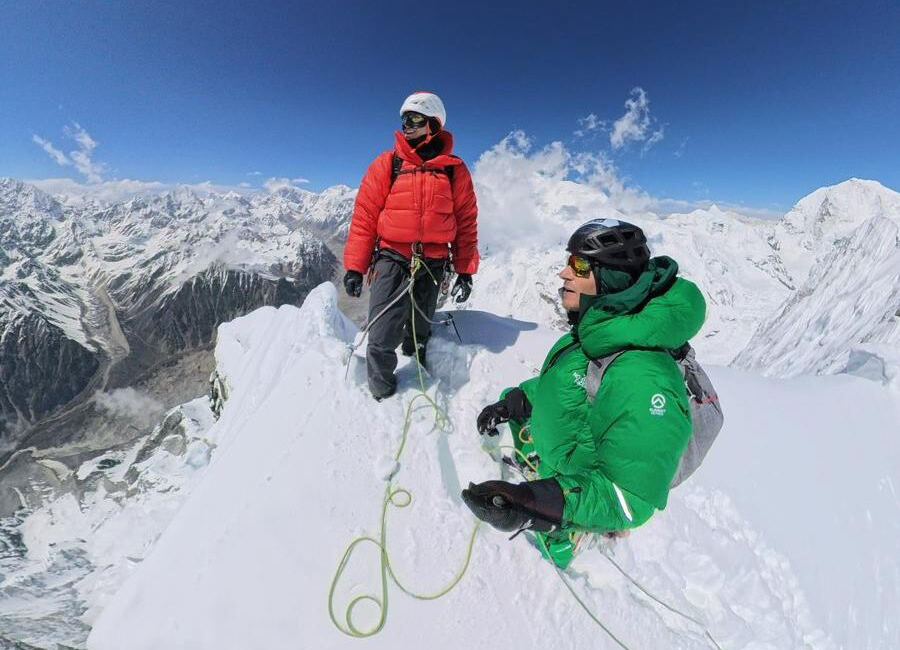
We are used to following David Goettler’s Himalayan expeditions and Colin Haley’s climbs in Patagonia, the Alps, and the U.S. This spring, they joined forces in Nepal’s Langtang Valley with great results: a new 1,000m route up the north face of 6,420m Langshisa Ri.
The climbers shared details of the climb with ExplorersWeb.
Teaming up
“David and I usually overlap for part of the winter in Chamonix and have done some fun mountain days together over the years there,” Colin Haley said. “Last year, I asked David if he was interested in climbing together in the Himalaya, and slowly we planned this trip to Langtang.”
Haley noted that Langtang is easily accessible from Kathmandu, and a comfortable lodge in Kianjing Gompa village can even serve as a base camp.
“There are a number of nice mountains in Langtang, but we were interested in Langshisa Ri from the beginning,” Haley said. “It is an aesthetic peak, and because it is under 6,500m, it has a more affordable climbing permit.”
Fast and light
Haley said they decided on their climbing line after studying photos of the mountain and checking conditions on the peak as they hiked up the valley.
We discussed a few different options…We definitely wanted to do a technical route, something that isn’t just walking, but also wanted to pick something that wasn’t super technical, so that we could climb fast.
I think that both David and I are big fans of light and fast, and we enjoy that style of climbing a lot. Picking a route that wasn’t extremely difficult allowed us to climb the whole route in one day.
By contrast, the last ascent of the north side of Langshisa Ri, in 2014 — by Mykyta Balabanov, Mykhailo Fomin, and Viacheslav Polezhaiko of Ukraine –– took six bivouacs on the ascent alone.
Haley also trusted Goettler’s wide experience in the Nepalese Himalaya.
“David is very fit and a strong high-altitude climber,” Haley said. He admitted he had been busy renovating his apartment during the winter, and his training was not as intense as he had wished.
“In alpine climbing, there is always a massive difference between breaking trail or not, and early in our trip, I was managing to do only about 15% of the trail breaking. Then I did manage to catch up somewhat, and on Langshisa Ri, I did probably 35-40% of the trail breaking…still not my fair share, but at least a lot better than 15%.”
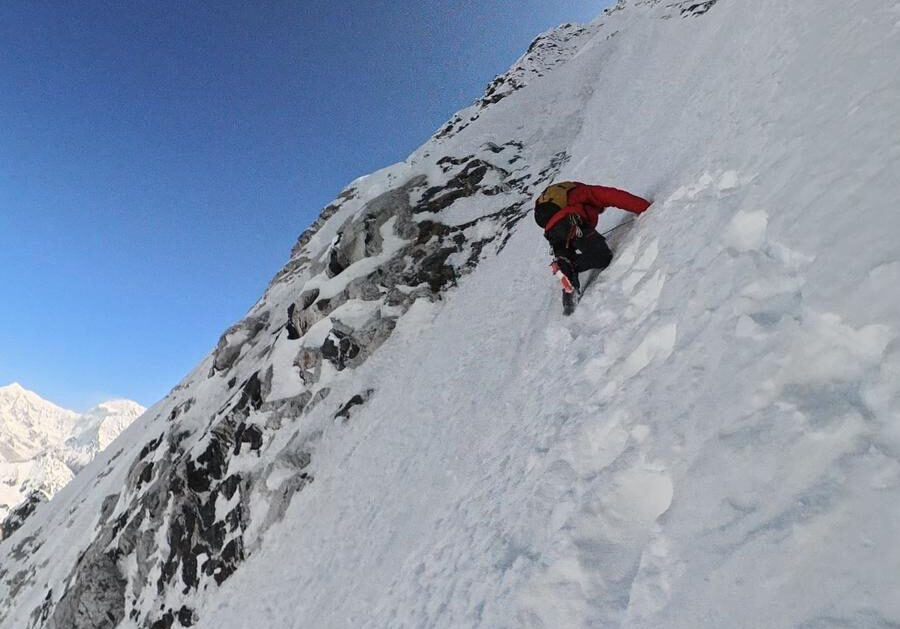
A steep snow section. Photo: David Goettler
The climb
Once in place and with the goal clear, the pair waited for the right weather. On May 12, they took their day packs and set off.
“We went to the last meadows at around 4,550m above the Langtang Glacier under Langshisa Ri’s northwest face from the lodge in Kyanjin Gumba,” David Goettler said. “When we started at 3:15 am, we left the tent, sleeping bags, and pads behind and took only the stove.”
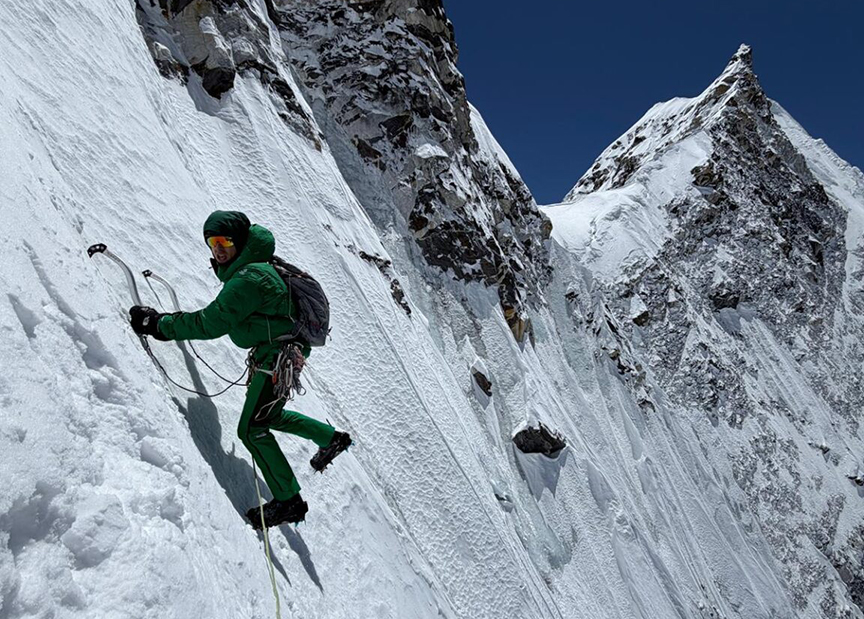
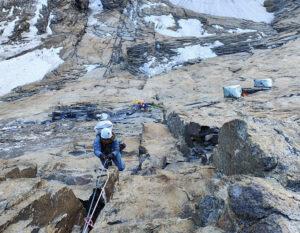
David Goettler at work. Photo: Colin Haley
The climbers first covered what Haley called a “semi-technical” approach, mainly up snow ramps while avoiding some rock bands and a serac.
“In this section, we were really happy to find a hidden canyon to climb through,” Goettler said. “After that, we arrived on a small plateau at around 5,300m, where the real climbing started.”
The first part was sugary, loose, deep snow on rocky slabs, making progress a bit slow and unpleasant at times. Then, after another small plateau with deep snow, the climbers reached the final headwall, which, Goettler said, gave better climbing because it was steeper — up to 75º — and covered with snow or hard ice.
“The last crux was a mixed pitch of around M5, which brought us close to the top of the ridge,” Goettler said.
Middle Summit point
“We ended up at a small summit along the east ridge coming down from Langshisa’s main summit,” Goettler said.
Fatigue and the late hour prompted them to turn around at this point after some discussion. “It felt like a complete route to us, and we were very happy with it.”
“So, our route topped out on a small summit that could logically be called something like Langshisa Ri Middle,” Haley said. “It only has about 50m of prominence, but it still felt like a real summit.”
“It would have been cool to go to the main summit, but it would’ve required first descending the ridge in between, and it was late enough, and we were tired enough, that it would’ve been a risky decision,” Haley explained. “Climbing with no bivouac equipment leaves less of a safety margin, so you have to make conservative decisions.”
The descent
They descended down the south face and then wrapped around to the west side of the mountain. “The south face is way smaller and way less steep than the north face, so it was the obvious decision,” Haley said.
Goettler added that the challenge was to find a way through the icefall on their way down. “We hadn’t had any information about it, since to our knowledge, it had never been climbed up or down.”
Luckily, after two rappels, they found a way through the chaos of ice. After another glacier traverse, they finally reached the so-called Langshisha Glat, a col lying on the normal route of Langshisa Ri.
The climbers then returned to the tent in the dark.
New route?
The climbers believe they have climbed a completely new route — at least, among legal expeditions.
“As this area gets quite some ‘under the radar’ climbs, we are still not 100% sure if this line was climbed before,” Goettler said. “Personally, if there had been a previous ascent, this wouldn’t change anything about the experience and adventure I had there, as we didn’t have any previous information on the line.” Goettler also noted that they didn’t find any trace of any previous team.
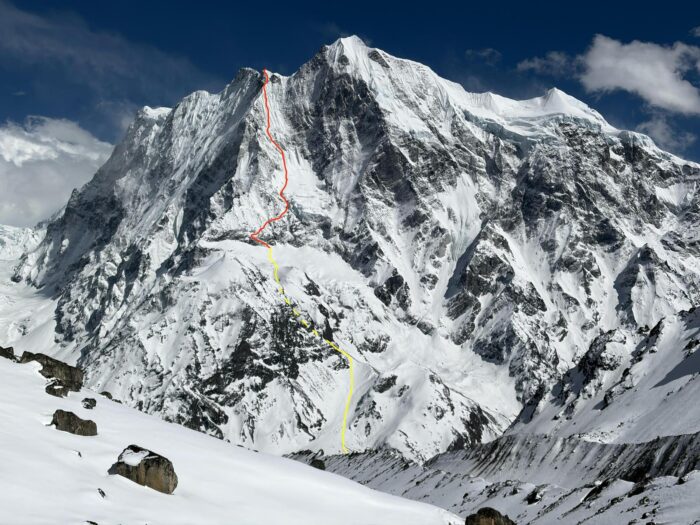
Topo of their route on Langshisha Ri. Photo: David Goettler
“It was a beautiful day of exploring and moving in a nice, efficient, and light style,” he said. “The mountain is impressively big and complex, with many lines to explore. The same is true for all the Langtang Valley, such a wild place.”
They named the route Ask the Snow Leopard and graded it 1,000m, 75°, M5.
Further plans?
In the last few years, Goettler has combined 6,000’ers with even higher peaks. Last year, he climbed Baruntse and then went to Pakistan and climbed the Schell Route on the Rupal Face of Nanga Parbat.
As to whether they have any other goal in mind, both Haley and Goettler belong to that school of climbing that prefers to discuss what they’re doing after they’ve done it. However, they didn’t say they were going home, so we’ll give the guys some space and wait for news, in case they are not yet done with the Himalaya.