As a teenager, Dane Steadman saw a video on YouTube that he never forgot. It showed a wild climb that combined vertical rock, strange snow features, and precarious icicles, done by two guys he had never heard of named Steve House and Marko Prezelj. He had never heard of the peak, either: the west face of Cayesh in the Peruvian Andes.
Today, Steadman is in his twenties and a recent Piolet d’Or recipient. Prezelj and House are in their late fifties. Those old enough to have followed Prezelj and House’s careers started reading about them in magazines, bought their books, and studied their online reports in the early years of the internet. Contemporaries of Dane Steadman sometimes found inspiration for their first vertical steps from this pair.
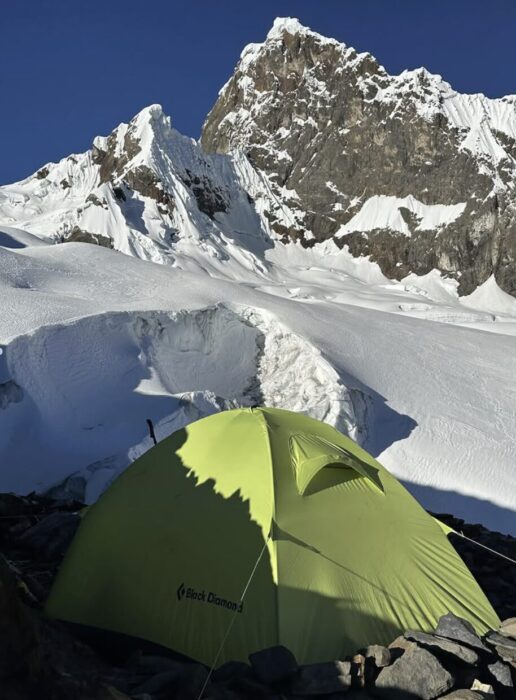
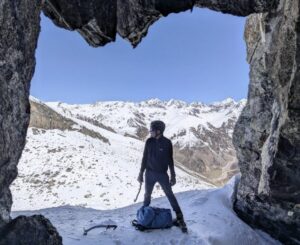
The climbers’ camp at the base of Cayesh’s west face. Photo: Dane Steadman
Twenty years later
Steadman is currently in Peru’s Cordillera Blanca. Last week, he suggested to his climbing partner and fellow Piolet d’Or winner Cody Winckler that they venture up a valley called the Quebrada Quilcayhuanca to give that same west face of Cayesh a try.
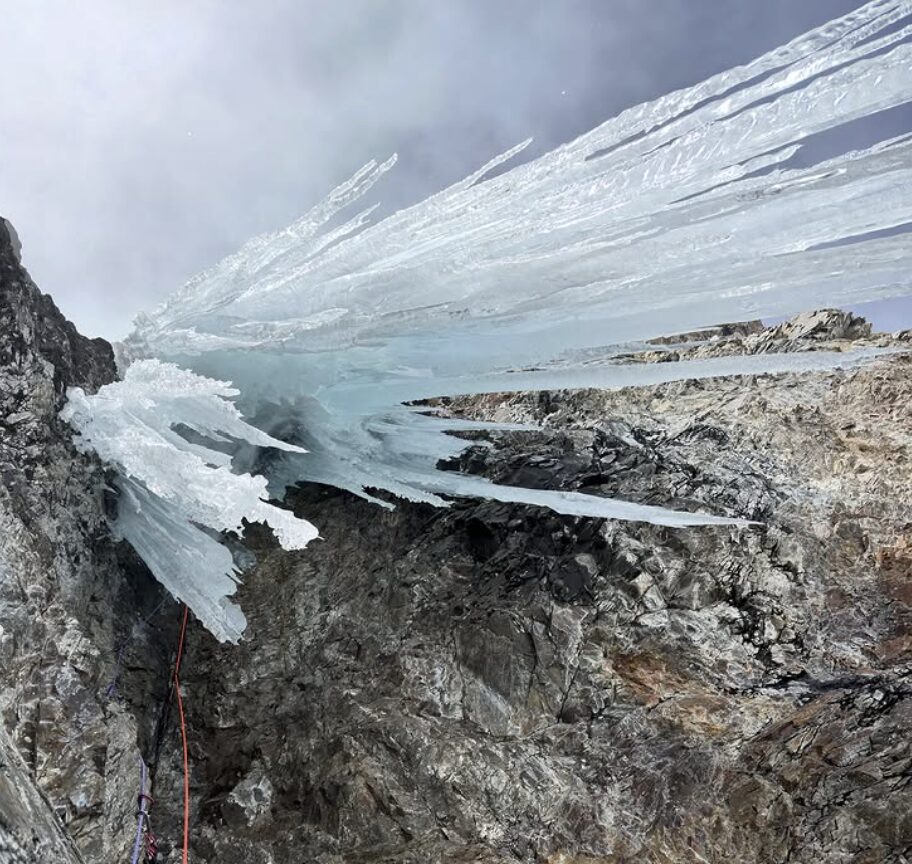
“Electric energy replaced aching shoulders (the donkeys we’d arranged to carry our things to the base never showed up), as we saw the same icicles Steve and Marko had climbed dangling from the face,” Steadman reported.
The next day, the climbers observed that despite the strong afternoon sun, the icicles didn’t fall. They began their attempt on that 20-year-old American-Slovenian route on June 12:
A couple pitches above the glacier, Cody set off up the first of the cruxes, a steep, angling dihedral glazed with icicles. It took him nearly two hours of delicate rock hooking, beak pounding, cleaning off the bad icicles, and drilling screws up into the remnant roofs, but he sent what was surely the most difficult wild pitch either of us had encountered in the big mountains.
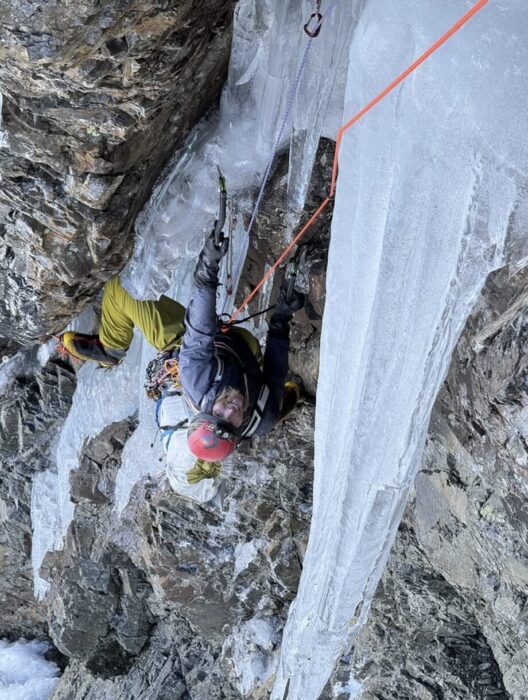
Dane Steadman among the icicles on Cayesh. Photo: Cody Winckler
The octopus
Steadman followed up a “monstrous octopus of ice hanging atop an overhung runnel of shattered slate.” The climber spent 45 minutes chopping ice to escape from the octopus’s tentacles, “fighting off nausea and shaking legs.”
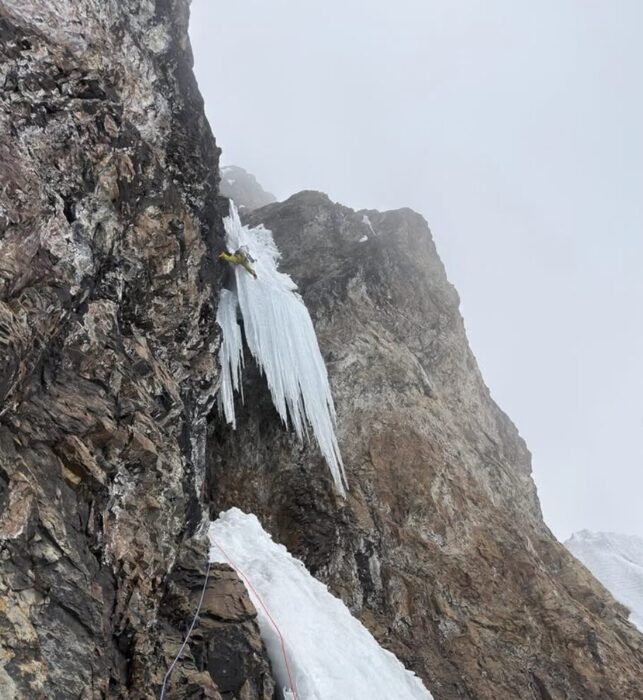
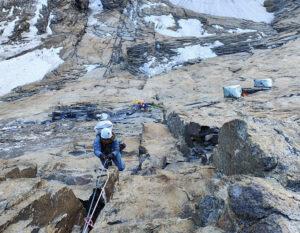
Mixed terrain on the west face of Cayesh. Photo: Dane Steadman
The pair hoped to open a variation route, including a direct line to the third icicle that Prezelj and House had skirted. However, conditions became too unstable as the day progressed, and the climbers traversed to the right to join what is known as the German Route.
Short of the main summit
“A few more pitches of thin alpine ice and compact slate brought us to the summit ridge and a solid ice belay beneath a swollen cornice after dark,” Steadman said.
The plan was to summit one at a time, belaying each other from below the cornice, the last safe place. Unfortunately, their 60m rope was only long enough to reach the peak’s south summit, a small bump of snow a couple of meters lower and 15m away from the northern bump, the main summit.
I returned to the cornice belay, and we made plans for me to move with him so he could reach the true summit on his turn, [but] as he traversed the ice at the base of the cornice, swinging exactly where I had, there was a sharp crack and groan, and we felt the whole mass of snow and ice shift.
For a single, terrifying moment, I envisioned the whole thing, with us anchored to it, tipping off the mountain. Then it stopped. In hindsight, we must have just shaken some icicles loose on the backside of the doubly overhung feature, but at the time we had no idea of the integrity of it all. So, Cody abandoned his summit lap.
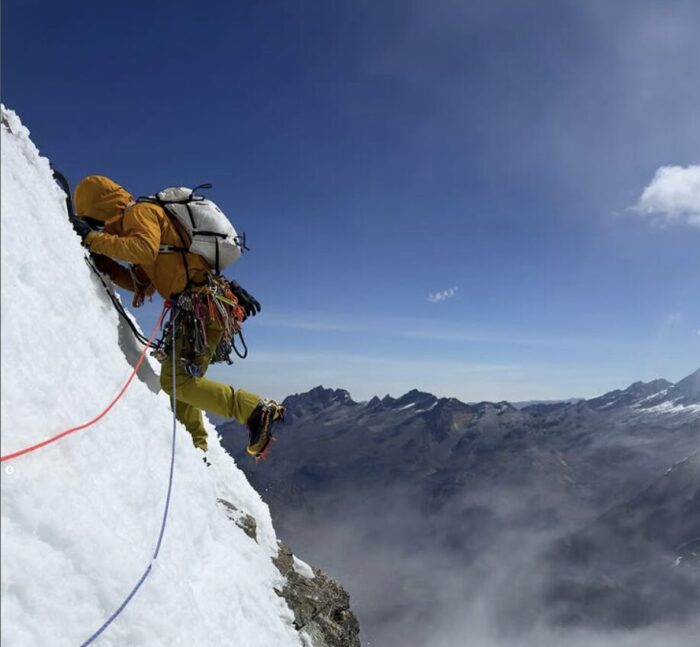
The upper sections. Photo: Dane Steadman
The climbers rappelled as quickly as they could back to safe terrain. They reached the glacier at midnight, after 20 nonstop hours on a 600m route with difficulties up to M7 WI6+.
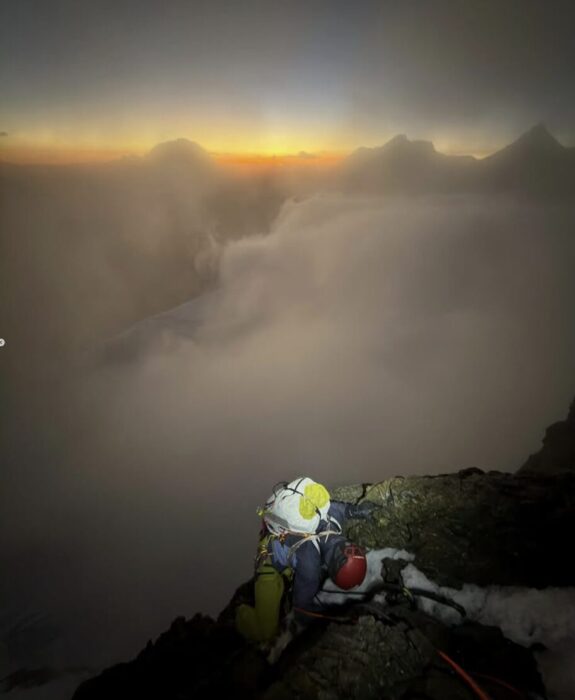
Descending as dark falls. Photo: Dane Steadman
A message
“We were slower than Steve and Marko had been 20 years earlier, and we climbed an easier variation than they did at the top,” Steadman concluded. “It was still absolutely magical to experience firsthand the route that had inspired me so deeply at the start of my alpine journey.”
Immediately after posting the story on Instagram, Steadman received the following comment: