Despite difficult conditions this year, climbing in the Peruvian Andes has yielded some remarkable results for young alpinists looking for new challenges.
Despite its relative lack of altitude, the 5,830m Tulliraju is one of the most difficult peaks of Peru’s Cordillera Blanca. Lionel Terray of France, who did the first ascent in 1956, said the climb could be one of the most arduous in the history of mountaineering. That is a lot to say for a man who bagged first ascents of Makalu, Fitz Roy, Chacraraju, and Jannu.
Both Terray’s route from the north and the second ascent — the 1980 Italian line up the south-southeast ridge — are rated as difficult and are rarely repeated. All other lines on that mountain are even harder and are rated as extremely difficult.
Now Taulliraju has had two ascents in the last two weeks.
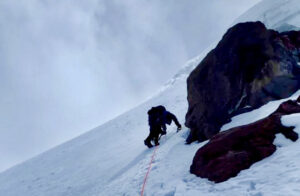
The first to succeed were recent Piolet d’Or recipients Dane Steadman and Cody Winckler of the U.S. They chose the 800m-long Fowler/Watts route, opened in 1982 by Mick Fowler and Chris Watts of the UK, up the east buttress of the southwest face. The Americans’ was the fourth ascent and the first free-climb of that line.
The team reportedly encountered difficulties of AI5+, M8, and a brief stretch of 5.10 over the five days they spent on the route. Winckler and Steadman onsighted every pitch, while their climbing partner, Josh Wharton, used aid climbing techniques on two short pitches but reached the summit nevertheless.
Snow squalls
During the climb, the team had to deal with delicate sections and several snow squalls, despite an optimistic weather forecast. Welcome to the Andes. The hardest part came on the third day. Says Steadman:
[The first cruxes were] three pitches rated A1-2 by the 2021 team. The first went quickly, but the next clearly wouldn’t. A snowy ramp led to a hairline diagonal seam, the only feature on a smooth sweep of vertical granite. It was punchy, but it went and I managed to not plug up the pin scars for the other guys. The crux came next: creaky flakes and high rakes through the steepest part of the route.
Above these difficult sections, the climbers found no suitable spots for a bivouac and ended up perching on top of a snow mushroom, which they would use for three nights (including the night after the summit).
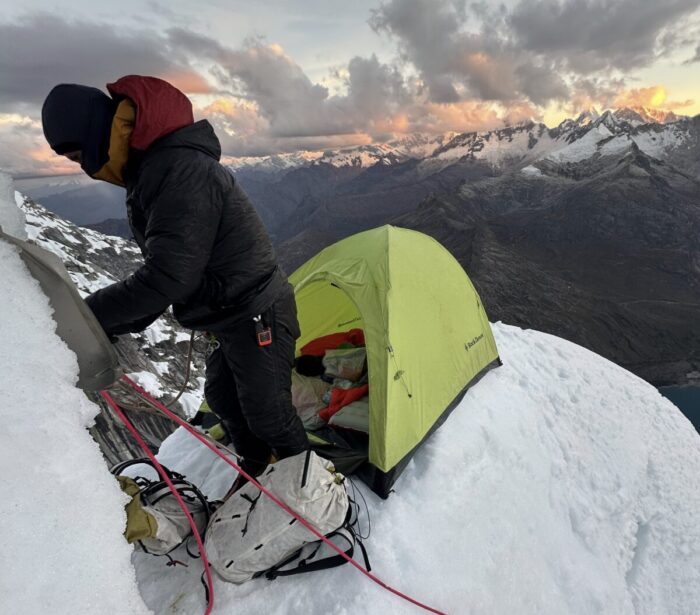
Snow mushroom as a bivy spot. Photo: Steadman/Winckler
On the fourth day, still in poor weather, the team used a capsule style: They fixed ropes through the final cliff band, which ended in a difficult roof section that Cody sent. That was the last section left to free climb.
On the fifth day, the climbers progressed across the dream-like Andean snow formations (luckily, they were pretty stable), past a false summit and a final serpentine ridge to the true top.
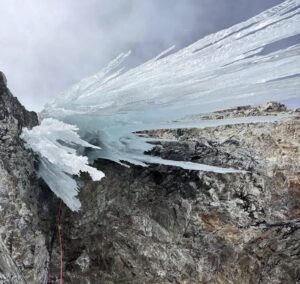
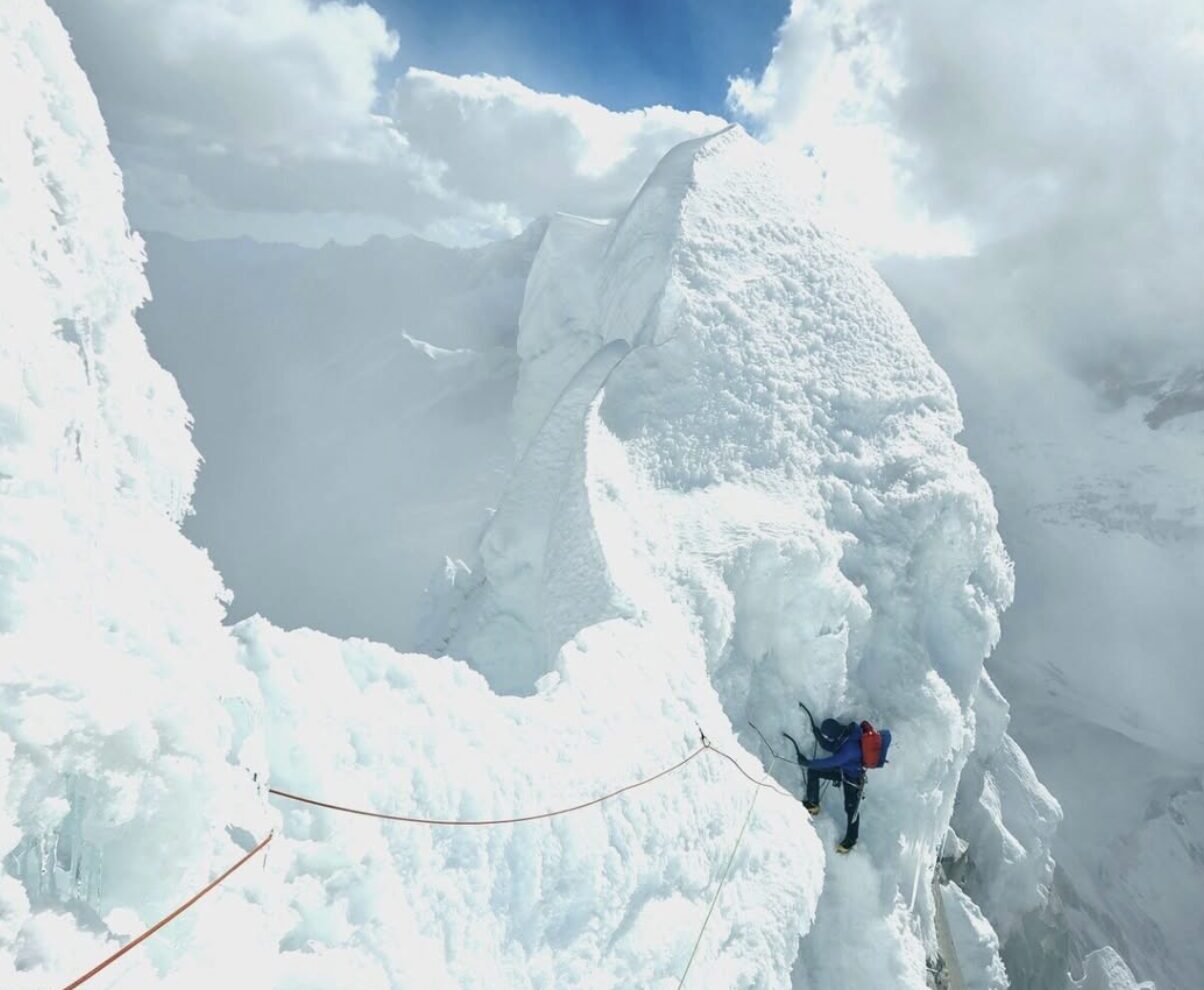
The winding summit ridge featured meringue-like cornices of snow and ice. At some points, the cornices formed holes and tunnels, through which the climbers went, roped up. It felt safer than trying to climb over the cornices.
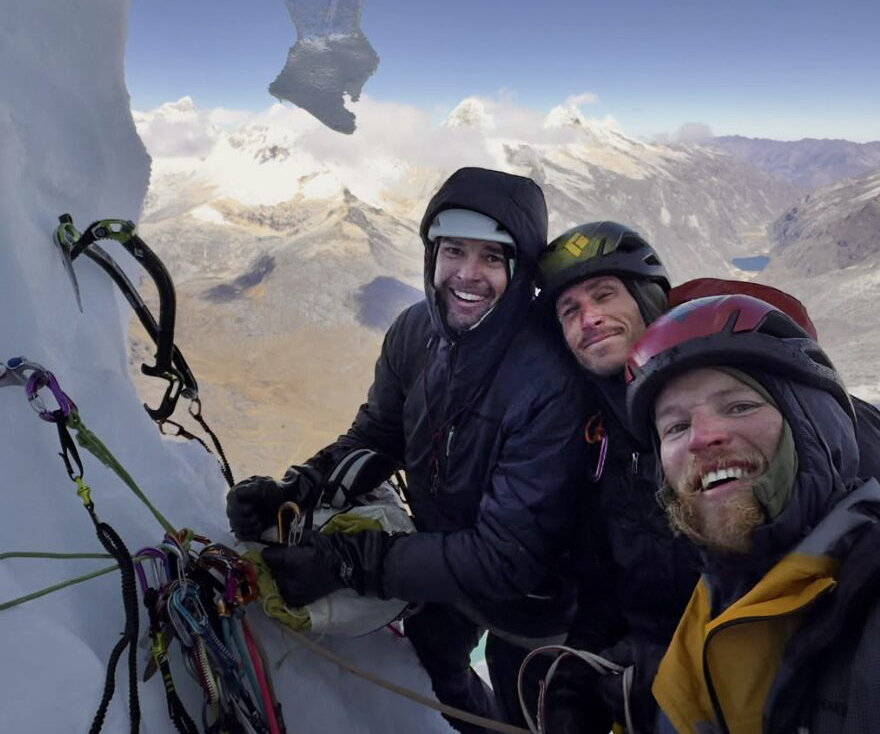
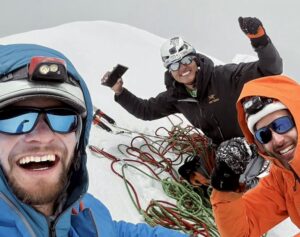
Left to right, Wharton, Winckler, and Steadman. Photo: Dane Steadman
That night, the team retreated to their bivy spot on the snow mushroom and rappelled down the following day.
“It’s a beautiful route on a magnificent mountain, featuring some of the best stone and coolest positions I’ve encountered, and is very worthy of more traffic,” Steadman concluded.
Italian route
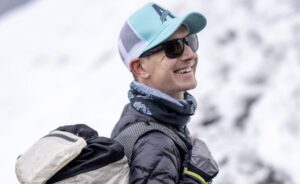
The second climb of Tulliraju occurred just days later. Wadim Jablonski of Poland and Adam Kaniak of Slovakia summited via the Italian route after four days, July 5-9. They made the fifth overall repetition of the route, with difficulties up to ED2, M6, A1, AI5, 100°.
” caption=”false”]
“Numbers can hardly capture the complexity and difficulty of this mountain,” Jablonski noted. “We had to bring absolutely everything we knew to the table, and Wadim and I agreed that neither of us had ever climbed anything more serious or demanding in the mountains.”
The climbers admit the physical and mental struggle to climb on highly exposed passages “fried their brains,” and made them cry when they finally approached the summit. See a video here:
Jablonski and Kania made the first ascent of Pakistan’s Chumik Kangri last year.
Siula Grande
The Andes are attracting a growing number of climbers, from elite alpinists to promising young ones like Mattia Sandionigi, 25, Pietro Saggiante, 22, and Sandro Maranetto, 26, of Italy. On their first experience in South America, the threesome bagged a beautiful new rock route on the East Buttress of Siula Grande (6,344m). Best known as the peak that Joe Simpson miraculously survived in Into the Void, it lies in the Huayuash range.
The team climbed their new line between July 9 and 12. It covers 700m up the East buttress, with difficulties up to 6c+ and AI5. The climb ended on top of the rocky face. They didn’t climb the upper section to the main summit due to dangerous snow conditions, as they told CAI. This is a common occurrence in the Andes, where unstable snow cornices cover the summits of the nevados (the local name for high peaks).
Ranrapalca
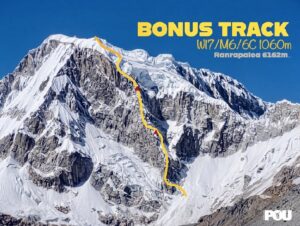
Finally, between July 15 and 17, another two young alpinists, Dawid Bartoszek and Wiktor Smaglowski, climbed the north face of 6,162m Ranrapalca in the Cordillera Blanca. They did it via a new variation route that overlaps with the Pou Brothers’ Ya Pe’ Cholo route on its upper part.
The climbers called their variation Climate Change and graded it ED+, 6C+, A1, R.