Where do I start? I pored over these cases for several hours at a time, and I always find myself back to square one. Or more like square zero. They’re called The Missing 411. These cases have a habit of sweeping you away, much like the unfortunate souls on this list. People reportedly vanish in national parks throughout the United States and beyond every year. Many say the reports are exaggerations, coincidences, or conspiracy theories. But let’s see.
One day, you’re on a trail with a friend. You walk a few steps ahead. All of a sudden, it becomes a one-sided conversation, as your friend has disappeared. This is usually how these stories start.
A manhunt ensues, helicopters comb large expanses of wild terrain, canines sniff out every trail in the park, and hundreds of volunteers strive to find clues. But in these particular cases, searchers invariably come up empty-handed.
As time goes by, there is still no closure for loved ones. Many of the Disappeared are never seen again. But sometimes, out of the blue, in a previously searched area, a body turns up.
These missing 411 cases feature many peculiar details. These could include no signs of a struggle, no blunt force trauma, and clothes worn oddly or missing. Some who survive these events turn up alive after a time but experience memory loss or brain fog as to how they went astray.
So how did these particular disappearances become so weird?
Notable cases

Robert Springfield. Photo: Strangeoutdoors.com
One of the most famous cases was the disappearance of a hunter named Robert Springfield. Springfield, 48, was last seen in Montana’s Bighorn Mountains on September 19, 2004. He had been elk hunting with his 13-year-old son, Colton, and Colton’s cousin, Brent Brooks.
An experienced hunter and former Marine, Springfield was comfortable in the bush. That day, he had cold-weather clothing and a firearm. They had found no elk that day, and Springfield decided they should split up so that he could find an elk and nudge it toward his son. They agreed to meet at a rendezvous point while cousin Brent stayed with the car. However, several hours passed, and Springfield never showed up.
To make matters more alarming, snow started to fall. Colton decided to head back up the road to camp, in case his father was there. But nothing. He and his cousin called the authorities, launching a large-scale search for the missing hunter. But despite several aerial and ground searches, involving canines and hundreds of volunteers, there was no sign of him.
Skeletal remains
A year later, in October 2005, two hikers discovered skeletal remains believed to be Springfield’s, including a skull, a leg bone, several other fragments, and some personal effects. The wallet appeared surprisingly intact, and his belt was reportedly found rolled up. A single hole was noted in the back of his vest. According to the family and several accounts, the remains were in an area that search teams had already passed through during the initial effort.
For some reason, the police, Crow Nation authorities, and the FBI colluded to keep the body from the family. Due to red tape and bureaucracy, the family could not receive the answers they sought, and no one knows what happened to him.
Some theories suggest Springfield injured himself and became disoriented, later dying from exposure. It is also worth noting that he was partially blind in one eye from a past injury, which might have led to a fall and an injury from which he could not recover.
Was it an accidental killing? This would explain the hole in the vest (maybe an accidental shot from a fellow hunter who mistook him for a deer). Maybe this person placed the remains there later, where the volunteers had previously searched. No one has come forward.
Stacy Arras
Another famous case is that of 14-year-old Stacy Arras, who vanished in Yosemite in 1981. She was on a horseback trip with her father; they were part of a larger group of other hikers. Stacy arrived at the Sunrise High Sierra Camp, where many other hikers had also camped.
After setting up camp, Stacy told her dad she wanted to take pictures of a nearby lake and an abandoned cabin just a short walk away. She asked her father if he wanted to come, but he declined. Instead, a 72-year-old man from the group accompanied her partway, then sat down to rest. Stacy continued on alone. The man continued after his short rest, but she had already vanished. All that was left was her lens cap.
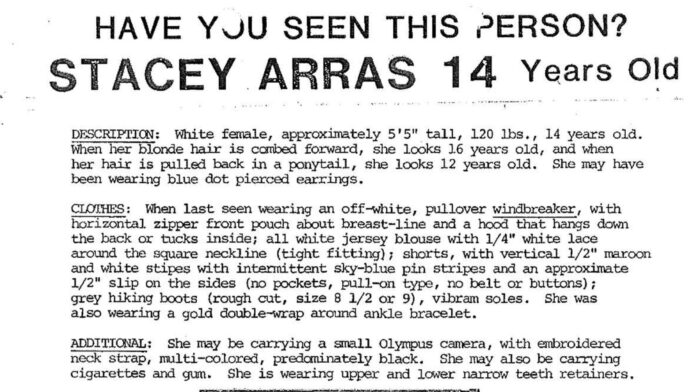
Yosemite National Park archive of Stacy’s disappearance. Photo: National Park Service
As with Springfield, a large manhunt involving dogs and aerial searches found no trace. The national park was supposedly hesitant to release Stacy’s case file. What was the park hiding? In this case, there was no body to examine for clues. Online sleuths suggested she might have fallen into the lake or been attacked by an animal. If so, there should have been evidence.
I have no explanation for this one.
David Paulides
There’s no stronger advocate for the theory that The Missing 411 form a pattern than David Paulides. A former police officer with the San Jose, California, Police Department, he worked as a SWAT team member and in the Street Crimes Unit. He began his research into these disappearances when a Yosemite ranger told him about all the people who go missing regularly in the park and a possible cover-up by the authorities. This sparked a decades-long (and ongoing) investigation into U.S. national parks. His Missing 411 series started in 2012, and he has put out three documentaries.
In the over 1,440 cases identified and cataloged, Paulides identifies some core markers for typical 411 cases:
- Vanished suddenly
- Athletic and intelligent hikers or experienced hunters
- There is a distinct cluster of missing persons in a given area. (eg. the Pennsylvania cluster, the Yosemite cluster, and the Great Smoky Mountains cluster)
- Bodies are found at great distances, in unlikely places or even in places previously searched
- Survivors cannot recall events of their disappearance, or there are time gaps in their memories
- Dogs are unable to pick up a scent
- Clothes are either missing or unusually placed (eg. one victim’s clothes were turned inside out)
- Near bodies of water (eg. lakes, waterfalls, creeks)
- Inclement weather at the time of disappearance
One controversial marker is that many of the missing had German ancestry or a disability or illness.
Paulides was determined to find out how many people were missing, where, and how. But the road was not going to be easy. The first order of business is that he needed a complete list of missing persons. In Missing 411: A Sobering Coincidence, he details how his attempts to contact Yosemite for the list took an unexpected turn:
I filed a series of FOIA requests against the Department of the Interior and the National Park Service, asking for the lists of names of missing people inside their system. Weeks later, they sent me a note saying that they don’t have any lists…
…I filed another FOIA, requesting that the National Park Service put together a list of missing people for Yosemite National Park and the entire parks system…
The attorney told me that they’d agree to do it, but it would cost $34,000 to get the list of the missing from Yosemite and $1,400,000 to get the list of missing from their entire system.
Because of this obstruction, David Paulides believes that something sinister is happening in national parks. The conspiracy theorist has not said outright that supernatural forces are involved, but prefers to leave the conclusions to his readers. However, he implies a cover-up.
Criticism
David Paulides is a polarizing figure these days. He is not just a former police officer turned crypto-investigator, but he is also a believer in America’s most beloved cryptid: Bigfoot. His first set of books, published before the Missing 411 books, were about that elusive hairy giant. It covered various sightings, eyewitness accounts, Native American folklore, and more. He is also the founder of the North America Bigfoot Search group. To many, this background raises concerns about a potential bias for far-fetched theories.
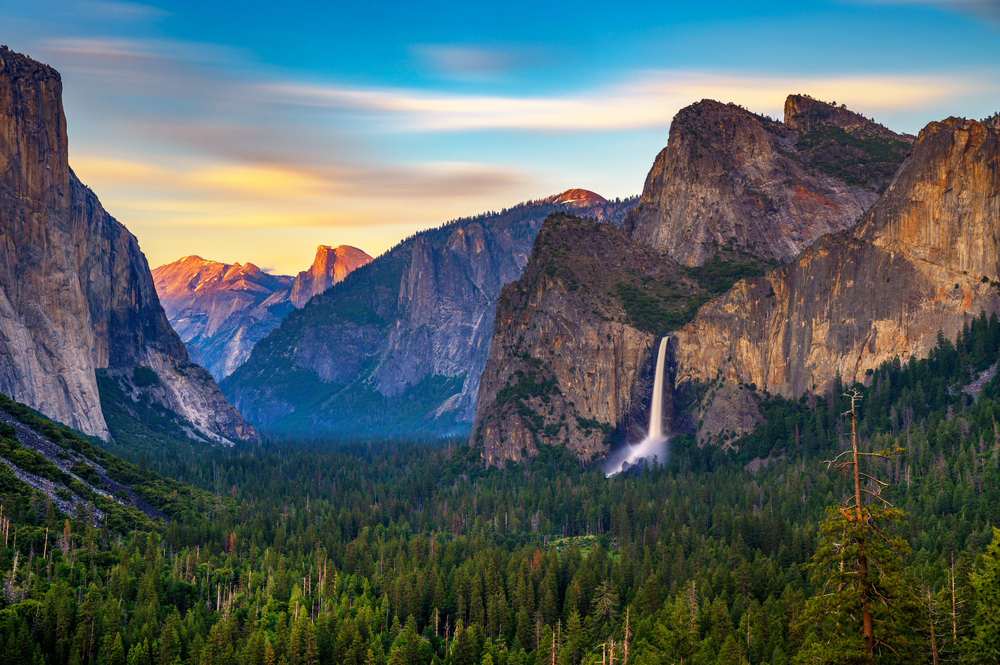
Yosemite National Park. Photo: Nick Fox/Shutterstock
In one of the cases, Paulides recounted an old story of a child who went missing in a forest, but was thankfully found alive later on. The little girl stated that a bear-like creature took her somewhere into the forest, where it fed her berries and kept her warm for the night. Several of these stories about children who went missing but returned alive likewise featured encounters with strange bear or wolf-like creatures who stood on their hind legs. Some critics suggest Paulides is trying to build a case for Bigfoot or some other crypto-creature.
Others argue that he has exaggerated or left out vital information to make these cases appear more mysterious. Data analysts believe that the connections and markers he identified might not be a pattern but simply a coincidence.
Conclusion
Here’s my take: no.
National parks are huge. Some of them are so big that it is easy for even seasoned hikers to get lost. Unpredictable terrain may combine with unpredictable weather, creating almost instant emergencies. Real search-and-rescue events happen almost daily in these parks in high season.
As for park bureaucracy purportedly concealing information, these parks have been severely understaffed and underfunded for long periods. Perhaps the parks are also trying to stay away from bad publicity.
Sadly, it is a reality that national parks, which draw millions of beginners unfamiliar with the outdoors as well as seasoned people like Robert Springfield, are often places where things go wrong.