Armando Zuzarte Cortesao started his career as a mapmaker for an expedition to São Tomé, a Portuguese-controlled island off West Africa. That got him work as a civil servant in Portuguese Guinea. But Cortesao is not the missing explorer our title promised. Cortesao was a 20th-century historian and the true detective in our story.
He was living in exile from Portugal after a conflict with the dictator Antonio Salazar, and spent his time scouring international archives for old Portuguese maps. One day, he stumbled across an important footnote.
It was in a collection of notes left by the author of an 1849 atlas, which reproduced 16th-century maps by the explorer Francisco Rodrigues. This footnote mentioned that in 1850, Rodrigues’ atlas went to the Library of the National Assembly in Paris. Bound with it, the note mentioned, was a copy of a long-lost volume called Suma Oriental.
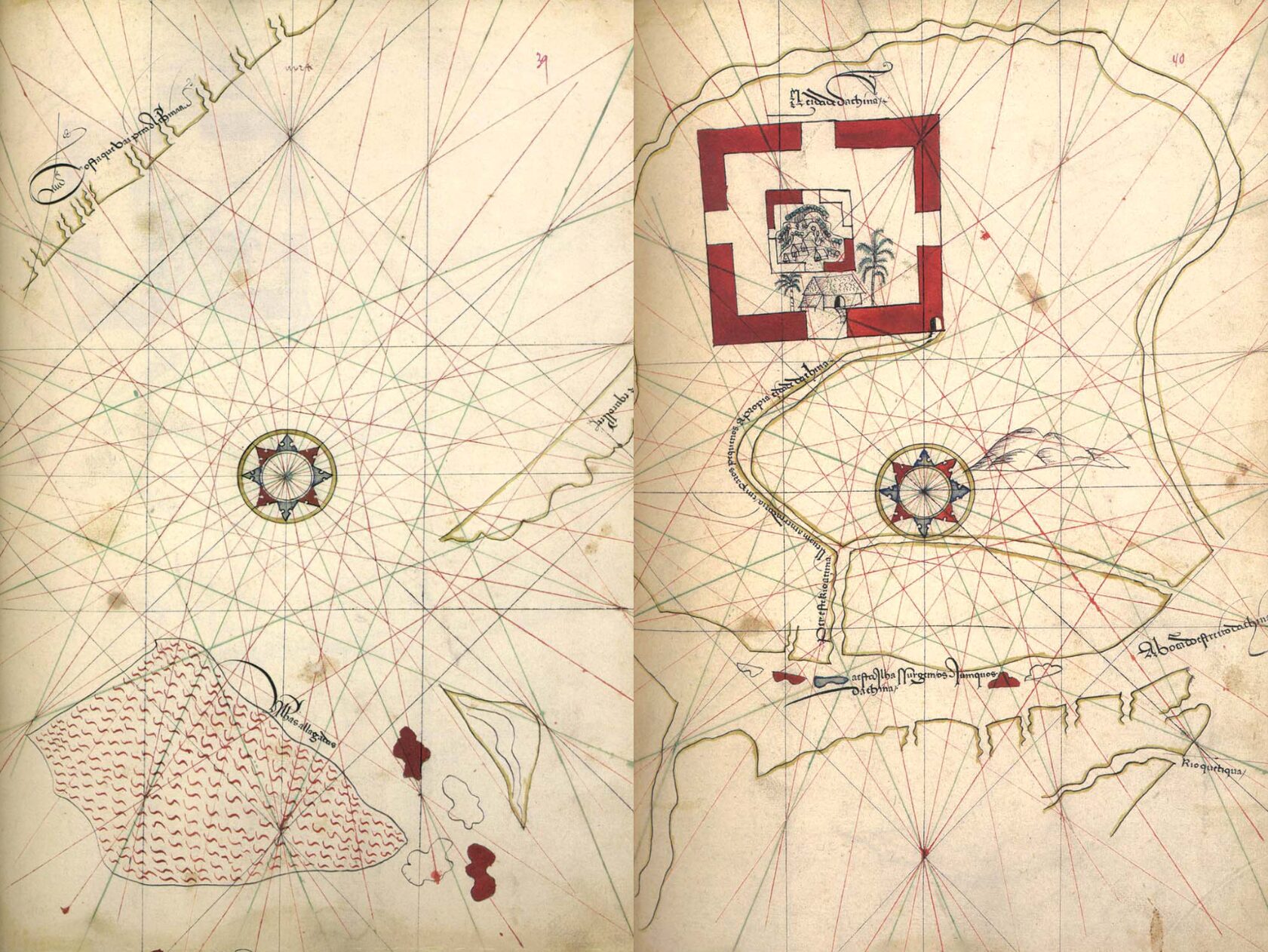
These early 16th-century maps provided a clue to the location of a lost book. Photo: 1515 Atlas of Francisco Rodrigues
The search for the Suma Oriental
Cortesao immediately followed up on the clue. He wrote to Paris, but no one there could find the book he described. Not satisfied, he visited himself in 1933, searching the national and public libraries, but found nothing. When he went again in 1937, he unearthed another clue. An old catalog had an entry for Rodrigues’ book, which had apparently been the property of an 18th-century hydrographer named the Comte de Fleurieu.
How the book came to be there is a bit curious. Apparently, it was being transported for its owner, a bishop, on a Portuguese ship captured by the English. This likely took place in 1600, when the Earl of Essex sacked the city of Faro. We know he stole a collection of books from the local bishop, which went to the Library of Oxford.
In the intervening century and a half, the book somehow found itself with Fleurieu, who rebound it. From his collection, it eventually ended up in the library of the Chamber of Deputies in Paris, where Cortesao finally cornered it.
The book wouldn’t reveal its secrets easily. Cortesao’s efforts to transcribe it were interrupted by World War II, while the transcriber operated anti-aircraft batteries in London. But finally he finished, and the long-lost Suma Oriental was restored to historians. It was, it turned out, a remarkable work.
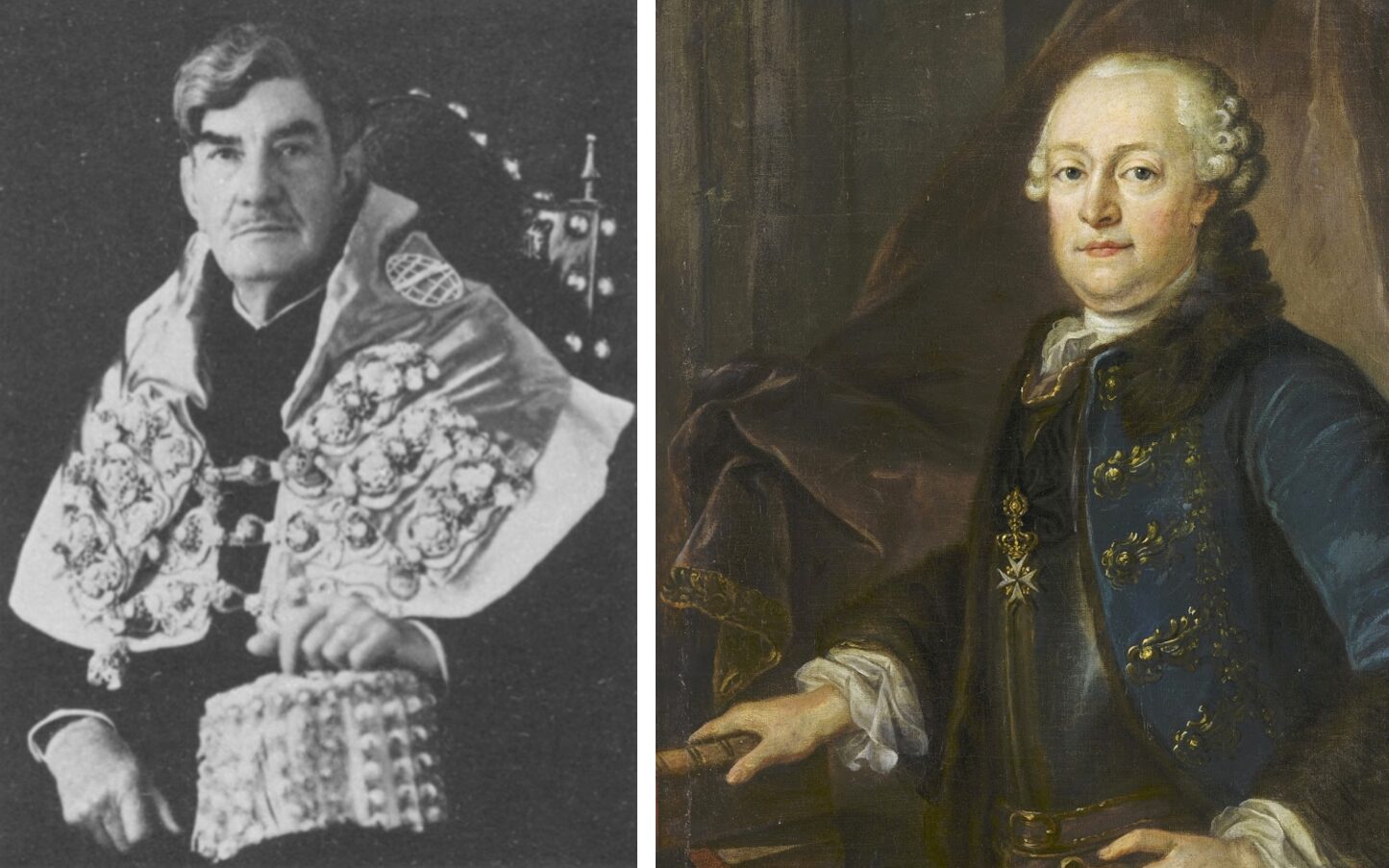
Left, 20th-century historian Armando Cortesao. Right, the Comte de Fleurieu, mysterious acquirer of ‘Suma Oriental.’ Photo: Wikimedia Commons
An enigmatic pharmacist
So, what actually is Suma Oriental, and why was it so important?
The work of an early 16th-century ambassador and explorer, it contains a remarkably detailed and accurate account of lands then practically unknown to Europeans, including the first Western descriptions of the Spice Islands, Malacca, and the Malay Archipelago.
The author, Tome Pires, was an apothecary. He must have been pretty good at it, because he was the pharmacist to the Portugal’s prince by the time he was twenty-three. We know little about his life. Outside of his monumental work, there are only a few letters, passing mentions, and administrative data. He had several siblings, and may have been a widower. Cortesao theorizes that the loss of his wife may have led Pires, in his early forties, to seek a position under the famous general and conquistador, Afonso de Albuquerque, then the governor of Portuguese India.
With very good references from important court officials, Pires sailed to India in 1511 to oversee the medicine trade. He wasn’t there long before he impressed Albuquerque enough to be sent even farther afield. “He seems to me a diligent man,” the general reasoned, and appointed the pharmacist to go see about disturbances in Malacca.
Malacca sits at a crucial location if you long to control the spice trade, which the Portuguese did. Albuquerque had conquered it just a year earlier. Pires, an interested, observant man, was fascinated by a place practically unknown in the West. He began writing a detailed account.
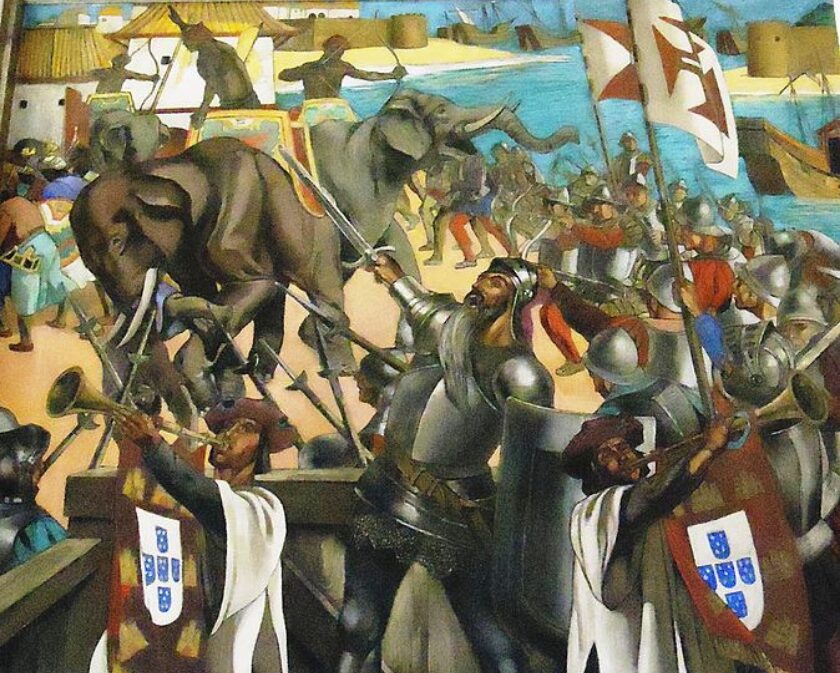
This fresco of the conquest of Malacca is displayed in the Portuguese Parliament, so it seems like they aren’t particularly sorry about it. Photo: Wikimedia Commons
Notes on the spice trade (and other things)
Starting from the Red Sea, Pires charts his journey to India, and the local government, climate, and geography of the lands he passed along the way. He was especially interested in trade networks. Then he proceeded through India to Malacca.
Positioned as he was, Pires got a glimpse of the next several centuries of colonial conflicts and trade wars in the region, when he noted that “whoever is Lord of Malacca, has his hand on the throat of Venice.”
Most of his notes were less analytical. Pires seemed to write down whatever interested him, whether from interviewing locals or observing his surroundings. He recorded everything from snake-charming techniques to the material composition of coinage to a given kingdom’s preferred sexual position.
However far his duties took him, he brought his chronicling with him. Malaysia, Java, and Sumatra were almost completely unknown to the West, so it’s no surprise that Pires’ firsthand descriptions were received with wonder by his superiors back in India.
Some details suggest that Pires’ sources occasionally pulled his leg. In the Pasai Sultanate of Sumatra, he was told that whoever killed the king became the next king by custom. In one day, his source averred, there were seven kings, all killing each other in a row. Unfortunately, this was not true. On some points, however, he was very accurate, such as giving a spot-on estimate of the island’s circumference.
Pires takes us as far as the Moluccas, which exported valuable cloves, and there his account ends.
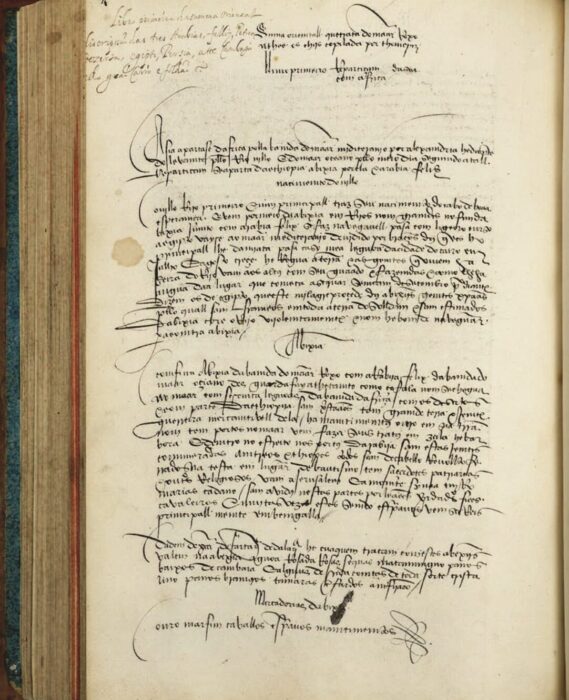
A page from the Paris copy of ‘Suma Oriental.’ Photo: La Bibliothèque de l’Assemblée nationale
Whatever happened to Tome Pires?
Pires returned to India, finishing the Suma Oriental. From there, he planned to return to Portugal at last. But his adventures were far from over. While Pires was away, Albuquerque had died, and a new governor and new fleet captain were in charge. They planned an ambitious mission to China. Astoundingly, the new governor insisted that the humbly born scrivener, Tome Pires, was the only choice to lead it.
Though a commoner, Pires was very well educated, and the Suma Oriental had impressed the higher-ups. Pires, tempted by a promotion and a chance to chronicle an unknown land, put aside his homecoming. He set off for China with 67 companions, loaded down with gifts and friendly letters for the emperor in Beijing.
Representing the first Western delegation in nearly 200 years, Pires became embroiled in political conflict as his countrymen’s misbehavior tainted his local standing. Emperor Zhengde was also unimpressed by the conquest of Malacca, formerly one of his client states.
Reports also reached the emperor that a second Portuguese delegation, led by Simao de Andrade, had caused a disturbance in Guangdong. Chinese sources say that the visitors had captured and cannibalized infants, which I can’t technically disprove.
So the emperor kept the Portuguese ambassadors languishing in Canton, where they’d landed, for several years. When Pires was finally allowed to go on to Beijing, he failed to secure an audience with the emperor and was sent back to Canton. Then things really went south.
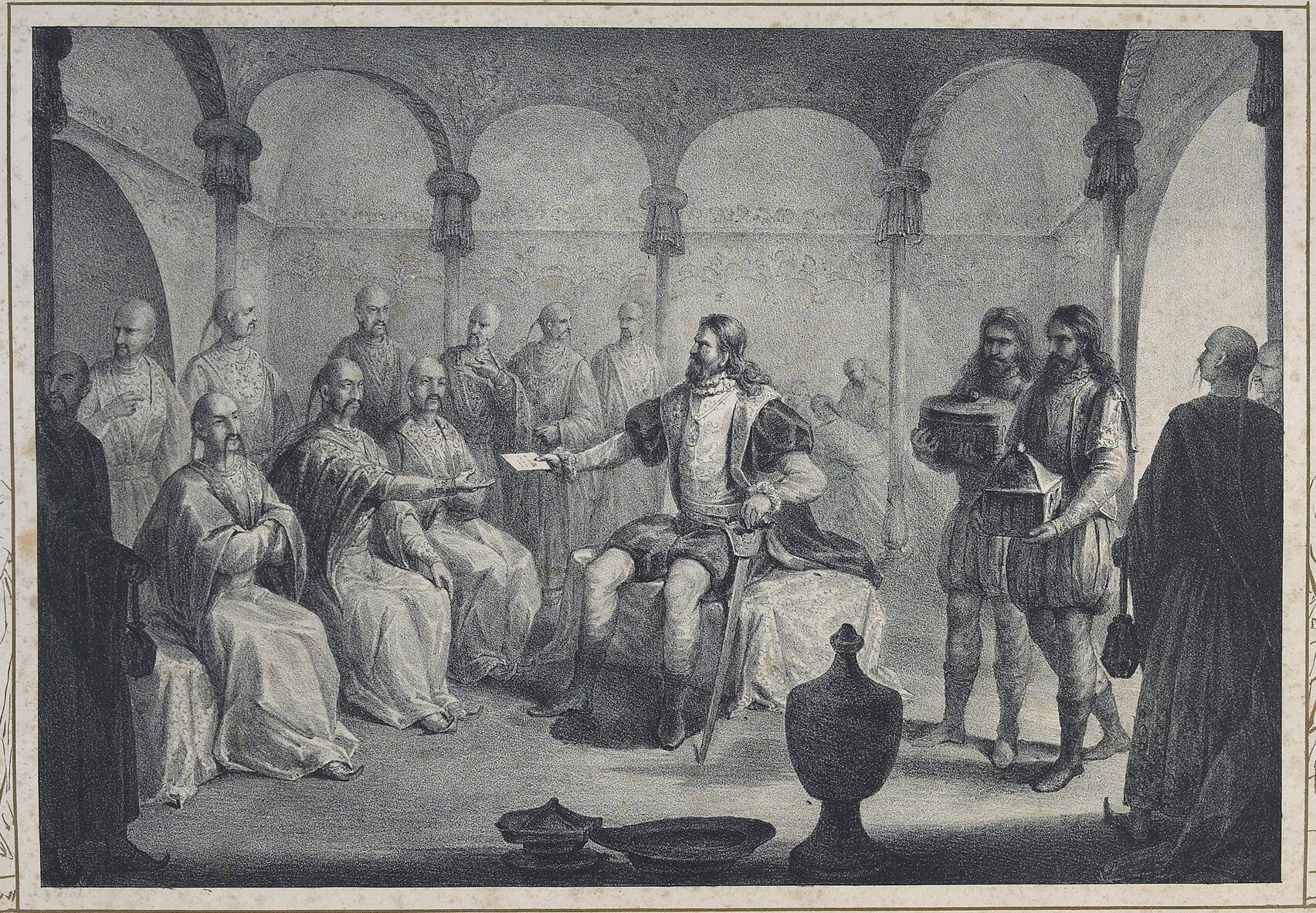
19th-century engraving imagining Pires at the Chinese court. Photo: Biblioteca Nacional de Portugal
Tension becomes antagonism
The breakdown of negotiations was complicated, but to summarize: When the Portuguese refused to leave China after the 1521 death of Emperor Zhengde, awkward tension became outright antagonism. Andrade had not helped by illegally acquiring massive numbers of Chinese slaves and building a “trading outpost” that was very visibly a military fort.
Though they had no connections with Andrade, Pires and several other delegates were arrested and held in Canton. Ming government ministers called for the Portuguese ships to be expelled, and the navy enforced their orders.
Three years of later, fellow prisoner Cristovao Vieira wrote that Tome Pires had died of an illness in jail. But then there’s the account of Fernao Mendes Pinto, a contemporary explorer. In it, he told of visiting northern Jiangsu province and meeting a woman of mixed Chinese and European descent. She said her father, Tome Pires, had raised her as a Catholic and died of old age in 1540. It’s not as absurd as it seems; something very similar happened, for instance, to a shipwrecked Dutchman in neighboring Korea.
Sources also disagree on whether Pires was ever freed or lived the rest of his life in captivity. After 1524, when he managed to get a letter out, his life is a black box. Who knows, however, what else might be found in a forgotten archive one day?