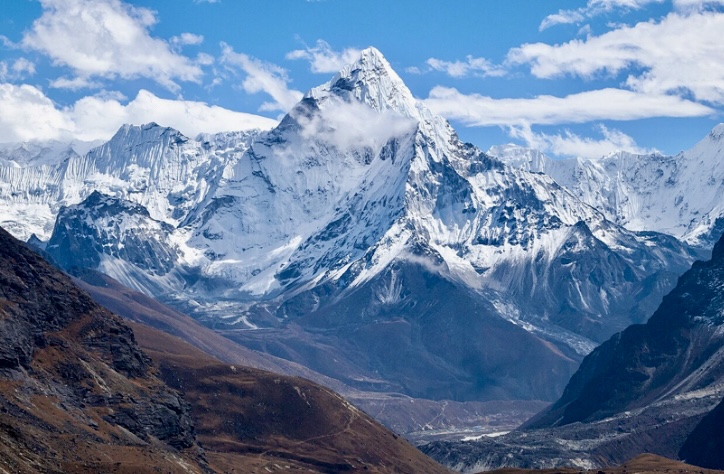
Today marks the 65th anniversary of the first ascent of Ama Dablam, one of the most beautiful mountains in the Himalaya.
Ama Dablam lies in the Khumbu region of eastern Nepal, within Sagarmatha National Park, and about 12km south of Everest. The 6,814m peak rises directly above the Dudh Kosi River valley and is a major landmark on the trekking route to Everest Base Camp. It is visible in all its glory from the monastery at Tengboche.
Its Sherpa name
Ama means ”mother”, and Dablam refers to the pendant that Sherpa women wear as a family treasure or protective charm. It also refers to the hanging glacier just below the main summit, which resembles a pendant cupped between the mountain’s long ridges, like a mother’s protecting arms.
Ama Dablam stands out in the Khumbu like nothing else. Its sharp, elegant shape draws your eye no matter where you are in the valley. By early 1961, the big peaks around it had already been climbed: Everest in 1953, Cho Oyu in 1954, Lhotse in 1956, and even smaller ones like Island Peak and Lobuche had had climbers on their summits. But Ama Dablam stayed untouched. Many considered this sharp peak almost unclimbable or too difficult.
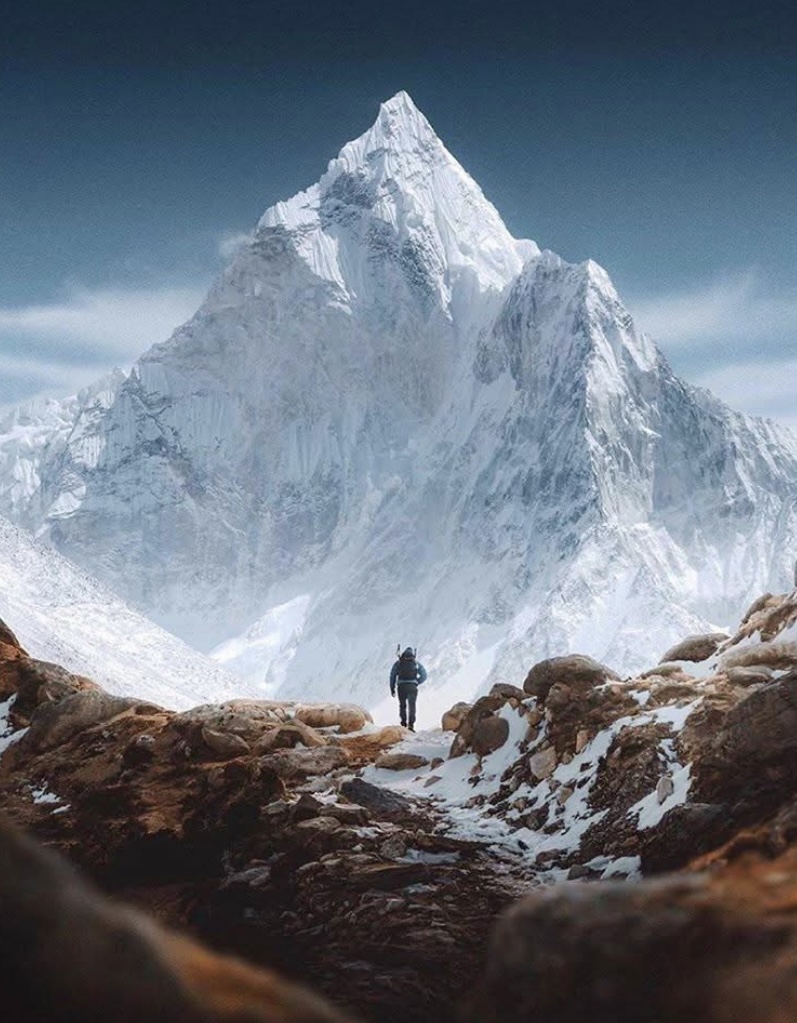
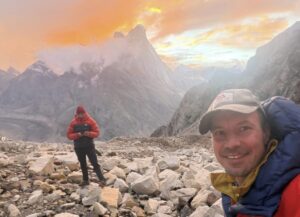
Trekking toward Ama Dablam. Photo: Black Sails via Lugares de Nieve/Facebook
The mountain had two serious attempts before its first ascent in 1961.
In the autumn of 1958, a British-Italian party in 1958 led by Alfred Gregory attempted the southwest ridge, but abandoned the climb at 6,000m due to technical difficulties.
Tragedy, and mystery
In the spring of 1959, J. H. Emlyn Jones of the UK led a party to the North Ridge-Northeast Spur. Jones and his team (George Fraser, Mike Harris, Frederick Jackson, Nea Morin, Ted Wrangham, and Sherpas Annulu and Urkien) arrived at Base Camp on April 17. Nobody knew that this expedition would end in tragedy and mystery.
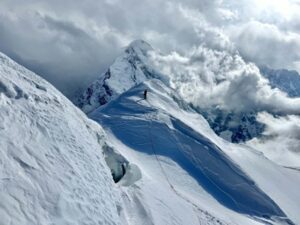
The team made good progress up the route, which involved high-standard climbing, with difficulties up to VI. On May 20, two climbers, Harris and Fraser, established a high camp along an ice ridge. On May 21, climbers in the lower camps observed the duo through a telescope, climbing strongly. They crossed a large ice tower (where they had cut steps the previous day) and were last seen moving toward the summit slopes around 2:30 pm, at an estimated height of 6,550m. They had less than 300m to go.
Fraser and Harris were carrying their tent, suggesting their intent to push for the summit that day or bivouac high. Soon, clouds and mist closed in, obscuring the view. After that, they never reappeared, and no further sightings or signals were made.
No trace
The rest of the team waited and searched as conditions allowed, but no trace, no bodies, no equipment, or signs of them descending or summiting were found. The expedition concluded that the two men were lost high on the mountain, likely due to a fall, an avalanche, exhaustion, or another issue on the exposed, technical upper ridge. No bodies were ever recovered, and the case remains one of the unsolved disappearances in Himalayan mountaineering.
After the expedition, Jones noted that ”we shall probably never know whether, in fact, they reached the summit.” The expedition report expressed a hopeful sentiment that Fraser and Harris may have reached the top before tragedy struck, but no evidence supported a successful summit. The 1959 incident added to Ama Dablam’s fearsome reputation.
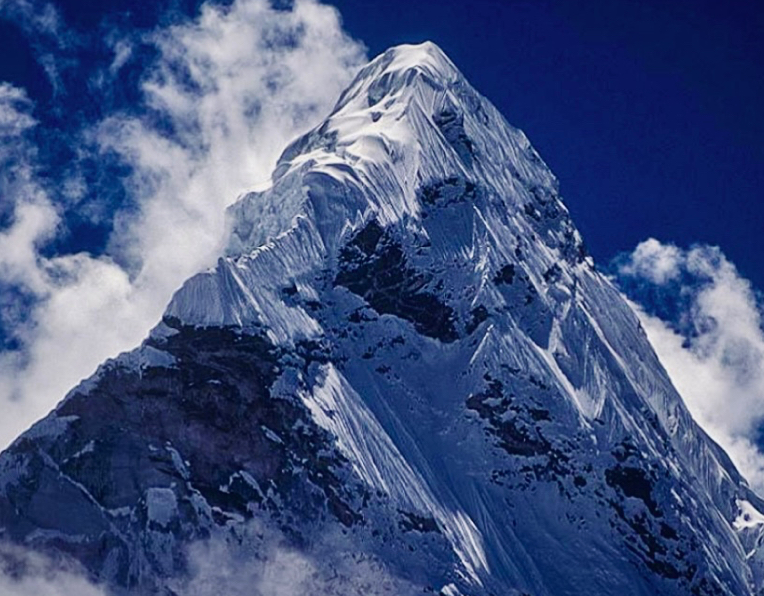
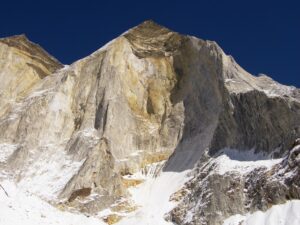
Ama Dablam’s upper section. Photo: Tomaz Humar
The first ascent
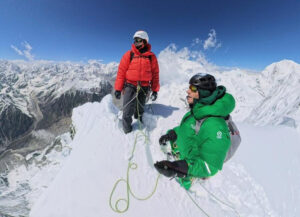
On March 13, 1961, Ama Dablam was finally climbed, when Mike Gill and Wally Romanes of New Zealand, Mike Ward of the UK, and Barry Bishop of the U.S. summited via the southwest ridge. An interesting side fact of this expedition is that they weren’t even there primarily to climb. They were part of Sir Edmund Hillary’s Silver Hut Expedition, living for months in a high-altitude lab at 5,800m to see how the human body responded. That brutal winter in the hut gave them very good acclimatization.
The team climbed the southwest ridge, which featured the challenging Yellow Tower, a stretch of steep granite and overhangs that required ropes and specialized gear. Beyond that, the terrain changed to sharp ridges of ice and snow.
They set up four camps along the way, including an ice cave at around 6,400m. Ward later described the intense wind and the constant danger of a fall into the Mingbo Valley. It was a technical climb that required more skill than some of the taller neighboring peaks, yet they managed to summit on March 13, 1961, after a light approach and no supplemental oxygen.
To their surprise, the summiters found a plateau at the top. They expected a sharp point, but there was enough space to walk around, which contrasts nicely with the knife-edge reputation of the ridges.
Not without cost
The climbers got down safely, but not without cost. Gumen Dorje, who was a vital part of the support team and worked as a high-altitude Sherpa for the expedition, broke his leg on the way down when struck by a rock.
Interestingly, the ascent was unauthorized by the Nepalese government, which caused some brief diplomatic tension for Hillary afterward.
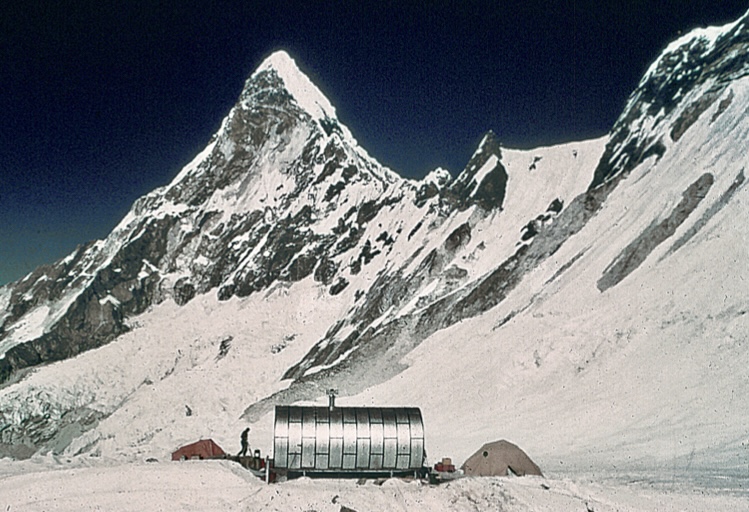
The Silver Hut at 5,800m, with Ama Dablam in the background. The southwest ridge route is roughly up the left-hand skyline. Photo: Jim Milledge/Alpine Journal
Aftermath
Decades later, in 2004, Jones, the 1959 expedition leader, sent two letters to the technical director of the Himalayan Database, Richard Salisbury. In his January letter, Jones wrote: “Incidentally, Michael Ward, who made the first complete ascent of Ama Dablam, having seen our photographs, is fairly certain that Mike Harris and George Fraser reached the summit and were probably lost on the way down.”
Two weeks later, Jones clarified his earlier statement in a second letter: “I reckoned that Mike Harris and George Fraser were good enough climbers to have climbed Ama Dablam by their route. That’s why I made this remark. We saw no signs of them on the summit.”
The Himalayan Database succinctly notes that ”Fraser and Harris disappeared on way to summit (fall?).”