After weeks of delay, Sherpas are rushing to open the route to the summit. They hope to reach the top next week. Meanwhile, down in Base Camp, cargo drones were suddenly banned, then unbanned, followed by strange new regulations around photos.
What’s up with the drones?
Last week, drone pilots were shocked when their flying licenses were revoked just as a new U.S.-made drone was about to be tested. According to an article in The Kathmandu Post, geopolitics may be responsible.
Airlift Technology, allied with the Sagarmatha Pollution Control Committee (SPCC) and the Khumbu Municipality, was using a new version of the Chinese DJI cargo drone. It was able to carry 50kg to Camp 1 in about 10 minutes, which would have taken a dozen Sherpas five to seven hours. It is also the safest way to carry loads through the Khumbu Icefall, where two people were injured in an avalanche yesterday.
Meanwhile, The Kathmandu Post noted something highly unusual: a VIP visitor accompanied the new U.S. drone:
The drone was formally inaugurated [at Everest Base Camp] in a ceremony attended by Sergio Gor, U.S. President Donald Trump’s Special Envoy for South and Central Asian Affairs, highlighting the geopolitical undertones of what might otherwise appear as a purely technological demonstration.
A climbing robot?
“Seven Summit Treks, Nepal’s leading expedition operator, had subcontracted Airlift to conduct a test flight of the American drone following the success of Chinese heavy-lift drones last year,” The Kathmandu Post noted.
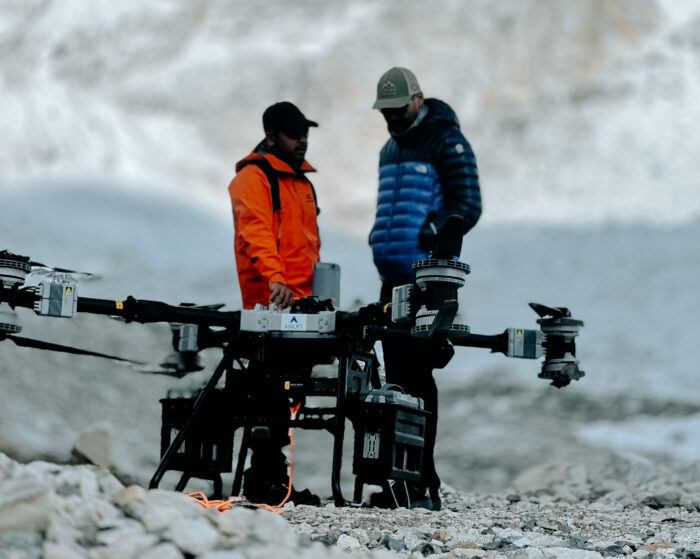
The China-made DJI Flycart 100 Cargo drone at Everest Base Camp. Photo: Airlift Technology
In the article, journalist Sangam Prasain wrote that the U.S. hoped to test its new industrial drone, the Alta X Gen 2, as well as a robot that could go up and down the Khumbu Icefall.
“In a development that has caught Nepali authorities off guard, the American company [producing the drone] also proposed sending a robot to climb Everest,” The Kathmandu Post reported. “The plan ran into immediate uncertainty, as Nepal currently has no legal framework that allows a non-human entity to attempt an ascent of the peak.”
The Alta X Gen 2 is produced by Aeronautics.
The U.S. drone never took off from Base Camp, not even on a test flight, as Nepalese authorities suddenly refused permission. Citing “safety concerns,” they also revoked the permit for the Chinese drone.
The owners of Airlift Technology discussed the issue with officials in Kathmandu and reapplied for permission, with positive results: The ban was lifted yesterday. Apparently, the avalanche at the Icefall that injured two climbers earlier that day hastened the decision.
Avalanche shows drone’s importance
“Tuesday’s incident caused immediate panic, prompting the Expedition Operators Association Nepal and the Icefall Doctors to seek drone assistance to assess the situation and locate climbers,” the paper explained.
According to The Kathmandu Post, the Ministry of Culture, Tourism, and Civil Aviation lifted the ban. However, as of this morning, Airlift Technology was still waiting for the go-ahead from Sagarmatha National Park authorities.
We have asked Airlift Technology for comments, but we have not yet received a reply.
Image censorship
Coincidentally (or perhaps not), the Department of Tourism issued a strange new regulation on Tuesday, requiring climbers and expedition operators to obtain approval before taking or publishing photos or videos from Everest Base Camp.
“Without prior approval from this department, no photos or videos should be taken, published, or broadcast within the Sagarmatha [Everest] Base Camp area and above,” the notice said. It added that all information relating to activities in the area must be reported to a temporary field office, according to the Everest Chronicle.
As far as we are aware, climbers and outfitters are still posting their Everest photos on social media.
First summits next week?
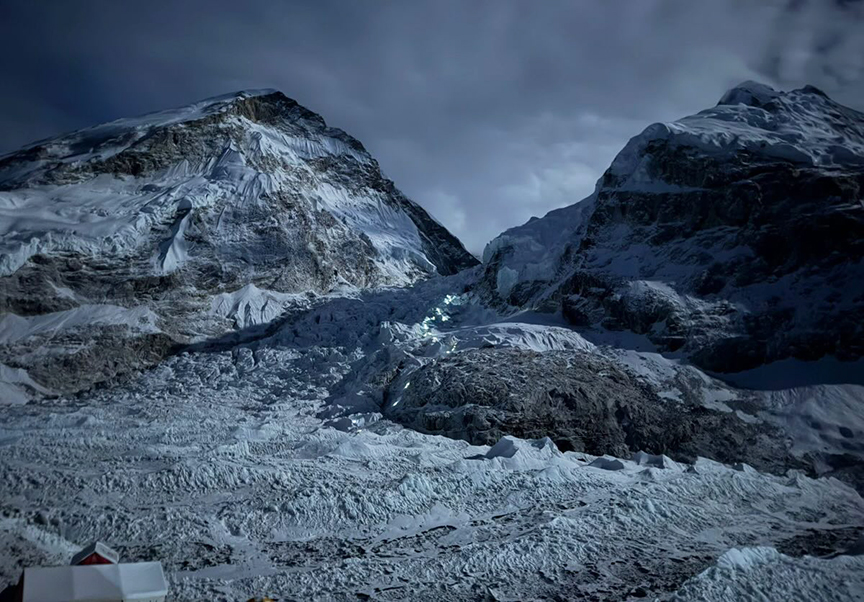
Meanwhile, the rope fixing is progressing quickly: The nine-member Sherpa team of rope fixers is speeding up the Lhotse Face above Camp 3. They expect to reach the South Col at nearly 8,000m tomorrow or Friday.
“With Camp 3 now established and ropes fixed higher, the route is open for load ferrying and acclimatization rotations,” said Chhang Dawa Sherpa of Seven Summit Treks, who is personally coordinating the work. Indeed, workers from several other teams are following closely behind the rope fixers to set up camps for their clients.
The South Col is the location of Camp 4, the last stop before the summit. Outfitters told The Tourism Times that they expect summit pushes to begin by the end of the second week of May — as always, weather permitting.
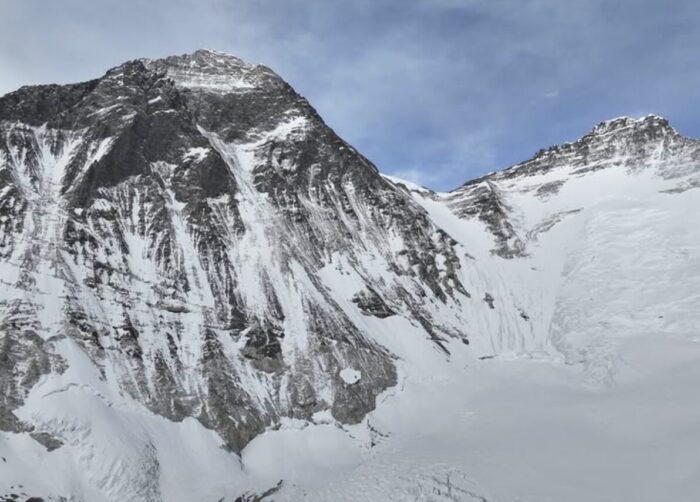
Left to right, the summit of Everest, the South Col, and Lhotse, with the snowy Lhotse Wall where Camp 3 is located. Photo: Imagine Nepal
Numbers grow
Meanwhile, the number of permits for Everest continues to increase. According to the latest update from Nepal’s Department of Tourism, 464 foreign climbers have received permits to climb Everest so far. With an even higher number of Sherpas currently on the mountain, the final summit tally could reach a record number.
Forecasts show moderate wind and afternoon snow flurries, but no major storms or high jet-stream winds:
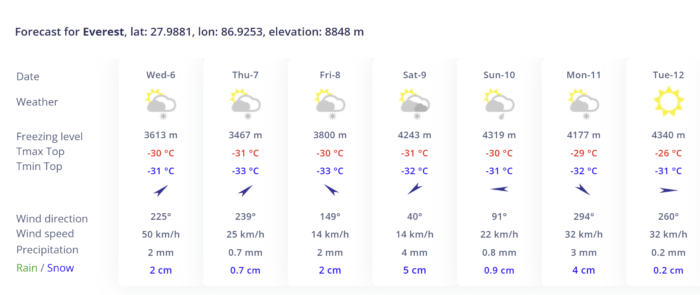
Multimodel forecast for Everest at summit altitude, by Meteoexploration.com.